Low testosterone and type 2 diabetes often appear together, which makes a simple idea appealing: could testosterone treatment prevent diabetes? Two major randomized research programs produced different findings, and understanding their designs is more useful than choosing whichever headline sounds most convincing.
T4DM found a favorable diabetes-related result when testosterone injections were added to a lifestyle program in selected men. The TRAVERSE diabetes substudy did not find significant prevention or improved glucose control in men with confirmed hypogonadism. These were different populations, interventions, and outcome definitions.
Why does the association create confusion?
An association means that two findings occur together more often than expected. It does not establish which causes which or prove that changing one will reliably correct the other. Body composition, underlying illness, age, medicines, and other factors can influence both hormone measurements and metabolic health.
A randomized trial asks a stronger treatment question by assigning participants to an intervention or comparison group. Even then, its answer depends on who entered, what treatment was used, and how success was defined.
Our low-testosterone testing guide explains why symptoms and appropriately repeated testing matter. A diabetes diagnosis or a single low hormone result does not, by itself, settle whether testosterone replacement is indicated.
What was T4DM designed to test?
T4DM was a two-year, double-blind, placebo-controlled trial at six Australian centers. It enrolled men aged 50–74 with a waist circumference of at least 95 cm, testosterone of 14.0 nmol/L or lower, and impaired glucose tolerance or newly diagnosed type 2 diabetes. Importantly, participants did not have pathological hypogonadism. Original T4DM report.
All participants entered a community-based lifestyle program. They were randomized to long-acting intramuscular testosterone undecanoate or placebo injections. The research regimen included 1,000 mg at baseline, six weeks, and then every three months. This describes the trial; it is not a dosing recommendation or a regimen to copy.
The study therefore tested the addition of testosterone to a lifestyle program in a particular metabolic-risk population. It did not compare testosterone alone with doing nothing, and it was not restricted to the same diagnostic population later enrolled in TRAVERSE.
What did the two-year glucose test show?
T4DM’s main diabetes endpoint used an oral glucose tolerance test, or OGTT. Participants drink a standardized glucose load, and blood glucose is measured at defined times. The study counted a two-hour glucose result of at least 11.1 mmol/L as meeting the diabetes endpoint.
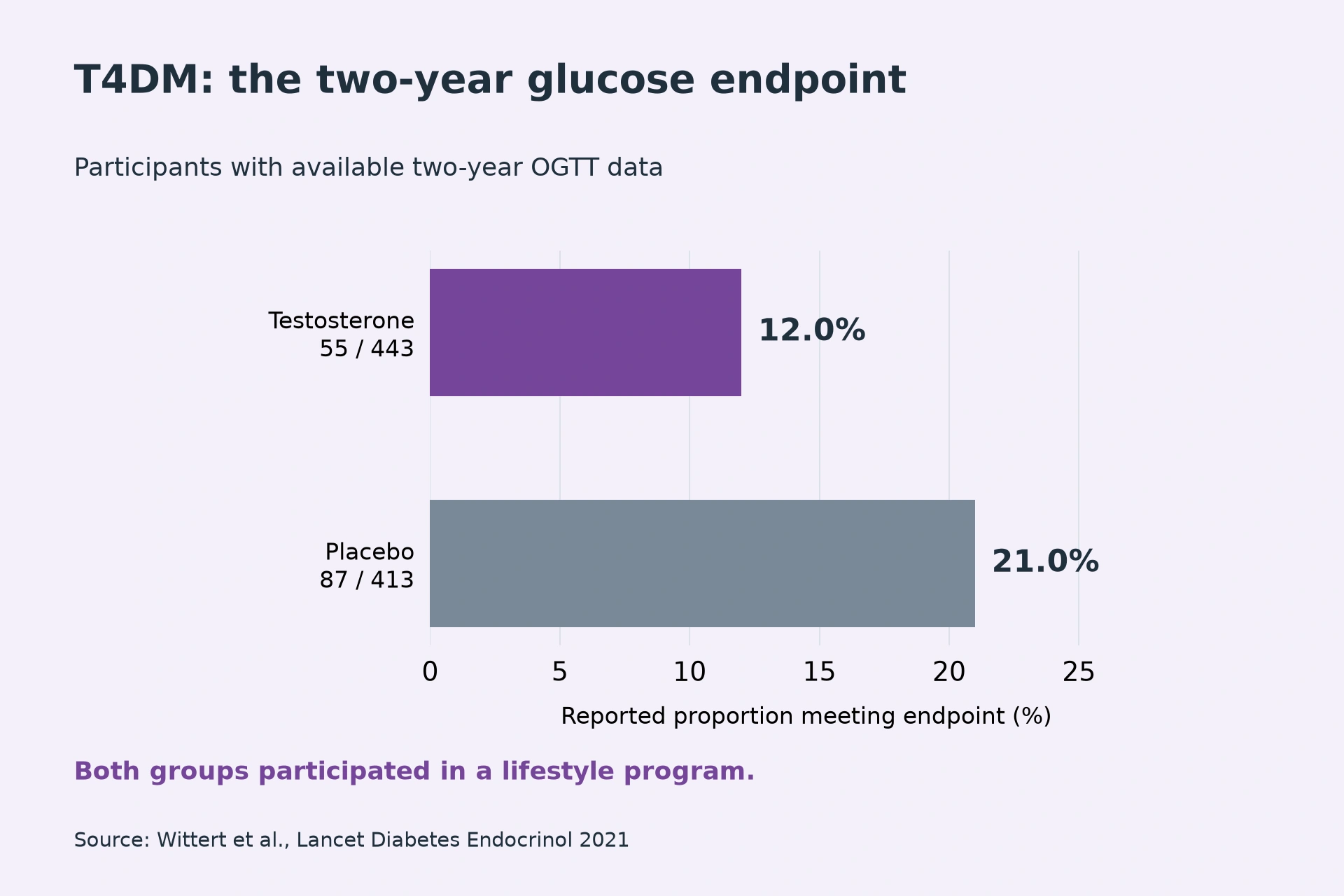
At two years, that endpoint occurred in 55 of 443 assessed testosterone participants (12%) and 87 of 413 assessed placebo participants (21%). The relative risk was 0.59, with a 95% confidence interval of 0.43–0.80. T4DM results.
The endpoint denominators are participants with available two-year data, not all 1,007 randomized men. The roughly nine-percentage-point difference also should not be confused with the relative reduction summarized by the relative risk.
Some participants already had newly diagnosed diabetes at entry. Consequently, describing every endpoint difference as prevention of new diabetes would be incomplete. The trial examined preventing progression or reverting early diabetes within its defined population.
Why does the glucose measurement matter?
The OGTT assesses the body’s response to a glucose challenge. Fasting glucose measures a different state, while HbA1c reflects longer-term glucose exposure. They are related but do not always change identically.
A favorable effect on a two-hour glucose endpoint does not automatically prove the same improvement in HbA1c, remission under every definition, or fewer long-term diabetes complications. Naming the test prevents a broad phrase such as “reversed diabetes” from claiming more than the trial measured.
The T4DM authors also reported a greater improvement in two-hour glucose as a continuous measure. That supports the endpoint result, but the need for longer-term durability and safety research remained part of their interpretation. The trial was funded by public and industry sources, including the Australian National Health and Medical Research Council and Bayer.
What safety tradeoff appeared in T4DM?
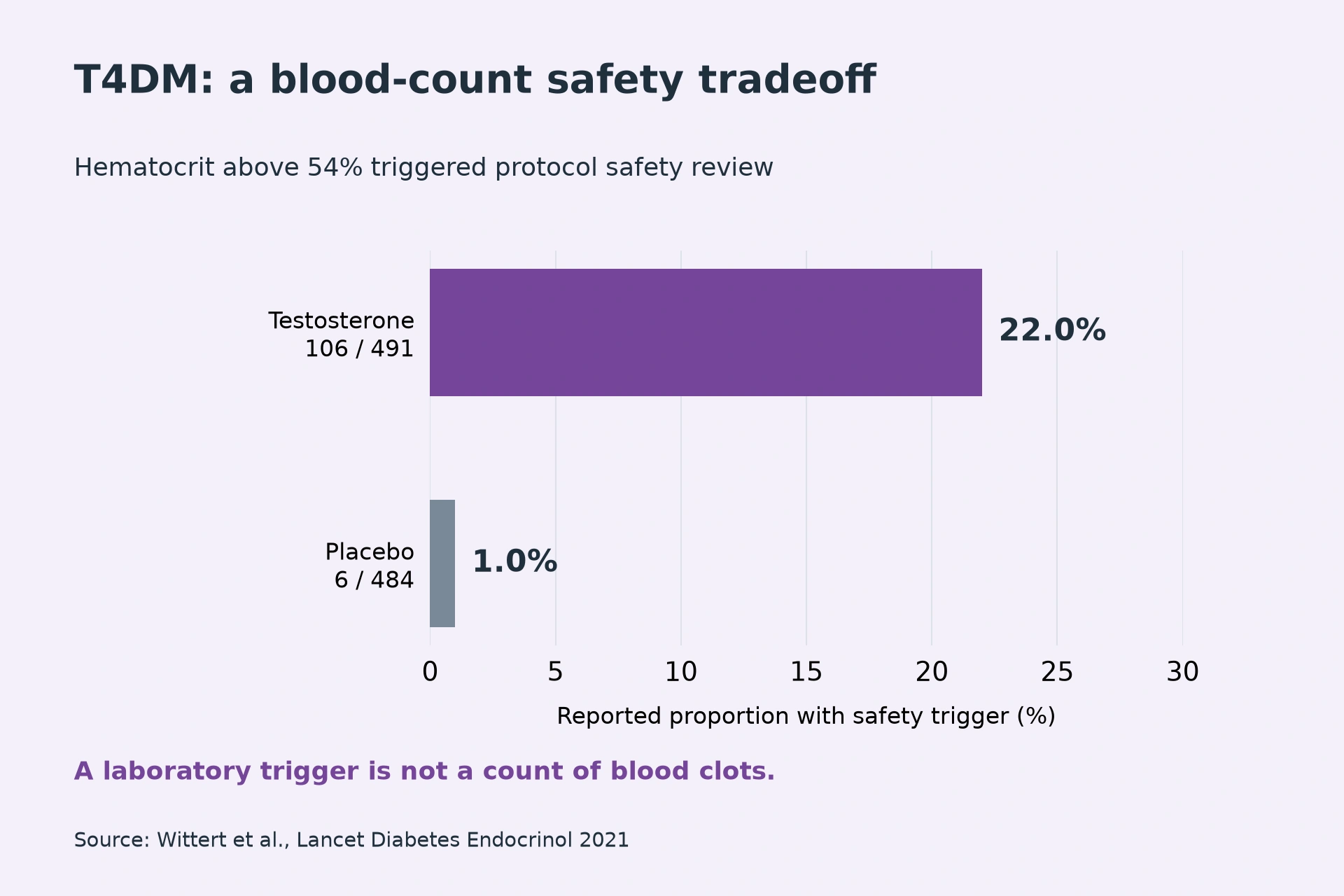
A hematocrit safety trigger above 54% occurred in 106 of 491 assessed testosterone participants (22%), compared with 6 of 484 placebo participants (1%). Hematocrit measures the proportion of blood volume occupied by red blood cells. Safety results.
This was a laboratory safety trigger, not a count of blood clots or heart attacks. Nevertheless, it was frequent enough for the authors to identify hematocrit increases as potentially treatment-limiting. A favorable glucose result should not be presented without that tradeoff.
Prespecified serious adverse events occurred in 55 of 504 testosterone participants and 37 of 503 placebo participants. These counts do not establish that testosterone caused every event, but they reinforce why the study does not support a casual prevention prescription.
Our TRT blood-count guide and testosterone-anemia evidence review explain why correcting a low blood count and pushing a count too high are different clinical outcomes.
Who entered the TRAVERSE diabetes substudy?
TRAVERSE enrolled men aged 45–80 with symptoms of hypogonadism, two testosterone concentrations below 300 ng/dL, and cardiovascular disease or increased cardiovascular risk. Its diabetes substudy included 1,175 men with prediabetes and 3,880 with diabetes. Participants received 1.62% testosterone gel or placebo gel. Original TRAVERSE diabetes paper.
This was a different treatment route and clinical population from T4DM. It also did not test the same testosterone-plus-community-lifestyle-program package. The primary diabetes question was progression from prediabetes to diabetes; a secondary question examined glycemic remission among men with diabetes.
The analysis used repeated follow-up measurements. Reading one selected visit as if it were the trial’s sole result would miss the prespecified comparison across time.
What did TRAVERSE find?
Progression to diabetes did not differ significantly between testosterone and placebo in the overall analysis. The reported omnibus P value was 0.49. Glycemic remission and changes in fasting glucose and HbA1c were also similar between groups. TRAVERSE results.
For example, at 24 months the reported progression proportions were 50 of 494 assessed testosterone participants, or 10.1%, and 67 of 460 placebo participants, or 14.6%. That numerical difference should not be cherry-picked as proof of prevention when the overall analysis did not establish it.
Later visits also had smaller numbers assessed. Treatment discontinuation and withdrawal were substantial, although sensitivity analyses supported the main findings. These limitations deserve attention, but they do not justify replacing the reported conclusion with an assumed benefit.
The investigators concluded that TRT alone should not be used to prevent or treat diabetes in men with hypogonadism. That is more specific than saying testosterone never affects any metabolic measurement under any circumstances.
Why can two randomized studies differ?
| Feature | T4DM | TRAVERSE diabetes substudy |
|---|---|---|
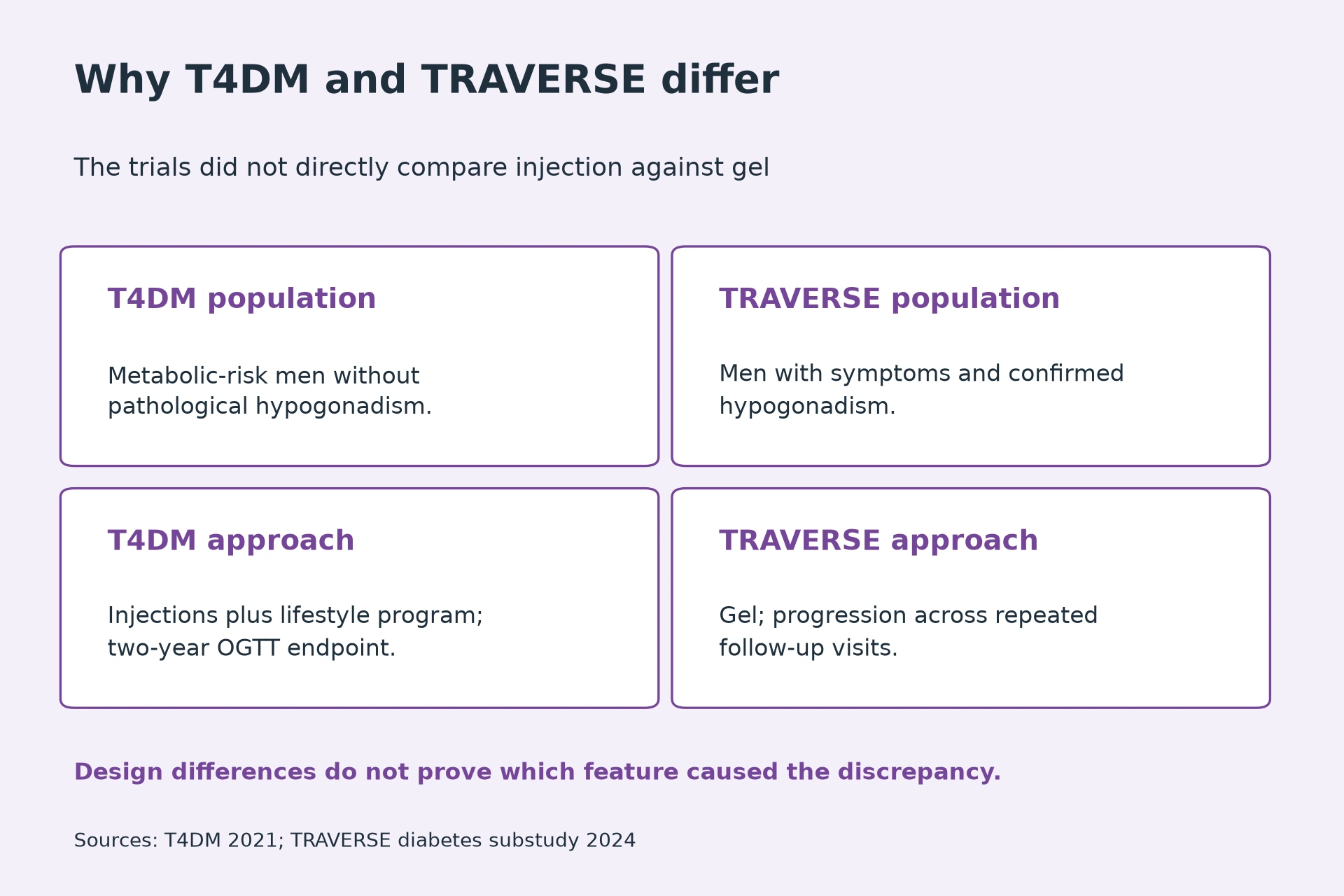
| Hormonal population | Lower testosterone, without pathological hypogonadism | Symptoms and confirmed hypogonadism |
| Metabolic setting | Impaired glucose tolerance or newly diagnosed diabetes | Prediabetes or established diabetes |
| Treatment | Long-acting testosterone injections plus lifestyle program | Testosterone gel versus placebo gel |
| Main diabetes assessment | Two-hour OGTT endpoint at two years | Progression across repeated follow-up visits |
| Major interpretation issue | Hematocrit safety triggers and durability | No significant prevention or glycemic benefit |
These differences provide plausible reasons that results may vary, but they do not prove which design feature caused the discrepancy. The trials did not randomly compare injection against gel, lifestyle support against no support, or one diagnostic population against the other.
It would therefore be inappropriate to conclude that injections prevent diabetes while gel does not. Establishing that route-specific claim would require direct evidence designed to test it.
What evidence supports diabetes prevention more directly?
The Diabetes Prevention Program randomized 3,234 people at high risk to intensive lifestyle intervention, metformin, or placebo. Over an average 2.8 years, diabetes incidence was 4.8, 7.8, and 11.0 cases per 100 person-years, respectively. Relative reductions versus placebo were 58% for lifestyle intervention and 31% for metformin. Original DPP report.
Those are results from a separate study, not a direct comparison against TRT. They illustrate why prevention decisions should begin with interventions evaluated for that purpose and tailored to the person’s risk, preferences, and clinical circumstances.
Our tirzepatide and prediabetes review examines another prevention-related research program in adults with obesity and prediabetes. That evidence also has its own population, treatment, and follow-up boundaries; it should not be presented as proof that everyone with prediabetes needs a medication.
How should a man with diabetes approach possible low testosterone?
Diabetes care and evaluation of hypogonadism can proceed together, but they should have explicit goals. If TRT is being considered, the question is whether the person has an appropriate diagnosis and a reasonable expected symptom benefit—not whether testosterone can replace glucose-lowering care.
The Endocrine Society guideline recommends against using testosterone specifically to improve glycemic control in men with type 2 diabetes and low testosterone. It also emphasizes consistent laboratory confirmation and assessment of the cause. Guideline recommendations.
Discuss fertility plans, blood counts, blood pressure, prostate history, sleep concerns, and monitoring. The TRT prostate-safety review and fertility-recovery review address separate parts of that decision.
The FDA’s current page describes requested June 2026 testosterone-label revisions. Those updates should not be interpreted as a new diabetes-prevention indication or as overriding the study findings discussed here. Current FDA information.
Where do CoreAge Rx treatment pages fit?
The TRT information page can support a consultation about hypogonadism, and the tirzepatide information page can support a separate discussion about weight-related treatment. Neither product link is a substitute for diagnosing prediabetes or diabetes and selecting evidence-based care.
Ask which outcome treatment is intended to improve and how it will be followed. Symptom relief, body composition, HbA1c, glucose-tolerance results, and preventing a new diagnosis are different endpoints. Naming the goal makes it easier to recognize whether the evidence actually matches the proposed use.
Watch: a separate diabetes-prevention research program
This NEJM video summarizes tirzepatide research in obesity and prediabetes. It is included to show a distinct prevention evidence base and does not describe T4DM or prove that tirzepatide should replace an individualized diabetes-prevention plan.
Common questions about testosterone and diabetes
Did T4DM prove TRT should be prescribed to prevent diabetes?
It demonstrated a favorable result for a specific testosterone-plus-lifestyle strategy in selected men, alongside important safety findings. It does not establish routine testosterone prescribing for diabetes prevention.
Does the TRAVERSE result mean TRT has no legitimate use in someone with diabetes?
No. A person with diabetes may separately have appropriately diagnosed hypogonadism. The point is to distinguish treatment for that condition from an unsupported promise of better glucose control.
Can increased muscle mass substitute for measuring HbA1c or glucose?
No. A plausible metabolic mechanism does not guarantee a clinically useful glycemic result. The actual outcome needs to be measured and interpreted.
What is the central takeaway?
Keep the diagnosis and treatment goal explicit. T4DM and TRAVERSE answer different questions, and neither supports replacing established diabetes care with a general promise that testosterone will prevent or reverse diabetes.
Original papers and supporting sources
The references distinguish full research papers, published abstracts, and official guidance. This educational narrative review is not a systematic review or an individual treatment recommendation. Sources were checked in October 2026.
- Wittert G et al. Testosterone treatment to prevent or revert type 2 diabetes in men enrolled in a lifestyle programme (T4DM): a randomised, double-blind, placebo-controlled, 2-year, phase 3b trial. (2021). Published abstract reviewed. DOI: 10.1016/s2213-8587(20)30367-3.
- Bhasin S et al. Effect of Testosterone on Progression From Prediabetes to Diabetes in Men With Hypogonadism: A Substudy of the TRAVERSE Randomized Clinical Trial. (2024). Full text reviewed. DOI: 10.1001/jamainternmed.2023.7862. Open full text.
- Knowler WC et al. Reduction in the incidence of type 2 diabetes with lifestyle intervention or metformin. (2002). Published abstract reviewed. DOI: 10.1056/nejmoa012512.
- Endocrine Society. Testosterone Therapy in Men With Hypogonadism, 2018. Professional guideline.
- FDA. Testosterone Information, including requested June 2026 revisions. Current FDA information.