Low testosterone can contribute to a mild reduction in hemoglobin, the protein in red blood cells that carries oxygen. That makes anemia an important but sometimes overlooked part of the testosterone discussion.
It also creates a risk of oversimplification. Fatigue is not a diagnosis of anemia, anemia is not automatically caused by low testosterone, and raising hemoglobin is not a reason to keep increasing it without limits. Two randomized research programs, the Testosterone Trials and TRAVERSE, help define the potential benefit and the boundaries of the evidence.
What is being measured: hemoglobin versus hematocrit?
Hemoglobin is the oxygen-carrying protein measured as a concentration in blood. Hematocrit describes the proportion of blood volume occupied by red blood cells. They are related measurements, but they are not identical and should not be substituted for each other when reading a trial or a lab report.
Anemia means that the blood has too few healthy red blood cells or insufficient hemoglobin to meet normal oxygen-carrying needs. A diagnosis depends on laboratory results and clinical context. Feeling tired can have many causes, including poor sleep, heart or lung disease, mood conditions, medications, and endocrine problems.
The NHLBI’s explanation of anemia causes describes pathways including reduced production, blood loss, and increased destruction of red blood cells. That broad differential is why low hemoglobin needs evaluation rather than an automatic testosterone prescription.
Our TRT and blood-count guide explains the monitoring conversation, while anemia and weight changes addresses another common symptom question.
TRAVERSE: who was included in the anemia analysis?
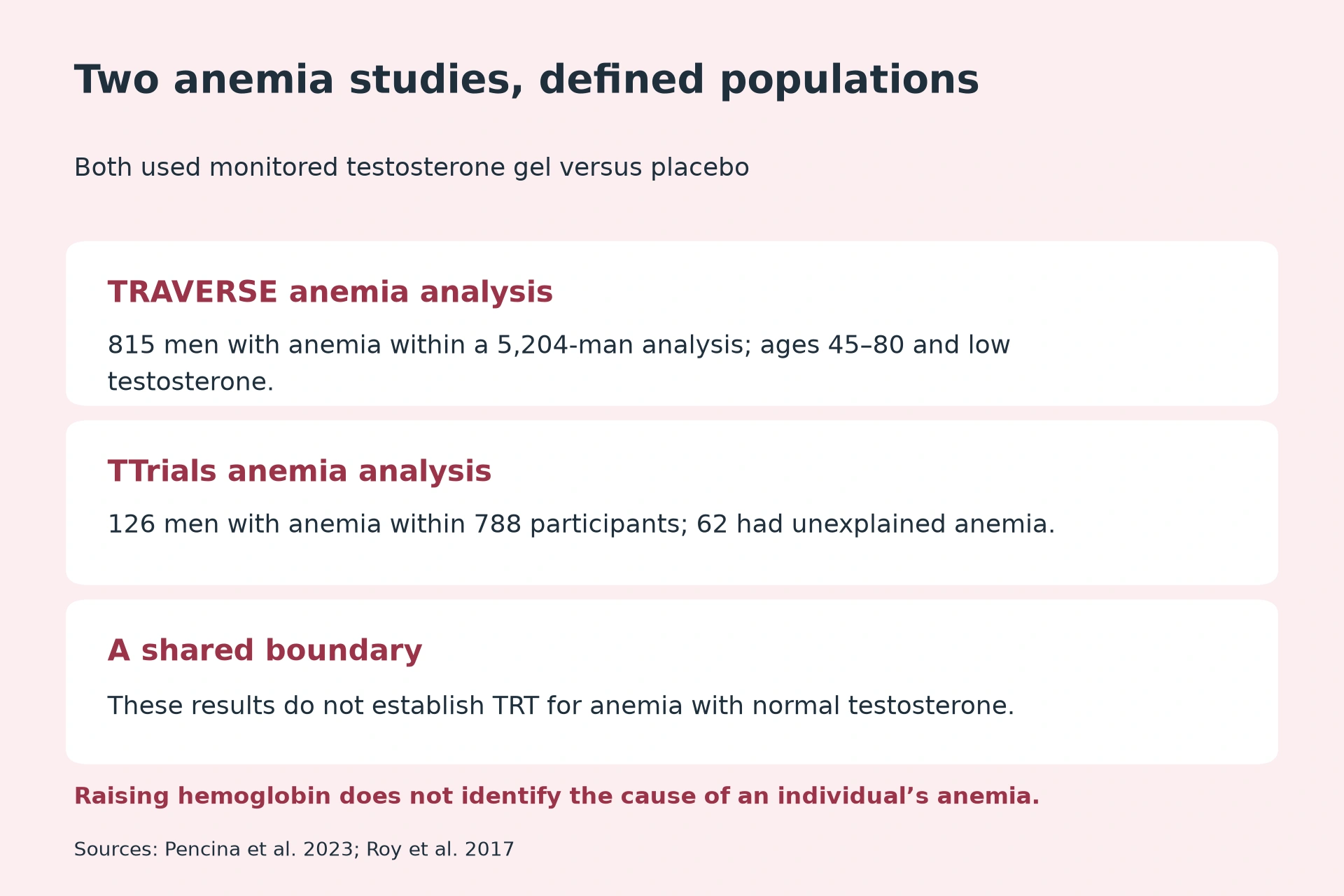
The anemia study was nested within the larger TRAVERSE testosterone safety trial. It included 5,204 men, of whom 815 had anemia at baseline and 4,379 did not. Participants were aged 45–80, had symptoms of hypogonadism, two testosterone results below 300 ng/dL, and established cardiovascular disease or increased cardiovascular risk. Original TRAVERSE anemia paper.
Participants received daily 1.62% testosterone gel or placebo gel. Treatment was monitored and adjusted under the trial protocol. This was not a study of bodybuilding doses, injections chosen without testing, people with normal testosterone, or anemia in women.
The study defined anemia as hemoglobin below 12.7 g/dL and correction as reaching at least 12.7 g/dL. A threshold used in a trial is not a replacement for a laboratory’s reference range or a clinician’s interpretation. It tells us exactly how the investigators counted the endpoint.
How often did anemia correct?
At six months, anemia corrected in 143 of 349 assessed men receiving testosterone, or 41.0%, compared with 103 of 375 receiving placebo, or 27.5%. At 12 months, the figures were 152 of 338, or 45.0%, and 122 of 360, or 33.9%. TRAVERSE anemia results.
The simple percentage-point differences are 13.5 at six months and 11.1 at 12 months. Those are visit-specific proportions, not a guarantee that a given person will respond and not percentages of all 5,204 participants.
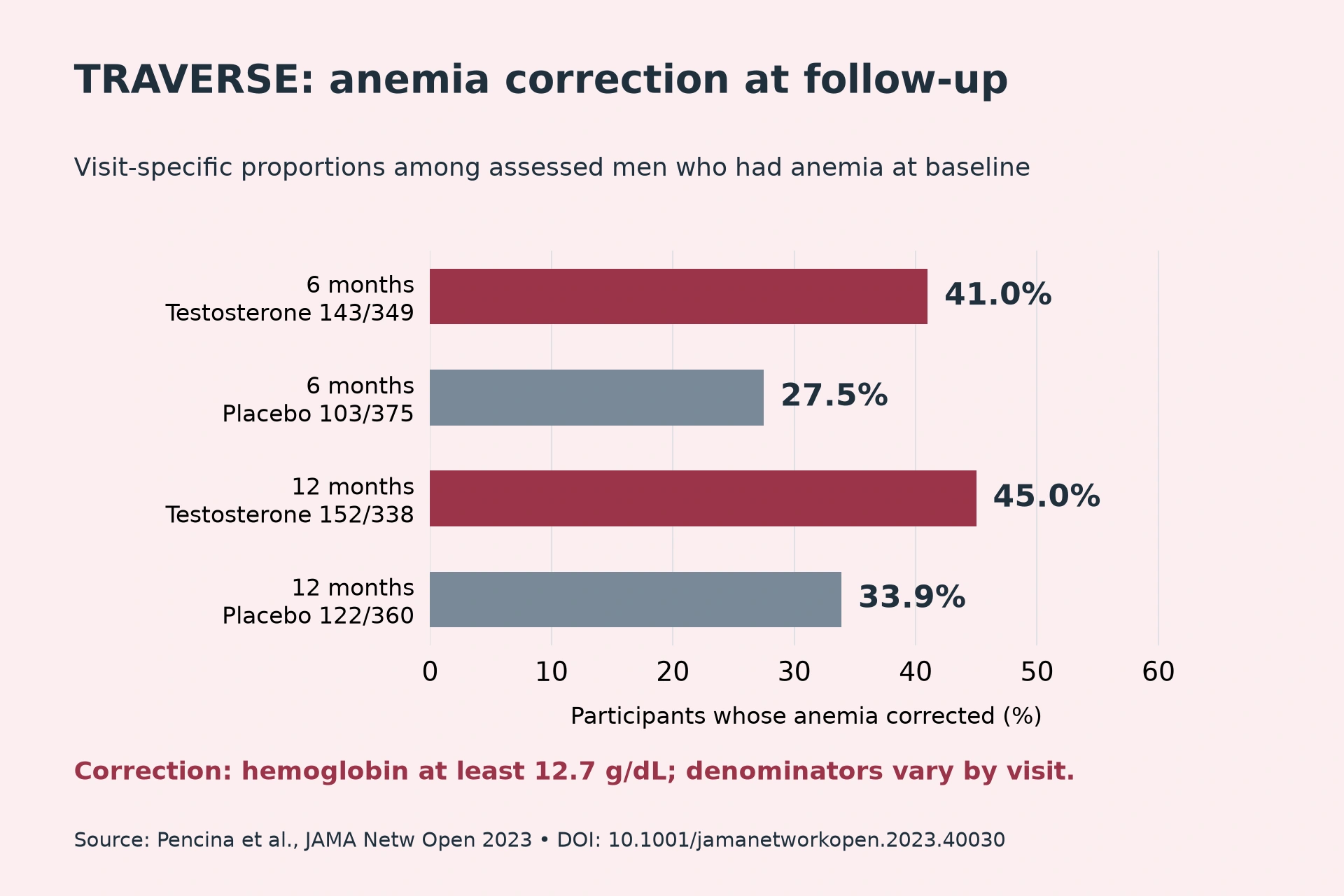
The paper also reported later visits and a repeated-measures analysis across follow-up. The number of participants with available measurements became smaller over time. For example, at 48 months the reported denominators were 92 and 97, much smaller than at six months. That makes it misleading to display a long series of percentages without acknowledging the changing numbers assessed.
Among participants who were not anemic at baseline, fewer testosterone-treated men developed anemia. Changes in hemoglobin were also associated with changes in energy scores. That association does not mean the study proved that every episode of fatigue was caused by low hemoglobin or that correcting a number guarantees restored energy.
What TRAVERSE could not tell us about the cause of anemia
The authors identified a major limitation: the study did not establish the cause of anemia in the enrolled participants. It therefore cannot tell a clinician that a particular patient’s low hemoglobin is caused by testosterone deficiency rather than iron deficiency, bleeding, chronic inflammation, kidney disease, or another condition.
The trial also had substantial treatment discontinuation, and the pandemic affected retention. Sensitivity analyses supported the overall findings, but those limitations remain relevant when predicting long-term real-world response.
Most importantly, the results apply to the hypogonadal men studied. They should not be extended to people with normal testosterone, supraphysiologic dosing, or populations excluded from the trial. A favorable average hemoglobin response is evidence to consider within a diagnosis, not a shortcut around making the diagnosis.
What did the earlier Testosterone Trials find?
The Testosterone Trials, often called TTrials, included a smaller anemia analysis in men aged 65 or older with average testosterone below 275 ng/dL. Among 788 participants, 126 had anemia and 62 had no identified cause for it. Treatment was testosterone gel or placebo for 12 months. Original TTrials anemia report.
Among men with unexplained anemia, 54% in the testosterone group had a hemoglobin increase of at least 1.0 g/dL at month 12, compared with 15% in the placebo group. The proportion no longer classified as anemic was 58.3% versus 22.2%.
Those are two different endpoints: a rise of at least 1.0 g/dL and crossing the anemia threshold. A participant can meet one without necessarily meeting the other, depending on the starting value. A careful explanation keeps the definitions attached to the percentages.
The findings support the possibility that low testosterone contributes to anemia in some older men. The unexplained-anemia subgroup was small, however, and the reported confidence intervals were wide. The authors also emphasized that the results did not apply to unexplained anemia with normal testosterone.
Why these are two research programs, not many independent confirmations
TRAVERSE produced several reports on different outcomes, including cardiovascular safety, anemia, sexual function, and fractures. Those reports draw on the same parent trial population or nested groups. They are valuable because they ask different questions, but they should not be counted as entirely independent trials simply because they appear in separate journal articles.
TTrials similarly coordinated several outcome studies within one program. When a review refers to anemia, bone, and sexual-function findings, it should explain the overlap rather than imply that every report recruited a fresh unrelated population.
Our TRT sexual-function review and TRT bone and fracture review use that distinction. A benefit in one outcome does not establish a benefit in every other outcome.
The other side of the effect: blood counts can rise too far
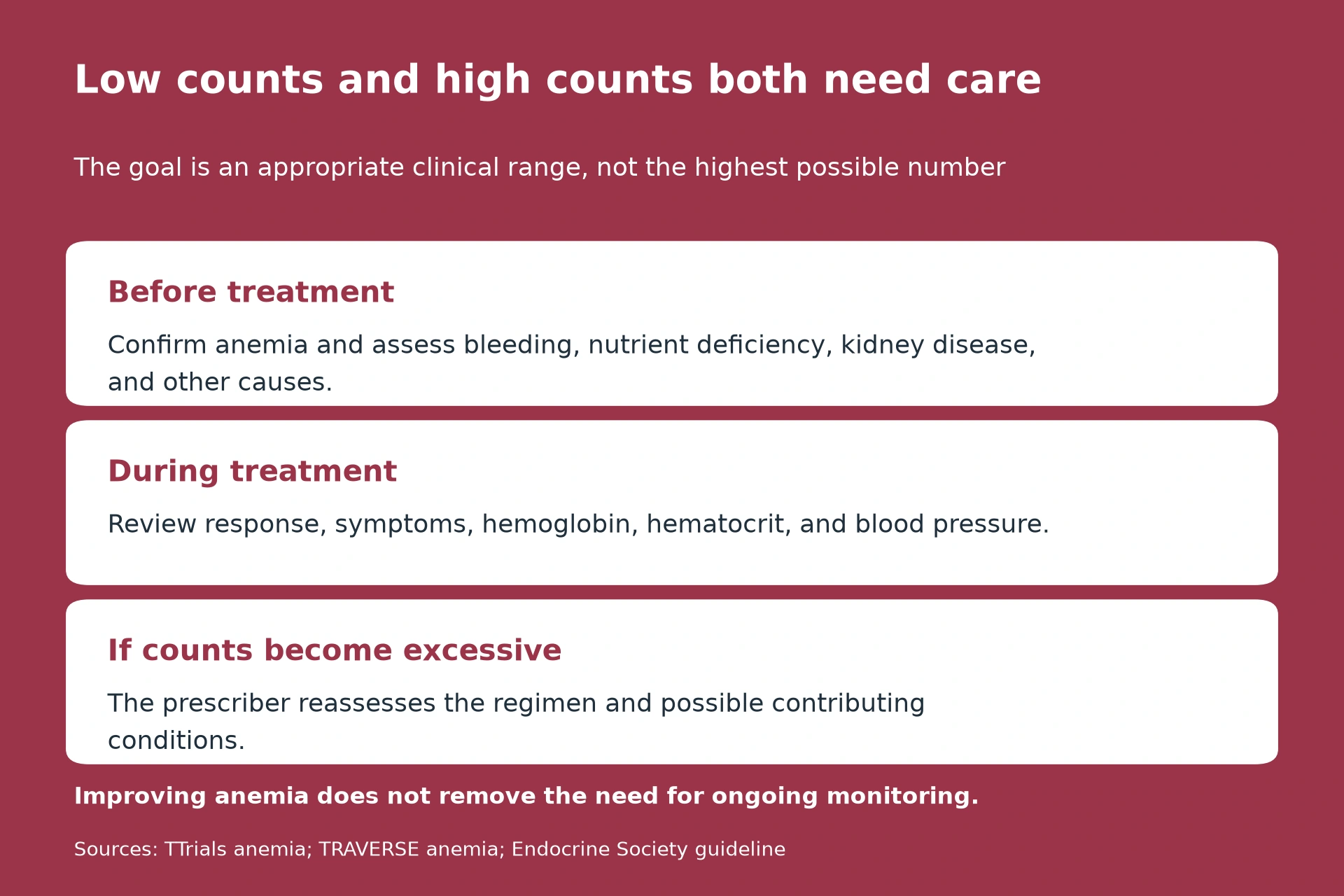
Stimulating red-cell production can help selected men with anemia, but excessive increases are a known monitoring concern during TRT. In the TTrials anemia report, six men who were not anemic at baseline developed hemoglobin above 17.5 g/dL. In the TRAVERSE anemia report, six participants stopped study medication because hematocrit exceeded 54% at the lowest study dose.
These are trial observations, not an instruction to wait until a particular threshold before contacting a clinician. The appropriate action depends on the complete blood count, trend, symptoms, treatment, and other causes. Dehydration and untreated sleep apnea can complicate interpretation.
Our TRT side-effects and monitoring guide and TRT and sleep-apnea article explain related follow-up questions. Do not respond to an abnormal blood count by independently increasing testosterone, arranging repeated blood donation as a workaround, or adding iron without assessing whether iron is needed.
How do the cardiovascular findings fit?
The parent TRAVERSE trial found testosterone noninferior to placebo for its major cardiovascular-event composite in the studied population. Events occurred in 7.0% versus 7.3%, with a hazard ratio of 0.96 and a 95% confidence interval of 0.78–1.17. It also observed higher incidences of atrial fibrillation, acute kidney injury, and pulmonary embolism in the testosterone group. Original cardiovascular report.
“Noninferior” means the trial met its prespecified comparison criterion. It does not mean testosterone prevented cardiovascular disease or had no possible adverse effects. These results need to be integrated with blood-pressure and blood-count monitoring, rather than treated as permission to ignore them.
The FDA’s February 2025 update removed the boxed-warning language about increased adverse cardiovascular outcomes and required blood-pressure warnings. The FDA’s current information page also describes requested June 2026 changes to age-related-hypogonadism limitation language and prostate safety information. These are specific labeling developments, not evidence that TRT is appropriate for every tired person or risk-free. 2025 FDA communication; current FDA information.
What should happen before considering TRT for a man with anemia?
A clinician should confirm the anemia, review its pattern and severity, and investigate likely causes. History may include bleeding symptoms, diet, medications, kidney disease, inflammation, and other medical conditions. Testing is individualized; there is no single universal panel that an article can prescribe.
If symptoms suggest testosterone deficiency, diagnosis also requires appropriate hormone testing and clinical interpretation. The Endocrine Society guideline emphasizes compatible symptoms and consistently low testosterone, with repeat morning testing to confirm the finding and evaluation of the cause.
Before treatment, discuss fertility plans, sleep apnea, prostate-related issues, blood pressure, and follow-up. Our starting-TRT questions and TRT and fertility guide provide a practical checklist. The CoreAge Rx TRT information page can support an individualized consultation; the anemia studies do not establish eligibility on their own.
Watch: the parent TRAVERSE safety study
This NEJM video explains the cardiovascular parent trial. It provides safety context for the research program; it does not summarize the separate anemia findings, which are described above and linked in the references.
Common questions about testosterone and anemia
Can low testosterone be the only cause of anemia?
It can contribute, but a person may have more than one cause. The TRAVERSE anemia study did not determine each participant’s cause, so it cannot replace a clinical workup.
Should I take iron if I feel tired while on TRT?
Fatigue does not establish iron deficiency. Iron treatment should be based on an appropriate assessment, because anemia can arise through several mechanisms and unnecessary supplementation may be inappropriate.
Does the research support TRT when testosterone is normal?
No. The trials discussed here enrolled men with low testosterone and defined clinical criteria. They do not establish testosterone as a general anemia treatment in people with normal hormone levels.
Is more hemoglobin always better?
No. Correcting anemia and pushing blood counts too high are different outcomes. Monitoring is needed throughout treatment, even if a low baseline result initially improves.
What is the most useful conclusion?
TRT can improve anemia in selected men with confirmed hypogonadism. That potential benefit belongs in a broader decision that also investigates the anemia’s cause and plans for blood-count, blood-pressure, symptom, and treatment monitoring.
Original papers and supporting sources
The references distinguish full research papers, published abstracts, and official guidance. This educational narrative review is not a systematic review or an individual treatment recommendation. Sources were checked in October 2026.
- NHLBI. Anemia causes and risk factors. NIH patient guidance.
- Pencina KM et al. Efficacy of Testosterone Replacement Therapy in Correcting Anemia in Men With Hypogonadism: A Randomized Clinical Trial. (2023). Full text reviewed. DOI: 10.1001/jamanetworkopen.2023.40030. Open full text.
- Roy CN et al. Association of Testosterone Levels With Anemia in Older Men: A Controlled Clinical Trial. (2017). Full text reviewed. DOI: 10.1001/jamainternmed.2016.9540. Open full text.
- Lincoff AM et al. Cardiovascular Safety of Testosterone-Replacement Therapy. (2023). Published abstract reviewed. DOI: 10.1056/nejmoa2215025.
- FDA. Testosterone labeling changes, February 28, 2025. FDA labeling communication.
- FDA. Testosterone Information, including requested June 2026 labeling revisions. Current FDA information.
- Endocrine Society. Testosterone Therapy in Men With Hypogonadism, 2018. Professional guideline.