
Tirzepatide storage depends on the exact product and presentation. A compounded multi-dose vial, a Mounjaro single-dose pen, and a Zepbound KwikPen do not share one universal “out of the fridge” rule. Identify the product before borrowing a temperature limit or deadline from another person’s prescription.
For compounded tirzepatide, start with the dispensing pharmacy’s written instructions and verify unclear or conflicting information. FDA also gives specific guidance about warm injectable GLP-1 shipments and the first-use discard period for sterile compounded multi-dose vials. These points should be reviewed before a trip or a questionable shipment is used.
This guide separates the current branded presentation rules from compounded-vial questions and shows how to keep a useful travel and storage record.
Start with four product details
Read the medication label and package before searching for a deadline. Write down:
- The brand or compounded product name.
- The presentation: single-dose pen or vial, multi-dose vial, or single-patient-use KwikPen.
- Whether it is unopened or has been used.
- The relevant expiration, pharmacy date, first-use date, and room-temperature history.
If a label only says tirzepatide without enough detail to answer those questions, contact the dispensing pharmacy. An ingredient name is not a complete storage instruction.
Our compounded GLP-1 medication guide explains why pharmacy and formulation information matter. Tirzepatide reconstitution questions addresses the additional issue of a dry preparation versus an already dispensed solution.
Current Mounjaro and Zepbound branded rules
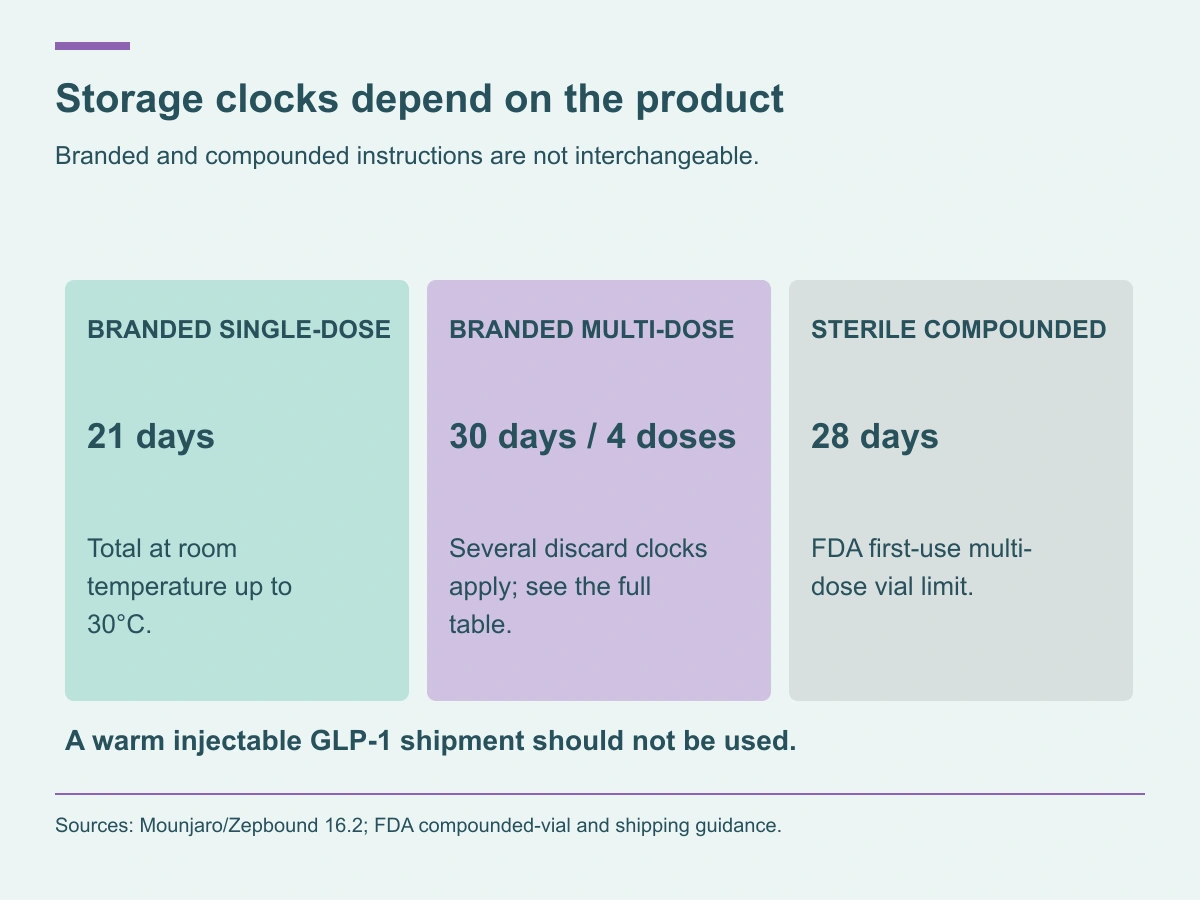
The current U.S. prescribing information for both brands distinguishes single-dose presentations from multi-dose vials and single-patient-use KwikPens. The table below summarizes the selected storage passages; use the instructions accompanying your actual product.
| Branded presentation | Refrigeration | Room-temperature and discard information |
|---|---|---|
| Single-dose pen or single-dose vial | 2–8°C / 36–46°F | Up to a total of 21 days at no more than 30°C / 86°F; discard after that total |
| Unopened multi-dose vial or single-patient-use KwikPen | 2–8°C / 36–46°F; usable until labeled expiration when refrigerated | Discard after 30 days if stored at room temperature up to 30°C / 86°F |
| Opened multi-dose vial or single-patient-use KwikPen | Original carton, refrigerated or at room temperature up to 30°C / 86°F | Discard after a total of 30 days at room temperature, 30 days after first use, or after 4 weekly doses |
Sources: Mounjaro section 16.2 and Zepbound section 16.2. These are branded-product instructions, not authorization to apply the same clocks to a compounded vial.
The labels say not to freeze these products or use them if frozen, and to protect them from heat and light in the original carton. Returning a product to the refrigerator does not erase a stated total room-temperature period. Track the actual history instead of restarting the count.
Why a compounded vial needs its own review
Compounded medicines can differ in concentration, ingredients, preparation, packaging, and pharmacy instructions. They are not FDA-approved versions of Mounjaro or Zepbound, and a matching active ingredient does not establish identical stability.
FDA explains that compounded medicines do not undergo its premarket review for safety, effectiveness, and quality. The dispensing pharmacy should be able to identify the prescription and explain the written storage conditions. FDA unapproved GLP-1 guidance
Ask about the required temperature range, unopened date, first-use limit, and how to handle an excursion outside that range. If directions are missing, resolve the question before using the product rather than adopting the branded 21-day rule.
Do not use appearance alone to decide that a compounded product remains suitable. A liquid looking clear cannot establish its temperature history, potency, or sterility.
The compounded multi-dose vial first-use rule
FDA states that sterile compounded drugs in multi-dose vials should be discarded within 28 days after first use, even when the compounded label states a longer timeframe. It also says to use a new sterile syringe and needle for each injection. FDA compounded-vial guidance
This guidance concerns sterile compounded multi-dose vials. It should not be confused with the current 30-day and four-dose rules for the branded presentations in the table above.
Keep the first-use date on a written record. Also follow any earlier expiration or pharmacy-directed discard point. When dates conflict or are unclear, ask the pharmacy to resolve them; do not choose the latest date to avoid wasting medication.
An unopened pharmacy date and a first-use limit answer different questions. Starting a new first-use clock does not extend an already expired product.

What if the shipment arrives warm?
FDA advises consumers not to use injectable GLP-1 medicines that arrive warm or with inadequate refrigeration. Contact the dispensing pharmacy about the affected shipment and what happens next. FDA shipping concerns
Record when the package arrived, what packaging was present, and the condition you observed. Keep the label and shipment details available so the pharmacy can identify the actual medication.
Refrigerating a warm shipment afterward does not establish that the earlier exposure has been reversed. Similarly, a frozen pack inside a box does not prove the medicine remained within its required range throughout transport.
Do not take an extra or substitute dose to compensate for a shipment problem. Ask the prescribing team about treatment timing if you cannot use the delivered product.
Preparing for travel
Resolve the product-specific storage questions before departure. A cooler bag can help with transport planning, but the bag itself does not prove the medicine stayed at the required temperature.
Ask the pharmacy how to maintain the prescribed conditions for your route and duration. Consider transit time, weather, waiting periods, overnight storage, and whether you can access appropriate refrigeration at the destination.
Bring the labeled product and written instructions, and keep the pharmacy and prescribing contacts accessible. Pack the supplies needed for the actual presentation rather than assuming every tirzepatide product uses the same equipment.
If travel rules or security requirements are relevant, verify them with the actual carrier or authority for your trip. This article does not establish current rules for every country, airline, or border.
Heat, freezing, and hotel refrigerators
Cars, direct sun, and luggage storage can expose a medicine to conditions that differ from the room around you. Plan where the medication will be during every part of travel rather than only at the destination.
Cold transport also needs care. Putting a vial directly against a frozen pack can create a freezing concern. Ask the pharmacy about appropriate packing and how to avoid that exposure.
Hotel or small refrigerators may have uneven conditions. Verify suitable storage rather than assuming the coldest shelf is best. A temperature record is more informative than simply noting that the vial was “in the fridge.”
For related planning, see semaglutide storage and travel and Zepbound refrigeration questions. Do not transfer one product’s limits to another without verifying the actual instructions.
What to record when a storage problem occurs
Gather what you know without inventing missing measurements. Approximate observations should be labeled as approximate.
| Detail | Example of useful information |
|---|---|
| Product identity | Full label name, presentation, pharmacy, and prescription details |
| Dates | Expiration or pharmacy date, first-use date, and days out of refrigeration |
| Exposure | Known temperature, duration, location, heat or possible freezing |
| Packaging | Carton, transport container, cooling materials, and any damage |
| Use | Whether a dose was already taken and when |
Share the record with the pharmacist and prescriber. They can determine the next step based on the actual product and exposure. This article cannot certify a vial from a photograph or an estimated room temperature.

What if you already injected a questionable product?
Contact the prescribing team and pharmacy promptly with the product and storage history. Describe any symptoms and the time of use. Do not repeat the dose because you suspect the medicine lost potency.
Seek urgent medical care for severe symptoms. For broader symptom questions, see compounded tirzepatide side effects. That guide does not establish that a particular symptom proves a storage failure.
Ask for a clear plan about the next scheduled dose and any replacement. Keep the plan in writing when possible so the storage problem does not turn into a dosing misunderstanding.
Frequently asked questions
Does compounded tirzepatide need refrigeration?
Use the dispensing pharmacy’s instructions for the exact product. Do not infer its required conditions from a branded pen or from another compounded prescription.
Can I leave it out for 21 days like Mounjaro?
The 21-day total applies to the branded single-dose presentations described above. It is not a universal compounded-vial rule.
Does putting it back in the fridge reset the clock?
Do not erase prior exposure from the record. The branded instructions use total room-temperature periods, and a compounded product requires its own pharmacy review.
What if it looks normal after getting warm?
Appearance cannot establish an acceptable storage history. FDA specifically advises against using warm or inadequately refrigerated injectable GLP-1 shipments.
Is 28 days the same as the KwikPen limit?
No. FDA’s 28-day first-use guidance concerns sterile compounded multi-dose vials. The branded multi-dose and KwikPen instructions described above have their own 30-day and four-dose conditions.
Where can I review treatment information?
CoreAge Rx’s tirzepatide information page provides treatment context. Pharmacy-specific storage questions still need the team dispensing your actual prescription.
Educational information for adults; individual treatment decisions require a qualified clinician. Sources reviewed October 3, 2026. Original AI-generated article images depict fictional people and objects, not patient outcomes. Other editorial images are illustrative. Graphics summarize the cited sources.