
A vial marked “10 mg tirzepatide” does not tell you how much bacteriostatic water to add. The amount printed on a container is only one piece of information. A safe preparation also depends on what the product actually is, its intended final concentration, the prescribed dose, its ingredients, and instructions from the dispensing pharmacy. A generic online mixing recipe cannot establish those details.
If your medication arrived as a ready-to-use solution, adding water can change the concentration and create an error. If a seller supplied a powder labeled for research, a calculation does not turn it into an appropriate prescription medicine. Start by identifying the product and contacting its legitimate dispensing pharmacy before preparing or injecting anything.
This guide explains why reconstitution questions are product questions first, how to distinguish the numbers on a label, and what information to request when instructions are unclear.
What does tirzepatide reconstitution mean?
Reconstitution means adding a specified liquid to a dry preparation to make a solution. It is different from withdrawing a prescribed amount from a vial that already contains liquid. It is also different from using a manufacturer’s pen, which has its own preparation and administration instructions.
These distinctions matter because people sometimes use “mixing” to describe every step involving a vial. Someone might actually be asking how to draw up an already prepared injection, while another person has obtained a dry research product. They are not facing the same task.
FDA warns about unapproved GLP-1 products, dosing errors with compounded preparations, and products sold directly to consumers under research-use language. Compounded medicines do not receive FDA’s premarket review for safety, effectiveness, and quality. These concerns are separate from whether a shopper can perform division correctly. FDA’s explanation of unapproved GLP-1 drugs
For a broader introduction, see compounded GLP-1 medications: ingredients and questions to ask. Understanding the dispensing process comes before interpreting a syringe.
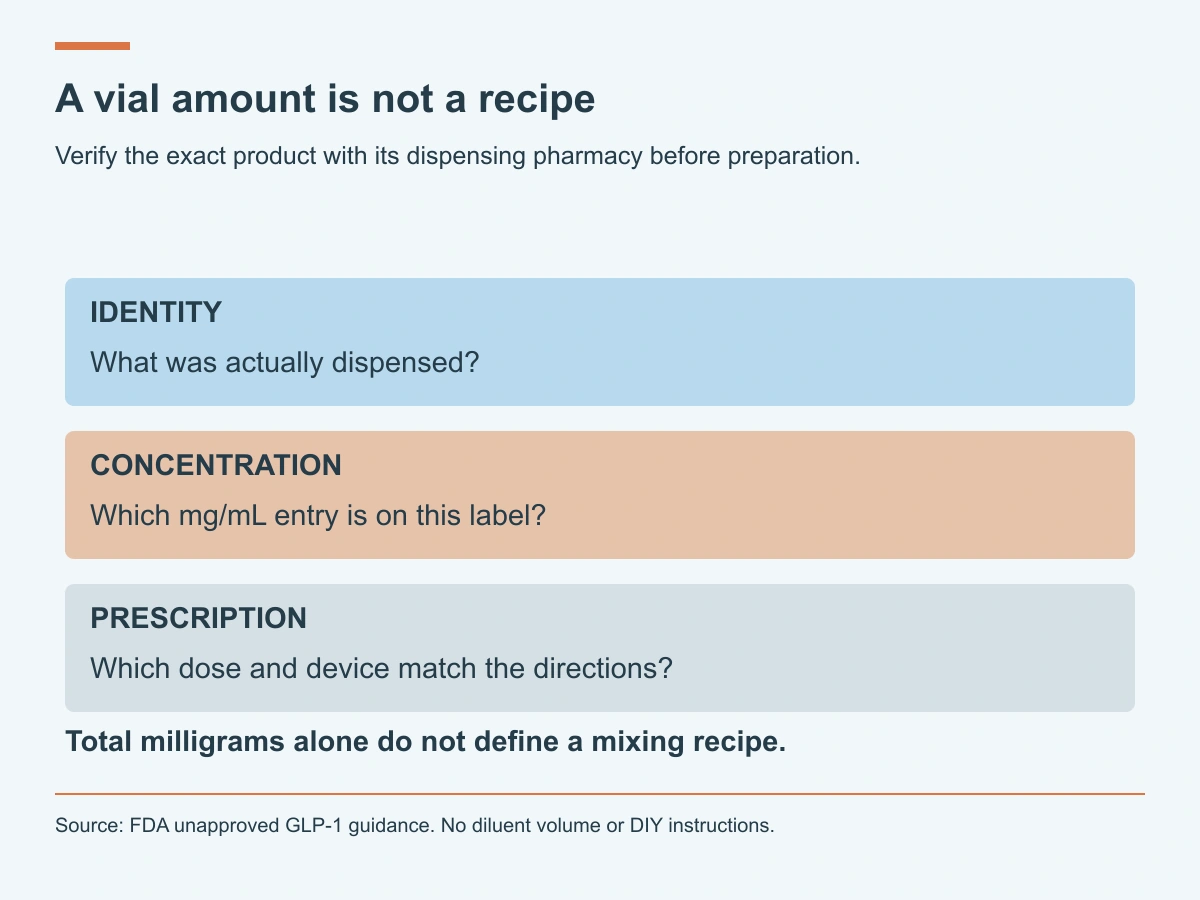
Why “10 mg” is not a complete mixing instruction
A total drug amount does not specify the final liquid volume. Without that volume, you do not know the concentration. Without an actual prescribed dose and a matched measuring device, you do not know which marking represents the intended injection.
Even when an online answer supplies all three numbers, it may describe a different product. It cannot verify the identity of your container, whether it was prepared properly, which liquid is compatible, or what storage and discard instructions apply.
| Information | What it describes | What it does not establish alone |
|---|---|---|
| Total milligrams in a vial | Amount of drug stated for the container | A preparation method or prescribed injection |
| Concentration in mg/mL | Stated amount of drug in each milliliter | Whether the product is suitable for you |
| Prescribed milligrams per dose | Treatment amount ordered for that patient | A syringe marking without the matching concentration |
| Volume in mL | Amount of liquid | Drug identity, sterility, or appropriateness |
| Syringe markings | Measurement scale on a particular device | A universal tirzepatide dose |
Keep the complete label, prescription directions, and device together. A cropped photograph that shows only “10 mg” leaves out the information most likely to prevent a mistake.
Milligrams, milliliters, and “units” answer different questions
Milligrams describe drug amount. Milliliters describe liquid volume. A syringe’s unit scale describes markings on that syringe; it is not a standardized tirzepatide prescription language.
Two prescriptions can use the same milligram dose but require different liquid volumes when their concentrations differ. Conversely, the same syringe marking can deliver different drug amounts from different concentrations. Copying a friend’s “units” therefore does not confirm your dose.
FDA describes errors involving confusion between these measurements and varying compounded concentrations. Ask the pharmacist to explain your own prescription in terms you can repeat back, with the exact device you will use. FDA dosing-error concerns
A useful question is: “Please show me how the dose on my prescription matches the concentration on this label and the marking on this syringe.” That asks for verification of an actual dispensed product rather than an internet conversion chart.
Our Mounjaro dosage chart explains the branded treatment context. It should not be used as a conversion chart for a compounded vial or an unidentified powder.
First identify which situation you are in
A branded pen or vial
Mounjaro and Zepbound are branded tirzepatide products with manufacturer instructions. Their current labels include multiple presentations. Do not assume every container with the same active ingredient requires the same steps, and do not add liquid to a manufacturer’s prepared solution.
Use the instructions supplied for that exact presentation. Product name, single-dose versus multi-dose status, and device all matter. A video about another pen or vial may leave out a required step or describe a different product.
A prescription compounded solution
Check the dispensing pharmacy, your name, the prescribed directions, concentration, and storage information. If the vial already contains solution, ask whether it is ready to use as dispensed. Do not add liquid because another person’s vial looked similar.
FDA advises obtaining prescription GLP-1 medicines through a licensed health professional and a state-licensed pharmacy. When contact details or labeling seem inconsistent, verify them independently before using the product. FDA consumer guidance
A dry product with unclear instructions
Pause preparation and contact the dispensing pharmacist. Ask whether preparation is intended to occur at the pharmacy or at home, what written instructions apply, and what training is required. The person answering should be able to identify the exact prescription and product rather than simply repeat a generic recipe.
A powder sold as a research peptide
Research-use labeling is a major identity and suitability concern. FDA advises consumers not to purchase GLP-1 products sold under this language for personal treatment. A clean-looking vial, purity claim, or familiar ingredient name does not resolve the concern. FDA research-product warning
Questions to ask the dispensing pharmacy
Bring the package and prescription information to the conversation. Ask one question at a time and request written clarification when the current directions are incomplete.
- What exactly was dispensed? Confirm the medication, formulation, ingredients, and whether it is a solution or a preparation requiring further steps.
- Is it ready to use? Establish this before opening another container or adding a liquid.
- Where should any preparation happen? Ask who is responsible and what training is needed.
- What concentration applies to this prescription? Read the full mg/mL entry rather than just total milligrams.
- Which device matches these directions? Have the pharmacist confirm the supplied syringe or pen instructions.
- What are the storage and discard rules? Distinguish an unopened date, first-use date, and any temperature problem.
- Whom should I contact if the shipment or label is wrong? Keep the pharmacy’s verified contact information available.
If the answers conflict with the label, ask the pharmacy to reconcile them before use. A verbal instruction that leaves you uncertain is a reason to seek clarification, not to choose whichever number appears most often online.
Why sterility is a separate issue from concentration
A concentration calculation says nothing about microorganisms, contaminants, container integrity, or how a preparation was handled. A kitchen counter, a new bottle of liquid, and a vial that looks clean do not establish a validated sterile preparation process.
Likewise, knowing the ingredient name does not establish which diluent, materials, or preparation conditions were intended. Avoid substituting liquids or improvising a process from a social-media demonstration. Request the actual product instructions and pharmacy training.
For prescribed compounded multi-dose vials, FDA states that a new sterile syringe and needle should be used each time. This is a handling requirement; it does not make an unidentified product safe. FDA compounded-vial guidance
Storage questions often reveal a product mismatch
“How long does mixed tirzepatide last?” has no single answer that applies to every vial. The product, its preparation, the dispensing instructions, and first-use history must be identified.
Our tirzepatide storage and travel guide separates branded presentation rules from compounded-product questions. The important habit is keeping a written first-use and temperature record, rather than borrowing a deadline from a different medication.
If an injectable GLP-1 shipment arrives warm or with inadequate refrigeration, FDA advises against using it. Contact the dispensing pharmacy about the affected shipment; putting it into a refrigerator afterward does not establish that the problem has been corrected. FDA shipping guidance

What if you already prepared or injected an uncertain amount?
Do not take a replacement or additional dose to correct a suspected error on your own. Contact the prescribing team and pharmacist promptly with the container, directions, product concentration, device, estimated amount, and time of use. Describe symptoms clearly and keep the packaging available.
If there are severe symptoms, obtain urgent medical care. Breathing trouble, fainting, confusion, or severe ongoing vomiting should not wait for an email response. A clinician can decide what assessment is needed based on the actual exposure and symptoms.
For the next conversation, compounded tirzepatide side effects explains why a dosing problem and an expected treatment effect require different questions.
Frequently asked questions
How much bacteriostatic water should I add to a 10 mg vial?
The total milligrams alone cannot determine that. Identify the product and obtain its actual preparation instructions from the dispensing pharmacy. Do not use a universal online volume or assume a ready-to-use solution needs water.
Can I use a recipe written for semaglutide?
No generic recipe can establish the correct preparation for another medication or formulation. A shared syringe style or similar container does not make the products interchangeable.
Does a larger volume make the medication weaker?
Volume and concentration are related, but changing a dispensed preparation is not an appropriate way to adjust treatment. Ask the pharmacist to verify the original product and directions rather than trying to alter them yourself.
Is a research product acceptable if a clinician prescribes tirzepatide?
A prescription does not verify a separate product purchased from a research seller. Ask the prescriber and a licensed dispensing pharmacy to identify an appropriate legitimate medication source.
Where can I learn about treatment options?
CoreAge Rx’s tirzepatide information page provides a starting point for discussing treatment. A product page cannot authenticate an unrelated vial or replace pharmacy-specific preparation and device training.
Educational information for adults; individual treatment decisions require a qualified clinician. Sources reviewed October 3, 2026. Original AI-generated article images depict fictional people and objects, not patient outcomes. Other editorial images are illustrative. Graphics summarize the cited sources.