
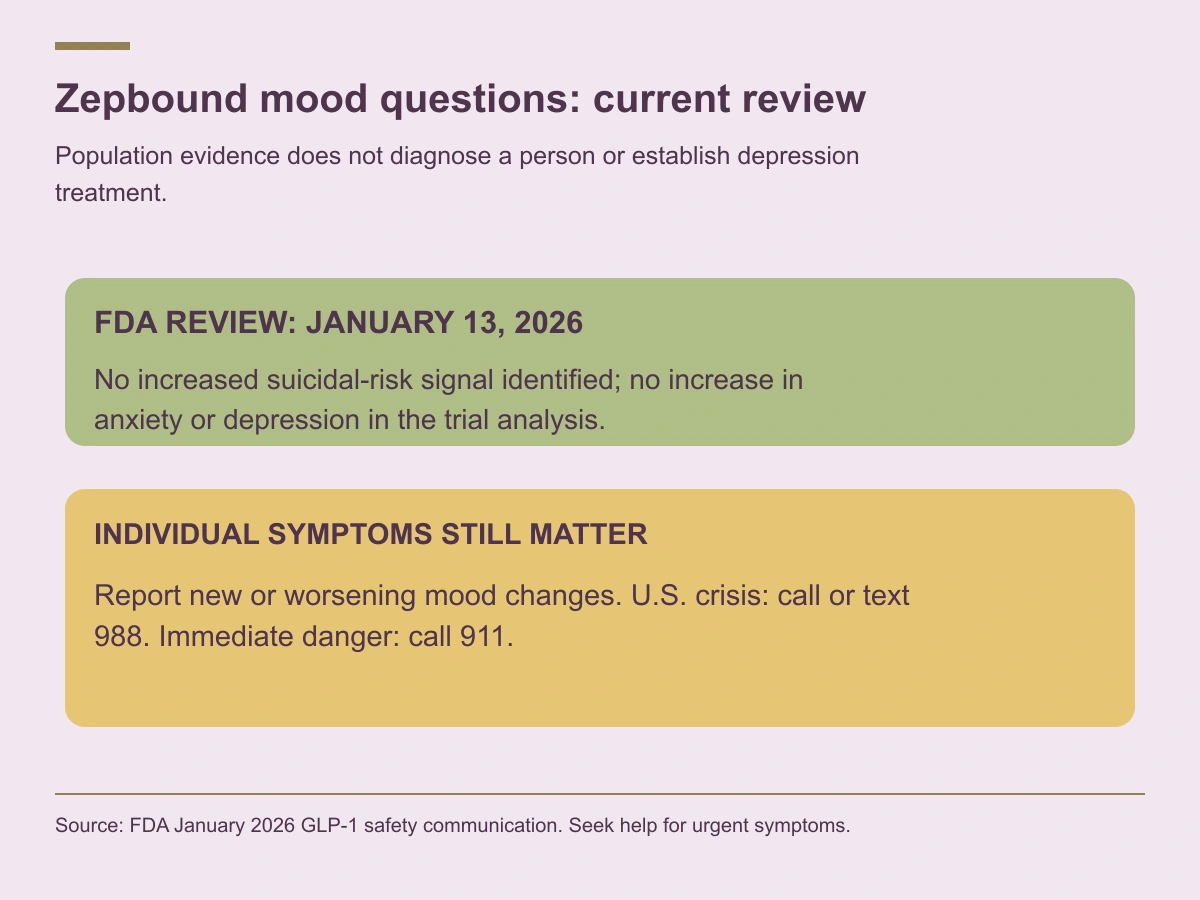
FDA’s January 2026 review did not find an increased risk of suicidal ideation or behavior with GLP-1 receptor agonists, and its trial analysis did not find increased anxiety or depression. FDA requested removal of the suicidal-behavior and ideation warning from the labeling of Zepbound, Wegovy, and Saxenda. That finding is useful, but it does not mean a person’s new mood symptoms should be ignored. FDA safety communication
If you feel depressed, unusually anxious, or different from your usual self during treatment, contact the prescribing team. If you have thoughts of suicide or self-harm, seek help immediately: in the United States, call or text 988. Call 911 for immediate danger or a medical emergency.
This guide explains the current FDA finding, what it can and cannot tell an individual, and which details help a care team assess mood changes while taking Zepbound.
What changed in January 2026?
On January 13, 2026, FDA announced the results of its review and requested that manufacturers remove the suicidal-behavior and ideation warning from the three named weight-management products. This was a conclusion about the reviewed evidence, not an instruction that all psychiatric symptoms are harmless.
The agency examined clinical-trial evidence and other data. Its analysis of placebo-controlled trials did not find an increased risk of suicidal thoughts or behavior. It also did not identify increased anxiety, depression, irritability, or psychosis in that analysis. FDA review findings
The event date matters when reading older articles. A page that still says a warning is under investigation or presents its earlier wording as the current conclusion may be out of date. The date a web page was updated is also not necessarily the date of the safety announcement.
What evidence did FDA review?
FDA described a meta-analysis of 91 placebo-controlled trials with 107,910 participants. It also described a large Sentinel study comparing people with type 2 diabetes starting GLP-1 medicines with people starting SGLT2 inhibitors.
Those are different sources of evidence with different populations and comparisons. The agency considered them together in reaching its conclusion. They are not a personalized estimate of what will happen to one adult taking Zepbound for weight management. FDA evidence summary
| Evidence question | What the review helps answer | What it does not establish |
|---|---|---|
| Did the reviewed groups show increased suicidal risk? | FDA did not identify an increased risk | A guarantee that an individual cannot develop suicidal thoughts |
| Did the trial analysis show increased anxiety or depression? | No increase was identified in that analysis | A diagnosis of someone’s new symptoms |
| Does this prove Zepbound treats depression? | No psychiatric-treatment benefit was established by this finding | A reason to replace mental-health care |
| Should symptoms still be reported? | FDA advises reporting new or worsening mood concerns | A reason to wait until symptoms become severe |
This is the distinction to keep in mind: reassuring population evidence and an individual need for assessment can both be true.
Can someone still feel depressed or anxious during treatment?
Yes, a person may experience symptoms during the period they are taking a medicine. The timeline is important information, but it does not by itself establish the cause.
Mood can be influenced by health conditions, sleep, life stress, other medicines, and changes in daily routines. A clinician needs to consider those possibilities alongside treatment history. This article cannot decide whether Zepbound caused a symptom in a particular person.
Likewise, anxiety can refer to ongoing worry, a sudden panic-like episode, or physical sensations someone interprets as anxiety. Describe what actually happened: the feeling, any physical symptoms, duration, and effect on daily life.
For related product questions, see can Ozempic cause depression? and Ozempic, panic attacks, and anxiety. These address a different medicine’s context; they should not be treated as individual diagnoses or a reason to switch products yourself.
Symptoms that deserve prompt attention
FDA advises people using GLP-1 medicines to report new or worsening depression, suicidal thoughts, or unusual changes in mood or behavior. Do not assume the review means you should tolerate a significant change without help. FDA patient guidance
Contact the treating team when mood symptoms persist, worsen, interfere with work or relationships, or make usual self-care difficult. Mention major sleep changes, panic episodes, and whether the symptoms are new or resemble an earlier condition.
Get help immediately if you have thoughts of suicide, feel unable to stay safe, or are experiencing an acute mental-health crisis. In the U.S., 988 provides crisis support by call or text. Emergency services are appropriate for immediate danger.
Do not wait for a routine weight-check appointment to report an urgent problem. A support person can help you contact care when making the call feels difficult.

What information helps the prescribing team?
A short timeline is more useful than a long search history. Write down when symptoms began and what changed around that time.
- The actual product, formulation, prescribed schedule, and recent treatment adjustments.
- Whether symptoms began before treatment, soon afterward, or much later.
- What “depression” or “anxiety” means in your own experience.
- Sleep changes, meals, fluid intake, digestive symptoms, and caffeine or alcohol use.
- Other medicines, supplements, or recent changes in them.
- Any past mood, anxiety, or sleep conditions and current mental-health treatment.
- How symptoms affect daily functioning and whether there are safety concerns.
This is a communication checklist, not a way to prove causality at home. Avoid changing several medicines or supplements to run an informal experiment.
The Mounjaro side-effects guide and compounded tirzepatide side-effects guide can help you identify additional product and symptom questions. Brand name and formulation remain important even when the active ingredient is related.
Review sleep and caffeine without assigning blame
Poor sleep and anxious feelings can overlap. NHLBI identifies stress, schedules, environment, caffeine, and other conditions as factors in insomnia. A sleep review can therefore be useful even when the initial concern is mood. NHLBI insomnia causes
FDA also describes anxiety, jitters, palpitations, and sleep disruption among symptoms of too much caffeine. Sensitivity varies, including with medicines and medical conditions. Its general adult caffeine discussion is not an individual allowance that everyone should reach. FDA caffeine guidance
Include coffee, energy drinks, teas, supplements, and caffeine-containing medicines in the record. This does not establish caffeine as the cause; it gives the clinician a more complete picture.
Our Zepbound and insomnia guide and sleep and weight-management guide discuss related questions. Persistent insomnia deserves assessment rather than simply being managed with another stimulant or a generic sleep supplement.
Eating patterns and mood questions belong in the same conversation
If appetite or meals have changed, tell the care team what you can actually eat. Include nausea, food aversions, skipped meals, or a pattern of eating very little for much of the day.
Do not interpret an inability to eat as evidence that treatment is working particularly well. The plan still needs to support adequate nutrition and daily function.
You can ask for help adapting meals, reviewing symptoms, or involving a dietitian. Balanced meals for weight management provides flexible food ideas, while food noise, hunger, and cravings explains why different experiences should be described clearly.
Neither article establishes that a specific food will treat depression or anxiety. Mental-health care should be based on an assessment of the actual condition and needs.
Should you stop Zepbound if your mood changes?
FDA’s communication advises patients to continue medicines as prescribed and discuss concerns with the health professional. New symptoms still need timely review. Ask the prescriber what to do about treatment rather than stopping, skipping, increasing, or switching doses on your own. FDA patient recommendations
If there is an urgent safety concern, seek immediate care instead of waiting for a medication-plan discussion. The clinician can address both the symptoms and the treatment decision.
When a plan changes, request clear instructions and a follow-up point. It should be clear which symptoms require another call and who is coordinating care if more than one clinician is involved.

Can Zepbound improve mood?
The FDA risk review does not establish Zepbound as a depression or anxiety treatment. A person may notice changes in mood during a weight-management journey, but that is different from evidence that the medicine should be prescribed to treat a psychiatric condition.
Do not reduce or replace an antidepressant, therapy, or other mental-health care because a weight-management article sounds reassuring. Tell both care teams about the full treatment plan so they can coordinate it.
Similarly, a positive online story cannot guarantee how you will feel. Use your own symptoms, functioning, and clinician assessment to guide the conversation.
Frequently asked questions
Does Zepbound cause suicidal thoughts?
FDA’s January 2026 review did not identify an increased risk with GLP-1 medicines and requested removal of the warning from named products including Zepbound. Any suicidal thoughts still require immediate help.
Is depression impossible while taking it?
No population review can establish that no individual will develop depression. Report new or worsening symptoms and obtain an appropriate assessment.
Is anxiety listed in the FDA trial conclusion?
FDA said its meta-analysis did not identify increased anxiety, depression, irritability, or psychosis. That does not determine the cause of a particular episode.
Can I take an antidepressant with Zepbound?
Have the prescriber and pharmacist review the actual medicines, conditions, and symptoms. This article does not provide a universal pairing or dose-adjustment rule.
Should I wait to see whether symptoms go away?
Do not delay reporting significant, worsening, or unusual mood changes. Urgent safety concerns require immediate care.
Where can I review tirzepatide treatment information?
CoreAge Rx’s tirzepatide information page provides a starting point for questions about treatment. Ongoing mental-health concerns should be discussed with qualified professionals alongside weight-management care.
Educational information for adults; individual treatment decisions require a qualified clinician. Sources reviewed October 3, 2026. Original AI-generated article images depict fictional people and objects, not patient outcomes. Other editorial images are illustrative. Graphics summarize the cited sources.