
Eating watermelon at night does not automatically prevent weight loss, and it has no established special fat-burning effect at bedtime. The more useful questions are how much you eat, what it replaces or accompanies, whether you are hungry, and whether late eating affects your symptoms or sleep.
Watermelon is a fruit with water and carbohydrate, including naturally occurring sugars. It can fit into meals or snacks, but it is not a complete meal and does not need a special clock-based rule. If a large bowl late in the evening causes discomfort, review that individual pattern rather than banning fruit for everyone.
This guide answers questions about nighttime watermelon, portions, nutrition, reflux, and weight-management routines using a defined USDA reference rather than estimating nutrients from a photograph.
Watermelon nutrition: use a defined amount
The USDA FoodData Central SR Legacy entry for raw watermelon provides a 100-gram reference and a defined cup of diced fruit weighing 152 grams. The cup figures below are calculated from that reference and rounded; they are not measurements of every bowl sold or prepared at home. USDA raw-watermelon record
| Nutrient | 100 g raw watermelon | Defined 1 cup diced, 152 g |
|---|---|---|
| Calories | 30 | About 46 |
| Carbohydrate | 7.55 g | About 11.5 g |
| Total sugars | 6.2 g | About 9.4 g |
| Fiber | 0.4 g | About 0.6 g |
| Water | 91.45 g | About 139 g |
This is the named raw-fruit reference, not a watermelon drink, juice, candy, or dessert. Its naturally occurring sugar is also different from sugar added to a prepared product.
The fiber figure deserves attention alongside the water content. A juicy fruit is not automatically a high-fiber food. You can include different fruits and other foods across the day rather than expecting one choice to provide everything.
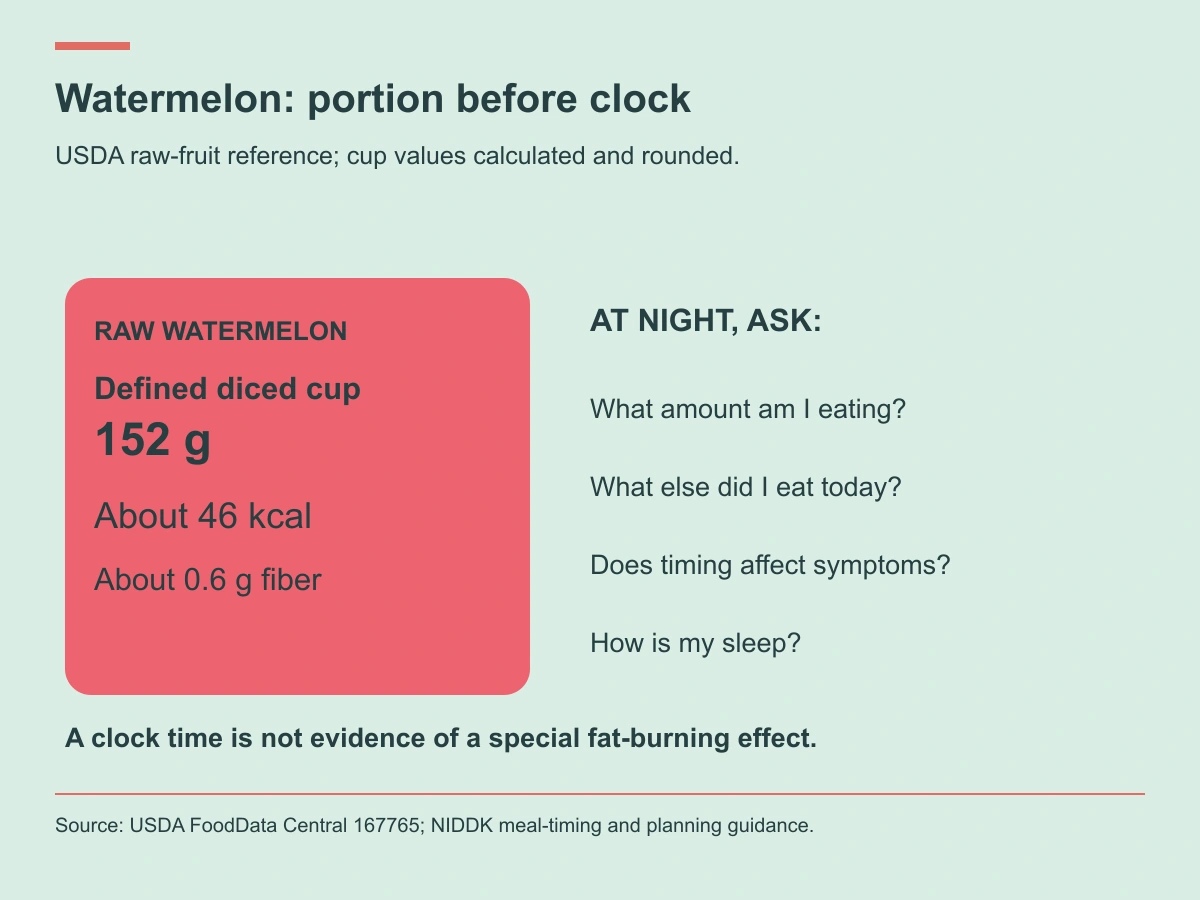
A bowl, wedge, and cup are not interchangeable
The amount matters when you want a useful estimate. A large wedge may weigh much more than a small one, and a bowl’s capacity depends on the bowl. The USDA cup is a defined diced-fruit weight, not a promise about the portion in an image.
If you need a more precise estimate for a nutrition or glucose plan, use the actual edible amount and appropriate professional guidance. Otherwise, learning the approximate portion you usually eat may be enough to make a routine more consistent.
Avoid using a fixed fruit count or a photograph as exact data. Our best fruits for weight loss guide discusses portions and dietary variety rather than ranking fruit by a promised slimming effect.
Does nighttime watermelon cause weight gain?
A particular time does not by itself tell you whether a person’s eating pattern supports weight loss. Your overall intake, needs, activity, treatment context, and consistency matter. A nighttime snack also has to be understood in relation to what happened earlier in the day.
For one adult, watermelon may replace a usual sweetened dessert. For another, it may be an additional snack after adequate meals. Someone else may be hungry at night because meals were repeatedly missed. These are different situations, even when the food is the same.
NIDDK’s Body Weight Planner uses personalized adult planning rather than one universal calorie prescription. It excludes children and people who are pregnant or breastfeeding. NIDDK Body Weight Planner
The calorie-intake guide explains why a standard online number does not establish an appropriate deficit for every person. Watermelon does not need to be either a forbidden food or a weight-loss treatment to fit that plan.
Is it better to eat watermelon in the morning?
There is no established special weight-loss advantage in this guide for eating it at breakfast rather than in the evening. Choose a time that fits your meals, appetite, symptoms, and any individualized dietary instructions.
If fruit is convenient at breakfast, pair it with the rest of a meal that meets your needs. If you prefer it as an evening snack, think about the portion and whether it leaves you comfortably satisfied.
The question becomes more useful when it is specific: “Does this snack help me manage hunger?” or “Does eating close to bed worsen my reflux?” Those questions can be observed and discussed. “Which hour makes watermelon burn fat?” assumes an effect that has not been established.
Reflux can change the timing conversation
If you have reflux symptoms at night or while lying down, NIDDK says eating meals at least three hours before lying down or going to bed may improve symptoms. That is guidance for a symptom pattern, not a universal ban on evening fruit. NIDDK GERD eating guidance
The same source describes individual food triggers. It does not establish watermelon as a trigger for everyone. Note the amount, timing, other foods or drinks, and symptoms instead of diagnosing a cause from one evening.
When symptoms repeatedly disrupt sleep, ask the care team about the pattern and next steps. Do not simply add an over-the-counter treatment indefinitely or assume that removing one fruit settles the underlying issue.
| Evening situation | Useful observation | Question to discuss |
|---|---|---|
| Reflux after lying down | Meal time, amount, and symptoms | Would earlier eating help my specific symptoms? |
| Repeated late hunger | Meals and appetite across the day | Am I missing needed food earlier? |
| A very large snack | Actual portion and comfort | Would a different amount or meal plan fit better? |
| Sleep disruption | Sleep schedule, symptoms, and drinks | What else may be affecting sleep? |

Water content does not replace a hydration plan
Watermelon contains a substantial amount of water in the USDA reference. That is useful nutrition information, but it does not establish how much fluid you personally need or mean you should replace drinking water with fruit.
Fluid advice may differ with medical conditions, medicines, activity, and weather. Follow any prescribed fluid restrictions or targets rather than adopting a generic fruit-based hydration rule.
Our water and drinks guide explains everyday beverage choices. Keep the distinction between a food’s water content and your overall fluid plan clear, especially if a clinical team has given you specific instructions.
What about watermelon sugar?
The raw-fruit reference includes naturally occurring total sugars. That is not the same as added sugar in a sweetened drink or syrup. FDA’s label guide explains the difference between total sugars and added sugars. FDA Nutrition Facts guide
This does not mean portion size is irrelevant or that a fruit-based drink has the same profile as raw fruit. Check actual ingredients and serving amounts when watermelon is blended, juiced, sweetened, or incorporated into a prepared product.
If you monitor carbohydrate for diabetes care, use the plan your clinician or dietitian provides. Do not assume fruit must be excluded, or that its natural sugar never matters. The defined carbohydrate amount above can support a conversation about the actual portion.
Can watermelon be dinner?
A fruit-only dinner does not provide the same range of nutrients as a varied meal. If you repeatedly replace meals with watermelon because appetite is low, tell the care team what you can eat and why usual foods are difficult.
You might serve fruit alongside a meal, use it as a snack, or combine it with other foods you enjoy. The point is to review the complete eating pattern rather than promote a “watermelon diet.”
Balanced meals for weight management offers flexible meal ideas. Protein breakfast ideas illustrates how foods can contribute different roles without assigning a single ideal plate.
Sleep deserves its own assessment
If you are awake and snacking frequently, consider the sleep pattern as well as the snack. Stress, schedules, environment, and caffeine can contribute to insomnia. NHLBI describes these as factors to assess rather than assuming one food is responsible. NHLBI insomnia causes
Persistent difficulty falling or staying asleep, especially with daytime effects, is worth discussing with a clinician. A fruit timing rule is not a treatment for insomnia.
For broader context, read sleep and weight management or semaglutide and insomnia if the question began during that treatment. Those guides address related concerns without diagnosing the cause of your sleep symptoms.

A realistic way to decide
Try asking three questions: Am I hungry? What amount am I serving? How do I feel afterward? Include what happened earlier in the day so the answer does not become an isolated bedtime rule.
If the snack suits your needs and does not cause symptoms, there may be no reason to invent a special restriction. If the pattern is uncomfortable or difficult to manage, adjust it with the care team or dietitian rather than pursuing a promised detox or fat-burning schedule.
Keep changes practical. Buying fruit you enjoy, storing it appropriately, and having workable meal options may help a routine more than trying to eat it at a supposedly perfect minute.
Frequently asked questions
Can I eat watermelon before bed while losing weight?
It can fit into an individualized eating pattern. Consider your portion, daily intake, hunger, and whether eating near bed affects symptoms or sleep.
Does watermelon burn belly fat?
The USDA nutrient reference does not establish a fat-loss effect, regional or otherwise. No special nighttime effect is supported by the sources reviewed here.
Is one bowl the same as one cup?
Not necessarily. The reference cup is diced watermelon weighing 152 grams. A bowl’s actual amount can be quite different.
Is watermelon high in fiber?
The USDA raw-fruit reference has 0.4 grams per 100 grams, or about 0.6 grams in the defined cup. Include a variety of foods rather than relying on watermelon for fiber.
Is juice equivalent to the fruit?
Do not assume so. Preparation, ingredients, and the amount consumed differ. Check the actual product rather than applying the raw-fruit table to every watermelon beverage.
Where can I discuss broader weight-management options?
CoreAge Rx’s tirzepatide information page offers a starting point for a clinician conversation. A treatment plan should also account for meals, symptoms, and realistic daily routines.
Educational information for adults; individual treatment decisions require a qualified clinician. Sources reviewed October 3, 2026. Original AI-generated article images depict fictional people and objects, not patient outcomes. Other editorial images are illustrative. Graphics summarize the cited sources.