Minoxidil side effects depend on the route, the amount used, the complete formulation, and the person taking it. A topical product can cause scalp irritation or unwanted hair growth. Oral minoxidil exposes the whole body to a blood-pressure medicine and requires a clinician to review cardiovascular risks, other medicines, and monitoring.
Using oral and topical minoxidil together is another prescribing question, rather than an automatic way to get faster results or prevent shedding. Bring every hair product you use to the review, including combination formulas and nonprescription preparations. The useful starting point is the exact medicine and the reason for the hair loss.
How are minoxidil pills different from topical products?
Oral minoxidil is approved as a treatment for severe hypertension that is not adequately controlled by other treatment. Its use for hair loss is off label. Topical minoxidil products have their own drug labels for specific pattern-hair-loss uses and populations.
The oral tablet label carries a boxed warning about serious effects, including pericardial effusion that can progress to cardiac tamponade and worsening angina. Pericardial effusion means fluid collects around the heart; tamponade is a dangerous effect on the heart’s ability to function. Those warnings should not be dismissed because a hair prescription uses a lower amount. Oral minoxidil label.
The hypertension label also describes management involving other medicines. That does not mean a person should add a diuretic or beta blocker independently when using minoxidil for hair loss. The off-label plan needs its own clinician-led assessment. Our oral minoxidil effectiveness guide explains the evidence alongside these practical differences.
Which side effects can occur with oral minoxidil?
Unwanted hair growth, headache, fluid retention, and cardiovascular symptoms are relevant to an oral-treatment discussion. A clinician needs to consider blood pressure, heart and kidney history, other prescriptions, and any symptoms that appear after treatment begins.
Low-dose hair-loss studies help describe reported effects in selected patients. They do not establish that every lower-dose prescription is harmless, or remove the warnings in the approved tablet label. A trial that reports few cardiovascular events also cannot rule out a rare event in broader use.
Tell the clinician about swelling, dizziness, a fast heartbeat, shortness of breath, or unexplained weight change. Do not try to manage a reaction by adding another hair medicine, taking someone else’s diuretic, or changing the tablet amount yourself. Oral minoxidil labeling.
What did the oral-versus-topical randomized trial find?
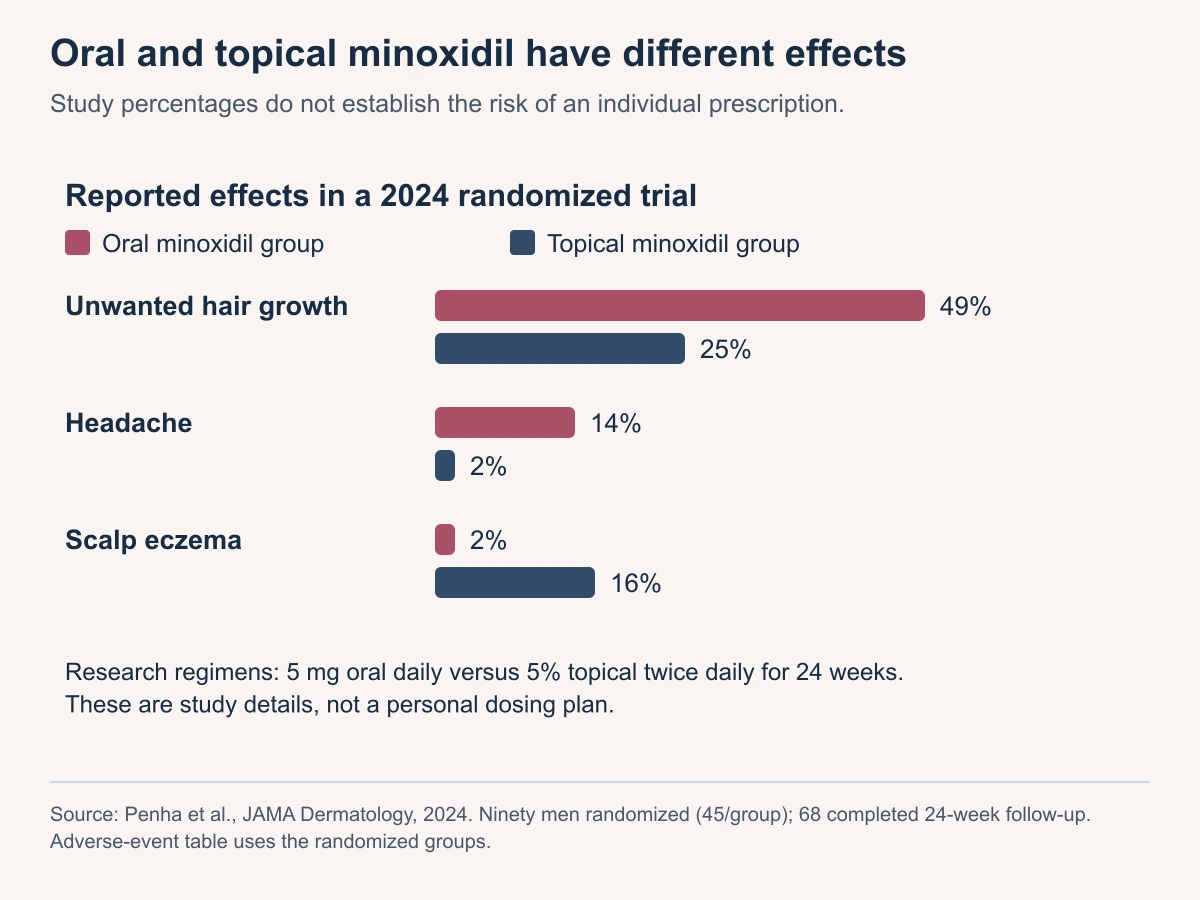
A 2024 trial randomized 90 men with androgenetic alopecia, commonly called male-pattern hair loss. It compared 5 mg oral minoxidil once daily with 5% topical minoxidil twice daily for 24 weeks. These are research regimens, not instructions for an individual reader.
Sixty-eight participants completed follow-up. Oral treatment did not demonstrate superiority over topical treatment for the primary hair-density comparisons. A secondary photographic assessment favored oral treatment at the vertex, but that finding should not replace the primary result or become a promise of better regrowth for everyone.
| Reported effect | Oral group, 45 randomized participants | Topical group, 45 randomized participants |
|---|---|---|
| Unwanted hair growth | 49% | 25% |
| Headache | 14% | 2% |
| Scalp eczema | 2% | 16% |
Source: 2024 randomized trial. The percentages describe the study’s adverse-event table. The selected men, study amounts, follow-up period, and incomplete follow-up limit application to other patients and prescriptions. The trial compared two routes; it did not test taking both together.
Can you take oral and topical minoxidil together?
A clinician may need to review overlap when changing treatments or assessing a broader hair-loss plan. It should not be assumed necessary simply because both products are available. Combining routes changes the treatment exposure and makes it harder to identify the cause of a new symptom if several things change at once.
Ask what the combination is intended to accomplish, what evidence applies to that goal, how the complete treatment will be monitored, and what the written plan says about each product. “Two forms must work twice as well” is not evidence. Neither is a study that compares oral with topical treatment without a combination group.
The reviewed research does not justify a universal oral-plus-topical schedule. It also does not establish that every possible clinician-managed overlap is ineffective. The useful decision is specific to the diagnosis, response, tolerability, and actual products, rather than a blanket stacking rule.
Does overlap prevent the temporary shedding called “dread shed”?
A 2024 retrospective study examined 115 patients starting low-dose oral minoxidil. Thirty-seven continued topical minoxidil during initiation. Six patients reported temporary shedding, including two in the overlap group. The researchers did not find a significant reduction in shedding from maintaining topical treatment.
That study relied on chart review and subjective patient reports, with a small number of shedding events. It does not prove that a particular overlap plan will prevent shedding, establish the best transition schedule, or answer every long-term regrowth question. Original overlap study.
This is an important distinction when reading treatment advice: a study about temporary shedding is not automatically a study about additional hair density after months of combined use. Ask which outcome the proposed plan is supposed to improve. If you are switching routes, obtain clear instructions from the prescriber rather than interpreting these study groups as a transition recipe.
Which topical effects should you watch for?
The reviewed men’s 5% solution label directs users to stop use and ask a doctor for scalp irritation or redness, unwanted facial hair, chest pain, rapid heartbeat, faintness, dizziness, sudden unexplained weight gain, or swollen hands or feet. A product applied to the scalp is still a medicine with warnings. Men’s topical solution label.
An irritated scalp can have more than one explanation. Another scalp condition, a new hair product, or a formulation ingredient may be involved. Do not continue adding products while trying to work out the cause. Save the package and describe which area is affected and when the problem began.
The women’s 5% foam label has its own population, administration instructions, and warnings. Directions from a men’s solution should not be copied onto every foam or compounded blend. Women’s foam label.
Can the solution or foam’s other ingredients matter?
Yes, the complete formula is relevant. The reviewed men’s solution contains alcohol, propylene glycol, and water in addition to minoxidil. A foam has another ingredient list. That difference can matter when a clinician reviews irritation or a suspected ingredient sensitivity.
It does not establish that every foam is safer for every person, or that switching forms will solve an undiagnosed scalp problem. A compounded topical blend may also include another active medicine, which introduces another set of questions. Show the whole label instead of describing it only as “minoxidil.”
The reviewed topical labels advise against use with other medicines on the scalp. If a clinician has prescribed a combination or a separate scalp treatment, have the entire plan reviewed explicitly. Our ketoconazole shampoo guide distinguishes treating dandruff or a scalp condition from proving additional hair regrowth.

Does using more improve the result?
The topical labels warn that using more than directed or more often does not improve results and can increase side effects. More concentrated products, extra applications, or an added oral tablet should not be used as independent solutions to slow progress.
Ask whether enough time has passed to assess the intended treatment, whether the diagnosis is correct, and whether the actual directions have been followed. The minoxidil results timeline explains why a treatment review needs consistent observations rather than daily mirror comparisons.
A missed application is not a reason to double the next amount. If you are unsure how to restart after an interruption, or whether another product changes the plan, ask the pharmacist or prescriber for the directions that apply to your formulation.
When should the cause of hair loss be assessed first?
The reviewed topical labels identify situations in which self-treatment is inappropriate, including sudden or patchy hair loss, an unknown cause, and a red, inflamed, infected, irritated, or painful scalp. The men’s product is not labeled for every pattern or body area.
Hair loss after an illness, a major nutrition change, or another treatment needs its own assessment. Minoxidil should not substitute for identifying that trigger. Our hair shedding during tirzepatide treatment guide discusses why a timeline and nutrition review can be relevant when hair changes occur during weight management.
Before starting another medicine, explain the distribution, onset, scalp symptoms, family history, and any recent health or medication changes. A clinician can decide whether the pattern fits the product being considered or calls for a different evaluation.
What about pregnancy and breastfeeding?
The reviewed topical labels warn that the products may be harmful during pregnancy or breastfeeding. Discuss pregnancy, pregnancy planning, or breastfeeding before use. Do not assume that applying a medicine to the scalp eliminates those questions.
Oral use needs its own review of the tablet labeling and individual circumstances. If several hair products are being combined, assess each ingredient rather than assuming a single minoxidil discussion covers the whole preparation. Topical solution label, women’s foam label, oral label.
What should you bring to a side-effect review?
Bring the names, routes, strengths, and directions of every hair medicine and supplement, plus your other prescriptions. Record when each was started or changed and what the symptoms are doing. If prescribed monitoring was requested, bring those results too.
If spironolactone is also part of your care, our spironolactone and weight-change guide explains why fluid balance, potassium, and the reason for the prescription belong in that review. It does not establish that the medicines should be combined.
Useful questions include whether a symptom needs urgent assessment, whether the formula or another medicine could contribute, how to evaluate the expected benefit, and what the plan says about concurrent oral and topical use. Ask for clear instructions before changing either route.
Chest pain, fainting, significant breathing difficulty, or a suspected serious allergic reaction requires urgent care. Other new cardiovascular symptoms or unexplained swelling should be assessed promptly. A treatment review should weigh the intended hair benefit alongside tolerability and the patient’s wider health, rather than treating side effects as the price of faster regrowth.
What does a monitoring plan need to clarify?
The plan should identify who is prescribing, which product is being used, which health questions were reviewed, and how symptoms or measurements will be assessed. If the clinician requests blood-pressure measurements or other monitoring, clarify how to record them and what findings should prompt contact.
Do not copy a fixed monitoring schedule from someone with a different heart history, kidney function, dose, or combination of medicines. A person already taking blood-pressure medicines may need a different review from someone who is not. The oral label’s warnings and the full medication list provide context for that discussion.
An international expert consensus published in 2025 addresses off-label low-dose oral minoxidil prescribing. The PubMed abstract describes consensus guidance, rather than a randomized trial proving a universal protocol. Expert agreement can inform care, but it is not FDA approval for hair loss and does not predict an individual person’s response.
How can you separate benefit from tolerability?
Track the intended benefit and adverse symptoms as separate questions. More unwanted body hair does not tell you how much scalp hair has improved. Scalp irritation does not establish that a medicine is working strongly. Likewise, having no side effects does not prove that a particular hair-loss diagnosis will respond.
Ask how the clinician plans to assess progress: the relevant scalp areas, a consistent photography method if appropriate, and the interval for reviewing change. Keep lighting and hairstyle differences in mind when looking at photographs. The research trial used defined measurements, which is more specific than comparing two unrelated social-media pictures.
If treatment is not helpful or is difficult to tolerate, review the diagnosis, product, directions, and wider health before adding another route. The next step may involve reassessing the plan rather than simply increasing exposure.

Is oral-plus-topical minoxidil the same as minoxidil plus another hair medicine?
No. Oral and topical minoxidil deliver the same active medicine through different routes. A minoxidil preparation containing finasteride or another active ingredient introduces a different medicine with its own uses and precautions.
Evidence for one combination cannot be transferred to every other combination with a similar marketing name. Ask which active ingredients are present, whether the cited study actually tested that combination, and how the complete prescription addresses safety. This is especially useful when a topical bottle contains more than the single ingredient discussed in an article.
Will stopping a product immediately solve a symptom?
That cannot be promised. A symptom may have another cause, and some problems need assessment even if a product has been discontinued. Follow the label’s stop-use warnings and seek the appropriate care rather than waiting for a presumed medication reaction to disappear.
For ongoing care, ask how any treatment change affects the hair plan and when the clinician wants an update. Do not replace a suspected offending product with several new products at once. Clear documentation of the change makes the next review more useful.
Educational information for adults; individual treatment decisions require a qualified clinician. Sources reviewed September 30, 2026. Original AI-generated article images depict fictional people and objects, not patient outcomes. Other editorial images are illustrative. Graphics summarize the cited sources.