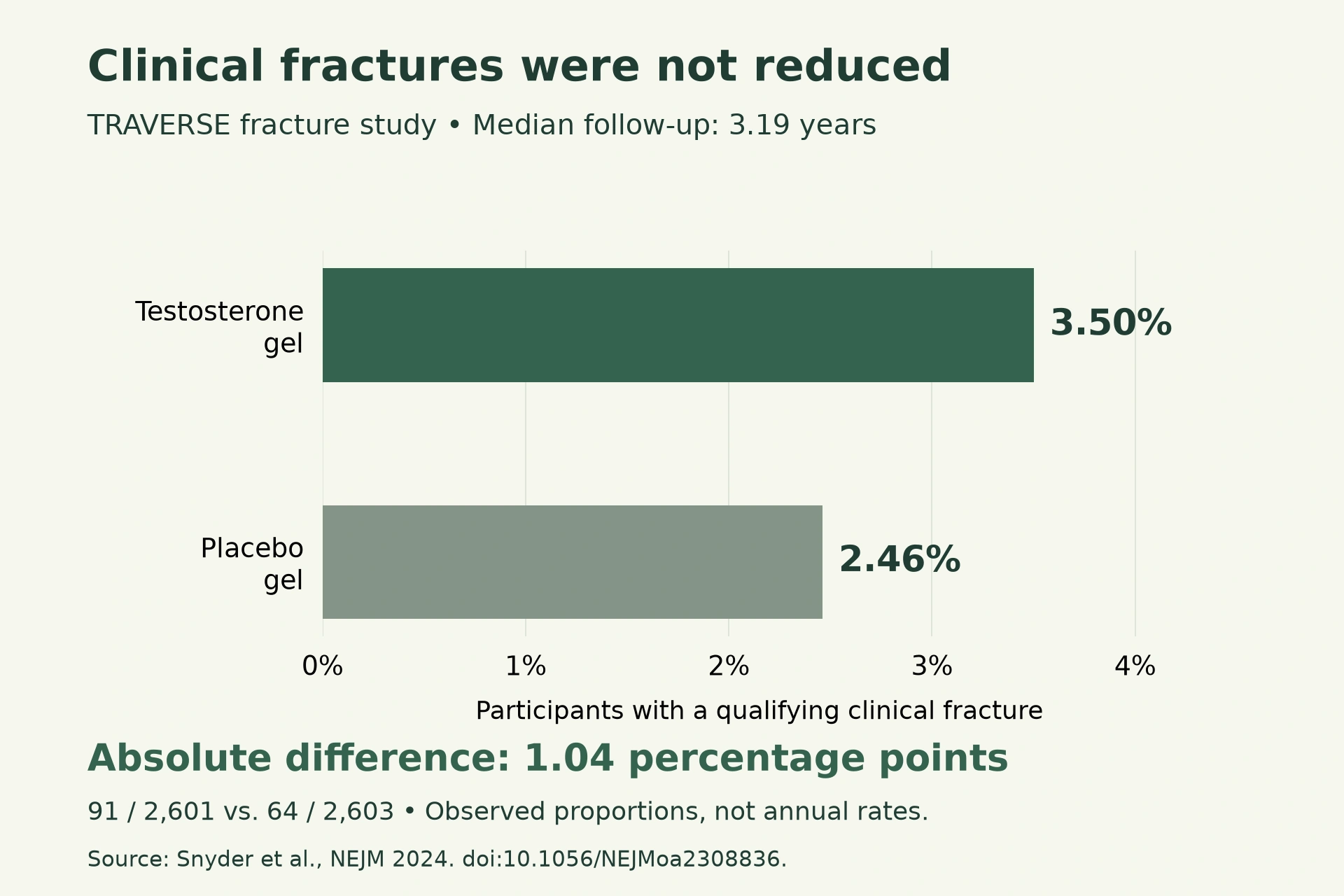
Testosterone treatment can improve bone-density measurements in some men with low testosterone. That does not establish that it prevents broken bones. In a large randomized study, clinical fractures occurred in 3.50% of men assigned to testosterone and 2.46% assigned to placebo over a median 3.19 years of follow-up. Original fracture paper.
Those findings can sound contradictory. They become easier to understand once you separate a measurement made on a scan from an outcome that happens in everyday life. This article follows that distinction through four scientific papers, two journal videos, and three original research graphics.
For someone considering testosterone replacement therapy (TRT), the practical question is not simply whether a scan might improve. It is whether the treatment addresses a confirmed hormone deficiency, what benefits are realistic, and whether bone health needs its own assessment and treatment plan.
What is the connection between testosterone and bones?
Low testosterone can be one contributor to poor bone health. The bone-trial paper describes bone loss in men with severe hormone deficiency and improvements in bone measurements after replacement. But an association between low hormone levels and fractures does not establish that raising those levels will prevent fractures in every population. Bone Trial background.
Age, previous fractures, medicines, nutrition, other illnesses, balance, and falls also matter. A clinician therefore looks beyond a single testosterone result. NIH guidance recommends reviewing fracture history, conditions and medicines that affect bone, lifestyle, and physical function when evaluating osteoporosis. NIAMS diagnosis and treatment resource.
The diagnosis of hypogonadism also requires more than feeling tired or getting one low laboratory result. The Endocrine Society recommends compatible symptoms or signs, consistently low testosterone measured with reliable methods, repeat morning fasting testing, and assessment of the cause. Our low-testosterone symptoms and testing guide explains that process. Professional guideline.
Bone density, estimated strength, and fractures are different outcomes
Bone mineral density (BMD) describes the mineral content of bone relative to the area or volume measured. The familiar DXA scan measures areal BMD, usually at the hip and spine. The 2017 Bone Trial also used quantitative computed tomography, or QCT, to measure density in three dimensions and distinguish different bone compartments. Bone Trial methods; NIH explanation of DXA.
Estimated bone strength in that trial was calculated from CT images using a computer model of how bone responds to a load. Researchers did not deliberately stress participants’ bones until they broke. The estimate provides useful mechanical information, but it remains a modeled outcome.
Clinical fractures are actual broken bones that come to medical attention. A fracture trial asks whether people assigned to a treatment experience fewer of those events. It captures consequences that a scan alone cannot settle, including the circumstances of an injury.
An improved intermediate measurement is often called a surrogate outcome. That does not make it unimportant: DXA helps diagnose osteoporosis, estimate risk, and monitor care. It means that a treatment claim about fewer fractures needs evidence about fractures. The percentage increase in bone density is not a percentage reduction in fracture risk.
What did the 2017 Testosterone Trials Bone Trial find?
The Bone Trial enrolled 211 men aged 65 or older at nine U.S. centers. Their two morning testosterone measurements averaged below 275 ng/dL, and they met the parent Testosterone Trials’ symptom or functional criteria. Participants received testosterone gel or matching placebo for 12 months, with gel adjustments intended to maintain testosterone in the normal range for young men. Both groups received calcium and vitamin D. These are study methods, not a personal treatment regimen. Full paper.
The participants’ average age was about 72. Men with a DXA T-score below −3.0 at any measured site were excluded, as were those taking most medicines that affect bone. The trial therefore did not represent every man with severe osteoporosis or every form of testosterone deficiency.
The primary outcome was the percentage change in the density of trabecular bone—the spongy inner network—in the lumbar spine. The reported mean change was 7.5% with testosterone versus 0.8% with placebo. The model-adjusted treatment effect was 6.8 percentage points, with a 95% confidence interval of 4.8 to 8.7. That adjusted estimate is not exactly the subtraction of the rounded group means. Results and Table 2.
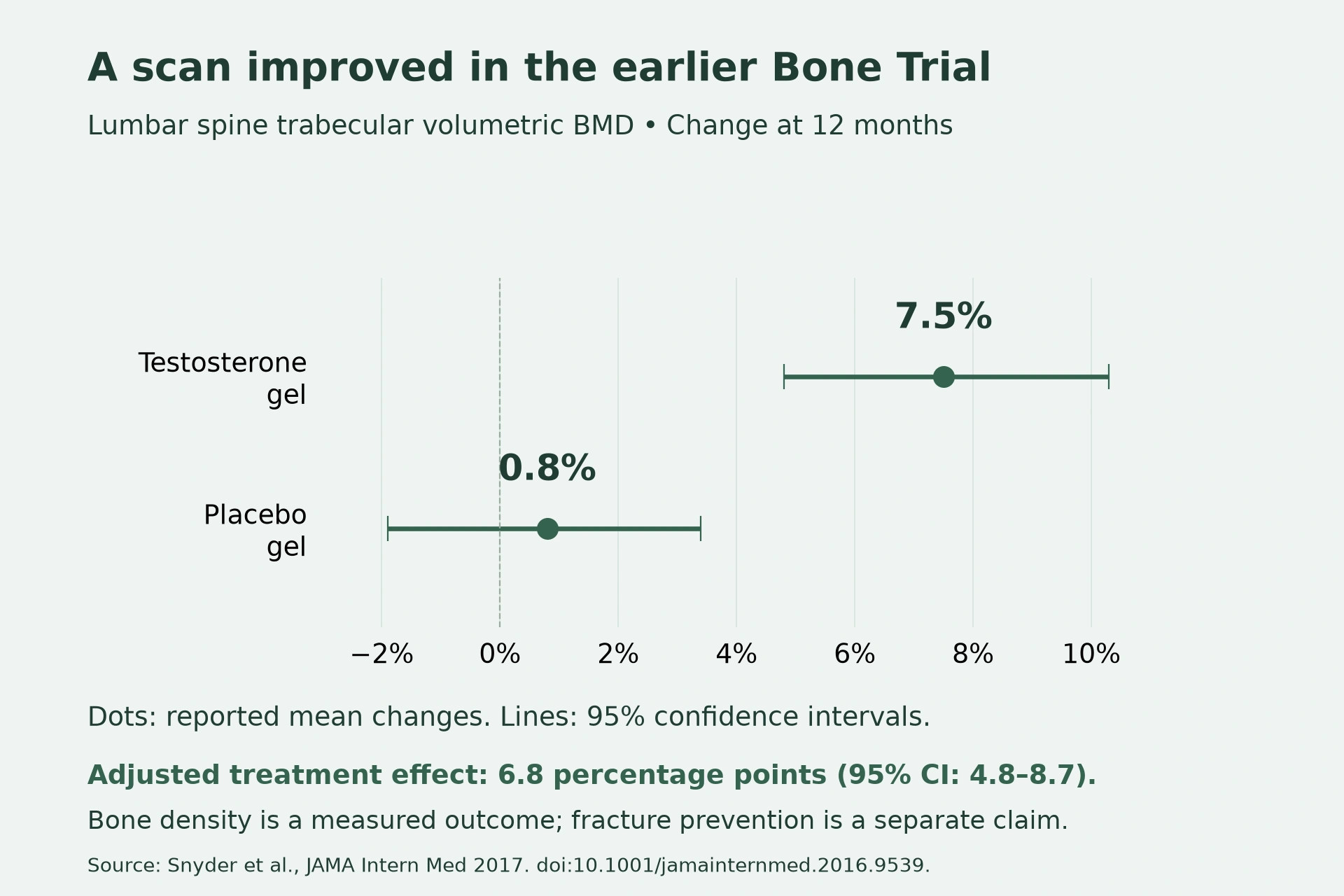
Estimated strength of spine trabecular bone also increased: 10.8% with testosterone versus 2.4% with placebo, with an adjusted treatment effect of 8.5 percentage points. Effects were generally larger in the spine than the hip and in trabecular than peripheral bone. The familiar DXA measurement at the spine changed less: 3.3% versus 2.1%. These figures refer to different measurements and should not be used interchangeably.
There were analyzable baseline and 12-month scans for 189 participants. More placebo participants failed to complete the study, and an analysis accounting for missing scans produced a smaller primary-outcome difference that still favored testosterone. The small sample, selected population, and one-year duration limit what can be concluded. The authors explicitly called for a larger, longer study of fractures. Results and limitations.
What did the larger TRAVERSE fracture study show?
The 2024 fracture paper reported a planned subtrial of TRAVERSE, a study originally designed around cardiovascular safety. Its full-analysis population included 5,204 men aged 45–80, all with symptoms of hypogonadism, two fasting morning testosterone measurements below 300 ng/dL, and existing cardiovascular disease or elevated cardiovascular risk. Osteoporosis was not required for entry. Fracture trial methods.
Participants were assigned to daily 1.62% testosterone gel or placebo gel. At follow-up visits, they were asked about fractures; records were then reviewed by an adjudicator who did not know their treatment assignment. The main fracture outcome was the first confirmed clinical spine or non-spine fracture, excluding fractures of the sternum, fingers, toes, facial bones, and skull.
Over a median 3.19 years, at least one qualifying clinical fracture occurred in:
- 91 of 2,601 men receiving testosterone: 3.50%.
- 64 of 2,603 men receiving placebo: 2.46%.
The difference between the published proportions was 1.04 percentage points, or approximately 10 additional men with a fracture per 1,000 participants during the observed follow-up. It is not an annual rate, a prediction for a particular patient, or a claim that every fracture was caused by treatment. Fracture results.
The reported hazard ratio was 1.43, with a 95% confidence interval of 1.04–1.97. A hazard ratio uses the timing of events; 1.43 corresponds to a 43% higher estimated fracture hazard in the testosterone group. It does not mean 43% of men broke a bone. The confidence interval was not adjusted for multiple comparisons, a limitation the paper specifies.
You may also see 3.8% versus 2.8% in summaries of this study. Those are estimated cumulative incidences at year three, accounting for follow-up and death as a competing event. They are different calculations from the observed 3.50% and 2.46% proportions across the trial. Both tell the same central story: this study did not demonstrate fracture prevention.
Did testosterone weaken bones or cause more falls?
The trial does not establish that mechanism. Bone density and structure were not measured in TRAVERSE. The researchers therefore could not show that testosterone weakened participants’ bones, or connect individual changes in density to individual fractures. Discussion and limitations.
Most fractures were associated with trauma, often falls. However, falls were not systematically assessed in everyone; information was collected around reported fractures. Physical activity and risk-taking were also not measured. Suggestions that men became more active, took more risks, or fell more frequently remain hypotheses, not demonstrated explanations.
It would also be misleading to dismiss the findings because many injuries involved trauma. Falls are an important route to clinically meaningful fractures. The main outcome deliberately counted specified clinical fractures, and an analysis limited to non–high-impact fractures still had a point estimate favoring placebo, although its confidence interval included no difference. Fracture endpoints and trauma table.
The narrower outcomes were less precise. For example, the study recorded seven men with hip fractures in the testosterone group and six in the placebo group. That small count cannot establish a reliable hip-fracture effect by itself. The most useful conclusion stays attached to the main clinical-fracture result and its uncertainty.
How do the four papers fit together?
These are four reports from two trial programs, not four independent confirmations of the same claim. The Bone Trial was part of the Testosterone Trials; the fracture analysis was part of TRAVERSE.
| Scientific paper | What it contributes | What it cannot establish |
|---|---|---|
| Testosterone Trials, NEJM 2016 | One-year symptom and functional outcomes in 790 older men with low testosterone | Long-term safety or reliable fracture prevention |
| Bone Trial, JAMA Internal Medicine 2017 | Bone-density and modeled-strength measurements in 211 participants from that trial program | That improved scans translate into fewer fractures |
| TRAVERSE cardiovascular report, NEJM 2023 | A large randomized comparison focused on major cardiovascular events | Universal safety across every outcome, population, or formulation |
| TRAVERSE fracture report, NEJM 2024 | Adjudicated clinical-fracture outcomes in the same larger trial program | The mechanism of the fracture finding, or outcomes in every form of hypogonadism |
The 2016 Testosterone Trials report found a moderate benefit in sexual function and some improvements in mood. It did not find a significant benefit on the primary vitality outcome. The primary walking-distance responder outcome was not significantly improved within the Physical Function Trial, although an analysis pooling participants across the three main trials differed. This is why “TRT improves function” needs a specific outcome and population attached. 2016 primary paper.
Our TRT benefits and results guide connects those findings to realistic goals. The body composition and strength guide explores a similar distinction: more lean mass does not automatically mean better strength, mobility, or fewer injuries.
Watch the journal’s research summaries
Testosterone treatment and fractures
NEJM Group: “Testosterone Treatment and Fractures in Hypogonadism” is a 2-minute, 1-second overview of the fracture study. Use it alongside the original paper and the absolute numbers above. The key question is whether actual fractures decreased—not whether an earlier trial improved a scan measurement.
The cardiovascular study that provided the trial setting
NEJM Group: “Cardiovascular Safety of Testosterone Therapy” is a 2-minute, 25-second summary of the parent TRAVERSE cardiovascular report. It helps explain why the participants had cardiovascular disease or elevated risk and why the study’s main headline addressed a different outcome.
The videos accompany the 2024 fracture and 2023 cardiovascular research, respectively. They are dated research summaries; current prescribing decisions also need current guidance and a patient’s clinical history.
Why does the cardiovascular result not settle overall safety?
The parent TRAVERSE paper reported major cardiovascular events in 7.0% of testosterone participants versus 7.3% of placebo participants. Its primary composite included cardiovascular death, nonfatal heart attack, or nonfatal stroke. Testosterone met the trial’s prespecified noninferiority criterion: the study ruled out an increase as large as its selected margin for that endpoint. It did not prove that testosterone protects the heart or has no risks. Cardiovascular paper.
Atrial fibrillation, acute kidney injury, and pulmonary embolism were observed more frequently in the testosterone group. These findings and the fracture outcome belong in an overall benefit–risk discussion, even though they answer different questions from the primary cardiovascular endpoint.
In February 2025, FDA announced removal of boxed-warning language about increased adverse cardiovascular outcomes, while requiring blood-pressure warning changes and retaining limitations for age-related hypogonadism. That update should not be reduced to “all risks have been removed.” FDA communication. Our TRT heart-health and blood-pressure guide explains the distinction.
What are the important limitations of the fracture evidence?
Randomization, blinding, more than 5,000 participants, and central review of fracture records are substantial strengths. Several boundaries still matter:
- Selected participants: men were 45–80 and had cardiovascular disease or risk factors. A testosterone concentration below 100 ng/dL was an exclusion criterion. Results should not be treated as a precise estimate for younger men or every cause of severe hormone deficiency.
- Incomplete treatment and follow-up: the paper reports 61.6% early discontinuation of assigned treatment while assessments continued and 39.0% early withdrawal with no further assessments. These are different concepts. Similar rates in the two groups help interpretation but do not erase uncertainty from missing follow-up.
- No bone measurements: the study could not compare its participants’ density changes with the earlier Bone Trial.
- Limited mechanism data: it could not determine whether activity, falls, bone structure, or another pathway explained the fracture difference.
- Industry sponsorship: TRAVERSE was funded by a testosterone-manufacturer consortium led by AbbVie. The fracture committee designed the subtrial, an independent center performed its statistical analyses, and the paper describes sponsor involvement and author disclosures. The earlier Bone Trial received NIH and industry support. Fracture methods; Bone Trial disclosures.
These limitations qualify the interpretation. They do not justify promising a fracture benefit that the trial failed to show.
Should someone with osteoporosis use TRT instead of bone treatment?
TRT should not be assumed to replace treatment directed at osteoporosis. A person may need evaluation for hormone deficiency and a separate assessment of fracture risk. The Endocrine Society’s osteoporosis patient resource advises against using testosterone as the primary osteoporosis treatment for men; that resource predates the 2024 fracture results. The newer trial adds direct evidence against assuming a fracture-prevention benefit. Society resource; 2024 trial.
NIH guidance describes a broader plan: adequate nutrition, appropriate exercise, fall prevention, review of causes of bone loss, and medication when indicated. The choice of a bone medicine depends on the person’s fracture history, bone-density results, overall risk, other conditions, and treatment history. There is no single drug choice or supplement dose that follows from these testosterone studies. NIAMS treatment guidance.
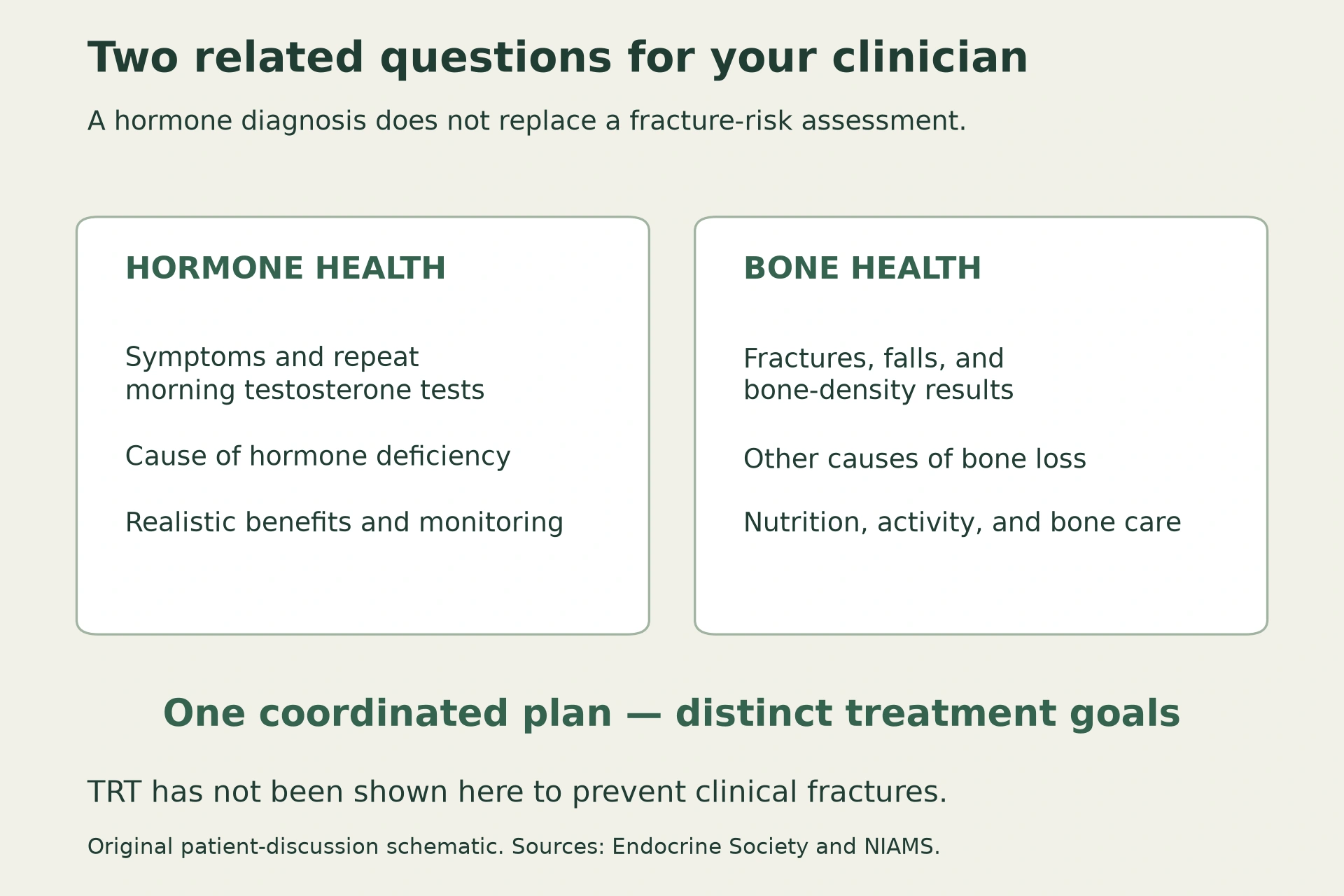
| Bring to the appointment | Why it matters |
|---|---|
| Prior fractures, loss of height, back symptoms, and falls | A history of injury or possible vertebral fracture can change the assessment. |
| Previous DXA reports and all medicines or supplements | The clinician needs the actual measurements and possible contributors to bone loss. |
| Testosterone results, collection times, and symptoms | A repeatable hormone diagnosis is distinct from a bone-density diagnosis. |
| Exercise, balance, diet, alcohol, and smoking history | Fracture prevention includes factors that changing a hormone level alone cannot address. |
For men with osteoporosis or a prior fracture, exercise should be adapted to ability and fracture risk. Weight-bearing activity, resistance work, and balance training can be useful components, but a clinician or physical therapist can help choose safe movements. Review fall hazards and medicines that cause dizziness as part of the same conversation. NIH living-with-osteoporosis guidance.
Do these gel trials prove the same results for injectable TRT?
The main trials discussed here used transdermal gels. They did not directly compare injection schedules, compounded preparations, or every commercially available testosterone formulation. It is reasonable to consider the findings when discussing testosterone generally, while being explicit that the exact fracture estimate was observed with the studied gel strategy.
For formulation differences, see TRT injections versus gel. CoreAge Rx’s Injectable TRT service page explains that offering; it should not be read as a claim that injectable TRT has proven fracture-prevention benefits. Ask the prescribing team which exact product is proposed, what evidence applies, and how its monitoring requirements fit your history.
The TRT side-effects and monitoring guide covers follow-up, including testosterone measurements, blood counts, blood pressure, and appropriate prostate assessment. Fertility considerations also belong before treatment, because testosterone therapy can suppress sperm production. Endocrine Society guideline.
Common questions about TRT and bone health
Does an improved DXA scan mean treatment is working?
It may be useful evidence about bone density, but it does not answer every treatment goal. Ask what changed, whether the change is meaningful for that scan, and how it affects your overall fracture-risk plan. A normal testosterone level and a better scan do not eliminate the need to review symptoms, falls, adverse effects, and any osteoporosis treatment.
Does this mean everyone taking TRT should stop?
No. These studies inform a decision; they do not determine every individual’s prescription. Someone with confirmed hypogonadism may have treatment goals beyond bone density. Discuss the fracture evidence, personal risk factors, and benefits experienced with the prescriber before making changes. Our testosterone replacement therapy guide outlines the diagnosis and follow-up process.
Can a higher testosterone dose provide better bone protection?
These trials do not establish that increasing a dose prevents fractures. Their protocols included defined targets, monitoring, and stopping rules. A larger laboratory change is not proof of a better clinical outcome, and self-adjustment can create additional risks.
What should I ask before starting?
Ask four concrete questions: What confirms my hormone diagnosis? What benefit are we trying to achieve? Do I need a separate bone-density or fracture-risk assessment? How will we decide whether continuing treatment remains worthwhile? Bring the medication list, prior scans, and fracture history rather than relying on a headline percentage.
The most useful message is that improved bone measurements and fracture prevention are separate claims. The Bone Trial supports the first in a defined group. TRAVERSE did not establish the second. A good care plan keeps those findings together.
Read the scientific papers and supporting sources
- Snyder PJ and colleagues. Effect of Testosterone Treatment on Volumetric Bone Density and Strength in Older Men With Low Testosterone: A Controlled Clinical Trial. JAMA Internal Medicine, 2017. DOI: 10.1001/jamainternmed.2016.9539. Full Bone Trial paper.
- Snyder PJ and colleagues. Testosterone Treatment and Fractures in Men with Hypogonadism. New England Journal of Medicine, 2024;390:203–211. DOI: 10.1056/NEJMoa2308836. Journal page · Publisher-hosted PDF.
- Snyder PJ and colleagues. Effects of Testosterone Treatment in Older Men. New England Journal of Medicine, 2016. DOI: 10.1056/NEJMoa1506119. Full Testosterone Trials paper.
- Lincoff AM and colleagues. Cardiovascular Safety of Testosterone-Replacement Therapy. New England Journal of Medicine, 2023. DOI: 10.1056/NEJMoa2215025. Journal page · Publisher-hosted PDF.
- Endocrine Society. Testosterone Therapy for Hypogonadism: 2018 clinical practice guideline resources. Diagnosis and monitoring recommendations.
- National Institute of Arthritis and Musculoskeletal and Skin Diseases. Osteoporosis: Diagnosis, Treatment, and Steps to Take. NIH patient resource.
- U.S. Food and Drug Administration. Class-wide labeling changes for testosterone products, February 28, 2025. FDA communication.
- Endocrine Society. Osteoporosis Treatment, January 2022. Patient resource. This resource predates the TRAVERSE fracture report; its older statement about the absence of fracture data is superseded by the 2024 study discussed here.
Research approach: This focused narrative review checks original papers for populations, outcomes, statistical measures, limitations, and funding; it is not a systematic review or individualized treatment advice. Sources were reviewed October 7, 2026. Four papers represent two trial programs with overlapping participants within each program. Videos are journal research summaries. Original graphics summarize published aggregate data; the AI-generated cover is an illustrative teaching model, not a patient scan or treatment result.