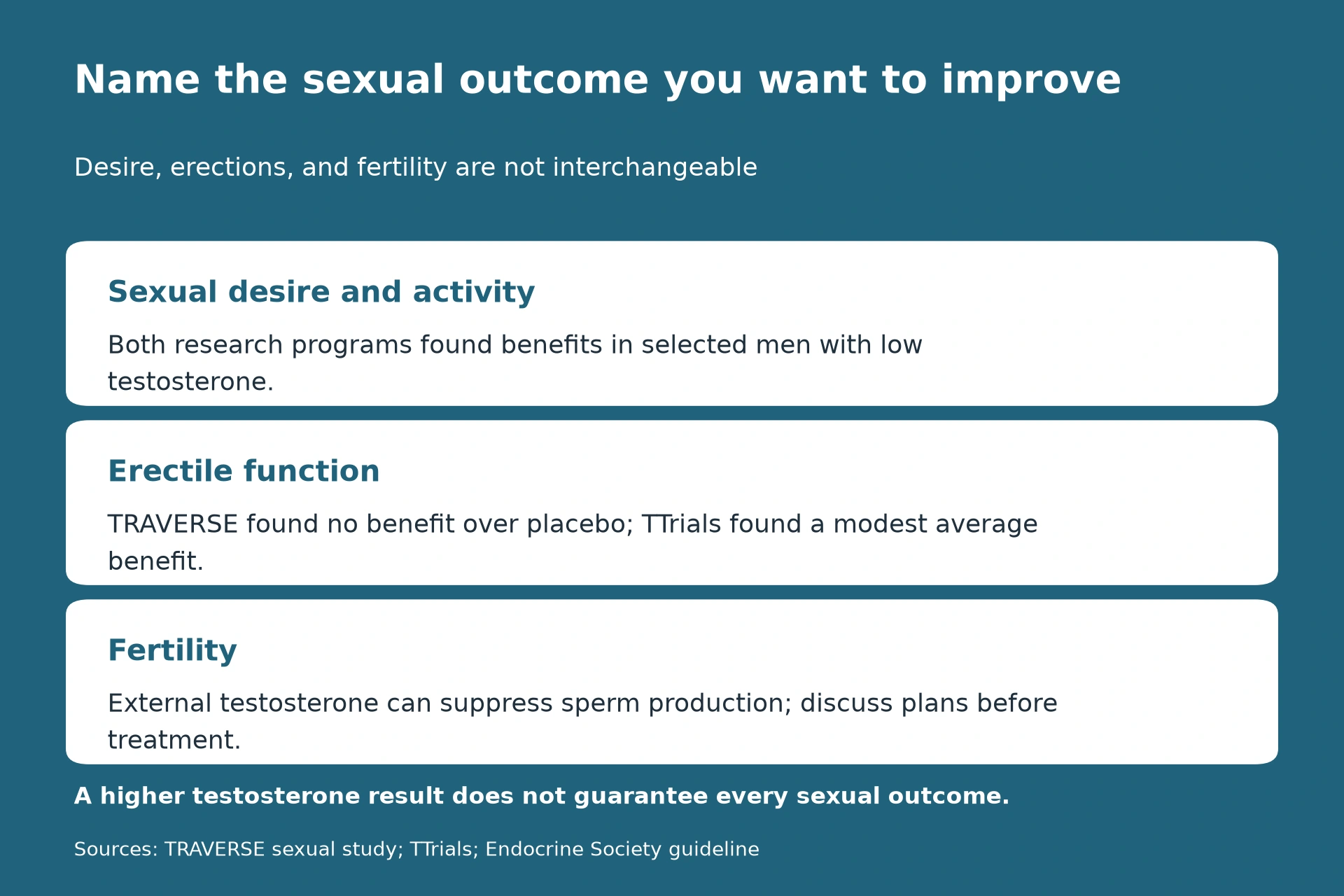
“Does TRT improve sexual function?” sounds like one question, but it contains several. Sexual desire, sexual activity, erection quality, orgasm, satisfaction, and fertility are different outcomes. A treatment may improve one without meaningfully changing another.
The randomized testosterone literature illustrates this particularly well. The TRAVERSE Sexual Function Study found improvements in desire and activity, but not erectile function compared with placebo. The earlier Testosterone Trials found a broader pattern of improvement, with a relatively modest erectile-function effect. Understanding who participated and what was measured helps set more realistic expectations.
Separate the outcome before choosing the treatment
Libido refers to sexual desire or interest. Sexual activity describes behaviors or experiences recorded by a questionnaire. Erectile function concerns the ability to achieve and maintain an erection. Fertility concerns the ability to achieve a pregnancy and involves sperm production and other factors.
These domains can interact, but they are not interchangeable. A person can have low desire with otherwise adequate erections, or strong desire with erectile difficulty. A questionnaire may record increased activity without showing that a vascular cause of erectile dysfunction has resolved.
Our practical TRT, libido, and erectile-function guide starts with those distinctions. This article focuses on the original studies that make them clinically important.
TRAVERSE: who entered the sexual-function study?
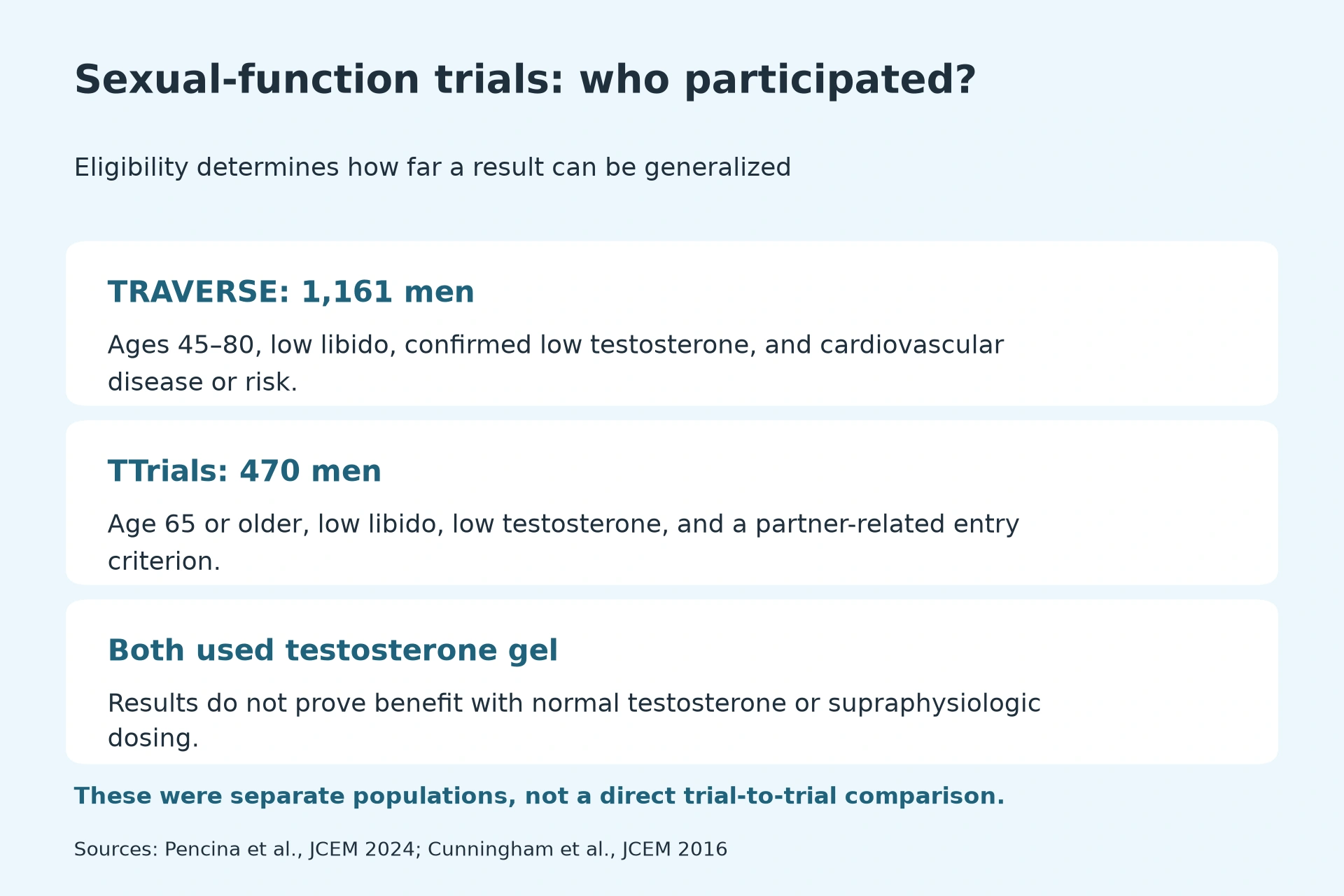
The parent TRAVERSE program included men aged 45–80 with hypogonadal symptoms, two testosterone levels below 300 ng/dL, and cardiovascular disease or increased cardiovascular risk. Within that program, 1,161 men reporting low libido entered the Sexual Function Study. Of those, 587 were assigned daily 1.62% testosterone gel and 574 placebo gel. Original TRAVERSE sexual-function report.
The primary outcome was change in sexual activity score. Secondary outcomes included sexual desire, erectile function, and hypogonadal symptoms. This matters because low libido was an entry criterion, and the study deliberately measured desire separately from erections.
The trial does not answer whether testosterone helps a person with normal hormone levels, whether injections are superior to gel, or whether escalating above physiologic levels improves outcomes. Its treatment was monitored replacement therapy in a defined clinical population.
What did TRAVERSE find?
Testosterone produced a greater improvement in sexual activity than placebo. The estimated between-group differences were 0.49 recorded acts per day at six months, with a 95% confidence interval of 0.19–0.79, and 0.47 at 12 months, with an interval of 0.11–0.83. The treatment effect was maintained at 24 months. Study results.
These are questionnaire-derived group estimates. They should not be translated as a promise of an extra episode of intercourse every other day. The measure includes a broader set of sexual interests and activities, and an average difference is not an individual’s schedule or expected response.
Sexual desire and hypogonadal symptoms improved with testosterone. Erectile function did not improve compared with placebo in this study. That distinction is central: a positive conclusion about “sexual function” should not be rewritten as proof that TRT reliably treats erection problems.
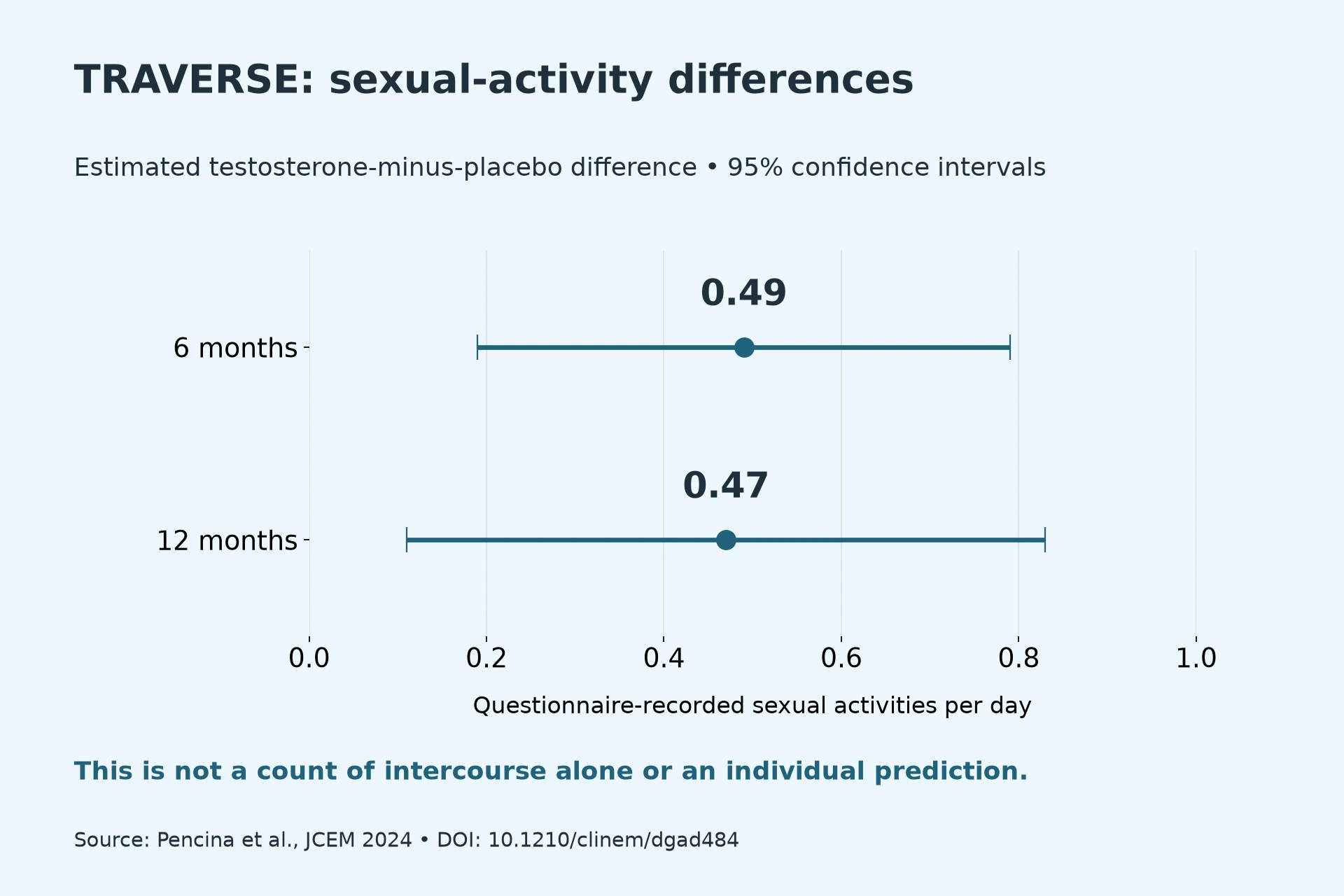
The confidence intervals also matter. They describe uncertainty around the estimated average effect. A graph displaying only a large treatment arrow would conceal both the scale of the finding and the variability the study is compatible with.
What did the earlier Testosterone Trials show?
The TTrials Sexual Function Trial enrolled 470 men aged 65 or older who had low libido, average testosterone below 275 ng/dL, and a partner willing to have intercourse at least twice monthly. Men received testosterone gel or placebo for one year, with repeated questionnaires. Original TTrials sexual-function analysis.
Testosterone improved 10 of the 12 measures of sexual activity examined. The program also found improvements in desire and erectile function. The erectile-function treatment effect was relatively modest: the paper described an average 2.64-point difference on the relevant International Index of Erectile Function domain, with a 95% confidence interval of 1.68–3.61.
Changes in testosterone and estradiol levels were associated with changes in desire and activity, but not with the erectile-function change. The investigators did not identify a clear hormone threshold above which sexual benefit reliably appeared, or a baseline characteristic that robustly predicted response after accounting for multiple comparisons.
These results support benefit in selected older men with low testosterone and low desire. They do not identify a magic testosterone number that guarantees a particular sexual response.
Are the two studies contradictory?
They are not identical experiments. TRAVERSE and TTrials differed in age criteria, cardiovascular-risk profile, size, duration, and other eligibility features. TTrials also had a partner-related eligibility requirement that limits how directly its results apply to every person seeking care.
Both programs support improvement in desire and activity in men meeting their low-testosterone criteria. Their erectile-function findings differ: TTrials found a modest average improvement, while TRAVERSE did not show a benefit over placebo. A balanced summary should preserve that difference instead of selecting only the more favorable result.
A useful clinical interpretation is that testosterone replacement may help the sexual symptoms of confirmed hypogonadism, while erection difficulty often needs its own assessment. The trials do not establish TRT as a dependable substitute for treatments directed at erectile dysfunction.
Why the hormone level is only one part of the assessment
The Endocrine Society guideline recommends diagnosing hypogonadism in men with compatible symptoms and unequivocally, consistently low testosterone, confirmed with repeat morning testing. It also recommends evaluating the underlying cause.
A single result needs context. Timing, illness, laboratory method, and other clinical factors can affect interpretation. The trial inclusion cutoffs of 275 or 300 ng/dL describe those studies; they do not replace individualized interpretation or establish that every result just below a threshold demands treatment.
Similarly, poor sleep, medication effects, mood symptoms, relationship difficulties, pain, and other medical conditions can contribute to sexual concerns. A careful history can identify what changed, whether the problem is desire or erections, and which other factors need attention. The goal is to find treatable contributors, not to dismiss symptoms because one hormone result is normal.
Our starting-TRT questions and TRT benefits and timeline guide can help prepare for that discussion.
Why erections may need a separate plan
An erection depends on vascular, neurologic, hormonal, and psychological factors. Correcting low testosterone cannot be assumed to resolve every contributor. In a person with diabetes or cardiovascular risk, new erectile problems may also be an opportunity to review broader health rather than treat the symptom in isolation.
The TTrials paper noted that too few participants were using phosphodiesterase-5 inhibitors at baseline to assess the interaction of those treatments with testosterone reliably. It therefore should not be cited as definitive proof that adding TRT will make an erectile-dysfunction medicine work for everyone.
A clinician may recommend evaluation and treatment tailored to the erection problem while separately considering whether genuine hypogonadism is present. The appropriate combination depends on the person’s diagnoses, medications, contraindications, and goals.
Sexual benefit is different from fertility benefit
External testosterone can suppress the hormonal signals needed for sperm production. Improved desire or sexual activity does not mean fertility has improved. This is particularly important for someone trying to conceive now or planning to do so later.
The Endocrine Society guideline recommends against starting testosterone in men planning fertility in the near term. A reproductive or endocrine evaluation may lead to a different strategy. Guideline recommendations.
Read our TRT and fertility guide before a treatment decision if pregnancy is a goal. Do not rely on libido improvement as a sign that sperm production is normal, and do not assume stopping TRT guarantees immediate recovery.
How safety and newer labeling updates fit
A decision about sexual symptoms also needs blood-count, blood-pressure, prostate-related, and sleep-apnea considerations. Our guides to TRT monitoring, hematocrit, and PSA and prostate follow-up cover practical questions.
The FDA’s current testosterone information page describes requested June 2026 revisions to age-related-hypogonadism limitation language and prostate safety information. Those changes should be distinguished from the February 2025 cardiovascular-warning and blood-pressure updates. They do not make the sexual-function trials evidence for unmonitored treatment or normal-testosterone enhancement. Current FDA information; 2025 FDA communication.
TRAVERSE’s sexual-function report also belongs to the same parent program as its anemia and cardiovascular reports. It is not an independent repetition of every safety finding. Our testosterone and anemia review and bone and fracture review explain why each outcome deserves its own interpretation.
What should count as success in follow-up?
Before treatment, define the symptom that matters. Is the main concern lack of interest, erection reliability, distress, low energy, or something else? If several concerns coexist, tracking them separately makes it easier to judge whether treatment is helping the intended problem.
A follow-up discussion can review symptom change, adverse effects, laboratory results, and whether the original diagnosis still fits. Raising the dose repeatedly because one symptom has not improved is not a conclusion supported by these trials.
If you are considering the CoreAge Rx TRT information page, use it to start a product-specific clinical discussion. The studies used monitored gel regimens; they do not prove that every route or preparation yields the same effect. Our injections-versus-gel guide discusses that separate choice.
Watch: a short clinical introduction to low testosterone
Mayo Clinic urologist Gregory Broderick explains why symptoms of low testosterone deserve a conversation with a healthcare professional. This is background education, not a video of the TRAVERSE sexual-function results.
Common questions about TRT and sexual function
Will TRT reliably fix erectile dysfunction?
No. TRAVERSE did not show improved erectile function over placebo, although desire and activity improved. TTrials found a modest erectile-function benefit in its different population. Erection problems need their own assessment and realistic expectations.
Can it improve libido when testosterone is normal?
These trials do not establish that benefit. Their participants had low testosterone and specified symptoms. Low libido with normal testosterone calls for evaluation of other contributors rather than extrapolation from a hypogonadism trial.
Does a higher testosterone level guarantee a better response?
No. TTrials did not identify a clear threshold that guaranteed benefit. The research supports appropriate replacement and monitoring, not pursuing progressively higher levels to chase a particular outcome.
Does more sexual activity mean improved fertility?
No. Sexual activity and sperm production are different outcomes, and external testosterone can suppress sperm production. Fertility plans should be discussed before treatment.
What is the most useful takeaway?
The most consistent trial evidence concerns improved desire and activity in selected men with confirmed low testosterone. A good treatment conversation names the exact sexual concern, considers other causes, and evaluates benefit and safety separately over time.
Original papers and supporting sources
The references distinguish full research papers, published abstracts, and official guidance. This educational narrative review is not a systematic review or an individual treatment recommendation. Sources were checked in October 2026.
- Pencina KM et al. Effect of Testosterone Replacement Therapy on Sexual Function and Hypogonadal Symptoms in Men with Hypogonadism. (2024). Published abstract reviewed. DOI: 10.1210/clinem/dgad484.
- Cunningham GR et al. Testosterone Treatment and Sexual Function in Older Men With Low Testosterone Levels. (2016). Full text reviewed. DOI: 10.1210/jc.2016-1645. Open full text.
- Endocrine Society. Testosterone Therapy in Men With Hypogonadism, 2018. Professional guideline.
- FDA. Testosterone Information, including requested June 2026 labeling revisions. Current FDA information.
- FDA. Testosterone labeling changes, February 28, 2025. FDA labeling communication.