
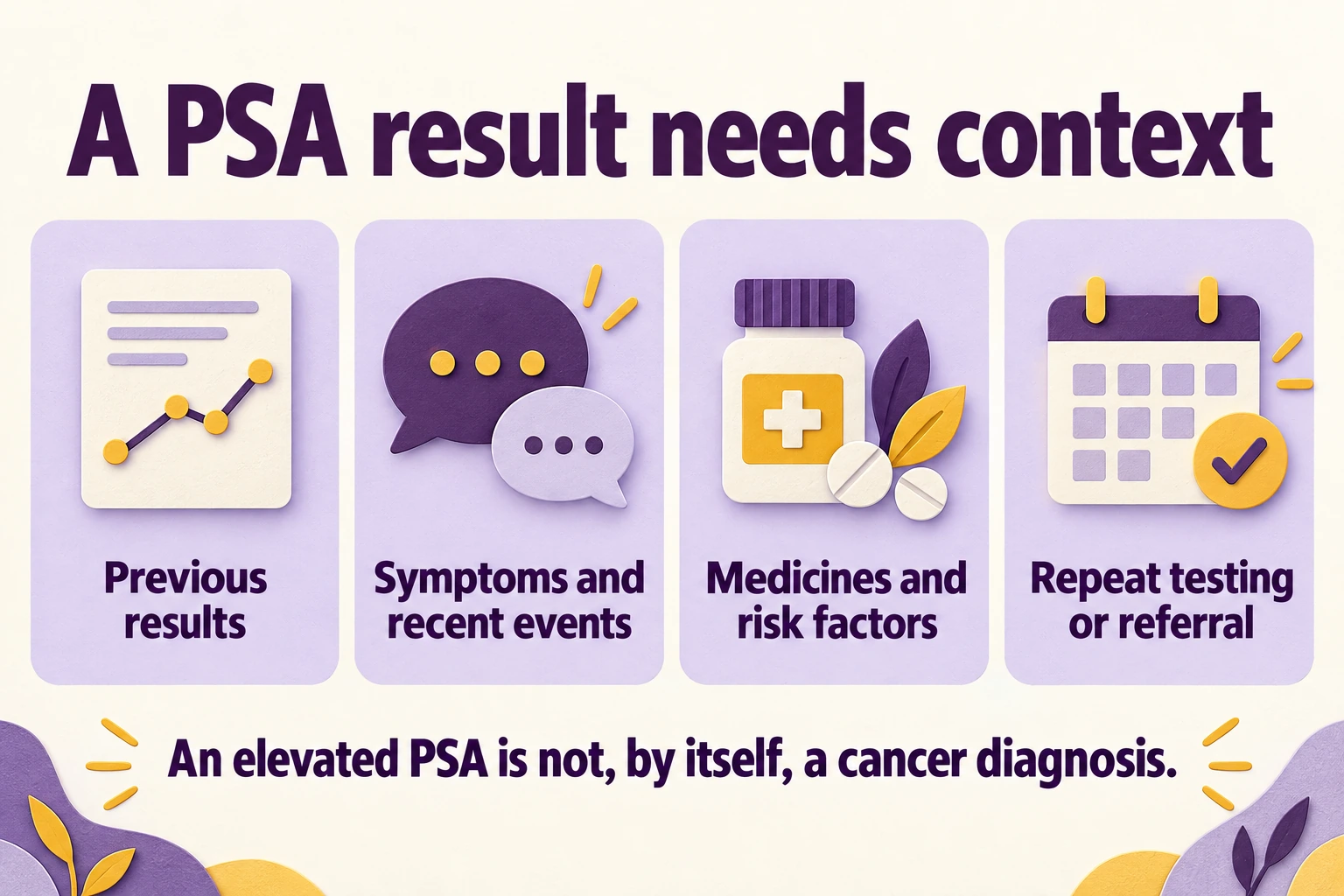
A PSA result that rises during testosterone treatment can be alarming, but PSA is not a stand-alone cancer diagnosis. Prostate-specific antigen is a protein made by prostate cells, and its level can be affected by cancer as well as benign conditions and temporary factors. The useful response is to review the result in context and follow a clear plan for confirmation or further assessment.
TRT does not remove the need for prostate-risk discussions and appropriate monitoring. This guide explains what PSA can tell you, what it cannot establish, and how to prepare for a follow-up appointment without treating one number as either a catastrophe or an automatic all-clear.
What the PSA test measures
PSA is produced by normal and malignant prostate cells. A blood test measures the concentration circulating in the bloodstream. It can be used in screening discussions, in evaluation of symptoms, and in follow-up after a prostate-cancer diagnosis or treatment. Those are different clinical situations.
The National Cancer Institute’s PSA fact sheet explains that benign prostate enlargement and inflammation can also increase PSA. There is no single value that perfectly separates cancer from noncancerous conditions. A result needs to be interpreted with the reason it was ordered.
Before comparing numbers, ask which question your clinician is addressing. Monitoring someone with no previous prostate cancer is not the same as interpreting PSA after prostate surgery or radiation. An internet threshold taken from the wrong setting can create unnecessary anxiety or false reassurance.
Why the baseline matters before TRT
A baseline provides a point of comparison and an opportunity to discuss symptoms, personal risk, prior results, and preferences about prostate monitoring. It also allows a clinician to identify concerns that need evaluation before testosterone treatment begins.
The Endocrine Society guideline recommends discussing prostate-risk evaluation and monitoring in appropriate age and risk groups. It advises against starting TRT when certain prostate findings are present without further urological assessment. The decision is not based only on whether a result has a red flag beside it in a portal.
Bring prior PSA reports when available, including dates and the laboratory units. Tell the clinician about family history, any previous biopsy or imaging, and urinary symptoms. A short timeline can be more useful than remembering that a result was “a little high a few years ago.”
Screening is a shared decision
PSA screening may help identify some cancers earlier, but it can also lead to false-positive results, additional procedures, and detection of cancers that might never have caused harm. The balance depends on age, health, risk factors, and preferences. It is reasonable to ask how those considerations apply to you.
The National Cancer Institute describes both potential benefits and harms. A thoughtful conversation should explain what would happen after an abnormal result, not only whether to obtain the blood test. Understanding the possible next steps makes the initial decision more informed.
TRT monitoring and general prostate screening overlap, but they should not be treated as an unexplained package of mandatory tests. Ask why a test is recommended in your situation, what it can reasonably show, and how the result will influence care. If you choose monitoring, make sure the follow-up plan is practical.
Why PSA may change during testosterone treatment
A clinician may see a PSA change after testosterone treatment starts, which is one reason the baseline and subsequent trend matter. The size of the change, confirmation of the result, symptoms, and other findings influence the next step. An increase should not be dismissed automatically as an expected hormone effect.
At the same time, a rise is not proof that TRT caused cancer. Distinguishing an association in time from a diagnosis requires appropriate evaluation. A person may need repeat testing, assessment of a temporary contributor, or a urology referral depending on the circumstances.
The TRT monitoring guide explains why follow-up includes several kinds of information. Prostate assessment is one component alongside symptom response, testosterone exposure, blood counts, and other relevant safety checks. Good results in one area do not cancel a concern in another.
Temporary factors and medicines can affect interpretation
Recent prostate inflammation or infection, certain procedures, ejaculation, and vigorous cycling can influence PSA in some circumstances. Medicines such as finasteride or dutasteride can lower PSA and change how a result is interpreted. These details are useful to report; they are not reasons to explain away an abnormal result yourself.
Ask the ordering clinician for preparation instructions and whether recent events affect when to test. Do not stop a medicine or repeatedly reschedule a test to obtain a preferred number. The goal is an interpretable result and a transparent history.
If a repeat test is recommended, clarify the timing and who will review it. A plan to confirm a result is different from ignoring it. Write the date in your calendar and ask what should happen if symptoms develop or the repeat result remains concerning.

What the TRAVERSE prostate study adds
The TRAVERSE prostate-safety analysis studied men with confirmed hypogonadism who were carefully evaluated before entering the trial. Rates of the measured prostate events were low and did not differ significantly between testosterone gel and placebo during the study. PSA increased more in the testosterone group.
The findings are reassuring within that studied setting, but the limits matter. Men with known prostate cancer, higher PSA values, and other high-risk features were excluded. Follow-up was limited relative to the many years over which prostate cancer can develop, and the number of cancer events was small.
The study therefore does not prove zero lifetime risk or establish safety for every patient, dose, or formulation. It also should not be used to skip evaluation of a new finding. A careful summary describes both what the trial observed and whom it did not study.
What current expert guidance still emphasizes
The Endocrine Society’s July 2026 TRT statement notes that long-term safety, including prostate-cancer safety, remains incompletely established. It continues to emphasize risk assessment before treatment and monitoring during treatment. New evidence can reduce some uncertainty without eliminating the need for follow-up.
This is a useful way to read headlines about TRT safety. A trial can answer a specific question in a selected population over a defined period. It cannot automatically answer every question about a different group or much longer use.
Ask the clinician how the evidence fits your situation. Someone with a previous prostate-cancer diagnosis needs a different discussion from a person with no such history and reassuring baseline evaluation. Specialist input may be essential, and a general educational article cannot make that treatment decision.
When a urology referral may be recommended
The Endocrine Society guideline identifies confirmed PSA changes and examination findings that warrant urological evaluation during treatment. Examples during the first year include a confirmed rise greater than 1.4 ng/mL above baseline or a confirmed PSA above 4.0 ng/mL. These are clinical referral criteria within a broader guideline, not universal cancer cutoffs.
A clinician may recommend evaluation for other reasons, including symptoms, individual risk, or a concerning examination. Conversely, a repeat test may be part of clarifying an unexpected result. Do not use a threshold to delay care because your result falls just below it.
Ask what the referral is intended to determine. A urology visit may lead to review of the history, repeat testing, imaging, additional biomarkers, or discussion of biopsy when appropriate. Referral means a question needs further assessment; it does not itself establish a cancer diagnosis.
Urinary symptoms should be described separately
Difficulty starting urination, a weak stream, feeling that the bladder does not empty, increased frequency, or nighttime urination can affect quality of life. These symptoms can occur for several reasons and should not be interpreted solely through the PSA result.
Tell the clinician when the symptoms began and whether they changed after TRT or another medicine was started. Include pain, fever, visible blood, or a history of urinary problems. A normal PSA does not rule out every cause of urinary symptoms.
Inability to urinate, severe pain, fever with significant urinary symptoms, or feeling acutely unwell warrants prompt assessment. Do not wait for a routine testosterone follow-up to address an urgent urinary problem. The immediate symptom may require care regardless of the most recent PSA number.
A result-review table to bring to the appointment
| Information to bring | What it helps clarify |
|---|---|
| PSA values with dates and units | The baseline, trend, and timing of change |
| TRT product and start or change dates | The treatment context |
| Urinary symptoms and when they began | Whether another assessment is needed |
| Medicines, including prostate and hair-loss medicines | Factors that may affect PSA interpretation |
| Recent infections or procedures | Possible temporary contributors |
| Family history and previous prostate evaluations | Individual risk and prior findings |
Keep the complete reports rather than a list of numbers alone. The laboratory method and clinical notes may be useful when care moves between practices. Ask for the clinician’s interpretation in writing so you can distinguish the result itself from the next action it requires.

Keep the rest of TRT monitoring in view
A PSA discussion should not eclipse the rest of the treatment review. Ask whether the original symptoms have improved, whether the diagnosis remains clear, and whether any adverse effects or other test changes need attention. An unchanged PSA does not mean every aspect of TRT is going well.
The TRT and hematocrit guide explains blood-count monitoring, and TRT, heart health, and blood pressure addresses a different set of considerations. The FDA’s 2025 testosterone labeling update included blood-pressure warnings, reinforcing the need to keep the overall safety picture in view.
For symptoms that remain difficult despite treatment, consider the separate articles on TRT and sexual function and sleep apnea. More testosterone is not an automatic response to an unresolved problem, especially when another condition may be contributing.
Common questions
Does a higher PSA mean I have prostate cancer?
No. PSA can increase for several reasons. It is a finding that may require confirmation or further evaluation, not a diagnosis on its own.
Does a normal PSA prove TRT is safe for me?
No. It does not rule out every prostate concern or address other TRT risks. Safety assessment includes the whole medical history, treatment response, examination when indicated, and appropriate monitoring.
Should I stop TRT while waiting for a repeat result?
Ask the prescribing clinician for instructions based on the finding and your history. Do not change treatment solely from a portal flag or an online threshold. If urgent symptoms occur, seek prompt care.
Did TRAVERSE prove testosterone cannot cause prostate cancer?
No. It found low event rates without significant differences in a selected population during limited follow-up. The study’s exclusions, duration, and small number of cancer events limit what can be concluded about long-term risk.
What is the most useful next step after an unexpected result?
Contact the ordering clinician, provide relevant history, and confirm the plan for repeat testing or referral. The main TRT guide explains how this fits into the larger treatment decision.
Related reading
- Low Testosterone, Stress, or Poor Sleep? Sorting Out Overlapping Symptoms
- TRT, Libido, and Erectile Function: Why These Are Different Outcomes
- TRT and Sleep Apnea: Screening, Symptoms, and Follow-Up
- Stopping TRT: Symptoms, Hormone Recovery, and Follow-Up
- Testosterone replacement therapy: the starting guide
- TRT side effects and monitoring
- TRT and fertility planning
Educational information for adults; personal treatment decisions require a qualified clinician. Sources checked September 16, 2026. Original AI-generated illustrations depict fictional people and are not patient testimonials.