Poor sleep can look like low testosterone: fatigue, reduced concentration, lower sexual interest, and less energy for daily activities. Obstructive sleep apnea adds another concern because breathing repeatedly becomes blocked during sleep. If TRT is being considered, possible sleep apnea belongs in the assessment before treatment and in follow-up afterward.
The Endocrine Society recommends against starting testosterone therapy in men with untreated severe obstructive sleep apnea. That recommendation makes identifying and managing the sleep disorder an important part of care. It does not mean every man who snores has sleep apnea or that every person with treated sleep apnea is automatically ineligible for TRT.
What obstructive sleep apnea means
Obstructive sleep apnea, often shortened to OSA, occurs when the upper airway repeatedly narrows or closes during sleep. Breathing pauses or becomes reduced, and sleep can be disrupted. Oxygen levels may also fall. The condition can affect health and daytime functioning even when the person does not remember waking.
The NHLBI overview explains how OSA differs from other causes of poor sleep. Insomnia, an insufficient sleep schedule, and a breathing disorder are different problems, although they can coexist. Spending enough hours in bed does not establish that sleep is restorative.
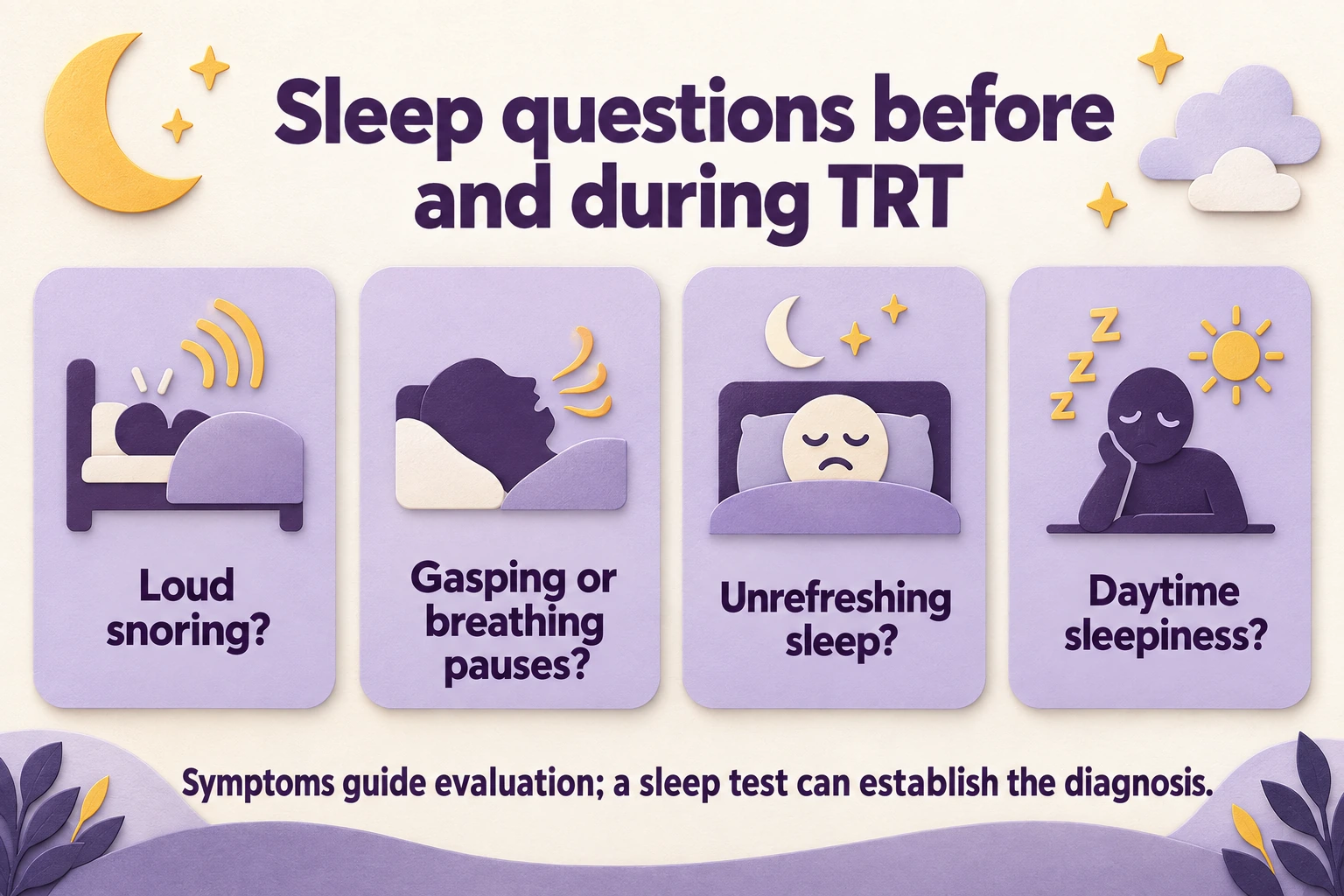
If someone has observed breathing pauses or gasping, include that information in the medical history. If you sleep alone, describe your own experience, such as unrefreshing sleep or marked daytime sleepiness. A lack of witnessed episodes does not settle the question either way.
Symptoms worth reporting before a TRT decision
Loud snoring, gasping during sleep, breathing pauses, and excessive daytime sleepiness can be useful clues. Morning headaches, dry mouth, or difficulty concentrating may also be part of the picture. None of these symptoms alone establishes the diagnosis.
The NHLBI symptom guide explains why sleep apnea can be missed when people focus only on daytime tiredness. Tell the clinician whether you doze during quiet activities, struggle to remain alert at work, or have had a near-miss while driving. Safety concerns deserve prompt attention.
You can bring a partner’s observations, but a phone recording or wearable score is not a substitute for medical assessment. Avoid dismissing a concern because an app reports a good sleep score. The clinically relevant question is whether breathing during sleep and its consequences need formal evaluation.
Why a low-testosterone workup should include sleep
A diagnosis of hypogonadism requires more than fatigue or a single low blood result. The Endocrine Society guideline recommends compatible symptoms or signs, reliable testing, repeat confirmation, and evaluation of the cause. Sleep concerns and other potentially contributing conditions belong in that process.
A person can have both OSA and confirmed testosterone deficiency. The goal is to understand each problem rather than choose one explanation and ignore the other. Treating the sleep disorder may be important regardless of whether TRT is ultimately prescribed.
Our guide to low testosterone, stress, and poor sleep explains this overlap. Ask which part of the symptom pattern each proposed treatment is intended to address. A hormone prescription should not be expected to keep an obstructed airway open, and a sleep treatment does not automatically establish that testosterone deficiency has resolved.
What research says about testosterone and sleep breathing
A 2012 randomized trial studied 67 men with obesity and severe OSA who received intramuscular testosterone undecanoate or placebo alongside a weight-loss intervention. Some measures of nighttime breathing and oxygenation worsened with testosterone at seven weeks, while the differences were not statistically significant at 18 weeks.
This was a small study using a particular formulation in a particular group. It cannot provide a reliable percentage risk for every man starting TRT, and it does not establish that any early worsening is safe to ignore. Results from one time point also should not be treated as proof that later monitoring is unnecessary.
The practical response is screening and follow-up, guided by symptoms and medical history. Avoid claims that TRT inevitably causes sleep apnea or that it can never worsen breathing. The evidence is more limited and context-dependent than either absolute statement suggests.
How sleep apnea is diagnosed
A clinician reviews symptoms, risk factors, and medical history and may recommend a sleep study. Testing can occur at home or in a sleep laboratory, depending on the situation. The appropriate test is chosen for the patient rather than simply selecting whichever option is most convenient.
The NHLBI diagnosis page explains the role of sleep studies. A screening questionnaire can help identify who needs further assessment, but a questionnaire score is not the same as a diagnosis. A clinician should interpret the test results and explain whether the findings account for the symptoms.
Ask what happens if a test is negative or inconclusive while the concern remains. Also ask how severity is being described and what the treatment goal will be. Understanding the result makes later discussions with the TRT prescriber more useful than reporting only that you “passed” or “failed” a sleep test.

Treated OSA requires an individualized TRT discussion
The guideline caution concerns untreated severe OSA. Someone using effective treatment still needs an individualized assessment of testosterone symptoms, repeated hormone results, other risks, and ongoing monitoring. Treatment of OSA is relevant information, not an automatic permission slip for TRT.
Bring details of the sleep diagnosis, prescribed treatment, and whether it is being used consistently and comfortably. If positive airway pressure is prescribed, the sleep team may review treatment data and symptoms to assess effectiveness. Tell the TRT clinician if equipment problems or intolerance are preventing regular use.
A coordinated plan should identify who follows the sleep disorder, who manages the hormone prescription, and how changes are communicated. If both clinicians assume the other is handling a new symptom, important follow-up can be delayed. A concise shared summary can help prevent that gap.
PAP therapy and other treatments have their own purpose
Positive airway pressure, including CPAP, helps keep the airway open during sleep. Other options may include an oral appliance, selected procedures, or changes that address contributing factors. The choice depends on the type and severity of the sleep disorder and the person’s circumstances.
The NHLBI treatment guide describes these approaches. If a mask is uncomfortable, pressure feels difficult, or the device is not being used, contact the sleep team for troubleshooting. A prescription sitting unused beside the bed is not the same as effective treatment.
Do not stop prescribed sleep-apnea treatment because energy or libido improves during TRT. Feeling better in one area does not demonstrate that nighttime breathing is controlled. Decisions about reducing or stopping sleep treatment should be based on reassessment by the clinician managing it.
Why blood counts may enter the conversation
TRT can raise hematocrit, the proportion of blood made up of red blood cells. Low oxygen exposure and other conditions can also be relevant when a blood count is elevated. If hematocrit rises, the clinician may review the testosterone regimen and assess possible contributing problems, including sleep-related breathing concerns.
This is not a reason to assume every abnormal blood count is caused by OSA, or to manage it with unsupervised blood donation. The TRT and hematocrit guide explains the need to investigate the pattern and follow an appropriate clinical plan.
At follow-up, mention new snoring, worsening sleepiness, or difficulty using prescribed PAP even if the visit was booked as a laboratory review. Symptoms and test results can inform one another. Treating the blood number in isolation may miss a problem that requires a different response.
Weight management can be part of OSA care
For some people, obesity contributes to OSA, and weight management can be one part of treatment. That does not make body weight the only factor or mean that care should wait until weight changes. Airway treatment, symptom assessment, and broader health planning may proceed together.
The FDA approved Zepbound, a branded tirzepatide product, for moderate to severe OSA in adults with obesity, alongside a reduced-calorie diet and increased physical activity. This is a product-specific indication. It does not mean every formulation containing tirzepatide has the same approval or evidence.
Our tirzepatide and sleep-apnea article explains the distinction in more detail. The CoreAge Rx tirzepatide service page describes a compounded offering, which is not FDA-approved and should not be represented as the approved Zepbound product. Discuss the actual prescription and the role of ongoing PAP or other treatment with the care team.
Follow-up after starting or changing TRT
Ask what changes should prompt contact between routine visits. New or louder snoring, observed breathing pauses, worsening daytime sleepiness, or a substantial change in sleep quality are worth reporting. Include when the symptoms began relative to a prescription change without assuming that timing proves the cause.
Keep the record practical. Note sleep-treatment use, major symptoms, and any relevant medication changes. If you use a device, the sleep team can advise which data are useful to share. Avoid trying to interpret every nightly fluctuation on your own.
The TRT monitoring guide covers the larger follow-up plan. A review should consider meaningful benefits and adverse effects together. If a treatment improves one concern while sleep worsens, both belong in the decision about what to do next.

Daytime sleepiness can be a safety issue
Do not drive or operate dangerous equipment when you are struggling to stay awake. Arrange a safer alternative and seek medical advice, especially if you have dozed while driving or had near-misses. Waiting for a hormone test is not an adequate response to an immediate alertness problem.
Severe shortness of breath, chest pain, fainting, or a sudden neurological change needs urgent assessment. These symptoms should not be attributed to ordinary tiredness or a medication adjustment without care. Report the complete medication list and any known sleep disorder to the treating team.
For less urgent but persistent symptoms, ask for a specific follow-up date and a clear contact route. A plan to “sleep better” is more useful when it identifies the suspected problem, the test or treatment being arranged, and how response will be assessed.
Common questions
Does snoring mean I have sleep apnea?
No. Snoring is one possible clue. Symptoms, history, and appropriate testing help establish whether OSA is present and how it should be managed.
Can I take TRT if I use CPAP?
That requires an individualized assessment. Effective treatment of OSA is relevant, but it does not replace confirming testosterone deficiency and considering the other benefits, risks, and monitoring needs.
Will TRT improve my sleep apnea by giving me more energy?
TRT is not a treatment for airway obstruction. A change in energy does not show that nighttime breathing is controlled, and sleep-apnea treatment should continue as prescribed unless the sleep clinician changes it.
Does treating OSA guarantee that testosterone returns to normal?
No. Hormone results and symptoms may have several contributors. A confirmed testosterone disorder may still need evaluation even when sleep care is effective.
What should I bring to the TRT appointment?
Bring the sleep-study summary if available, treatment details, relevant device-use concerns, your symptom history, and complete testosterone reports. The main TRT guide can help organize the broader questions.
Related reading
- Total vs. Free Testosterone: Understanding SHBG and Lab Results
- TRT, Libido, and Erectile Function: Why These Are Different Outcomes
- TRT and PSA: Understanding Prostate Monitoring Without Panic
- Stopping TRT: Symptoms, Hormone Recovery, and Follow-Up
- Testosterone replacement therapy: the starting guide
- TRT side effects and monitoring
- TRT and fertility planning
Educational information for adults; personal treatment decisions require a qualified clinician. Sources checked September 16, 2026. Original AI-generated illustrations depict fictional people and are not patient testimonials.