
A testosterone report can contain several numbers that appear to disagree. Total testosterone may look low while free testosterone remains within the laboratory range, or total testosterone may seem unremarkable while another result raises a question. The difference often involves how testosterone travels in the blood, the proteins that bind it, and the way the laboratory measures or calculates each value.
No single number should be read as a stand-alone instruction to start TRT. This guide explains total testosterone, free testosterone, and SHBG in adult men being assessed for hypogonadism, and shows how to prepare for a useful discussion of the complete report.
Total testosterone includes bound and unbound hormone
Most testosterone in the bloodstream is attached to proteins. A smaller fraction is unbound, often called free testosterone. Total testosterone includes both the bound and unbound portions. It is commonly the initial test used when a clinician investigates possible testosterone deficiency.
MedlinePlus explains the main testosterone test types, including total, free, and bioavailable testosterone. “Bioavailable” generally includes free testosterone and testosterone loosely bound to proteins such as albumin, rather than testosterone tightly bound to SHBG. The terms describe different measurements, not competing brands of the same test.
A useful analogy is a group of passengers traveling in different ways: counting everyone gives a total, while counting only those not attached to a carrier gives a different subset. The analogy is limited, but it helps explain why a change in binding proteins can change the relationship between the numbers.
SHBG is a carrier protein, not another form of testosterone
SHBG stands for sex hormone-binding globulin. It is a protein that binds sex hormones in the blood. Albumin also binds testosterone, though less tightly. The amount of binding protein helps influence how much testosterone is measured in bound and free forms.
A high or low SHBG value is not automatically a disease that needs its own treatment. It is a clue to interpret in context. Age, body weight, thyroid and liver conditions, and some medicines can affect SHBG. The direction and significance depend on the condition and the rest of the clinical picture.
The full Endocrine Society guideline describes situations in which altered SHBG makes free testosterone assessment useful. The practical question is not how to push SHBG into a preferred online range. It is whether the binding-protein pattern changes the interpretation of your testosterone result and whether an underlying cause needs attention.
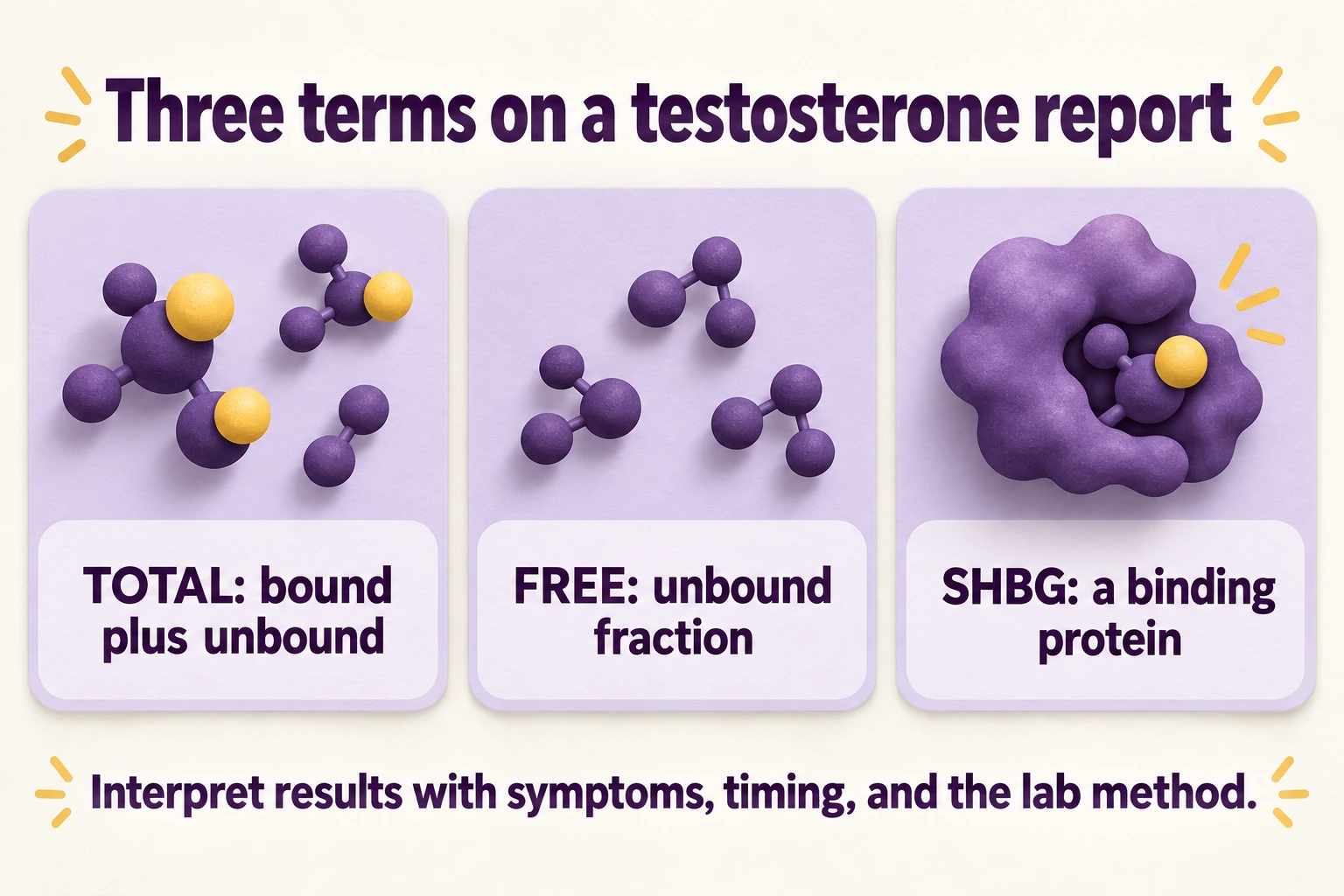
Why total and free testosterone can tell different stories
Imagine two men with a similar total testosterone value but different SHBG concentrations. Their free testosterone estimates may differ because the same total amount is distributed differently between bound and unbound forms. This is an illustration of the concept, not a formula for diagnosing either person.
Low SHBG can make total testosterone appear lower without necessarily producing the same degree of reduction in free testosterone. Higher SHBG can create the opposite interpretive concern. A clinician considers whether the pattern fits the history, whether the assays are reliable, and whether repeat testing is needed.
The result does not mean you should always ignore total testosterone or always choose whichever number supports treatment. Each measurement has limitations. Reading the full report with an appropriate method is more useful than selecting one value as the “real” testosterone number.
When free testosterone is particularly useful
The Endocrine Society recommends considering free testosterone when total testosterone is near the lower limit of normal or when a condition alters SHBG. That is a targeted use: it helps clarify a specific diagnostic uncertainty rather than creating a requirement for every person to order every available hormone test.
The guideline summary also emphasizes that diagnosis requires compatible symptoms or signs and consistently low concentrations. A free testosterone result does not remove the need to establish the clinical context and investigate the cause when deficiency is confirmed.
Ask the clinician what question the test is meant to answer. If the answer is “to see whether the low total value reflects altered binding,” you have a clear reason for the additional measurement. If the only explanation is that more numbers are always better, ask how the result would change the next step.
The testing method can matter as much as the test name
Free testosterone may be measured with a method such as equilibrium dialysis or estimated using a validated calculation based on total testosterone, SHBG, and albumin. These approaches are not identical, and the quality of the inputs matters. A calculated value is only as informative as the measurements and assumptions behind it.
The Endocrine Society guideline advises against direct analog free-testosterone immunoassays because of accuracy concerns. That technical distinction is a reason to ask about the laboratory method rather than assuming every test labeled “free testosterone” is interchangeable.
You do not need to become a laboratory specialist to have a useful conversation. Ask whether the method is appropriate, whether the reference range matches it, and whether an unexpected result should be confirmed. The clinician or laboratory can often clarify details that are missing from a simplified patient-portal display.

Timing and repeat testing are part of the result
For the initial diagnosis in adult men, morning fasting measurements on separate days are generally recommended. Testosterone varies over the day and between days, and food intake, illness, and other circumstances can affect interpretation. An isolated result obtained under unusual conditions may need a repeat assessment.
The Endocrine Society’s 2026 TRT statement reinforces the importance of at least two early-morning fasting tests and accurate, standardized assays. The statement also cautions against treating symptoms alone as diagnostic. The purpose is a reliable conclusion, not simply a second opportunity to obtain a low value.
If you work nights or have an unusual sleep schedule, tell the ordering clinician before arranging the draw. Ask for individualized instructions rather than guessing how “morning” applies. Do not stop medicines, change eating patterns, or deliberately sleep poorly to influence the result.
Units and reference ranges can create apparent contradictions
Reports may use different units for total and free testosterone, and laboratories may use different methods and reference intervals. A number copied from one report cannot always be compared directly with a number from another. The unit and the test name belong with the value.
| Report detail | Why it helps |
|---|---|
| Test name | Distinguishes total, free, and bioavailable testosterone |
| Units | Prevents comparing different measurement scales as though they were identical |
| Reference interval | Shows the range supplied for that laboratory method |
| Collection date and time | Adds context about timing and repeat measurements |
| Method or calculation | Helps explain disagreement between reports |
| Medicines and recent illness | Identifies circumstances that may affect interpretation |
Bring the full reports to the appointment. A cropped image showing only a red “low” flag can omit the details needed to understand it. If a new laboratory is used, ask how the clinician will compare the results with the previous method.
A cutoff is a decision aid, not the whole diagnosis
Clinical guidance may use numerical thresholds as part of assessment, but a threshold does not replace symptoms, testing quality, repeat results, and evaluation of the cause. Borderline values can require more context rather than an immediate yes-or-no decision about treatment.
Online “optimal testosterone” charts often imply that every man should reach the same high target. That is not the same as diagnosing and treating hypogonadism. A laboratory range is also not a promise that a person will feel a particular way at every point within it.
If a clinician proposes TRT, ask how the diagnosis was established and what symptom or sign the treatment is expected to improve. Our TRT benefits and timeline guide explains why different outcomes should be assessed separately. The goal is appropriate treatment and meaningful benefit, not winning a comparison with someone else’s report.
Confirming a low level leads to another question: why?
When testosterone deficiency is established, the next step is to investigate the cause. Hormones such as luteinizing hormone and follicle-stimulating hormone can help distinguish a testicular problem from a problem involving the pituitary-hypothalamic signaling system. Other testing depends on the history and findings.
This matters because treatment planning is not identical for every cause. Fertility goals, a pituitary concern, medication effects, or a reversible contributor can change the approach. The low testosterone, stress, and sleep guide explains why overlapping symptoms and contributing conditions deserve attention.
Ask which explanation the clinician considers most likely and what evidence supports it. If the cause remains uncertain, ask what follow-up will clarify it. A prescription should not erase the need to understand a newly identified hormone abnormality.
Results while taking TRT answer a different question
A testosterone measurement during treatment is used to assess exposure in relation to the prescribed formulation and schedule. The correct timing can differ between injections, gels, and other products. A treatment-monitoring result should not be interpreted as though it were an untreated diagnostic baseline.
Tell the clinician when the last dose was used and follow the exact blood-draw instructions. Do not move a dose to make the result look better or compare a sample drawn at a different point in the dosing interval without noting that difference.
The injections versus gel guide explains some formulation differences, while TRT monitoring covers the broader review. Testosterone is only one part of monitoring; symptoms, adverse effects, blood counts, and other appropriate assessments also matter.

Keep other hormone and supplement questions separate
An IGF-1 result, a testosterone value, and a supplement label do not describe the same pathway. Readers comparing different hormone-related services can start with sermorelin, IGF-1, and growth-hormone testing and the sermorelin product and evidence guide. A result in one system does not automatically justify treatment in another.
Likewise, creatine and kidney-test questions involve a different laboratory discussion from testosterone. Tell the clinician about supplements so the whole history is available, but avoid assuming that every unexpected number has the same explanation.
Organizing questions by their purpose can make an appointment more useful: diagnosis of a hormone disorder, monitoring a prescription, evaluating a symptom, or discussing a supplement. Those goals may overlap, but each should have a clear reason and next step.
Common questions
Is free testosterone always more important than total testosterone?
No. Total testosterone is usually the initial test, and free testosterone helps in selected situations. The most useful result depends on the clinical question, SHBG, and the method used.
Can I diagnose low testosterone with a home test?
A home result may prompt a discussion, but it does not replace a clinical assessment and appropriate confirmatory testing. Ask whether the collection method and assay are suitable for the question being investigated.
Should I try to lower SHBG myself?
Do not treat a carrier-protein result as an isolated target. A clinician should interpret it with the rest of the report and consider whether an underlying condition or medicine explains the pattern.
Why did two laboratories flag the same value differently?
They may use different methods, units, or reference ranges. Bring both complete reports so those differences can be reviewed before drawing a conclusion.
What should I ask before agreeing to TRT?
Ask how the diagnosis was confirmed, what cause is suspected, how fertility goals affect the choice, what benefit is expected, and how treatment will be monitored. The main testosterone replacement guide brings those questions together.
Related reading
- Low Testosterone, Stress, or Poor Sleep? Sorting Out Overlapping Symptoms
- TRT, Libido, and Erectile Function: Why These Are Different Outcomes
- TRT and Sleep Apnea: Screening, Symptoms, and Follow-Up
- Stopping TRT: Symptoms, Hormone Recovery, and Follow-Up
- Testosterone replacement therapy: the starting guide
- TRT side effects and monitoring
- TRT and fertility planning
Educational information for adults; personal treatment decisions require a qualified clinician. Sources checked September 16, 2026. Original AI-generated illustrations depict fictional people and are not patient testimonials.