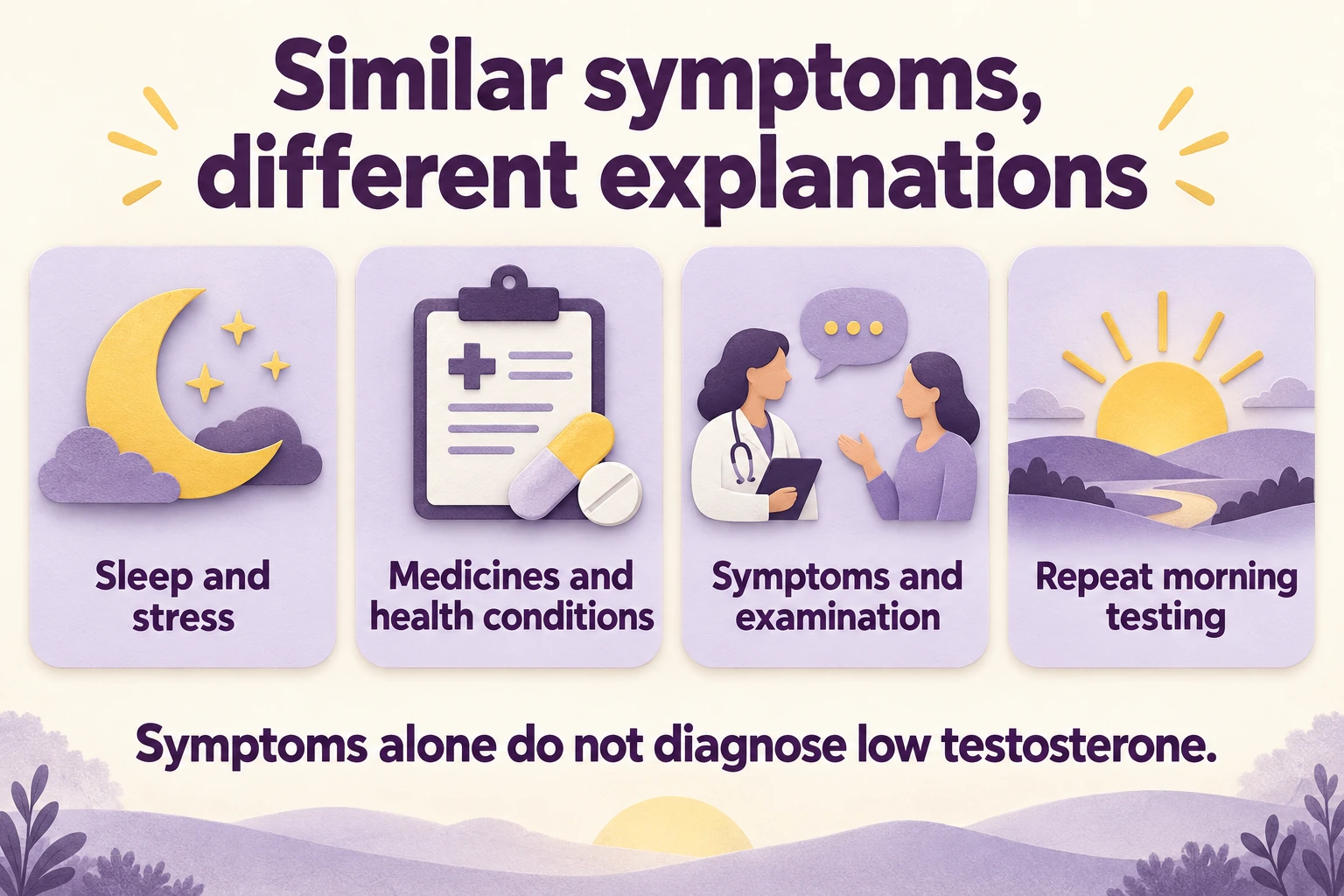
Low energy, lower sexual interest, poor concentration, and a disappointing workout can make testosterone seem like an obvious explanation. Those symptoms can occur with testosterone deficiency, but they also overlap with insufficient sleep, stress, depression, medication effects, and other medical conditions. Symptoms alone cannot diagnose low testosterone.
The useful next step is an assessment that connects the symptoms with accurately measured, repeatedly low hormone levels and investigates the cause. This guide focuses on adult men considering evaluation for hypogonadism, the medical term for inadequate testicular hormone production or function. It explains why a careful diagnosis can lead to a better plan than treating a symptom list as proof that TRT is needed.
Similar symptoms can come from different problems
A person may feel exhausted because they are not getting enough sleep, because their sleep is repeatedly interrupted, or because an illness or medicine is affecting energy. Stress and mood symptoms can also change concentration and sexual interest. More than one contributor may be present.
MedlinePlus describes the broad range of possible fatigue causes, including anemia, thyroid conditions, sleep disorders, depression, and medication effects. This does not mean everyone needs testing for every condition. It means the history and examination should guide the evaluation.
Try describing the experience precisely. Are you sleepy enough to doze off, physically weak, short of breath with activity, mentally drained, or less interested in things you normally enjoy? Those descriptions are more useful than assuming that every version of “tired” comes from the same hormone problem.
What makes a low-testosterone diagnosis different?
The Endocrine Society guideline requires compatible symptoms or signs together with unequivocally and consistently low testosterone concentrations. It recommends confirming an initial low result with repeat morning fasting testing and using reliable laboratory methods. A clinician then investigates why the result is low.
That sequence matters because testosterone varies and testing conditions can affect interpretation. A single afternoon result, a sample obtained during acute illness, or a poorly characterized home test may not answer the same question as a properly timed diagnostic assessment.
Our low-testosterone symptoms and testing guide explains the initial workup. The aim is not to make access to care unnecessarily difficult. It is to distinguish a treatable hormone disorder from another condition that may require a different treatment, and to avoid committing to long-term therapy on incomplete information.
Why sleep belongs near the beginning of the conversation
Ask whether you are allowing enough time for sleep and whether that sleep is restorative. A demanding schedule can reduce sleep opportunity. Insomnia can make it difficult to fall or stay asleep. Sleep apnea can repeatedly interrupt breathing and rest even when someone spends enough hours in bed.
The NHLBI sleep-apnea information explains why the condition needs its own assessment. Loud snoring, witnessed breathing pauses, gasping, and daytime sleepiness are useful details to report. Absence of a bed partner’s observations does not rule it out.
TRT is not a sleep-apnea treatment. The Endocrine Society recommends against starting it in men with untreated severe obstructive sleep apnea. If sleep symptoms are present, evaluating them is part of choosing an appropriate treatment plan. Our TRT and sleep-apnea guide discusses screening, follow-up, and coordination between clinicians.
Stress and mood deserve direct questions
A prolonged stressful period can change sleep, relationships, appetite, and motivation. Depression may include low energy or loss of interest as well as sadness. These experiences deserve care whether or not a hormone test is abnormal.
Tell the clinician about the timeline. Did symptoms begin during a job change, caregiving strain, bereavement, or a period of poor sleep? Are they present across settings, or mainly during a particular situation? Do activities still feel enjoyable once you start them? There is no need to decide on a psychological explanation before sharing the history.
A normal testosterone result should not end the conversation with “nothing is wrong.” It narrows one part of the assessment. Likewise, an abnormal result does not make mood symptoms irrelevant. A plan can address more than one contributor, with clear follow-up for each rather than treating them as competing explanations.
Medicines and health conditions can affect the picture
Bring a complete medication list, including prescribed opioids, glucocorticoids, sleep medicines, and products obtained outside your usual care team. Some medicines can influence testosterone, fatigue, sexual function, or the interpretation of symptoms. Do not stop a prescribed medicine on your own to improve a test result.
The Endocrine Society’s July 2026 statement on TRT reinforces the importance of accurate diagnosis and evaluating reversible contributors, including obesity and medication effects. It also notes continuing uncertainty about long-term safety, which makes a clear indication and monitoring plan important.
Tell the clinician about recent illness, major changes in eating, weight changes, and prior anabolic steroid or testosterone use. These details may feel unrelated to the main concern, but they can change the meaning of a laboratory result. Honest information is more useful than trying to produce a “clean” history that fits a preferred diagnosis.

For a wakefulness-medicine example, our review of modafinil, appetite and weight-change evidence distinguishes short food-intake experiments, side effects and sustained weight outcomes. Unexplained changes need assessment rather than a medicine or hormone assumption.
Total testosterone, free testosterone, and context
Most initial assessments begin with total testosterone. Free testosterone can help in selected situations, such as a borderline total result or a condition affecting sex hormone-binding globulin, often abbreviated SHBG. Different tests answer different questions, and the method matters.
MedlinePlus explains the main types of testosterone tests. A laboratory reference range is a guide to interpretation, not a complete treatment decision. A result should be considered with symptoms, repeat testing, collection timing, units, and the laboratory method.
If two reports appear inconsistent, bring both complete reports rather than comparing screenshots of a single number. The total versus free testosterone and SHBG guide explains common reasons the numbers may tell different stories. Repeatedly ordering tests without a clinician’s question can create confusion instead of clarifying the cause of symptoms.
Weight management can be relevant without becoming the whole explanation
Body weight and metabolic health can affect the hormone picture, but weight should not be used to dismiss symptoms or skip an appropriate assessment. A clinician should consider whether weight-related factors, another illness, or a disorder of the testes or pituitary is contributing.
If weight management is part of the plan, it can include nutrition, activity, sleep care, and, when appropriate, medication. The NIDDK medication overview explains that prescription weight treatment requires an individualized discussion. TRT is not a substitute for an obesity treatment plan and is not prescribed simply to improve a scale number.
Readers exploring services can review the CoreAge Rx semaglutide information and tirzepatide information alongside the semaglutide questions guide and tirzepatide questions guide. The current service pages describe compounded offerings. These are not FDA-approved products; evidence and approvals for branded medicines should not be assumed to apply identically to a compounded formulation. The FDA’s GLP-1 compounding information explains that distinction.
What about NAD+, sermorelin, or “testosterone boosters”?
Products marketed for energy, recovery, or healthy aging do not all act on the same biological pathway. A claim about cellular energy or growth hormone does not establish that a product treats confirmed testosterone deficiency. A supplement label also cannot determine why a person feels tired.
The NAD+ and fatigue evidence guide and sermorelin testing guide explain different questions from a testosterone assessment. If comparing a service, read the Sermorelin product information with the sermorelin evidence overview, including the limits of adult anti-aging claims. It is not a replacement for diagnosing hypogonadism.
Bring any proposed product to the clinician’s attention before starting it. Adding several interventions at once can make it harder to know which one is responsible for a change and may postpone treatment of the actual cause. A careful evaluation is useful even when the eventual plan includes more than one kind of care.
A practical record for the first visit
Choose a few examples of what changed: less interest in sex, falling asleep in meetings, difficulty completing a usual walk, or a persistent drop in motivation. Note when the change started and whether it is stable, fluctuating, or worsening.
For a week or two, record sleep opportunity, major awakenings, symptoms, and any relevant medication changes. Include shift work and the timing of your main sleep period. You do not need an elaborate wearable or daily hormone testing to make the history useful.
Also identify the outcome you care about. “I want to stay awake during afternoon work” is more specific than “I want higher testosterone.” The clinician can then connect testing and treatment to a functional goal. If symptoms are severe, progressive, or associated with concerning signs, seek care without waiting to finish the record.
What an appropriate plan should explain
A useful plan identifies what is being evaluated, how tests should be obtained, who will review them, and what happens next. If testosterone is repeatedly low, ask how the cause will be investigated. If it is not, ask which other explanations remain relevant.
If TRT is being considered, discuss fertility before starting. Exogenous testosterone can suppress sperm production, and a future wish to conceive changes the treatment conversation. The TRT and fertility guide explains why this should be addressed before a prescription rather than after a problem develops.
Monitoring and expected benefits should also be clear. The main TRT guide covers the broader decision. A treatment that changes a blood value without improving a meaningful symptom still needs review; increasing exposure is not automatically the right response.

When symptoms need more urgent attention
New chest pain, severe shortness of breath, fainting, sudden neurological symptoms, or marked weakness needs prompt assessment. Do not attribute an acute change to low testosterone or stress without evaluating the symptom itself.
Persistent fatigue with unexplained weight loss, fever, or worsening function also warrants a clinical visit. If depression includes thoughts of self-harm, seek immediate support through emergency services or a crisis resource such as 988 in the United States. Hormone testing should not delay care for an urgent mental-health concern.
Common questions
Can symptoms tell me whether the problem is sleep or testosterone?
Not reliably. The overlap is substantial, and both can be present. A history, examination, and appropriately selected testing provide more useful information than a symptom checklist alone.
Should every man over 40 get testosterone checked?
The Endocrine Society does not recommend routine screening of asymptomatic men in the general population. Testing is most useful when there is a clinical reason to investigate possible deficiency.
If one result is low, should I start TRT?
A single result usually does not complete the diagnostic process. Confirmatory testing, symptom assessment, and evaluation of the cause help determine whether TRT is appropriate.
Does a normal result mean the fatigue is imaginary?
No. It means that result does not establish testosterone deficiency. The symptoms still deserve an explanation and a plan that addresses their effect on daily life.
Will better sleep always normalize testosterone?
No. Sleep care can be important without guaranteeing a particular hormone result. A confirmed underlying testicular or pituitary disorder requires its own evaluation and management.
Related reading
- Total vs. Free Testosterone: Understanding SHBG and Lab Results
- TRT, Libido, and Erectile Function: Why These Are Different Outcomes
- TRT and PSA: Understanding Prostate Monitoring Without Panic
- Stopping TRT: Symptoms, Hormone Recovery, and Follow-Up
- Testosterone replacement therapy: the starting guide
- TRT side effects and monitoring
- TRT and fertility planning
Educational information for adults; personal treatment decisions require a qualified clinician. Sources checked September 16, 2026. Original AI-generated illustrations depict fictional people and are not patient testimonials.