
Migraine can change during perimenopause, when hormone patterns become less predictable. If hot flashes or night sweats are also disrupting your life, the question is often whether HRT can be considered without making headaches worse. The answer depends on the headache pattern, whether aura occurs, your overall health, and the type of hormone treatment being discussed.
Migraine with aura is not automatically a contraindication to menopause HRT, according to British Menopause Society guidance. That does not mean every estrogen product is appropriate or that HRT treats migraine itself. Menopause treatment and migraine care need a coordinated plan, particularly when symptoms change.
Migraine is more than a severe headache
Migraine is a neurological condition that can involve headache, nausea, sensitivity to light or sound, and difficulty functioning. Some people have aura, which can include temporary visual, sensory, or language symptoms. Others have migraine without aura. Fatigue or difficulty concentrating can also occur around an episode.
The National Institute of Neurological Disorders and Stroke overview explains the range of symptoms and why migraine care involves more than choosing a pain reliever. A diagnosis should be based on a clinical history rather than an online checklist alone.
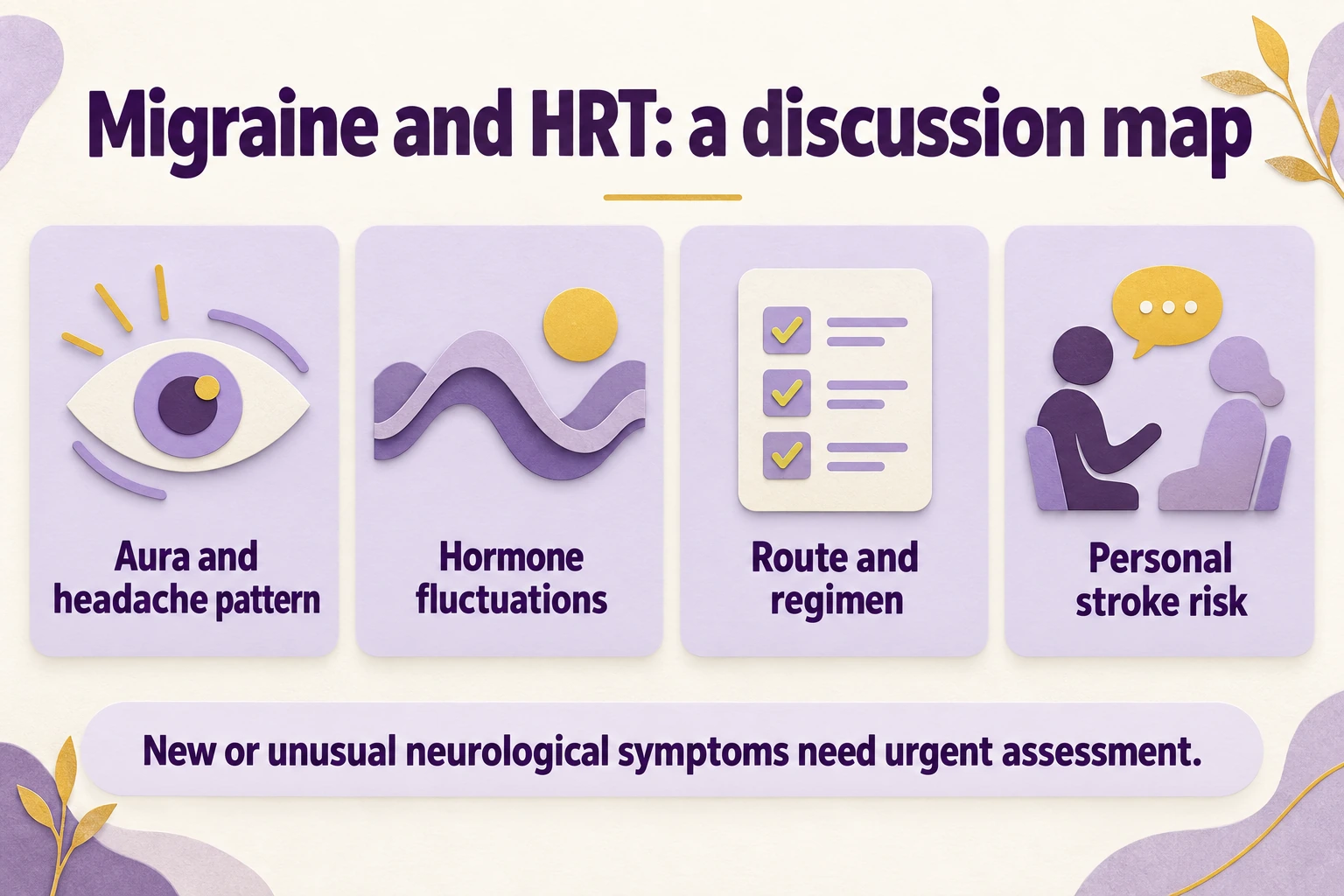
When discussing HRT, describe the pattern you have actually experienced. Include how the headache starts, how often it occurs, associated symptoms, and any change from your usual episodes. “I get headaches” is useful as an opening, but the details are what allow a clinician to assess the implications for treatment.
Why perimenopause can make the pattern less predictable
Hormone fluctuations can influence migraine in some people, and perimenopause can bring irregular cycles alongside changing estrogen levels. A previously predictable relationship between a menstrual period and a migraine episode may become harder to recognize. Sleep disruption, stress, missed meals, and other personal triggers may also be present.
The British Menopause Society’s April 2026 migraine and HRT guidance describes this overlap. It emphasizes identifying the headache pattern and choosing treatment in relation to the stage of the menopause transition and the person’s needs.
A diary can help clarify whether episodes occur around bleeding, night sweats, or a treatment change. It will not prove causation, especially when several things change at once. The goal is to bring useful observations to the appointment rather than to calculate a hormone dose from the calendar.
HRT and combined hormonal contraception are different
Advice about estrogen-containing contraception is often confused with advice about menopause hormone therapy. These treatments have different purposes, formulations, doses, and clinical considerations. A restriction that applies to one should not be transferred automatically to the other without reviewing the actual product and situation.
HRT is also not contraception. If pregnancy is possible during perimenopause, a separate contraception discussion is still needed. Tell the clinician about migraine aura and any previous advice about contraceptive choices so that the full plan is consistent.
Our guide to HRT during perimenopause explains why ongoing cycles and pregnancy potential matter. Avoid switching from a contraceptive to HRT, or combining products, based on a general comparison. The prescriber needs to know which hormones you are already using and why.
Does aura rule out menopause hormone therapy?
The British Menopause Society states that migraine aura does not itself contraindicate HRT. The decision still requires assessment of the individual, including vascular risk factors and the nature of the symptoms. This is a reason for a careful discussion, not a blanket statement that HRT is risk-free.
Tell the clinician if aura is new, has changed, lasts differently from usual, or has never been formally assessed. New neurological symptoms should not be labeled as aura simply because you have a history of migraine. Sudden weakness, trouble speaking, or vision loss can require emergency evaluation.
If different clinicians have given different advice, bring the exact names of the proposed products and ask what each recommendation is based on. Sometimes the apparent disagreement concerns contraception versus HRT; sometimes it reflects a personal risk factor that was not included in the original conversation.
Why the estrogen route may matter
Transdermal estrogen is delivered through the skin, usually with a patch, gel, or spray. Oral estrogen is swallowed. These routes have different practical and physiological features, and the choice can matter when trying to minimize hormonal fluctuations and account for vascular risk.
The BMS migraine guidance generally prefers transdermal estradiol where appropriate and recommends using the lowest estrogen dose that effectively controls vasomotor symptoms. Higher doses can be associated with more headache or migraine. The aim is symptom treatment with an appropriate regimen, not reaching a high hormone number.
The estrogen patch versus pill guide explains the broader route discussion. Do not assume that changing routes on your own will solve a headache pattern. The clinician should review the exact formulation, dose, timing, and other medicines before deciding whether a change is appropriate.

The progestogen and schedule also need attention
When the uterus is present, systemic estrogen usually requires adequate endometrial protection with a progestogen. The schedule and formulation may be relevant to how a person experiences treatment. A menopause plan should consider all components rather than treating estrogen as the only variable.
ACOG’s hormone therapy information explains the distinction between estrogen-only and combined regimens. Our article on estrogen and progesterone in HRT offers additional plain-language context. If you have had a hysterectomy, the operative details and conditions such as endometriosis may change the plan.
If headaches seem linked to part of a cyclic regimen, record that pattern and discuss it. Do not omit the protective component to test the theory yourself. A symptom diary can inform a supervised change while preserving the reason the regimen was prescribed in the first place.
HRT is not a guaranteed migraine treatment
Someone may experience fewer episodes when menopause symptoms and sleep improve, while another may have no change or worsening. HRT should not be presented as a dependable cure for migraine. Its main role in this discussion is treating an appropriate menopause indication while accounting for the headache history.
Migraine itself may need acute treatment for episodes, preventive treatment, or both. The choice depends on frequency, disability, other conditions, and medication use. The NINDS migraine resource describes these different approaches without implying that one medicine fits everyone.
At follow-up, discuss migraine outcomes separately from hot-flash outcomes. A treatment can help night sweats while creating a headache issue that needs attention. Combining all symptoms into a single rating can hide that tradeoff. Bring examples of what improved, what did not, and what became more difficult.
Build a diary you can actually maintain
A useful diary can record headache days, severity, effect on activities, possible aura, bleeding, sleep, and the medicines taken for the episode. Add HRT start dates or changes and note missed doses or patch problems. Keep the record simple enough to use consistently.
You do not need to identify a trigger for every episode. A diary is most useful when it captures the pattern honestly, including days when no clear trigger is apparent. Avoid making several self-directed changes at once, because that can make the pattern harder to interpret.
Bring the record to the clinician who manages migraine as well as the person prescribing hormones if they are different. Ask them to agree on which changes should be reported promptly and who will coordinate any treatment adjustment. Shared information matters more than having an elaborate app.
Keep sleep, meals, and daily routines in view
Regular sleep, hydration, and meal timing may be useful parts of a migraine-management plan, depending on personal triggers. These habits can also become harder to maintain when night sweats, work demands, or caregiving disrupt the day. The goal is a workable routine, not perfect control over every possible trigger.
If sleep is the main problem, distinguish sweating-related awakenings from insomnia, snoring, or gasping. Our article on HRT, sleep, and hot flashes can help frame that discussion. A separate sleep condition may need its own assessment even when menopause symptoms are present.
For meal planning, balanced meals for weight management provides practical ideas that can be adapted without severe restriction. If appetite changes during weight-management treatment, mention that to the care team. The relevance is maintaining a tolerable routine, not claiming that a particular food pattern or product cures migraine.
New or unusual symptoms need their own assessment
Seek emergency help for a sudden severe headache, new one-sided weakness, facial drooping, trouble speaking, sudden vision loss, or another abrupt neurological change. A familiar migraine diagnosis should not be used to explain away a new pattern without assessment.
Arrange a prompt clinical review if headaches become substantially more frequent, change in character, or begin for the first time later in life. Also report increasing reliance on headache medicines. Frequent use of some acute medicines can itself become relevant to the treatment plan, and the clinician needs an accurate list.
If the change began after HRT was started or adjusted, provide the dates and product details. That timing matters, but it does not establish that hormones are the only possible cause. Evaluation should address the symptom itself as well as whether the prescription needs to change.

Questions for a coordinated treatment discussion
- Is my headache pattern consistent with migraine, and is aura present?
- Do any new symptoms need evaluation before a hormone decision?
- What menopause symptom would HRT be treating?
- How do my health history and vascular risks affect the options?
- Would a transdermal route or a different regimen be appropriate?
- What should I track after starting or changing treatment?
- Who should I contact if headaches worsen?
NICE menopause guidance supports individualized discussion of treatment benefits and risks. The main menopause HRT guide can help you prepare for that broader review. Ask for a plan that covers both the hormone prescription and ongoing migraine care.
Common questions
Can I use HRT if I have migraine with aura?
Aura alone does not automatically rule out menopause HRT in BMS guidance. A clinician still needs to assess the symptom history, other risks, and the exact treatment. New neurological symptoms require assessment rather than an assumption that they are aura.
Will a patch definitely prevent headaches?
No. Transdermal estrogen may be a useful option in an individualized plan, but it does not guarantee that migraine will improve or remain unchanged. The response and any new symptoms need follow-up.
Should I increase estrogen if migraine gets worse?
Do not change the dose on your own. More estrogen is not automatically the answer and can worsen headache in some circumstances. Review the pattern, regimen, and other possible causes with the prescriber.
If HRT helps my night sweats, can I stop migraine treatment?
Do not assume the migraine condition no longer needs care. Discuss any change in acute or preventive treatment with the clinician managing it, using the actual episode pattern and functional impact.
Can menopause brain fog and migraine overlap?
They can be described in similar ways, especially around poor sleep or a migraine episode, but the labels are not interchangeable. The brain-fog and HRT guide explains how to describe cognitive symptoms and when a broader assessment is needed.
Related reading
- Brain Fog During Menopause: What HRT Can and Cannot Do
- Menopause and Joint Pain: Causes, Care, and the Role of HRT
- Bleeding on HRT: Patterns to Track and When to Seek Care
- How Long Can You Take HRT? Reviews, Stopping, and Symptom Recurrence
- Menopause hormone therapy: the complete starting guide
- HRT benefits and risks
- Menopausal skin care and changing skin needs
Educational information for adults; personal treatment decisions require a qualified clinician. Sources checked September 16, 2026. Original AI-generated illustrations depict fictional people and are not patient testimonials.