
There is no single number of years that everyone should take menopause hormone therapy. Some people use it for a limited period, while others continue longer because symptoms remain troublesome and the balance of benefits and risks still supports treatment. Reaching a birthday or finishing a fixed number of prescriptions does not, by itself, answer whether it is time to stop.
The useful question is whether the current treatment still has a clear purpose for you. That requires periodic review of symptom benefit, medical history, dose, route, and personal preference. Continuing a treatment started near menopause also raises different questions from starting systemic HRT for the first time much later.
Why a universal stop date does not work
Menopause symptoms do not follow the same schedule for everyone. Hot flashes may settle for one person while another continues to have disrupted sleep or daily discomfort. Health risks also change differently with age, medical conditions, and treatment type. A fixed deadline can overlook both ongoing benefit and a newly important concern.
The Menopause Society’s hormone therapy information emphasizes individualized treatment and regular reassessment. That approach does not mean staying on the same prescription indefinitely without review. It means using the review to make a reasoned decision rather than treating duration alone as the decision.
A productive visit can end with continuing, adjusting, changing the route, trying a supervised reduction, or stopping. The choice should be understandable in terms of your present situation. Ask the clinician to explain what supports the recommendation now and what would lead to a different recommendation later.
Continuing after 65 is different from starting after 65
The 2022 Menopause Society position statement does not recommend routinely stopping systemic hormone therapy solely because someone reaches 65. Selected patients may continue after counseling and reassessment. That is not a statement that every person should continue, or that risk stops changing with age.
Starting systemic therapy at an older age or many years after menopause can have a different benefit-risk profile from continuing established treatment. A friend’s experience of taking HRT comfortably for years does not automatically answer whether a new start is appropriate for you.
Tell the clinician when menopause occurred, when treatment began, and whether there have been long gaps. If dates are uncertain, an approximate timeline is still helpful. The goal is to distinguish the actual clinical situation instead of grouping every older HRT user into the same category.
Identify the benefit you are still getting
List the symptoms the treatment was intended to address and what happened after it started. Be specific: fewer nighttime awakenings from sweating, less interference with work, or improved comfort may be easier to assess than “more balanced hormones.” Include any side effects or burdens alongside the benefits.
If symptoms have been quiet for a long time, that could mean treatment is effective, the underlying symptoms have diminished, or both. It does not prove that treatment is unnecessary. A discussion of whether to try reducing or stopping can help address the uncertainty without assuming the answer in advance.
If the treatment never produced a meaningful benefit, review the original indication. A normal hormone result is not a substitute for a clear clinical goal. Our HRT monitoring guide explains why follow-up should include how you feel and function, not only laboratory information.
Review what has changed in your health
A review should include new diagnoses, changes in medication, blood pressure concerns, smoking status, clotting history, breast symptoms, and unexpected bleeding. Family history can also change when a relative receives a diagnosis. These details may affect the treatment discussion even when your menopause symptoms are stable.
ACOG’s HRT FAQ describes important risks and situations in which systemic hormone therapy may not be appropriate. The relevance of a particular risk depends on the treatment and the patient. A general statement that HRT is either safe or dangerous leaves out information needed for a personal decision.
Do not wait for an annual visit to report a significant new problem. Chest pain, sudden shortness of breath, new neurological symptoms, or other acute concerns require urgent assessment. Unexpected bleeding deserves timely evaluation through its own pathway, as explained in bleeding on HRT.
Dose, route, and regimen can be reviewed separately
A decision about duration does not have to be an all-or-nothing choice between the original prescription and no care. Depending on the situation, a clinician may discuss a different dose, route, formulation, or nonhormonal option. Each change should have a reason and clear instructions.
For example, practical difficulty with a patch is a different issue from a new medical contraindication. A person who dislikes taking several medicines may value simplifying the regimen, while another may prioritize avoiding the return of severe night sweats. Preferences belong in the conversation alongside clinical evidence.
Read estrogen patches versus pills and estrogen and progesterone in HRT if the terminology is unfamiliar. Do not split, stretch, alternate, or substitute products to create a lower dose without checking the exact product instructions with the prescriber or pharmacist.

What can happen when systemic HRT is stopped?
Menopause symptoms may return after stopping. The likelihood and severity vary, and a quiet period while taking treatment does not reliably predict the experience afterward. If symptoms recur, that is information for the next decision rather than evidence that stopping was a failure.
The Menopause Society position statement notes that vasomotor symptoms can recur and that evidence does not establish a single best stopping method for everyone. A useful plan anticipates the possibility of night sweats, sleep disruption, or hot flashes and specifies when to contact the clinician.
Ask what you should monitor and what level of symptom return would justify a review. You do not need to endure substantial disruption just to prove you can remain off treatment. Equally, restarting is a new prescribing decision that should account for any change in health, time off treatment, and the original reason for stopping.
Tapering versus stopping at once
NICE menopause recommendations advise offering a choice between gradual reduction and immediate stopping. Gradual reduction may lessen symptom recurrence in the short term, but it does not establish better long-term outcomes than stopping immediately. The decision can reflect the clinical situation and preference.
This is not a reason to design your own taper from an internet example. Different products release medicine differently, and a combined regimen may contain more than one component with a specific purpose. The prescriber should explain exactly what changes and what stays in place during the transition.
Ask for a written plan with dates or a clear sequence, along with follow-up instructions. If symptoms return before the next planned step, clarify whether to call, continue, or arrange a review. A plan that anticipates questions is easier to follow than one that simply says “wean off when ready.”
Local vaginal treatment has a separate discussion
Stopping systemic HRT does not automatically settle how vaginal dryness, pain with sex, or other genitourinary symptoms should be managed. Those symptoms may need continuing care, and local treatments have different purposes and exposure patterns from systemic therapy.
Our guide to vaginal estrogen versus systemic HRT explains the distinction. Tell the clinician which symptoms you are concerned about before changing treatment so the plan covers more than hot flashes. A moisturizer, a lubricant, and a prescribed vaginal hormone product are not interchangeable.
Facial skin care is separate again. Readers managing dryness or changes in skin texture can explore the menopausal skin-care guide and the Bounce Back copper-peptide cream information. A facial product addresses a different goal and should not be treated as a replacement for systemic or vaginal menopause care.
Bone health should remain in the plan
HRT can reduce bone loss and fracture risk while it is used, but the reason for prescribing it and the plan after stopping need to be clear. If bone protection is an important treatment goal, ask whether your fracture risk needs reassessment and whether another approach is indicated.
NICE guidance notes that fracture protection decreases after HRT is stopped. That does not mean every person needs a new medicine immediately. It means the clinician should consider the individual’s age, bone history, other risks, and relevant testing rather than assuming the decision concerns hot flashes alone.
Strength work and appropriate activity can remain part of general health planning. The strength-training beginner’s guide focuses on function and gradual progress. Exercise and supplements should not be presented as automatic substitutes for an osteoporosis treatment when one is clinically indicated.
Plan around real life without letting logistics decide everything
A difficult work period, travel, caregiving, or an upcoming procedure can affect when a planned treatment review is most practical. It is reasonable to discuss timing, especially if symptoms previously disrupted sleep or concentration. Scheduling preferences should sit alongside the medical reason for changing treatment.
If stopping is recommended because of a new safety concern, ask how urgently the change needs to happen and what can be used for symptom support. If the decision is elective, ask whether there is flexibility in timing and how follow-up will work while you are away.
Write down a contact route and keep an updated medication list. If different clinicians prescribe different hormone products, tell each of them about the full regimen. Avoid leaving one clinician to assume another is monitoring a component that no longer has a clear owner.

A practical review checklist
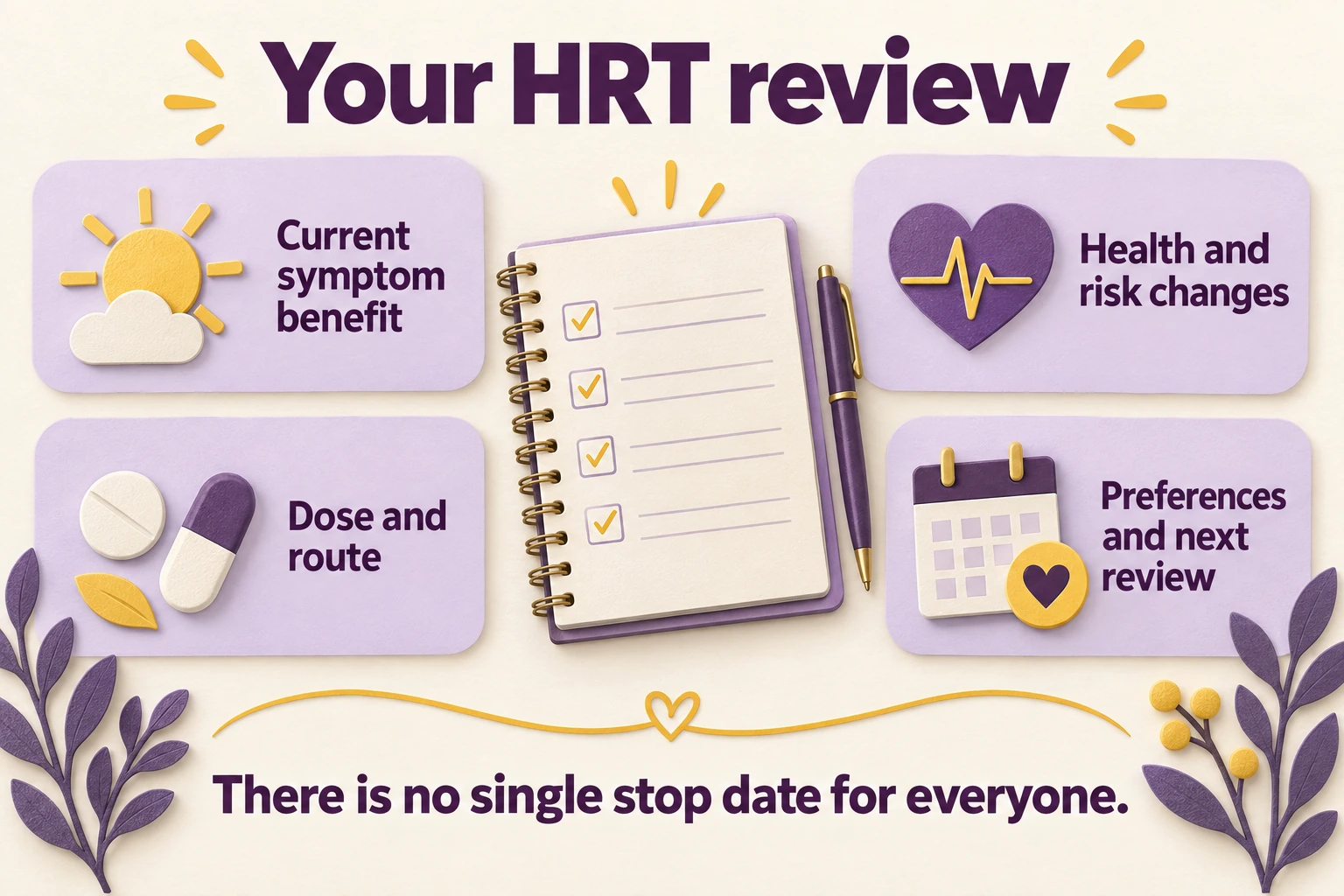
Before the visit, consider four areas: current benefit, current burden, changes in health, and your preference. Bring examples rather than a long list of general worries. “I sleep through most nights now but the patch irritates my skin” gives the clinician two concrete issues to address.
Questions to ask include:
- What is the main reason for continuing my current treatment?
- Has my benefit-risk balance changed since the last review?
- Would a different dose or route make sense, and why?
- If I stop, what symptoms might return and what is the follow-up plan?
- Does vaginal care or bone protection need a separate plan?
- When will we reassess this decision?
The starting HRT questions remain useful for long-term users, too. Understanding the purpose of the prescription is not a one-time task. A good review updates that understanding as your health and priorities change.
Common questions
Must everyone stop after five years?
No. Duration is one part of the assessment, and different regimens have different risk profiles. The decision should be individualized and reviewed rather than made from a fixed rule alone.
Does turning 65 mean HRT becomes forbidden?
No. Routine discontinuation solely because of age is not recommended by the Menopause Society. Continuing requires an appropriate indication and periodic reassessment; starting for the first time later in life is a separate discussion.
If symptoms return, does that mean I need HRT forever?
Not necessarily. Symptom recurrence can lead to a discussion of restarting, another treatment, or supportive care. The appropriate option depends on severity, health history, time off therapy, and preference.
Can a hormone test tell me when to stop?
There is no universal laboratory result that answers the duration question. The treatment goal, symptom burden, health risks, and personal priorities usually provide the more useful framework.
Can I restart the old prescription after a long break?
Arrange a review first. Your health, other medicines, and time since menopause may have changed. An old prescription does not automatically remain the right regimen after a substantial gap.
Related reading
- Brain Fog During Menopause: What HRT Can and Cannot Do
- HRT After Hysterectomy: Why Ovary Status and Medical History Matter
- Bleeding on HRT: Patterns to Track and When to Seek Care
- HRT and Migraine: Aura, Hormone Fluctuations, and Treatment Questions
- Menopause hormone therapy: the complete starting guide
- HRT benefits and risks
- Menopausal skin care and changing skin needs
Educational information for adults; personal treatment decisions require a qualified clinician. Sources checked September 16, 2026. Original AI-generated illustrations depict fictional people and are not patient testimonials.