
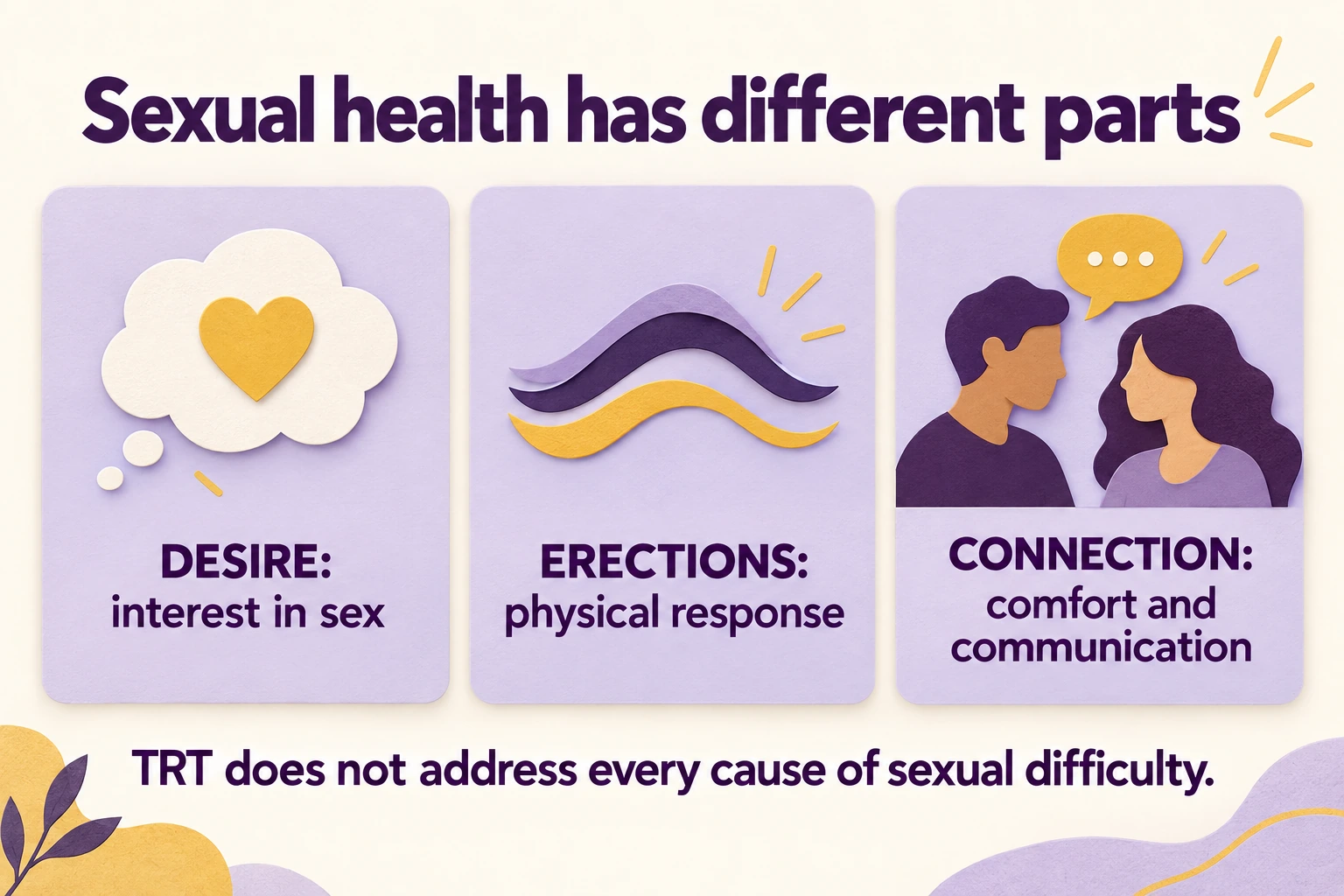
Sexual desire and erectile function are related, but they are not the same outcome. A man can want sex and have difficulty getting or maintaining an erection, or have reliable erections while experiencing little interest in sex. Testosterone replacement therapy may improve sexual desire in men with confirmed hypogonadism, but it does not address every cause of erectile dysfunction.
Separating these concerns makes the appointment more useful. Instead of asking whether TRT will “fix sex,” identify what has changed, what is most bothersome, and which parts of sexual health need their own assessment. This guide explains the evidence and the questions that can help shape a realistic plan.
Desire, arousal, erections, and satisfaction are different
Libido refers to interest in sexual activity. Arousal includes psychological and physical responses. An erection depends on a coordinated response involving blood vessels, nerves, hormones, and other factors. Satisfaction also involves comfort, expectations, communication, and the experience of the people involved.
These parts can influence one another without moving together. Repeated erection difficulties can make someone anxious and less interested in initiating sex. Low desire can affect opportunities for sexual activity even when the physical response is intact. Pain, medication effects, relationship strain, or poor sleep may add another layer.
You do not need perfect terminology. Describing a concrete change is enough to start: less interest, difficulty becoming erect, losing an erection, discomfort, or a change in orgasm. A treatment plan is easier to evaluate when it is clear which concern it is intended to address.
What low testosterone can and cannot explain
Low sexual interest can be a symptom of testosterone deficiency, but it is not diagnostic on its own. The Endocrine Society guideline requires compatible symptoms or signs and consistently low, accurately measured testosterone concentrations. Confirming the diagnosis and investigating the cause come before deciding whether TRT is appropriate.
Erectile dysfunction also has many possible causes. The NIDDK overview of ED causes includes blood-vessel and nerve conditions, certain medicines, psychological factors, and other health problems. A testosterone result is one part of that assessment rather than an explanation for every symptom.
Our low testosterone versus stress and poor sleep guide explains the overlap. If a hormone level is normal, the sexual concern still deserves attention. If it is low, other contributing conditions may still need care alongside any hormone treatment.
What the TRAVERSE sexual-function study found
The TRAVERSE sexual-function substudy included men aged 45–80 with hypogonadism, low libido, and cardiovascular disease or increased cardiovascular risk. Participants received testosterone gel or placebo. Testosterone improved sexual activity, desire, and hypogonadal symptoms, but did not show an improvement in erectile function compared with placebo.
That is an important distinction between outcomes. The study does not say that no individual can experience an erection-related change during TRT. It shows that an average benefit in desire should not be represented as proof of a corresponding erectile-function benefit in that studied population.
It also does not establish the same result for every formulation, for men with normal testosterone, or for a compounded combination product. Ask whether a claim is based on the same treatment, population, and outcome that matter to you. A broad phrase such as “better sexual performance” can hide those differences.
Why erection difficulties may need a broader health review
Erections depend partly on blood flow and nerve function. Diabetes, vascular disease, medication effects, and other conditions can be relevant. A clinical assessment may include medical history, examination, and selected testing rather than focusing only on testosterone.
Mention whether the change was gradual or sudden, whether it occurs in all situations, and whether there are other symptoms. Information about spontaneous or morning erections can help the history, but it does not establish a diagnosis by itself. The clinician should interpret the whole pattern.
A useful question is: “Does this concern suggest anything else about my health that should be checked?” The purpose is not to assume that every erection difficulty signals a serious disease. It is to avoid overlooking a condition that may benefit from treatment and to choose an intervention that matches the likely cause.
TRT and ED medicines have different roles
TRT treats appropriately diagnosed testosterone deficiency. Medicines used for ED, such as phosphodiesterase-5 inhibitors, act through a different pathway to support erections. Other options may include counseling, devices, or specialist treatment, depending on the cause and preference.
The NIDDK treatment guide explains these approaches and notes that a clinician may sometimes use testosterone with an ED treatment when both are indicated. Combining treatments is a prescribing decision, not a reason to stack products independently.
If a medicine is already being used, bring its name, strength, instructions, and the actual experience with it. Ask whether the response suggests a need to review administration, interactions, the diagnosis, or another option. A disappointing response does not automatically mean you need more testosterone or an additional ED drug.

How to evaluate a compounded product page
The CoreAge Rx 4Play page describes a compounded oral suspension containing apomorphine, sildenafil, tadalafil, and vardenafil. Readers comparing that service should discuss the complete combination with a licensed prescriber, including why it is being considered and how its risks compare with available alternatives.
The presence of ingredients used in other medicines does not make the compounded combination FDA-approved or establish that it has the same evidence as each ingredient used individually. The FDA’s explanation of compounded-drug risks explains that compounded drugs do not undergo FDA review for safety, effectiveness, and quality before marketing.
Do not add other ED medicines to a prescribed combination or combine it with nitrates. Make sure the prescriber knows about heart medicines, blood-pressure medicines, and every sexual-health product you use. A product page can explain the offering, but it cannot determine that the formulation is suitable for your medical history.
Fertility and sexual function should be discussed separately
Improved libido or erections does not establish that sperm production is normal. Exogenous testosterone can suppress the hormonal signals needed for sperm production, even when sexual interest improves. This is why fertility goals should be discussed before TRT starts.
The AUA/ASRM male-infertility guideline advises against prescribing exogenous testosterone to men interested in current or future fertility. A reproductive specialist can help evaluate appropriate alternatives and explain what testing is relevant. A semen analysis answers a different question from a blood testosterone level.
Our TRT and fertility guide goes into more detail. Do not assume that normal ejaculation, a strong sex drive, or a higher testosterone result means fertility is protected. Also do not rely on TRT as contraception; suppression of sperm production is not a reliable contraceptive plan.
Track the outcome that matters to you
Before treatment, choose a small number of goals. A person primarily bothered by low interest may track whether desire has returned to a personally comfortable level. Someone with erection difficulties may focus on reliability in the situations that matter to them. Another person may prioritize less anxiety or more comfortable communication.
Avoid judging success by comparison with an online account or by a frequency target that neither partner wants. Sexual health is not a performance score. The useful question is whether the plan improves a meaningful concern without creating unacceptable side effects or pressure.
If treatment changes more than one area, record each separately. “Interest improved, but erections are unchanged” is useful information. It helps the clinician decide whether a treatment is providing a real benefit and whether a separate concern remains. Our TRT results timeline guide explains why outcomes do not necessarily change at the same pace.
Communication can reduce avoidable pressure
A partner may interpret lower interest as rejection or an erection difficulty as lack of attraction. When appropriate and comfortable, a conversation can separate the health concern from assumptions about the relationship. It can also clarify which changes matter to both people.
You can start with a simple statement: “I have noticed a change and want to understand it. I do not want either of us to guess what it means.” There is no requirement to disclose every medical detail before you are ready, but shared expectations can make treatment decisions less pressured.
Counseling may be helpful when anxiety, relationship strain, or emotional concerns are part of the problem. That does not mean symptoms are imaginary or exclusively psychological. The NIDDK treatment resource includes counseling as one option within broader care. Physical and emotional contributors can be addressed together.
Sleep, activity, and metabolic health still matter
General health habits can support sexual health and help address contributing conditions. They should be practical and tailored to the person rather than presented as a guarantee. A clinician can help identify whether sleep apnea, diabetes, medication effects, smoking, or another factor deserves particular attention.
The TRT and sleep-apnea article is useful when snoring, gasping, or daytime sleepiness accompanies sexual concerns. Readers working on nutrition and activity can explore sustainable weight-management habits without assuming that weight alone explains the problem.
If a separate weight-management consultation is appropriate, the tirzepatide service information and tirzepatide questions guide describe a different treatment area. A compounded weight-management offering is not an ED treatment or a substitute for evaluating a new sexual-health concern.

Side effects and urgent symptoms should be clear
Before using any sexual-health medicine, ask what side effects are expected, which require contact, and which need emergency care. An erection lasting longer than four hours requires emergency assessment. Sudden vision or hearing loss after an ED medicine also needs immediate medical attention.
If chest pain, fainting, or severe shortness of breath occurs, seek urgent help and tell the treating team exactly which medicines were taken and when. Accurate medication information matters for emergency treatment choices. Do not omit a compounded product because it feels different from a conventional prescription.
TRT has its own monitoring needs, including blood counts and other assessments appropriate to the patient. The TRT monitoring guide explains why a sexual benefit does not remove the need for ongoing review of the rest of the treatment.
Common questions
Will TRT cure erectile dysfunction?
Not reliably. It can be appropriate for confirmed testosterone deficiency, but ED often has additional or different causes. The expected outcome should be discussed separately from changes in desire.
Can libido improve while erections do not?
Yes. These are distinct outcomes, and that pattern is consistent with the overall findings of the TRAVERSE sexual-function substudy. It is useful information to bring to follow-up.
Should I raise my TRT dose if sex is still difficult?
Do not change the dose yourself. Persistent difficulty may call for a review of the diagnosis, medication effects, vascular or nerve health, mood, sleep, or a separate treatment rather than greater testosterone exposure.
Does better sexual function mean my fertility is normal?
No. Sexual function and sperm production are different. Discuss fertility goals before treatment and ask which evaluation is appropriate.
What should the first appointment accomplish?
It should clarify the symptom, identify relevant health and medication history, decide whether hormone testing or another assessment is indicated, and establish a follow-up plan. The TRT overview can help prepare for that discussion.
Related reading
- Low Testosterone, Stress, or Poor Sleep? Sorting Out Overlapping Symptoms
- Total vs. Free Testosterone: Understanding SHBG and Lab Results
- TRT and Sleep Apnea: Screening, Symptoms, and Follow-Up
- TRT and PSA: Understanding Prostate Monitoring Without Panic
- Testosterone replacement therapy: the starting guide
- TRT side effects and monitoring
- TRT and fertility planning
- Tadalafil timing and safety questions — Separate an approved tablet response window, daily use, interactions and compounded combinations.
Educational information for adults; personal treatment decisions require a qualified clinician. Sources checked September 16, 2026. Original AI-generated illustrations depict fictional people and are not patient testimonials.