
ColonBroom is a product range, not one unchanging formula. Its original powder is built around psyllium fiber; the Premium version adds other ingredients. That distinction matters when someone asks whether it “works,” because help with bowel regularity and proof of lasting weight loss are different questions.
This review examines the original ingredient label, the registered Premium study, practical safety concerns, and how to compare fiber products. It is based on published product information and the study record, not a personal testimonial. Sources were checked September 26, 2026.
What is in the original ColonBroom powder?
The company’s ingredient page lists an approximately 5.7-gram scoop containing 3.6 grams of psyllium husk powder, 3 grams of dietary fiber, including 2 grams of soluble fiber, and 20 calories. The page describes 60 servings per container and also lists flavoring and other ingredients.
These figures apply to the original formula shown on that page. They should not be assumed to describe every flavor, later formulation, Premium product, or capsule sold under the brand. Compare the actual Supplement Facts panel on the product being purchased.
The amount of powder, amount of psyllium, and amount of dietary fiber are not interchangeable. A scoop’s total weight includes ingredients other than fiber. That distinction is useful when comparing cost or trying to understand how much a supplement contributes to daily intake.
What can psyllium reasonably do?
Psyllium is a bulk-forming fiber used for constipation. It absorbs liquid and changes the bulk and consistency of stool. That is a different mechanism from a stimulant laxative, and it does not mean the product removes unspecified toxins or produces an internal “cleanse.”
The brand’s ingredient page itself uses both “bulk-forming laxative” language and a “no laxatives” claim. The clearer description is the actual ingredient and its function. A reader should not have to infer the mechanism from a slogan.
For context, our fiber supplement guide explains common uses and limitations, while soluble versus insoluble fiber explains why fibers do not all behave alike. Improving bowel habits is a meaningful goal on its own; it should not be relabeled as proof of fat loss.
Is ColonBroom Premium the same product?
No. The company’s product explanation describes Premium as a psyllium-based blend with additional ingredients, including L-carnitine tartrate, Capsimax cayenne extract, chromium, vitamins B6 and B12, and iron. The registered Premium trial also identifies a combination formula.
Each additional ingredient creates its own evidence and safety questions. A study of psyllium alone cannot establish the effect of the entire blend, and a Premium trial cannot automatically prove the effect of the original powder or a separate GLP-1-branded capsule.
Check the precise formula and serving information before comparing products. If you already use a multivitamin, another fiber supplement, or products containing the same added nutrients, review the combined intake with a qualified professional rather than considering each label in isolation.
Does ColonBroom have a clinical study?
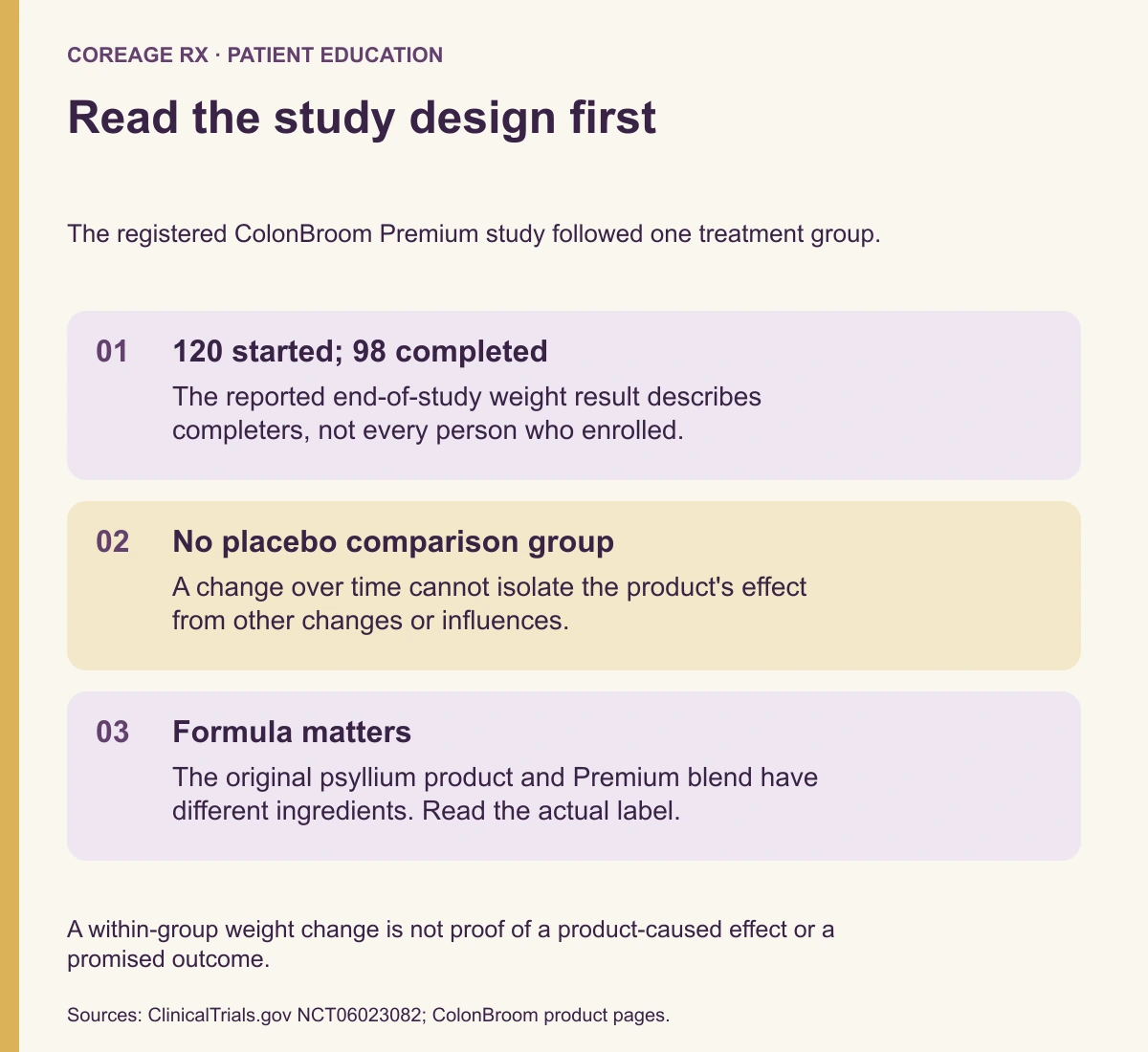
Yes. ClinicalTrials.gov record NCT06023082 describes a 12-week study of Colon Broom Premium sponsored by Gut Health, UAB. The study enrolled 120 participants, and 98 completed it. Participants were adults aged 30 to 50 with a BMI of at least 25 and self-reported digestive concerns.
It was a single-group study without a placebo comparison. The registry lists no masking, while noting that participants were kept unaware of the supplement’s brand and name. Concealing a brand name is not the same as randomly comparing an active product with an indistinguishable placebo.
Results are posted in the registry. The right conclusion is therefore neither “there is no study” nor “a study proves every advertised benefit.” The design determines which questions the results can answer.
What did the weight results show?
For the 98 participants included in the reported weight outcome, the registry lists a mean weight of 194.81 pounds at baseline and 189.86 pounds at week 12. That is a before-and-after difference of about 4.95 pounds in the studied group.
| What the study reports | What remains uncertain |
|---|---|
| Weight changed during the 12-week study | How much of that change was caused by the supplement |
| Participants used a Premium combination product | Whether the original powder or another formula would have the same result |
| The weight outcome includes 98 participants | How missing follow-up and the experience of noncompleters affect interpretation |
| There was no placebo group | How results compare with no supplement, another fiber, or a different intervention |
Without a comparison group, the study cannot separate the supplement’s effect from changes in behavior, ordinary variation, study participation, or other influences. Statistical significance for a before-and-after change does not solve that problem. The result is not a promise that a new customer will lose five pounds.

What about the study’s safety findings?
The registry results report no serious adverse events among the 120 participants and record nonserious gastrointestinal events, including diarrhea and bloating/gas. Five participants discontinued because of side effects. Events were assessed nonsystematically, according to the registry.
That is useful information, but a small, short study cannot rule out uncommon harms. Its eligibility criteria also excluded several groups, including pregnant or breastfeeding people, people with chronic constipation, and people with certain significant digestive problems.
Do not assume the study establishes suitability for a condition or population it excluded. The decision to try a fiber supplement should account for symptoms, swallowing ability, medications, and any known bowel disorder.
Is feeling less bloated the same as losing body fat?
No. Bowel contents, fluid balance, gas, and meal timing can influence abdominal comfort and short-term scale readings. A person may feel more comfortable after bowel habits improve without demonstrating a sustained change in body fat.
Likewise, a photograph of a flatter-looking abdomen cannot establish what changed or why. Lighting, posture, clothing, timing, and other behaviors are usually uncontrolled. A testimonial can describe an individual’s experience, but it cannot predict the result for another customer.
Our fiber and fullness guide discusses how fiber fits into eating patterns without turning satisfaction into a guaranteed weight-loss claim. A sustainable care plan should also consider nutrition, function, and the ability to maintain daily routines.
Water and swallowing precautions are essential
The product’s instructions and cautions emphasize adequate water because the powder can swell and cause choking or blockage if taken improperly. Follow the exact package directions and do not swallow the powder dry. Ask a clinician before use if you have difficulty swallowing or a condition that limits fluids.
If chest discomfort, trouble swallowing, vomiting, or breathing difficulty develops after taking a swelling fiber product, seek appropriate urgent care. A potential blockage or serious allergic reaction should not be managed by simply taking another serving.
Read our fiber and water guide for the practical relationship between fluids and bulk-forming products. A general instruction to “stay hydrated” should never override an individualized fluid restriction or swallow assessment.
Medication timing and side effects need review
The brand advises separating its product from medicines, but the correct interval can depend on the actual medication. Ask the pharmacist about the complete list, especially when a medicine’s absorption or monitoring is important. Do not assume one internet spacing rule covers every prescription.
Our fiber and medication-timing guide explains that review. Bloating or changes in bowel habits can also occur when fiber intake changes; the starting-fiber guide describes a gradual, symptom-aware approach rather than a race to the largest serving.
Persistent abdominal pain, vomiting, bleeding, or significant new bowel changes require assessment. Do not keep escalating fiber to treat a problem whose cause has not been established. Psyllium and other formula ingredients can also cause allergic reactions in susceptible people.
How should ColonBroom be compared with another fiber product?
Compare the same functions and quantities. Check grams of dietary fiber per serving, the type of fiber, added ingredients, flavoring, tolerability, and the number of servings you will actually use. A larger tub or heavier scoop does not necessarily supply more fiber.
For cost, use the actual purchase terms, including shipping, a subscription if selected, and the next renewal price. Compare cost per intended serving or per gram of fiber when that is the relevant goal. A discount on a large first shipment does not establish the ongoing cost.
Our fiber capsules versus powder article explains practical format differences. CoreAge Rx Full House fiber capsules should be assessed using their own label and fiber content; they should not be assumed equivalent to the ColonBroom formula or its Premium study.

Food, supplements, and weight-management care have different roles
A fiber supplement may help fill a specific intake gap or address an appropriate bowel concern, but it does not replace the variety of nutrients in food. Our food fiber versus supplements guide discusses meals, preferences, and practical ways to increase food variety.
If weight or metabolic health is the main concern, consider a clinical assessment rather than expecting a bowel supplement to answer every part of the problem. The calorie-intake guide and balanced-meal guide offer related planning questions.
Products marketed around “GLP-1” also need their own evidence review. Our natural GLP-1 article explains why an ingredient or hormone claim is not proof of prescription-like weight loss.
Frequently asked questions
Does ColonBroom detox the body?
A change in bowel regularity does not establish removal of unspecified toxins. Ask what substance is supposedly being removed and what clinical evidence supports that claim. Psyllium’s bulk-forming action is a clearer explanation than a general cleanse promise.
Is the Premium study a placebo-controlled trial?
No. The registered study had one treatment group and no placebo comparison. It provides observations about that group, with important limits on causal conclusions.
Is a more complex formula automatically better?
No. More ingredients can add cost and additional safety questions without establishing a greater benefit for your particular goal. Compare the complete formula with the evidence and the actual problem you want to address.
What is the most useful question before buying?
Ask whether you are trying to improve a specific bowel symptom, close a fiber-intake gap, or treat a weight-related health concern. Those goals call for different evidence and sometimes different care. Choose the next step around the goal rather than the product’s strongest slogan.
Educational information for adults; individual treatment decisions require a qualified clinician. Sources checked September 26, 2026. Original AI-generated article illustrations depict fictional people and objects, not patient outcomes. Other editorial images are illustrative. Graphics summarize the cited sources.