
Soluble and insoluble fiber describe how fibers behave in water. Soluble fiber can dissolve or form gels; insoluble fiber does not dissolve in the same way. Both occur in foods, and the distinction is useful—but it is not the only property that determines a fiber’s effect.
The basic difference
MedlinePlus describes soluble fiber in foods such as oats, beans, and some fruits, and insoluble fiber in foods such as whole grains and vegetables. Many foods contain a mixture, so you do not need to assign every food to one exclusive category.
| Type | A useful way to think about it | Label caution |
|---|---|---|
| Soluble | Can interact with water in solution or a gel | Not every soluble fiber has the same viscosity or effect |
| Insoluble | Remains structurally distinct in water | Food source and particle properties can matter |
| Mixed food fiber | A combination within ordinary foods | Total grams do not describe every characteristic |
Why “soluble” does not mean identical
Psyllium, glucomannan, and inulin can all appear in discussions of soluble fiber, yet they differ in gel formation and fermentation. The fiber evidence review explains why those physical properties can influence outcomes.
This is why a study of one fiber cannot be assigned to all products using the word “soluble.” The ingredient, amount, preparation, and goal still need to match. Our psyllium-versus-glucomannan comparison illustrates that point.

Build variety through foods
An ordinary food plan can include oats or whole grains, beans or lentils, fruits, vegetables, nuts, and seeds according to your preferences and tolerances. Think about additions you can repeat instead of trying to maximize one fiber type at every meal.
If your current intake is low, make changes gradually. A sudden jump in several high-fiber foods and supplements can make it harder to identify what your digestive system tolerates. The daily fiber guide offers a practical starting record.
What a supplement blend tells you
Full House includes psyllium and glucomannan within a 1,525 mg proprietary blend per two capsules. That blend also includes konjac root extract and apple cider vinegar powder. Its label does not disclose how many grams of dietary fiber or of each type the serving provides.
Do not use the ingredient names to fill in missing quantities. A product can contain a relevant fiber ingredient while still lacking the information needed for a precise nutrient comparison.
Keep the goal clear
If you want more food fiber, variety and consistency are practical goals. If you are trying to manage ongoing constipation or another digestive condition, discuss the suitable type and amount with your clinician. Food fiber versus supplements explains how the two can fit together without treating every fiber as interchangeable.

Use the categories as a map, not a complete prediction
Soluble and insoluble are helpful terms for describing behavior in water, but they do not capture every property relevant to digestion. A fiber’s viscosity, fermentation, and food structure can also matter. Two fibers sharing a category can therefore behave differently in a product or study.
This is why a simple chart labeling one type “good for everything” and the other “only for regularity” is too limited. The actual ingredient and the outcome being studied need attention. The fiber evidence review explains why physical properties help interpret those differences.
For everyday eating, the practical lesson is not to memorize every fiber molecule. It is to build a varied, tolerable food pattern and avoid assuming that one category replaces all the others.
Think of foods as mixtures
Many foods contain more than one type of fiber. A bean, a piece of fruit, or a whole-grain food does not need to be assigned exclusively to one side of a chart. Preparation, portion, and the specific food affect the overall contribution.
The MedlinePlus overview gives examples of foods associated with soluble and insoluble fiber. Use those examples to expand variety rather than to divide the kitchen into rigid categories. A mixed meal can contain several sources at once.
This approach also makes meal planning easier. Instead of asking whether every breakfast has a mathematically ideal soluble-to-insoluble ratio, ask whether the week includes fiber-containing foods you enjoy and tolerate. A clinician-directed diet may require a more specific approach, but a general article should not invent a universal ratio.
Compare viscosity and fermentation in plain language
Viscosity concerns how thick or gel-like a fiber becomes under relevant conditions. Fermentation concerns how microbes use the material. These properties are different: a fiber’s interaction with water does not fully describe its interaction with gut microbes.
Psyllium, glucomannan, and inulin are often mentioned in soluble-fiber discussions, yet they should not be treated as identical ingredients. The relevant research depends on the particular preparation and amount. A product cannot inherit every benefit reported for every soluble fiber merely by using that category on a label.
For someone comparing supplements, this means asking a focused question: which fiber was studied for the outcome I care about? The answer may be more useful than the broad category or a front-panel promise of digestive support.
Build variety with a few repeatable choices
A practical plan could include oats or another suitable whole-grain option at breakfast, beans or lentils in a familiar lunch or dinner, and fruits or vegetables that fit your preferences. Nuts and seeds may also fit some people’s routines. The exact choices depend on tolerance, allergies, budget, and medical needs.
You do not need to change every meal at once. Start with one place where a fiber-containing food would be easy to repeat. Perhaps a familiar fruit is convenient for a snack, or a tolerated bean can be added to a dish you already make.
If your current intake is low, build gradually and review fluid needs. If a clinician has prescribed a restricted-fiber plan, follow that individualized advice instead of overriding it with general food-variety suggestions. The daily-fiber guide helps organize a starting record.
Read a supplement blend without assigning missing quantities
Full House’s reviewed label includes psyllium husk powder and glucomannan, along with konjac root extract and apple cider vinegar powder, in a 1,525 mg proprietary blend. The presence of these names does not disclose the amount of each fiber type.
You cannot calculate a soluble-to-insoluble ratio from the reviewed panel. You also cannot count the entire blend as dietary fiber. The label identifies components and a total formulation weight, while leaving individual amounts and a dietary-fiber total unstated.
This is a useful distinction even if you prefer the capsule format. Convenience can be evaluated directly, but nutrient and study-dose comparisons require the relevant amounts. The Full House guide keeps those known and unknown details together.
Match symptom questions to appropriate assessment
If your goal is general dietary variety, a food plan may be the main focus. If you are trying to address persistent constipation, diarrhea, pain, or a sudden change in bowel habits, the type of fiber is only one part of the assessment.
Do not assume that choosing the opposite category will solve every symptom. A problem attributed to “too much insoluble fiber” may involve serving changes, medicines, another ingredient, or an unrelated condition. A clinician or dietitian can help interpret the pattern.
Keep a short record of the actual foods or products changed and the symptoms. Avoid a large unsupervised restriction that removes many foods based only on a category label. The goal is a useful, tolerable plan with the original concern clearly defined.
Frequently asked questions
Do I need separate supplements for both fiber types?
Not automatically. Many foods provide mixed fibers, and supplement needs depend on the purpose and health context. Ingredient categories alone do not establish a need for two products.
Is soluble fiber always better for bloating?
No. Soluble fibers differ in properties such as fermentation and viscosity, and tolerance varies. A broad category does not predict every person’s symptoms. Review the specific ingredient, amount, and overall routine.
Can I calculate the ratio in Full House?
The reviewed label does not disclose the individual amounts or a soluble-versus-insoluble breakdown. Do not infer a ratio from ingredient order or the total blend weight.
Should I aim for an exact ratio in every meal?
A universal meal-by-meal ratio is not established by the guidance reviewed here. For general food planning, variety and an appropriate overall intake are more practical starting points. Follow individualized instructions when a medical condition requires a specific diet.
Does cooking make the food’s fiber irrelevant?
Do not dismiss a food’s fiber simply because it is cooked. The food, preparation, and portion all matter. Choose forms you enjoy and tolerate, and use reliable nutrition information for the actual food when estimating intake.
Explore Full House™
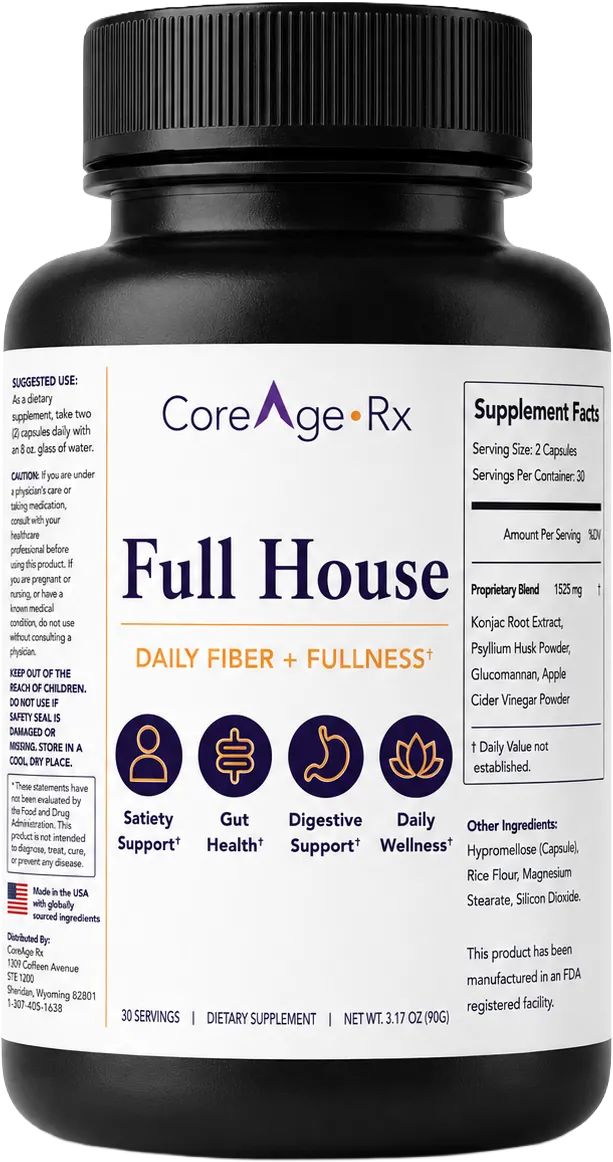
Full House combines konjac root extract, psyllium husk powder, glucomannan, and apple cider vinegar powder in a 1,525 mg proprietary blend per two capsules. See the current Full House™ page and check the bottle you receive before use.
Related reading
- Fiber Supplements: Types, Labels, and How to Choose
- How Much Fiber Do You Need Per Day?
- Fiber and Fullness: What the Evidence Can and Cannot Promise
- Constipation while taking a GLP-1 medication
Educational information, not individualized medical advice. Product information and linked research checked September 15, 2026. Ingredient research does not establish identical effects for a finished supplement.