
Tretinoin strength describes how much active ingredient is present in a preparation. It does not, by itself, tell you which prescription is best, how often to use it, or how quickly your skin will improve. The formulation, treatment goal, other products, and tolerance belong in the same decision.
For example, the reviewed U.S. RETIN-A label lists creams at 0.025%, 0.05%, and 0.1%, and gels at 0.01% and 0.025%. These are verified examples from that named product label, not a complete list of every tretinoin preparation or a ladder everyone should climb. RETIN-A cream and gel labeling.
What does the percentage mean?
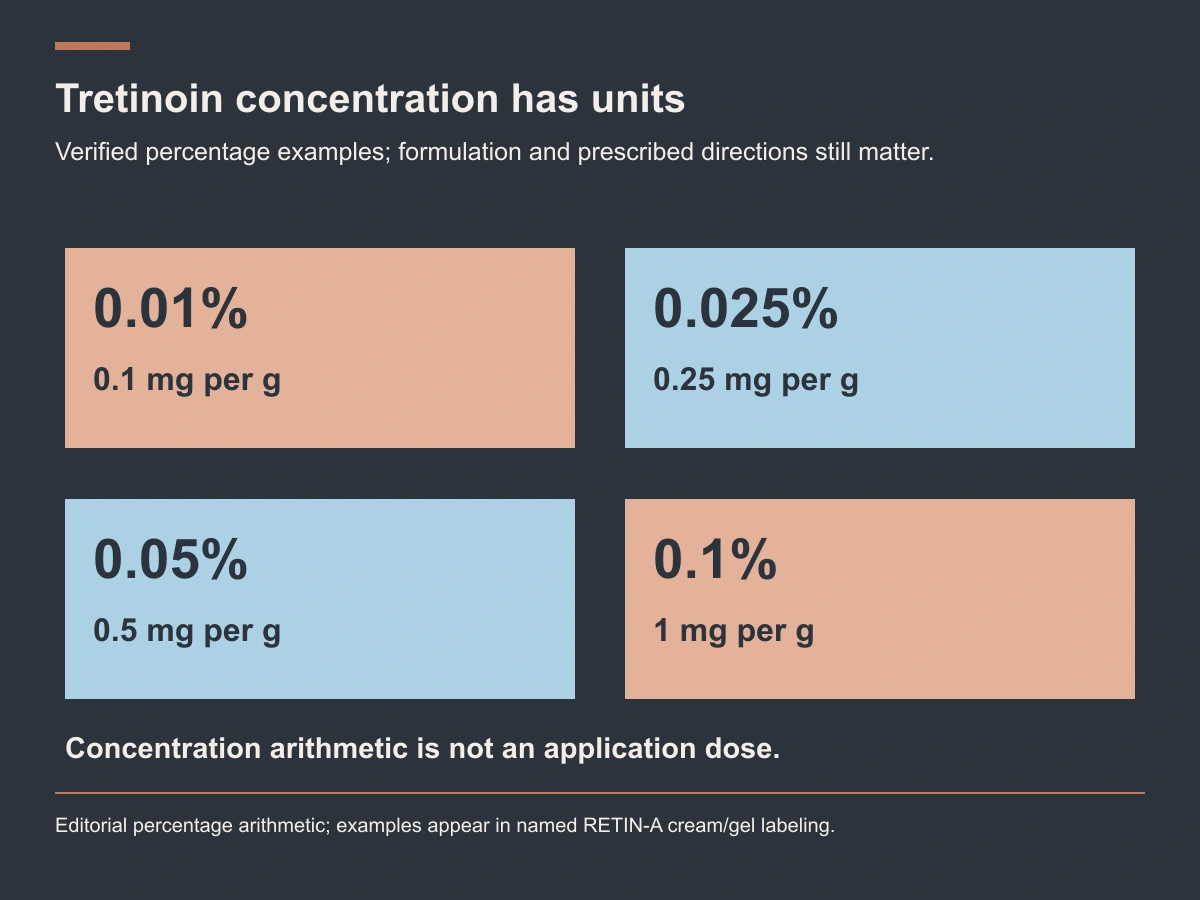
A percentage by weight describes an ingredient amount in a given weight of product. A 0.025% preparation contains 0.025 grams of tretinoin per 100 grams of preparation, which is equivalent to 0.25 milligrams per gram. This is concentration arithmetic, not an instruction for how much cream to apply.
Keeping those concepts separate helps avoid an easy mistake: a tube’s weight, the active concentration, and the amount used at an application are different measurements. A larger tube does not automatically mean a stronger preparation, and a higher percentage does not determine your personal application amount.
| Percentage example | Equivalent active amount per gram of preparation | What it describes |
|---|---|---|
| 0.01% | 0.1 mg per g | Concentration, not an application instruction. |
| 0.025% | 0.25 mg per g | Concentration, not a treatment schedule. |
| 0.05% | 0.5 mg per g | Concentration, not a promised response. |
| 0.1% | 1 mg per g | Concentration, not an automatic goal. |
The equivalents are mathematical explanations of percentages. Do not use them to weigh out tretinoin, mix products, or prepare your own dose. The dispensed prescription should specify the actual product and directions.
Which strengths appear in a verified label?
The RETIN-A label reviewed for this article describes two gel strengths, 0.01% and 0.025%, and three cream strengths, 0.025%, 0.05%, and 0.1%. It identifies these preparations for topical acne treatment. Other products, vehicles, combinations, and treatment indications need their own information. Named formulation examples.
These examples should not be presented as proof that every pharmacy stocks every option or that every online service offers all of them. A label describes a product; a prescription and dispensing arrangement determine what a particular patient receives.
If the pharmacy supplies a different brand, formulation, or compounded combination, read that product’s label and ask for clarification. Our prescription tretinoin guide explains clinician and pharmacy checks before starting a preparation.
Why the vehicle matters as well as the percentage
The vehicle is the base carrying the active ingredient, such as a cream or gel. The reviewed RETIN-A label describes different cream and gel bases, including an alcohol-containing gel formulation. Products with the same tretinoin percentage can therefore have other relevant differences. RETIN-A formulation descriptions.
The base can affect practical use and tolerance. Ask about your skin’s dryness, sensitivity, other products, and prior experiences. Do not assume that a percentage match makes two preparations interchangeable in the whole routine.
Similarly, a combination cream contains more than one active ingredient. The complete formula should be considered instead of focusing only on tretinoin. A familiar percentage from a single-ingredient product cannot define the directions for a different compounded mixture.
Is a higher percentage always better?
A higher percentage means more tretinoin per gram of preparation. It does not establish a proportional improvement in clinical results or make the product the best choice for every person. Tolerance, adherence, treatment indication, and the rest of the routine matter.
The RETIN-A label specifically warns that applying excessive amounts does not produce faster or better results and can cause marked redness, peeling, or discomfort. Increasing the amount applied is a different change from receiving another concentration, but neither should be used as an improvised shortcut. RETIN-A excessive-use warning.
A useful review asks whether the current preparation can be used as prescribed, whether the treatment goal remains appropriate, and whether troublesome symptoms are limiting use. “The highest percentage available” is not a substitute for those questions.
Does everyone need to begin at the lowest strength?
There is no universal starting prescription created by this article’s table. A clinician can consider the indication, existing skin condition, prior retinoid use, vehicle, other active products, and the directions they intend to prescribe.
Do not interpret a low concentration as permission to use unlimited amounts or apply it more frequently. Likewise, do not assume that prior experience with a cosmetic retinol product establishes tolerance to a particular tretinoin prescription.
Our guide to starting tretinoin helps organize a routine around the actual prescription. Ask for written directions covering the application area, amount, frequency, what to do with other products, and when to review the response.
Can you compare tretinoin and retinol percentages directly?
No simple percentage conversion should be used as a prescription guide. They are different ingredients, and a cosmetic’s retinol percentage is not a dose-equivalent instruction for tretinoin. The product formulation and evidence also need consideration.
Our tretinoin versus retinol guide explains the comparison and its limits. If you are switching, bring the actual product names rather than say only that you have used “a retinoid.” Include acids, acne products, exfoliants, and other actives that may affect the routine.
The reviewed RETIN-A label advises caution with concomitant topical medicines, strongly drying products, and certain other acne ingredients because of possible irritation. A product review is therefore useful even when the tretinoin percentage remains unchanged. RETIN-A concomitant-product precautions.
Acne, fine lines, and dark spots are different goals
The named RETIN-A label establishes an acne indication; it should not be used as a blanket regulatory statement for every anti-aging or pigment-treatment preparation. A discussion about fine lines, post-acne marks, or another concern should identify the product and evidence relevant to that goal. RETIN-A indication.
Ask what the clinician expects the treatment to address and what it is unlikely to change. The acne versus photoaging guide and tretinoin fine-line discussion provide related background. Different goals may require different ways to assess response.
Do not escalate a concentration simply because the original concern persists without first reviewing the diagnosis and treatment aim. A stronger retinoid cannot be assumed to solve every kind of scar, discoloration, or texture change.
When irritation should prompt a review
The RETIN-A label discusses redness, peeling, and irritation, with changes or discontinuation when the degree of irritation warrants. It also cautions about eczematous skin and advises discontinuation for a reaction suggesting sensitivity or chemical irritation. Follow the supplied directions and contact the prescriber about a significant reaction. RETIN-A precautions.
Do not treat pain, marked swelling, blistering, or crusting as proof that a high strength is working. The ability to continue a suitable routine matters, and symptoms should be described honestly rather than endured to reach a perceived goal percentage.
Our tretinoin irritation guide discusses what to review. Bring the concentration, vehicle, amount used, frequency, and other products. Those details help distinguish several changes that are often grouped together as “stronger skincare.”
Sun exposure and skin condition still matter
The label advises minimizing sunlight and sunlamp exposure and recommends sunscreen and protective clothing when exposure cannot be avoided. It also advises not using the product on sunburned skin until recovery. These precautions remain relevant when the concentration is low. RETIN-A sun precautions.
Our tretinoin sunscreen guide covers practical sun-protection questions, and the moisturizer guide explains how supportive care fits a prescribed routine. Neither sunscreen nor moisturizer makes an unsuitable prescription or excessive application appropriate.
Tell the clinician about a skin flare, broken or irritated skin, and products that have recently caused discomfort. A strength decision should account for the skin’s current condition, not only a number on a tube.
Pregnancy and breastfeeding require a specific discussion
Tell the prescribing team if you are pregnant, planning pregnancy, or breastfeeding before starting or changing treatment. The reviewed label discusses limited pregnancy information and advises an individualized benefit-risk decision; it also notes uncertainty about excretion in human milk. RETIN-A pregnancy and lactation information.
Do not assume that a lower topical concentration removes the need for this discussion or that advice for another retinoid applies unchanged. The clinician should review the exact product and the individual situation.
What strength is in CoreAge Smooth Move?
The current public Smooth Move page lists tretinoin, niacinamide, and vitamin C. Its captured ingredient summary does not disclose each ingredient’s numerical concentration. Do not assign a tretinoin percentage to the product based on a general RETIN-A table. CoreAge ingredient summary.
Ask the provider or dispensing pharmacy to confirm the prescribed formulation and written directions. Our Smooth Move ingredients guide explains why the complete combination matters. Compounded medicines have a different review pathway from FDA-approved finished products; FDA explains that compounded drugs are not FDA approved. FDA compounding explanation.
If the main concern is pigmentation, Spot On is a different CoreAge product listing hydroquinone, kojic acid, and niacinamide. Its existence does not mean it should be layered with tretinoin automatically. Discuss the actual concern and complete regimen rather than choose or combine products only by perceived strength. Spot On ingredient summary.

A useful prescription-review checklist
Confirm the active ingredients, concentration, vehicle, treatment goal, application area, amount, frequency, and follow-up plan. Ask what should happen with your current retinol, acids, acne treatments, moisturizer, and sunscreen.
Before a change, describe the response and tolerance to the current preparation. Ask whether the intended change concerns concentration, vehicle, frequency, another ingredient, or the diagnosis. A clear plan makes it easier to understand what is being evaluated.
If a refill looks different, compare the dispensing label with the prescription before using it. Confirm whether the active concentration, base, or another ingredient changed, and ask whether the previous directions still apply. Package color or tube size cannot resolve that question.
At follow-up, describe what you actually used rather than only the prescribed percentage. A preparation applied intermittently because of discomfort is a different clinical history from one used consistently as directed. That information helps the clinician decide what should change and what should remain part of the routine.
Frequently asked questions
Is 0.1% tretinoin twice as effective as 0.05%?
It has twice the active concentration per gram, but that arithmetic does not establish twice the clinical benefit. The formulation, treatment goal, tolerance, and prescribed use need consideration.
Can I mix two creams to make an intermediate strength?
Do not prepare an improvised concentration by mixing products. The ingredients and bases may differ, and the result is not a verified prescription. Ask the prescriber or pharmacy about the actual formulation required.
Does peeling mean I should move to a higher percentage?
Peeling is a tolerance question, not an escalation instruction. Explain its severity and the complete routine to the prescriber. Significant irritation needs review rather than an automatic increase.
Where can I explore Smooth Move?
Review the current Smooth Move page and bring your skincare products to the provider conversation. Confirm the dispensed strengths and directions; the general percentage examples here do not define your individual combination cream.
Educational information for adults; individual treatment decisions require a qualified clinician. Sources reviewed October 2, 2026. Original AI-generated article images depict fictional people and objects, not patient outcomes. Other editorial images are illustrative. Graphics summarize the cited sources.