
Mounjaro interactions need a review of the whole medication list, not just a check for another weekly injection. The current U.S. prescribing information highlights low-blood-sugar risk with insulin or sulfonylureas and potential effects on oral-medicine absorption because Mounjaro delays stomach emptying.
It also gives specific instructions for oral hormonal contraception: switch to a nonoral method or add a barrier method for four weeks after starting Mounjaro and for four weeks after each dose increase. These are labeled interaction questions for the care team; they are not instructions to adjust other prescriptions independently. Mounjaro U.S. prescribing information.
Start with the exact medicine and treatment purpose
Mounjaro contains tirzepatide. Its August 2026 U.S. label includes glycemic-control treatment for specified patients with type 2 diabetes and a cardiovascular-risk indication in specified adults with type 2 diabetes. Zepbound also contains tirzepatide but has separate labeling and treatment contexts. Shared ingredients do not make every instruction interchangeable. Current Mounjaro label.
Identify the brand, presentation, prescribed weekly dose, and reason for treatment. Include any compounded preparation in the medication list with its actual pharmacy and concentration. A vague description such as “a GLP-1 shot” is not enough to resolve dosing or interaction questions.
Our Mounjaro dosage guide keeps the dose tied to the prescription and presentation. The tirzepatide measurement guide distinguishes milligrams, liquid volume, and syringe markings.
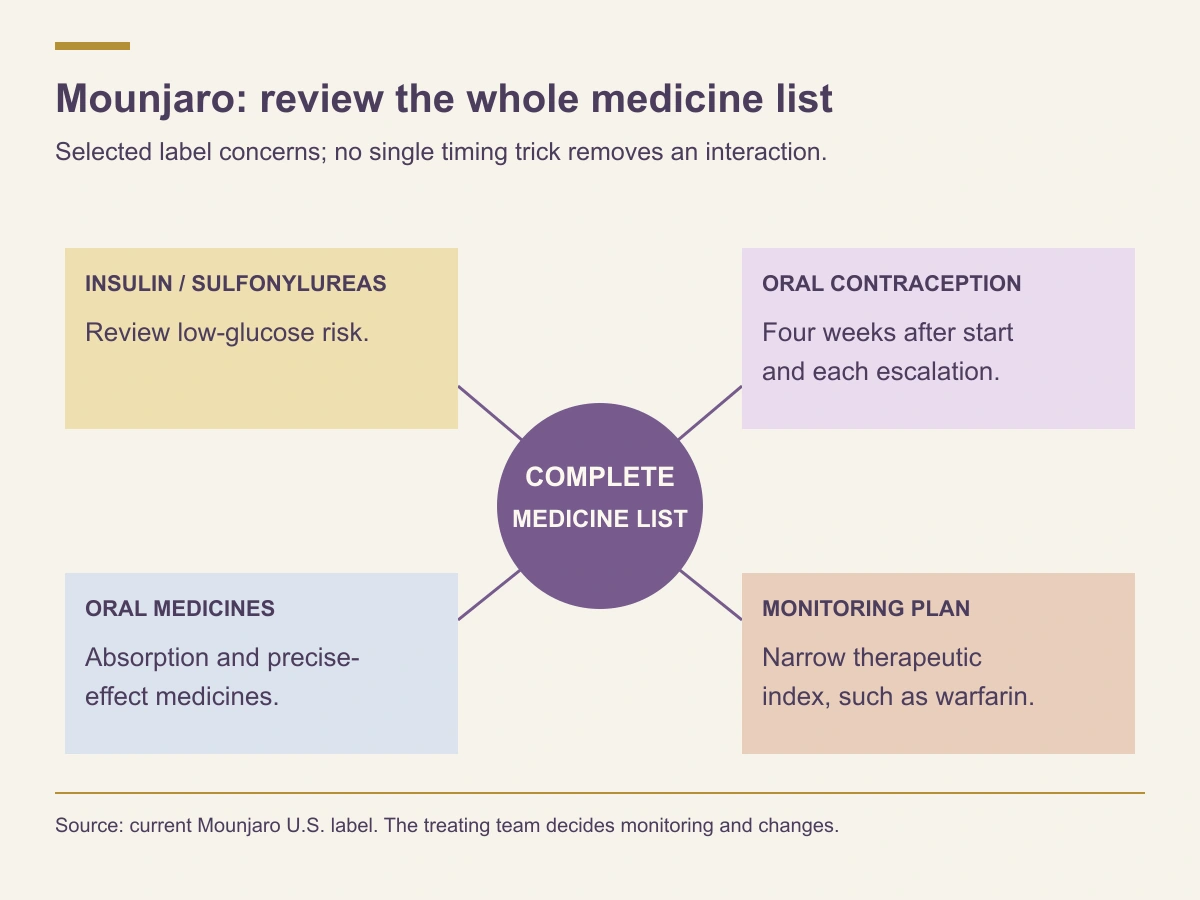
Which interaction questions does the label emphasize?
| Medicine or situation | Labeled concern or review question | Appropriate next step |
|---|---|---|
| Insulin or a sulfonylurea | Increased risk of hypoglycemia, including severe episodes. | Have the treating team review the combined plan and monitoring. |
| Oral medicines | Delayed stomach emptying can affect absorption. | Review the exact medicines and instructions with a pharmacist or prescriber. |
| Narrow-therapeutic-index medicines, such as warfarin | Monitoring is advised when used with Mounjaro. | Clarify the relevant testing and follow-up plan. |
| Oral hormonal contraception | Reduced effectiveness is a concern around initiation and escalation. | Arrange the labeled nonoral or additional-barrier plan. |
| Another injectable or diabetes treatment | Identity, purpose, administration, and monitoring need coordination. | Provide the complete list and avoid an improvised combination. |
The table is not an exhaustive interaction database. It summarizes important label-based questions, and it cannot decide whether an individual combination should continue, change, or be avoided. Mounjaro drug-interaction sections.
Why insulin and sulfonylureas need coordinated review
Mounjaro used with insulin or an insulin secretagogue, such as a sulfonylurea, can increase low-blood-glucose risk. The label notes that adjusting the other medicine may reduce that risk when clinically appropriate. The prescriber should decide the adjustment using the full diabetes plan. Mounjaro hypoglycemia warning.
Do not independently reduce insulin because you read that an adjustment may be necessary. The right plan depends on glucose patterns, the conditions being treated, food intake, illness, and the particular insulin regimen. Ask what readings or symptoms should trigger contact and how to respond to a low reading using your established instructions.
Bring glucose records if you monitor them, especially after initiation or escalation. If low appetite or vomiting changes your food intake, mention that promptly. Our GLP-1 illness guide explains why sick-day instructions need to account for insulin and other diabetes treatment as well as the weekly medicine.
Mounjaro and insulin must not be mixed in one injection
The label directs that Mounjaro and insulin be administered separately and never mixed. It permits the same general body region, but the injections should not be adjacent. Obtain practical training that fits both products and the devices you actually use. Mounjaro administration instructions.
This is an administration rule as well as a medication-review issue. Do not transfer medicine from a pen, combine liquids in a syringe, or use another product’s device routine to simplify the process. A changed presentation may require fresh training.
Our Mounjaro injection-site guide explains approved regions and device questions. A comfortable site cannot remove the systemic interaction risk of taking insulin or another medicine.
What does delayed stomach emptying mean for oral medicines?
Mounjaro delays gastric emptying and can affect absorption of medicines taken by mouth. Its label advises caution and monitoring for medicines that depend on threshold concentrations for effectiveness or have a narrow therapeutic index. Warfarin is given as an example. Mounjaro oral-medicine interaction section.
This does not mean that every oral medicine becomes ineffective or that every tablet must be stopped. It means the exact list should be reviewed. A pharmacist can consider the product, intended effect, timing instructions, monitoring, and whether symptoms such as vomiting affect the situation.
There is no universal “take all tablets two hours away from the injection” rule in the reviewed interaction section. A weekly injection’s effect should not be treated as if it disappears after a short clock interval. Follow medicine-specific advice instead of inventing a spacing schedule.
Why does warfarin get special mention?
A medicine with a narrow therapeutic index needs careful control because relatively small changes can matter to its effect or safety. The Mounjaro label specifically calls for monitoring patients taking such medicines and gives warfarin as an example. Label monitoring recommendation.
If you take warfarin, tell the team when Mounjaro is started or increased and ask how this fits the existing monitoring plan. Report important changes in intake, illness, or other medicines. Do not change an anticoagulant dose from a general interaction table.
Bleeding symptoms require appropriate assessment. Our guide to blood in stool during GLP-1 treatment discusses why the complete medicine history matters. That article is about symptom evaluation, not a personalized prediction of an interaction between warfarin and every GLP-1 product.

What should people using oral birth control do?
The current Mounjaro label advises switching to a nonoral contraceptive method or adding a barrier method for four weeks after initiation and four weeks after each dose escalation. It explains that delayed gastric emptying can reduce oral hormonal contraceptive effectiveness, with the delay largest after the first dose and diminishing over time. Mounjaro contraception guidance.
Discuss a suitable plan before treatment starts or the next increase occurs. Each prescribed escalation creates another period covered by the label’s advice. Do not wait until after an increase to discover that the contraceptive instructions were different from what you expected.
The label says hormonal contraceptives not administered orally should not be affected by this absorption concern. That statement does not establish that every nonoral method is suitable for every person. The contraception provider should consider the individual’s health and preferences.
Are birth control and menopausal HRT the same interaction question?
No. Different hormone prescriptions have different purposes, ingredients, routes, and monitoring needs. The specific four-week contraception instructions should not be copied into a blanket rule for every HRT prescription. Oral medicines still belong in the full review because of the label’s general absorption caution.
Give the actual hormone name and route, and explain whether it is used for contraception, menopausal symptoms, or another indication. The clinician or pharmacist can review the appropriate instructions rather than rely on the word “hormones.”
Our menopause hormone-therapy guide and estrogen patch versus pill discussion provide background for that conversation. They do not establish a tested interaction plan for each individual combination.
Can Mounjaro be used with metformin?
The label describes adult clinical trials in which Mounjaro was studied with metformin and other diabetes medicines. That supports a documented clinical context for combination treatment, but it is not a personal instruction to start or continue every combination. Mounjaro clinical-study overview.
The care team should consider the actual diabetes goals, tolerability, kidney history, and other prescriptions. If several medicines contribute digestive symptoms, explain the symptom pattern rather than independently choose which one to remove.
Similarly, the presence of another medicine in a trial does not eliminate the need for individualized monitoring. Clinical-study use and a specific patient’s treatment plan are related but different questions.
What about Ozempic, Wegovy, Zepbound, or compounded tirzepatide?
Tell the prescriber if you are using, switching from, or recently stopped any other GLP-1 medicine or tirzepatide product. The exact identity and time course matter. Do not improvise overlapping prescriptions, use leftover supplies to create a combination, or assume that changing the brand name removes duplicate-ingredient concerns.
This article does not create a universal washout or switching schedule. A transition should account for the products, recent doses, symptoms, and the treatment goal. Our tirzepatide versus semaglutide comparison discusses treatment fit and evidence limits.
If a compounded product is involved, review its own ingredient and pharmacy information. The compounded GLP-1 guide explains why it is not automatically equivalent to a branded product. An interaction discussion does not establish approval, quality, or a universal concentration.
Supplements and nonprescription medicines belong on the list
Include vitamins, herbal products, laxatives, pain relievers, antacids, and products taken only occasionally. Their names and ingredients can matter to the overall review. A vague entry such as “wellness supplements” makes it harder to identify what is actually being taken.
Bring labels or a written list when practical. Explain whether symptoms led you to add a new product, whether you are drinking alcohol, and whether another clinician recently changed a prescription. Ask the pharmacist to review the complete plan, including any product-specific timing instructions.
Do not interpret the limited table above as clearance for everything not named. A focused article cannot replace an up-to-date interaction review of an individual’s actual list.

Prepare for initiation and each dose change
Before the next prescribed change, confirm the weekly dose and presentation, the other medicines that need review, glucose-monitoring instructions when relevant, contraception arrangements, and who to contact if symptoms occur. Ask whether any laboratory or clinical follow-up is needed for the oral medicines you take.
Keep the plan readable and accessible. Several separate prescriptions should not become a collection of conflicting verbal instructions. If two clinicians manage different parts of your care, ask how they will coordinate important changes.
Frequently asked questions
Can I avoid interactions by injecting at night?
A different injection time does not remove the labeled concerns about hypoglycemia, gastric emptying, or oral contraception. Follow the weekly administration plan and obtain medicine-specific advice rather than assume bedtime creates a safe gap.
Should I stop every oral medicine when I start Mounjaro?
No blanket stop instruction follows from the label. The exact medicines should be reviewed, with monitoring or changes when appropriate. Important prescriptions should not be discontinued independently because of a general table.
Do the birth-control precautions repeat after every increase?
Yes. The current label specifies four weeks after initiation and four weeks after each dose escalation. Arrange a suitable nonoral or additional-barrier plan with the prescribing and contraception teams.
What should I ask a CoreAge tirzepatide service?
Review the tirzepatide page and ask about the actual formulation, complete medicine review, monitoring, and follow-up. If comparing another pathway, the semaglutide page can help organize questions. Do not treat either service page as authorization to combine or switch prescriptions independently.
Educational information for adults; individual treatment decisions require a qualified clinician. Sources reviewed October 2, 2026. Original AI-generated article images depict fictional people and objects, not patient outcomes. Other editorial images are illustrative. Graphics summarize the cited sources.