
If you are considering berberine while taking Ozempic, Wegovy, Zepbound, or another GLP-1 medicine, review the combination with your clinician or pharmacist before adding it. The available evidence about berberine by itself does not establish a reliable extra benefit or a standard safe regimen with those prescriptions.
The useful questions are specific: What benefit are you hoping to gain? Which exact supplement and medicine are involved? Could their effects or symptoms overlap? How do the rest of your medicines and health conditions change the decision?
What is berberine?
Berberine is a plant-derived compound sold in dietary supplements and studied for several metabolic questions. Its presence in plants does not make it equivalent to a prescription GLP-1 medicine.
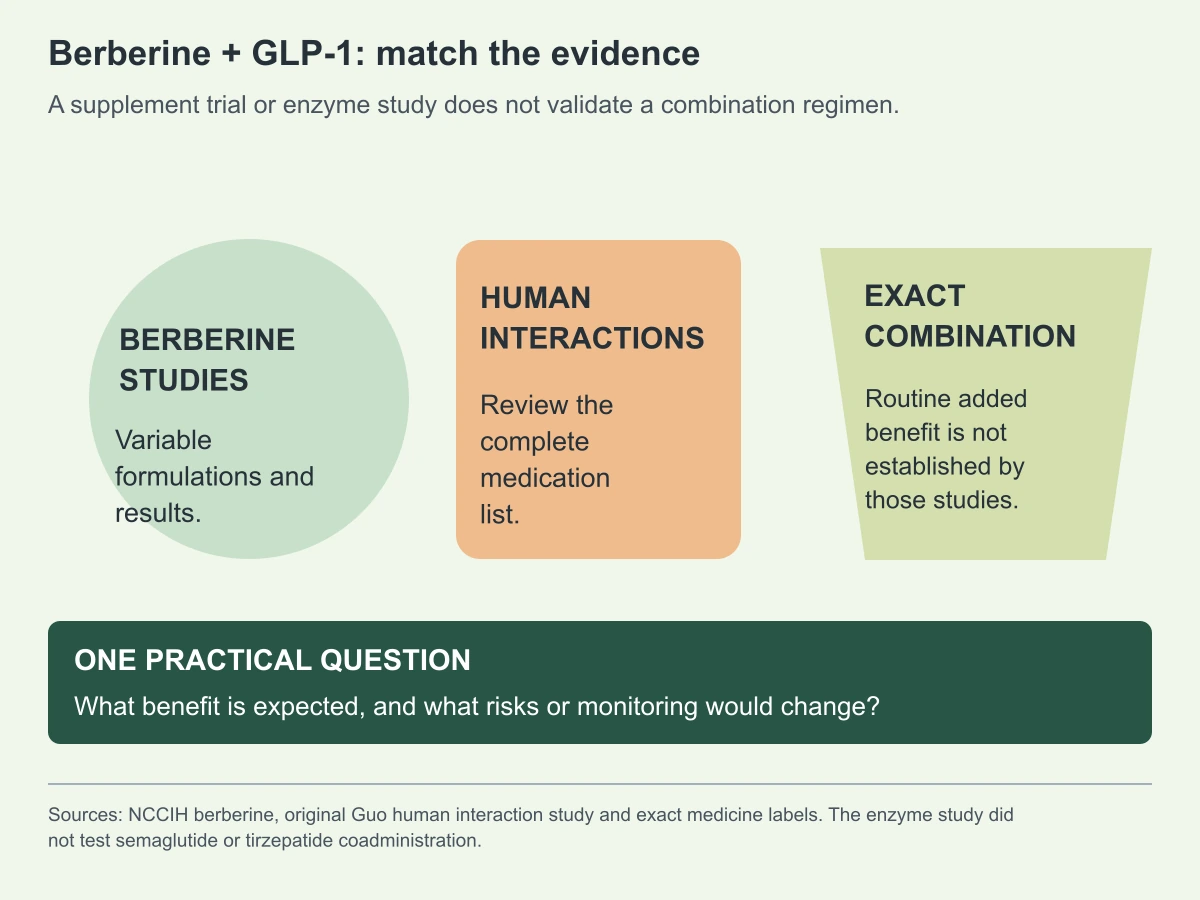
NCCIH’s berberine guidance describes inconclusive weight-loss evidence, variable study formulations, and safety concerns. Supplement trials may involve different doses, populations, and preparations. A result from one study cannot automatically be applied to every bottle on a shelf.
The phrase “natural Ozempic” is therefore misleading as a treatment comparison. Berberine and semaglutide are different substances with different evidence, regulation, and uses. A supplement should not replace a prescribed diabetes or weight-management treatment without a separate clinical decision.
Which GLP-1 medicine are you taking?
Identify the brand, active ingredient, route, prescribed dose, and any recent changes. Ozempic and Wegovy contain semaglutide, while Zepbound and Mounjaro contain tirzepatide, which acts through GIP and GLP-1 pathways. Their approved uses and product instructions differ.
The semaglutide questions guide and tirzepatide overview explain those distinctions. The label for the actual medicine—not the broad phrase “GLP-1”—belongs in the supplement review.
If the prescription is compounded, bring the pharmacy label and full formulation. A compounded preparation is not an FDA-approved branded product, and a brand’s trial results cannot establish equivalent performance or directions for it.
Do studies prove extra weight loss from combining them?
The sources reviewed here do not establish a routine added weight-loss benefit from combining a commercial berberine supplement with semaglutide or tirzepatide. Evidence that berberine may affect a metabolic measure on its own is not evidence that it improves an existing prescription regimen.
NCCIH notes that berberine weight studies have varied results and substantial limitations, including differences in formulations and participant health. Those findings do not select a personal supplement product or validate a combination schedule.
A useful clinical discussion should identify an expected benefit that can be assessed. “More weight loss” is incomplete without considering current treatment response, nutrition, symptoms, and whether another problem needs attention.
Why “different mechanisms” is not enough
Two substances can act through different pathways without producing a useful or well-tolerated combination. Laboratory findings and proposed mechanisms help generate research questions; they do not establish the clinical outcome of taking two finished products together.
Claims of synergy should therefore be matched to actual human combination evidence for the relevant formulations, doses, population, and outcome. A supplement advertisement may cite a berberine-only study or a cell experiment while implying a prescription-combination result.
Ask which study supports the exact claim and whether it actually tested the combination. The tirzepatide-versus-semaglutide guide similarly explains why the design and population of a trial matter when comparing treatment options.
Digestive symptoms can complicate the picture
NCCIH describes berberine-associated nausea, abdominal discomfort, bloating, constipation, and diarrhea. The Ozempic injection label and Zepbound label also describe gastrointestinal adverse reactions.
This overlap does not tell us how often the exact combination will cause symptoms. It does mean that adding a supplement can make a new symptom harder to interpret, particularly during initiation, escalation, or restarting a prescription.
If you already have continuing nausea, vomiting, bowel symptoms, or difficulty eating enough, report that before adding another product. The semaglutide nausea guide and tirzepatide first-month guide help organize that discussion. More discomfort is not proof of a more effective regimen.
Glucose questions depend on the complete treatment plan
Ozempic and Zepbound labels warn about increased hypoglycemia risk in relevant combinations with insulin or insulin secretagogues such as sulfonylureas. A supplement review should therefore include all diabetes medicines and any history of low glucose, rather than treating the GLP-1 prescription as the only relevant drug.
Berberine has been studied for glucose-related effects, but that does not provide a measured hypoglycemia rate for your supplement-plus-prescription combination. Ask whether the intended benefit makes sense and whether your current monitoring or medicine plan would need review.
Follow the glucose plan your treating team has given you. Do not independently reduce insulin, change a sulfonylurea, or add extra checking rules based on a supplement article. Symptoms suggesting a serious problem need appropriate care rather than waiting to see whether a new routine settles down.

Berberine can interact with other medicines
An original human interaction study by Guo and colleagues evaluated enzyme activity after repeated berberine exposure in healthy male volunteers. Seventeen participants completed the study. The researchers used specific probe medicines and found reduced activity of CYP2D6, CYP2C9, and CYP3A4.
These enzymes participate in handling many medicines, which makes the full medication list important. However, the study did not test semaglutide or tirzepatide coadministration. Its results should not be presented as a demonstrated direct interaction with either prescription.
NCCIH also describes an interaction involving cyclosporine. Tell the pharmacist about transplant medicines, anticoagulants, psychiatric medicines, and other prescriptions instead of assuming that a supplement is unrelated to them. The exact relevance depends on the actual products and clinical context.
What should you bring to the supplement review?
Bring the bottle or clear label images, including Supplement Facts, ingredients, serving size, and other active substances. Explain how often you currently take it or whether you are only considering it.
| Information | Why it matters |
|---|---|
| Exact supplement and manufacturer | Different formulations are not automatically equivalent |
| Amount listed per serving | A capsule and a labeled serving may be different quantities |
| Other ingredients | A “metabolic” blend may add several substances |
| Exact prescription and route | Brand and formulation instructions differ |
| Other medicines and supplements | Interaction assessment concerns the complete list |
| Recent prescription changes | Symptoms and response may still be changing |
| Current intake and symptoms | Tolerance and nutrition affect the decision |
| Intended benefit | Helps determine whether a trial of any addition has a clear rationale |
The dietary-supplement guidance explains why supplements are regulated differently from medicines. A quality claim or third-party test may answer a product-content question; it does not prove added weight loss or suitability for the combination.
Does taking them at different times solve the issue?
It should not be assumed to. Interaction concerns can involve effects that persist beyond the moment a capsule is swallowed. A morning-versus-evening schedule is not a validated way to make an uncertain combination appropriate.
GLP-1 medicines also have product-specific administration instructions. Those instructions should not be altered to accommodate an unreviewed supplement. Daily oral products and weekly injections have different routines, so a generic online timing suggestion may not even match your prescription.
Ask the clinician or pharmacist whether an addition is justified first. If it is, request the exact directions, monitoring, and reasons to contact the team. Do not infer a safe interval or washout from a half-life estimate alone.
Pregnancy and breastfeeding need a separate review
NCCIH describes concerns about berberine exposure in infants and possible risk during pregnancy or breastfeeding. These concerns are separate from the pregnancy precautions for the prescription medicine.
If you are pregnant, breastfeeding, or planning pregnancy, discuss every supplement and medicine with the treating team. A product marketed as botanical or natural does not automatically avoid reproductive-safety concerns.
Do not use one product’s stopping interval as the safety rule for another. A preconception plan must address the exact medicines, supplements, clinical conditions, and timing involved.
What if you have already started the combination?
Tell the prescribing team what you are taking, how long you have used it, and whether symptoms or glucose readings changed. This information is useful even if you feel well; a lack of symptoms does not establish that every medicine interaction has been excluded.
For severe or persistent gastrointestinal symptoms, difficulty maintaining fluids, or a significant change in daily function, seek clinical advice promptly. Emergency symptoms require emergency care. Keep the actual products available so the team can identify the ingredients.
Avoid changing several parts of the regimen at once without guidance. A clear history makes it easier to decide which problem needs attention and whether an addition should continue.

Could a different next step be more useful?
If weight or appetite response feels disappointing, start with the current prescription course, nutrition, administration, and follow-up. A supplement is not the automatic answer to a plateau or to little change in the first weeks.
The tirzepatide plateau guide explains how to review a longer trend without assuming the medicine has failed. Food intake, sleep, activity, symptoms, access, and the actual treatment history may reveal a more useful next step.
For service details, see CoreAge Rx’s semaglutide information or tirzepatide information. CoreAge Rx describes compounded offerings. Compounded medicines are not FDA-approved; branded evidence does not establish equivalent safety, effectiveness, or approved uses for those preparations.
Frequently asked questions
Is berberine the same as a GLP-1 medicine?
No. It is a different substance with different evidence and regulation. “Natural Ozempic” is not an accurate equivalence or a prescription-substitution instruction.
Is the combination guaranteed to cause low blood sugar?
No exact rate is established here. The complete glucose-lowering regimen, health history, intake, and supplement need review. Insulin and sulfonylureas are especially important to identify.
Can I prevent interactions by separating the doses?
Do not assume so. Effects may persist beyond the dosing moment, and timing alone does not establish a safe or useful combination.
Does a berberine study prove added benefit with tirzepatide?
Only a study actually testing a relevant combination could answer that question directly. A berberine-only trial or an enzyme study cannot supply the missing result.
Should I add it to overcome a weight-loss plateau?
Review the plateau and current treatment first. An unreviewed supplement can add symptoms or interaction questions without addressing the underlying reason for the trend.
What is the best question to ask my pharmacist?
Ask whether the exact supplement has a reasonable purpose with your exact prescription and complete medicine list, and what information would change that decision.
Educational information for adults; individual treatment decisions require a qualified clinician. Sources reviewed October 1, 2026. Original AI-generated article images depict fictional people and objects, not patient outcomes. Other editorial images are illustrative. Graphics summarize the cited sources.