
A cough that begins while you are taking Ozempic is worth discussing, but its timing does not prove the medicine caused it. The current Ozempic injection label does not list cough among its most common adverse reactions. Reflux, respiratory infections, allergies, asthma, other medicines, and several other conditions can also cause coughing.
The next step depends on the symptoms. Breathing difficulty or swelling of the face or throat needs emergency assessment. A persistent, worsening, or otherwise concerning cough needs a clinical review, rather than an assumption that it is a normal adjustment to the prescription.
What does the Ozempic label say?
The current Ozempic injection prescribing information, revised May 2026, lists nausea, vomiting, diarrhea, abdominal pain, and constipation as its most common adverse reactions. A cough frequency cannot be calculated from that list.
The absence of cough from the common-reaction list does not prove that the medicine could never contribute to a cough-related problem. Labels describe particular clinical and postmarketing evidence; they do not diagnose an individual symptom.
This article uses the injection label. A different formulation, another semaglutide brand, or a compounded preparation needs its own product review. The semaglutide questions guide explains why the exact product and treatment context matter.
When should you seek emergency help?
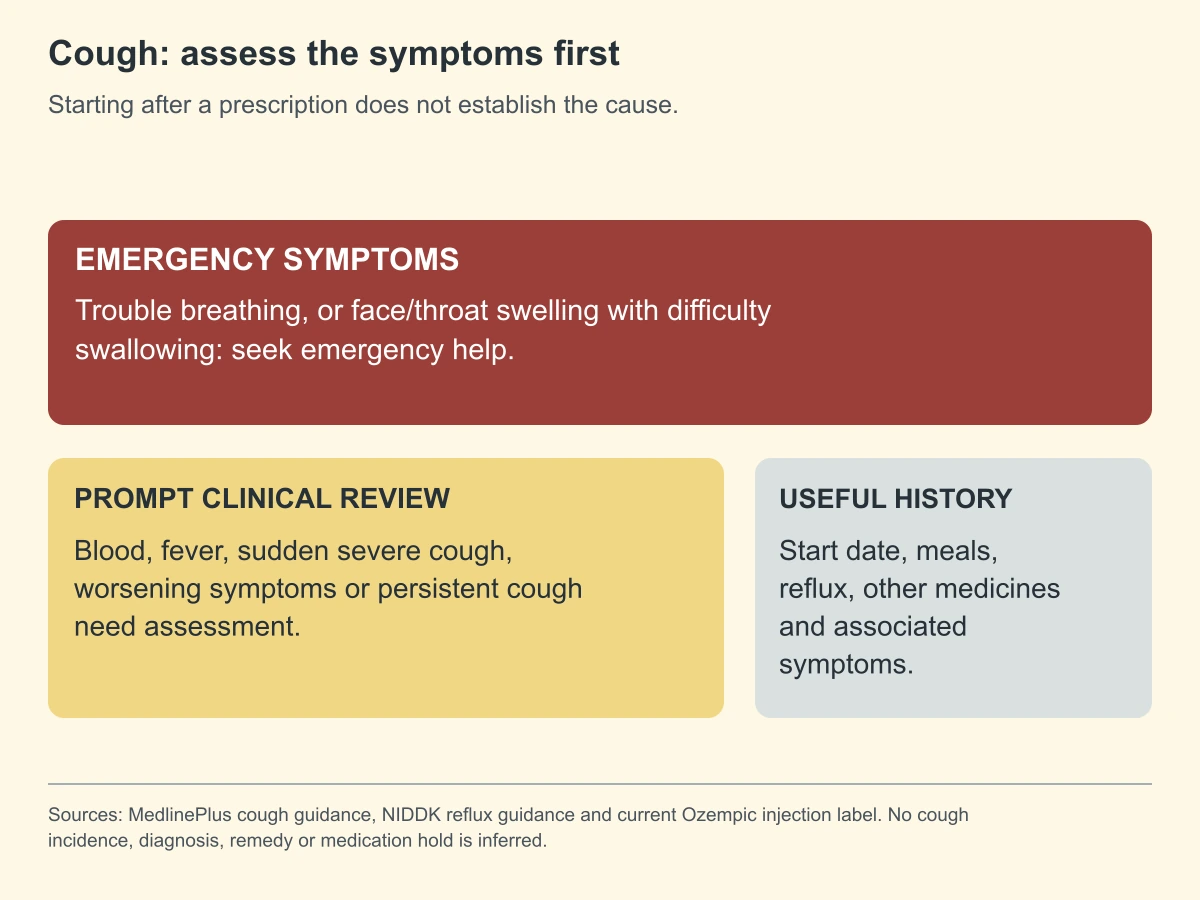
Seek emergency help for trouble breathing, or swelling of the face or throat with difficulty swallowing. The MedlinePlus cough guidance identifies those as emergency symptoms. Do not wait for a routine appointment to determine whether the cough is medication-related.
Ozempic’s label also warns about serious hypersensitivity reactions, including anaphylaxis and angioedema. Its instructions call for discontinuation and prompt medical attention when a serious hypersensitivity reaction occurs. Emergency care takes priority over sorting out which ingredient or medicine caused it.
A cough accompanied by a severe or sudden change in breathing is a different situation from an occasional throat-clearing sound. Describe the associated symptoms clearly when contacting help.
Other signs that need prompt clinical review
Contact a clinician promptly for coughing up blood, fever with concerning symptoms, a sudden severe cough, a high-pitched breathing sound, or a worsening pattern. Mention underlying heart or lung disease and any new swelling or trouble lying flat.
Persistence also matters. MedlinePlus advises contacting a provider for a cough lasting longer than ten to fourteen days. That is not an instruction to wait that long if symptoms are serious, worsening, or otherwise concerning.
Unexplained weight change, night sweats, persistent hoarseness, swallowing problems, or a new neck lump also belong in the assessment. These findings do not identify one diagnosis; they change which questions the care team may need to investigate.
Could acid reflux contribute?
It could be one possibility. The Ozempic injection label reports gastroesophageal reflux disease among gastrointestinal reactions occurring less commonly in the specified adult trials. It also explains that the medicine delays gastric emptying.
Separately, NIDDK’s reflux guidance describes chronic cough and hoarseness as possible GERD symptoms. Some adults with GERD do not have typical heartburn or regurgitation. Taken together, those facts make reflux a reasonable question to raise—not a confirmed explanation for your cough.
A clinician needs to distinguish that possibility from other causes. A cough that occurs after meals or when lying down can be useful history, but the pattern alone cannot establish the diagnosis or select a reflux medicine.
What symptoms help frame the reflux question?
Mention a burning feeling behind the breastbone, sour-tasting regurgitation, nausea, hoarseness, or swallowing discomfort. Describe whether the cough occurs near meals, overnight, or after a particular change in eating or prescription use.
Also report persistent vomiting, chest pain, signs of gastrointestinal bleeding, or unexplained weight loss. NIDDK recommends assessment for symptoms that could reflect reflux complications or other serious conditions.
The semaglutide nausea and vomiting guide and Wegovy side-effect guide provide related context, while retaining the differences between brands and labels. An article about a related medicine cannot establish the cause of your cough.

What else can cause coughing?
Common respiratory explanations include viral infections, nasal or sinus allergies, postnasal drip, asthma, and other lung conditions. Smoking and secondhand smoke can also be relevant. The symptom may have begun during treatment simply because another illness or exposure occurred at the same time.
Some medicines can cause cough too. MedlinePlus identifies ACE inhibitors, which are used for conditions including high blood pressure, heart failure, and kidney disease, among possible causes. Bring the full medicine list rather than focusing only on the newest prescription.
| Detail to describe | Why it helps the assessment |
|---|---|
| Start date and progression | Shows whether the symptom is improving, recurring, or worsening |
| Dry cough or mucus | Helps characterize the symptom without determining the cause alone |
| Fever or recent sick contacts | Adds respiratory-illness context |
| Nasal symptoms or seasonal pattern | Raises allergy and postnasal-drip questions |
| Meal or lying-down association | Adds information for the reflux assessment |
| Wheeze or breathing difficulty | Changes the urgency and respiratory evaluation |
| Other medicines and recent changes | Keeps possible medicine contributions in the review |
| Procedure or anesthesia history | Adds a separate context that the clinical team needs to know |
Does coughing mean a thyroid tumor?
A cough by itself does not diagnose a thyroid tumor. The Ozempic label’s boxed warning concerns thyroid C-cell tumors observed in rodents, with uncertain relevance to humans. It also specifies contraindications involving personal or family history of medullary thyroid carcinoma and MEN 2.
The label tells patients to report a neck mass, difficulty swallowing or breathing, and persistent hoarseness. Those symptoms need assessment; they should not be dismissed as ordinary reflux or interpreted as proof of cancer from an online description.
If you have relevant thyroid history, tell the prescribing team. Routine cough assessment and the specific thyroid warning are related safety conversations, but they are not the same diagnosis.
What if the cough followed a procedure?
The Ozempic injection label describes rare postmarketing reports of pulmonary aspiration during general anesthesia or deep sedation in people receiving GLP-1 medicines. It advises informing the care team about Ozempic before planned procedures.
That context should not be converted into a claim that ordinary daily coughing represents aspiration. A cough around a procedure, choking event, or new respiratory symptoms needs the clinical team’s assessment of what actually happened.
Tell the procedural and prescribing teams the exact medicine, route, last administration date, and symptoms. Do not choose a medication-hold interval or change fasting instructions from a general cough article. The label notes uncertainty about measures that might reduce the procedural risk.
Should you stop Ozempic because of an ordinary cough?
Contact the prescribing team to review the symptom and the treatment plan. The correct response depends on its severity, associated symptoms, suspected cause, and the reason Ozempic was prescribed. Serious allergic or breathing symptoms require urgent care, as described above.
For a nonemergency cough, do not run your own stop-and-restart experiment to determine causation. The medicine may be part of diabetes or another condition’s management, and interrupting it can affect that plan. A cough can also persist independently of a prescription change.
The semaglutide missed-dose and restart guide explains why a gap creates its own product-specific question. Do not resume a previous regimen without checking what the treating team advises after an interruption.
Can you take a cough medicine or reflux treatment?
Ask a pharmacist or clinician about the exact product, ingredients, other medicines, and health conditions. Combination cough-and-cold products can contain several active ingredients, and the most suitable treatment depends on the cough’s cause.
An empiric remedy is not a substitute for assessing red flags or a continuing symptom. Likewise, a cough that happens after meals does not automatically justify a particular acid-suppressing medicine, dose, or treatment duration.
Keep ordinary intake manageable while the problem is reviewed, particularly if nausea or poor appetite is also present. The protein shake meal guide offers food-planning context, but it does not treat a cough or establish that a liquid meal is necessary.

Preparing for the appointment
Bring the exact box or label, the prescribed dose history, and the date of the most recent injection. Explain whether treatment began, increased, or resumed before the symptom appeared. Include all other medicines and supplements.
A short symptom record is usually more helpful than repeatedly monitoring every cough. Note the pattern, meals or positions that seem relevant, associated symptoms, and impact on sleep or everyday activities.
Ask what causes are being considered, whether an examination or testing is needed, what treatment decisions should wait, and what change requires contacting the team sooner. A clear follow-up plan helps avoid treating the symptom as either automatically harmless or automatically medication-related.
For service details, see CoreAge Rx’s semaglutide information. CoreAge Rx describes a compounded offering. Compounded medicines are not FDA-approved; the Ozempic injection label does not establish the same ingredients, safety, effectiveness, or directions for a compounded preparation.
Frequently asked questions
Is cough one of Ozempic’s most common side effects?
It is not in the current injection label’s list of most common reactions. That does not provide a cough incidence or rule out a possible medicine contribution in an individual.
Can reflux cause a cough without heartburn?
Yes, NIDDK describes that possibility. It still requires assessment because several other conditions can cause a similar symptom.
Does a cough after an injection prove an allergy?
No. Report the timing and accompanying symptoms. Breathing difficulty or face or throat swelling with swallowing trouble needs emergency help, rather than waiting to establish the cause.
Should I switch to Wegovy or tirzepatide to avoid coughing?
A brand or medicine switch should follow an assessment of the cough and the treatment purpose. It is not a validated remedy for an unexplained symptom.
Will the cough disappear when semaglutide clears?
That cannot be promised. Clearance, symptom resolution, and the cause of coughing are different questions. Persistent symptoms still need review.
What is the most useful information to bring?
The exact product, treatment dates, full medicine list, cough pattern, associated symptoms, and any recent illness or procedure. Those details help the team evaluate the actual situation.
Educational information for adults; individual treatment decisions require a qualified clinician. Sources reviewed October 1, 2026. Original AI-generated article images depict fictional people and objects, not patient outcomes. Other editorial images are illustrative. Graphics summarize the cited sources.