
Overnight oats can be a convenient breakfast or snack because much of the preparation happens before you need to eat. Their usefulness for weight management depends on the finished meal: the oats, liquid, protein ingredients, fruit, sweeteners, toppings, and amount you actually eat.
There are also two different questions hiding in the phrase. Homemade overnight oats are a preparation method, while Oats Overnight is a brand with individual flavored products. A benefit of eating oats cannot establish that every branded packet has the same ingredients, nutrition, or effect on weight.
What are overnight oats?
Ordinary overnight oats are oats soaked in liquid under refrigeration so they soften before eating. Recipes may include milk, yogurt, fruit, seeds, spices, or other ingredients. Some people prefer a spoonable jar; other preparations are designed to be thinner.
The appeal is practical: breakfast can be ready when work, family, or commuting leaves little preparation time. You can also choose a texture and flavor you find manageable. Convenience can help you use a meal regularly, but it does not prove that the preparation itself causes weight loss.
If you use a commercial packet, follow its instructions. An oats-and-milk recipe and a powdered high-protein product can require different liquid amounts and preparation steps.
What benefits are reasonable to expect?
Oats can contribute carbohydrate and fiber, while other ingredients add their own nutrients. Milk, yogurt, or a formulated protein ingredient can change the protein contribution. Fruit and seeds provide different textures and variety.
The best benefit may be having a breakfast you can prepare, afford, enjoy, and fit into the rest of your day. That is different from a promise that soaking oats burns fat, speeds metabolism, or removes calories.
Think about whether the meal leaves you comfortable and adequately nourished, rather than demanding that it keep you full for an exact number of hours. Appetite, activity, other meals, medicines, and the amount eaten can affect that experience.
Can overnight oats fit a weight-management plan?
They can fit many eating patterns, but the name does not establish the portion or total intake. A small jar with plain oats and milk differs from a large jar with sweetened yogurt, nut butter, dried fruit, syrup, and several toppings.
The macros guide explains how protein, carbohydrate, fat, and overall intake work together. The calorie-needs guide also explains why a person’s appropriate intake cannot be selected from one breakfast’s calorie number.
If you find the meal useful, there is no need to make it the only breakfast you eat. Variety and practicality matter. A dietitian can help adapt an ordinary food to your needs without turning it into a rigid rule.
Oats Overnight: read the exact flavor’s panel
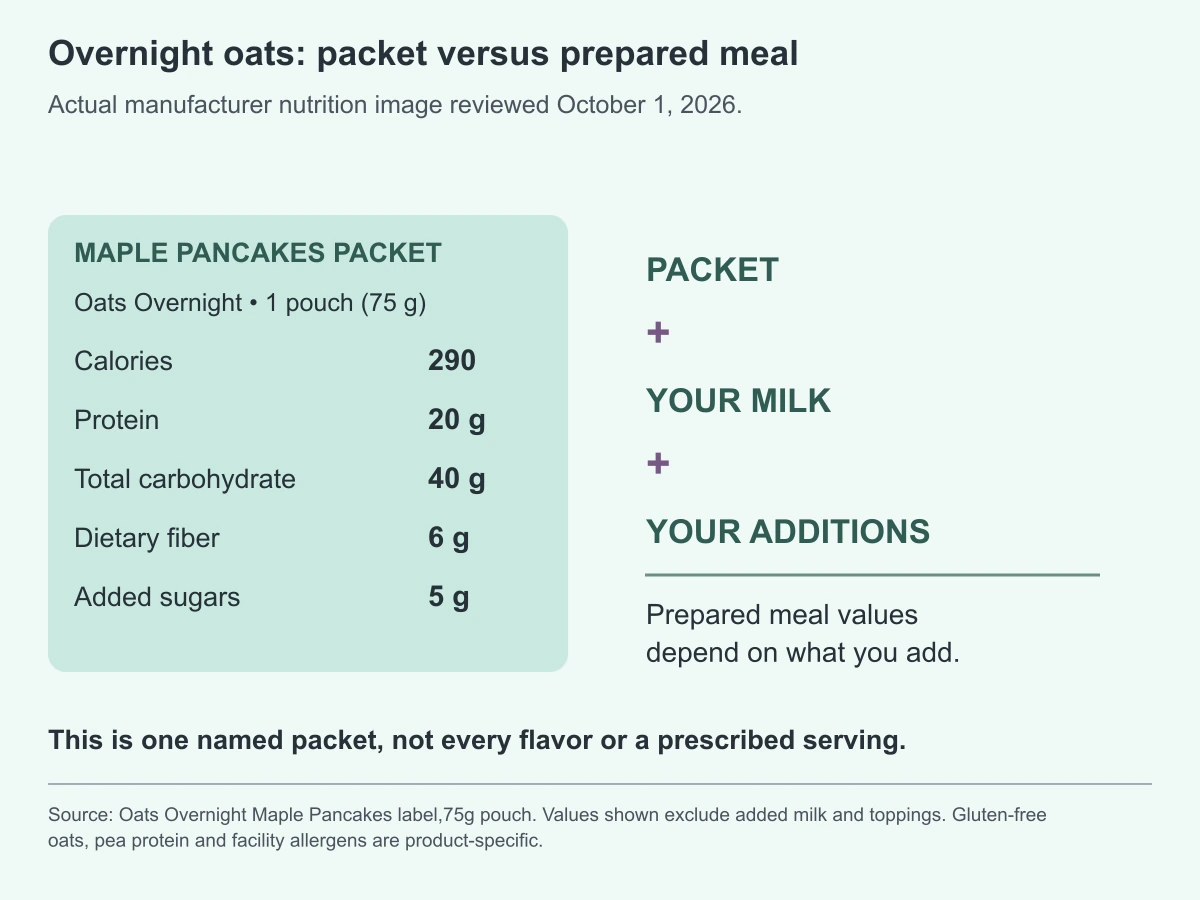
For a concrete example, we reviewed the manufacturer’s current Maple Pancakes nutrition image. Its panel identifies one pouch weighing 75 grams. The values describe that pouch, rather than the finished meal after adding milk or toppings.
| Maple Pancakes pouch, 75 g | Manufacturer panel value |
|---|---|
| Calories | 290 |
| Protein | 20 g |
| Total carbohydrate | 40 g |
| Dietary fiber | 6 g |
| Total sugars | 9 g |
| Included added sugars | 5 g |
The label lists certified gluten-free whole-grain rolled oats and pea protein isolate, along with date powder, molasses powder, chia seeds, flaxseed, maple sugar, hemp hearts, flavor, salt, and monk fruit. It also states that the facility handles milk, peanuts, and tree nuts.
This is one named product reviewed on October 1, 2026. Do not transfer its panel to another flavor, a retailer’s older package, or a different serving size. Check the pouch in your hand if the formulation changes.
Why the milk changes the calculation
The liquid you add has its own nutrition. Dairy milk, fortified soy beverages, and other plant-based drinks can differ in protein, carbohydrate, fat, energy, and fortification. Sweetened and unsweetened versions may also differ.
If you are comparing a packet with a homemade breakfast, compare the finished preparations. Counting only the powder in one meal while including milk and fruit in another creates a misleading comparison.
The FDA label guidance helps identify serving size, added sugars, and the amount actually consumed. If a package presents “as prepared” information, check which milk and quantity were used. Your version may need a different calculation.
Building a useful homemade jar
A simple approach is to choose a rolled-oat base, a suitable milk or other liquid, and the additions you enjoy. A protein-containing ingredient and fruit may help make the jar a more useful meal, depending on what else you eat.
For a manufacturer example, Quaker’s blueberry-banana overnight recipe uses old-fashioned oats, nonfat milk, vanilla, blueberries, banana, and optional chia seeds. Its directions call for at least eight hours in a refrigerator at 40°F or colder and recommend eating that recipe within 24 hours.
That example provides a preparation reference, rather than a prescribed serving or a promise about weight. If you change the milk, oats, fruit, or additions, you have changed the recipe and cannot assume its published nutrition describes your jar.

How to choose toppings without making the meal complicated
Choose additions for flavor, texture, nutrition, and tolerance. Fruit can provide a different texture from seeds or nuts, while spices may change the flavor without requiring a sweetened topping. Nut butter, yogurt, and sweeteners contribute their own nutrients and energy.
You do not need every possible topping in one jar. A useful meal can be simple enough to repeat on a busy day. If measuring helps you understand a recipe, use it as information; it does not have to become a permanent requirement for every breakfast.
The yogurt guide explains why plain, flavored, dairy, and plant-based products need separate label checks. A food described as “healthy” is still a particular product with a particular serving and ingredient list.
Fiber, texture, and digestive comfort
A jar containing oats, seeds, fruit, and added fiber ingredients may provide more fiber than you are used to eating at one sitting. Describe bloating, bowel changes, or difficulty tolerating the meal rather than assuming discomfort proves the breakfast is especially beneficial.
Try to identify what actually changed. Was it the amount, a new sweetener, the dairy ingredient, a seed mixture, or the timing of the meal? Persistent symptoms may need a clinical review, particularly when a medicine or an underlying condition could also be involved.
If lower appetite makes a large jar difficult, ask how to adapt it while preserving adequate intake across the day. The goal is a manageable meal, not an expectation that every person finish the same container.
Gluten, milk, and other allergy questions
Ordinary oats, a certified gluten-free product, and a flavored packet are not identical allergy decisions. Check the exact label and any requirements given by your clinician, especially if celiac disease or a serious food allergy is involved.
The Maple Pancakes example uses certified gluten-free oats, but its facility statement still matters for people with relevant allergies. A facility statement is also different from an ingredient list that says a particular allergen is contained in the product.
Your chosen milk, yogurt, nuts, or toppings can add allergens that were not in the oats. If you replace dairy with a plant-based drink, evaluate that product’s ingredients and nutrition rather than assuming every substitute supplies the same protein or calcium.
Refrigerate the prepared meal
“Overnight” should describe preparation under appropriate refrigeration when the recipe contains perishable ingredients. It is not an instruction to leave milk, yogurt, or a prepared jar on the counter until morning.
The FDA food-storage guidance recommends keeping the refrigerator at or below 40°F and limiting the time perishable food sits at room temperature. Follow the exact product or recipe’s storage directions and use clean containers and utensils.
If you take the jar to work, think about how it will stay cold during the commute and until you eat it. A meal does not become safe simply because it smells normal. If it was handled outside safe conditions, appearance cannot resolve the question.
What if you are using semaglutide or tirzepatide?
A convenient soft meal may be useful when preparing food feels difficult, but it should still fit your nutrition, symptoms, and prescription plan. Some people may need smaller, more frequent eating opportunities; others may need help preventing skipped meals and inadequate intake.
The GLP-1 nutrition advisory emphasizes dietary adequacy and muscle preservation. If nausea, vomiting, or very low appetite repeatedly makes eating difficult, contact the care team instead of trying to solve the problem by choosing the lowest-calorie jar.
The protein shake meal guide offers another practical food option, and the semaglutide symptom guide explains when the medicine conversation needs attention.
For service details, see CoreAge Rx’s tirzepatide information. CoreAge Rx describes a compounded offering. Compounded medicines are not FDA-approved, and a branded medicine’s evidence does not establish equivalent safety or effectiveness for a compounded preparation.

Questions that make the breakfast choice easier
Ask yourself whether you need a full meal or a snack, what amount feels manageable, and what else you will eat during the day. Compare the finished meal’s ingredients rather than a marketing protein number alone.
Consider cost per prepared meal, how often you will use it, refrigeration access, and whether the flavor is something you enjoy. A subscription or bundle can be convenient, but a product is not necessary simply because it is advertised for a health goal.
If you need help choosing, bring the actual label and your usual preparation to a dietitian. “One packet with my usual milk” becomes much more informative when the milk and additions are identified.
Frequently asked questions
Does soaking oats remove their calories?
No. Soaking changes preparation and texture. The ingredients still contribute energy, and added milk, fruit, sweeteners, or toppings change the finished meal.
Is Oats Overnight the same as homemade overnight oats?
No. It is a brand with particular flavored formulations. A homemade jar and a packet may contain different ingredients and amounts of protein, fiber, and sugar.
Does the Maple Pancakes protein number include my milk?
The reviewed 75-gram pouch panel lists 20 grams of protein for the pouch. Add the contribution of your milk and other ingredients when describing your prepared meal.
Can I use a dairy-free milk?
Check the product’s directions and your dietary needs. Plant-based drinks can differ substantially in protein and fortification, and sweetened versions add their own ingredients.
Can I eat overnight oats every day?
They may be a practical regular option, but suitability depends on tolerance, allergies, preferences, and the rest of your intake. There is no need to make one breakfast mandatory.
Are oats automatically a low-carb breakfast?
No. Oats supply carbohydrate, and the finished jar can include more. The rice and low-carbohydrate guide explains why a grain’s dietary fit and its general usefulness are separate questions.
Educational information for adults; individual treatment decisions require a qualified clinician. Sources reviewed October 1, 2026. Original AI-generated article images depict fictional people and objects, not patient outcomes. Other editorial images are illustrative. Graphics summarize the cited sources.