Testosterone cypionate and testosterone enanthate are two testosterone esters used in prescription products. Both can supply testosterone after the ester is broken down, but choosing between products involves more than the names “test C” and “test E.” The route, concentration, carrier ingredients, delivery system, lab schedule, and reason for treatment all matter.
There is no universal winner for testosterone replacement therapy, or TRT. A useful comparison starts with whether testosterone deficiency has been established, then considers the exact formulation and a follow-up plan. An ester comparison cannot supply a personal dose conversion or replace injection training.
What is a testosterone ester?
An ester is a chemical modification attached to testosterone. In these injection products, the modification and the formulation help influence how testosterone is released and becomes available. Cypionate and enanthate are different esters; they are not two unrelated hormones.
That shared active hormone does not make every product interchangeable. An oil-based vial intended for injection into muscle differs from a single-dose auto-injector designed for administration under the skin. Concentration and inactive ingredients can differ even when the ester name matches.
The TRT overview explains the broader diagnosis and treatment discussion. This article focuses on selected U.S. product examples rather than a bodybuilding cycle or an instruction to switch prescriptions.
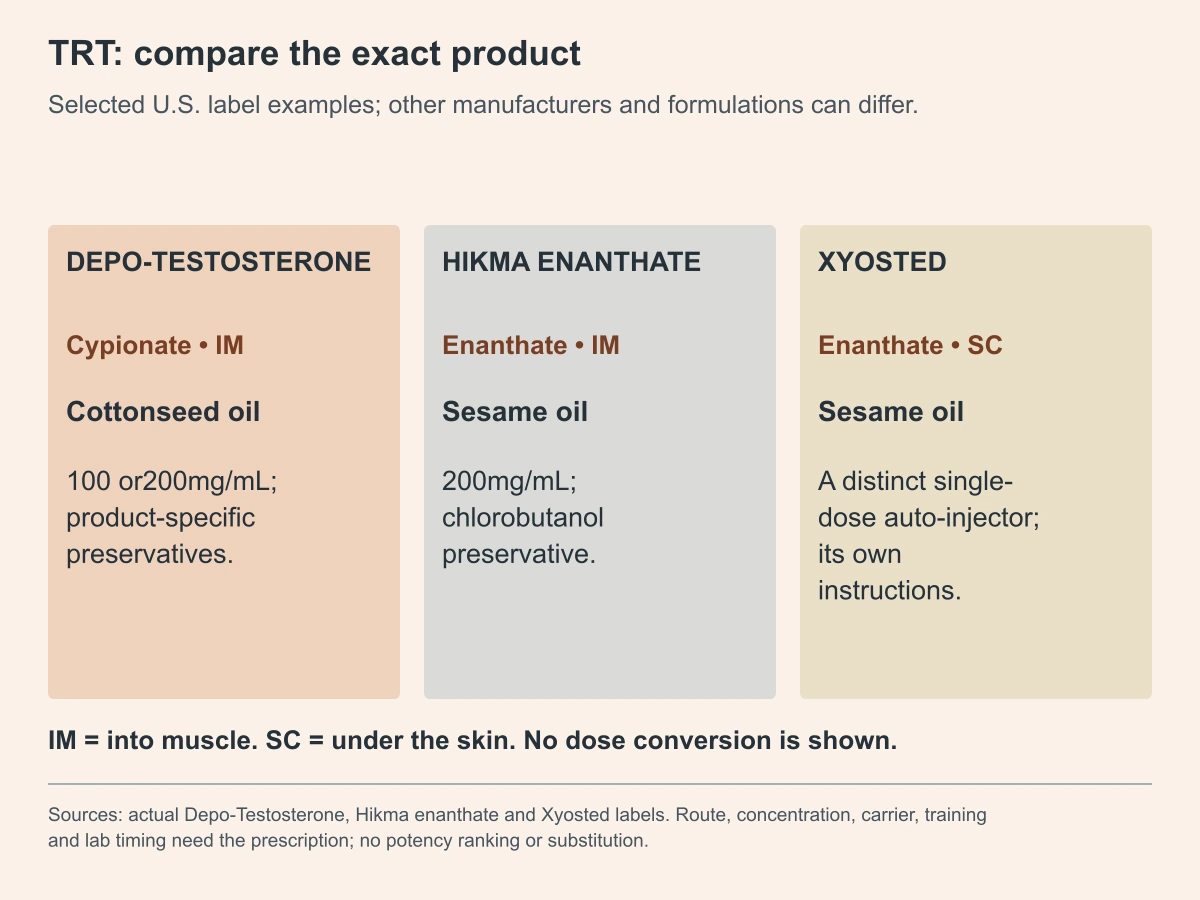
Compare the actual product, not just “C” versus “E”
The following examples come from the specific labels reviewed. Other manufacturers or compounded preparations may use different formulations.
| Product example | Ester and labeled route | Formulation details worth checking |
|---|---|---|
| Depo-Testosterone | Cypionate; intramuscular, or IM | The label lists 100 mg/mL and 200 mg/mL strengths, cottonseed oil, benzyl benzoate, and benzyl alcohol |
| Hikma Testosterone Enanthate Injection, USP | Enanthate; IM | The reviewed label lists 200 mg/mL in sesame oil with chlorobutanol preservative |
| Xyosted | Enanthate; subcutaneous, or SC, in the abdomen | A distinct single-dose auto-injector containing testosterone enanthate in sesame oil, with its own administration and adjustment instructions |
Read the Depo-Testosterone label, Hikma enanthate label, and Xyosted label for the matching product. The table describes formulation facts; it does not rank potency, recommend a dose, or establish the contents of another pharmacy’s product.
Is cypionate stronger than enanthate?
“Stronger” is not a useful general answer. Clinical response depends on the product, prescribed exposure, administration, lab results, symptoms, and individual tolerance. A higher number on a vial can describe a more concentrated solution rather than a better treatment.
For example, 100 mg/mL and 200 mg/mL describe different amounts of medicine in a given volume. They do not mean that a patient should draw up the same volume when changing strengths. The written prescription must identify the intended dose and the matching product.
A discussion about changing treatment should begin with the actual problem: persistent symptoms, an unexpected lab result, a reaction, difficulty administering injections, or trouble obtaining the medicine. Declaring one ester more powerful can distract from the factor that needs to change.
What does half-life tell you?
The Depo-Testosterone label reports an approximately eight-day half-life for testosterone cypionate injected into muscle. That is product and route context, rather than a personal calendar showing when all effects end.
The reviewed IM enanthate label describes slow absorption from the oil formulation. It also discusses the much shorter half-life of circulating testosterone itself. Those are different measurements. The short free-hormone figure should not be presented as the duration of an enanthate depot injection.
Xyosted has a labeled weekly SC regimen and its own lab-based adjustment process. A weekly administration interval is not automatically the same thing as a seven-day elimination half-life. Comparing an IM half-life with a separate product’s dosing interval would mix two different facts.
Can either one be injected under the skin?
Follow the route on the exact prescription and the training for that formulation. The reviewed Depo-Testosterone and Hikma enanthate products are labeled for IM administration. Xyosted is specifically labeled for SC administration in the abdomen and says to avoid IM or intravascular injection.
Some clinical practices may involve a route different from a particular label, but that requires a clinician’s specific decision and instructions. The existence of an approved SC enanthate auto-injector does not authorize using every enanthate vial in the same way.
Ask the pharmacist to review the box and instructions with you. If the presentation changes, confirm the technique, supplies, completion steps, disposal, and storage. A video for another device or another route may leave out a crucial difference.
Why carrier oils and preservatives matter
Inactive ingredients help make the product usable, but they can still matter to an individual. A history of allergy or an injection reaction belongs in the comparison. Bring the exact product name and describe what occurred, including whether symptoms were local or involved other parts of the body.
The named cypionate example uses cottonseed oil, while the named enanthate examples use sesame oil. That does not mean all cypionate products contain one oil or all enanthate products share the same preservative. Manufacturer, strength, and preparation should be checked directly.
Pain or redness cannot identify the responsible ingredient by itself. A clinician may consider technique, infection, a local reaction, or hypersensitivity. Trouble breathing or a serious allergic reaction needs urgent care, rather than an experiment with another vial.

Confirming low testosterone comes before choosing an ester
Fatigue, low libido, poor sleep, and changes in strength have many possible explanations. The Endocrine Society’s 2018 guideline recommends diagnosing hypogonadism when compatible symptoms and signs occur with unequivocally and consistently low testosterone concentrations. Repeat morning testing and evaluation of the cause are part of that process.
The low-testosterone testing guide explains why one result is not the whole diagnosis. The stress and poor-sleep comparison is useful when several symptoms overlap.
The reviewed labels also retain limitations concerning age-related hypogonadism. Normal aging, a desire for more energy, or an appearance goal does not by itself establish an approved reason for testosterone replacement.
When should labs be taken?
The relationship between the blood draw and the last injection can affect interpretation. Ask the clinician which measurement is wanted and when it should be obtained for the exact regimen. Bring the actual injection date if a draw happens at a different time than planned.
Xyosted’s label specifies a trough measurement seven days after the most recent dose following six weeks of dosing, with further instructions after adjustment. That is a product-specific process, not a universal schedule for cypionate or all enanthate prescriptions.
The total testosterone, free testosterone, and SHBG guide explains why results need context. Do not change the dose to chase a preferred online number or to compensate for a blood sample taken at an unintended point in the interval.
Both products need monitoring beyond testosterone levels
Follow-up should consider benefit, tolerability, blood pressure, hematocrit, and relevant medical risks. Hematocrit describes the proportion of blood occupied by red cells; an increase can change the treatment decision. The timing and response to an abnormal result should be established with the care team.
Xyosted’s label calls for hematocrit evaluation approximately every three months during treatment. The other reviewed labels also discuss blood-count monitoring. A formulation comparison does not make one product exempt from this concern.
In February 2025, the FDA announced class-wide testosterone labeling changes following cardiovascular-trial and blood-pressure findings. The agency retained the age-related limitation and required blood-pressure warnings. Removal of certain boxed cardiovascular-risk language is not a statement that TRT is risk-free or appropriate for everyone.
Fertility belongs in the first conversation
External testosterone can suppress signals involved in the body’s own testosterone and sperm production. If having children is a current or future priority, discuss it before starting or changing treatment. The Endocrine Society recommends against beginning testosterone therapy in men planning fertility in the near term.
Changing from cypionate to enanthate does not remove that underlying concern. Neither should be treated as a fertility-preserving version of the other. A clinician can evaluate alternatives and, when appropriate, involve a reproductive specialist.
Mention contraception, prior fertility difficulties, and the timing of family plans. Waiting until after months of treatment may make the discussion more complicated than addressing the goal at the outset.
What if you feel worse near the next injection?
Describe the pattern rather than adding an extra dose. Note which symptoms recur, when they occur, the actual administration dates, and whether sleep, stress, other medicines, or an illness changed. The care team can decide whether the pattern calls for a lab review, a prescription adjustment, or evaluation of another cause.
A symptom near the end of an interval does not by itself prove that the ester is wrong. Likewise, feeling more energetic soon after an injection is not enough to justify exceeding the prescription. The objective is appropriate replacement and meaningful benefit with monitoring.
The TRT body-composition and strength guide separates possible treatment outcomes from promises of fat loss or an ideal physique. Symptoms, function, and health goals provide a broader picture than a photograph or one gym performance.

Questions before a formulation change
Ask why the change is being considered, which exact product will be prescribed, and how its concentration and route differ. Confirm what happens to the existing supply, when the next administration should occur, and when labs and follow-up are due.
Discuss the full medicine list, including diabetes medicines, anticoagulants, and other hormone products. The reviewed labels describe interaction and monitoring considerations. Also ask about access and ongoing cost; difficulty obtaining a medicine can affect the practical choice without establishing a biological superiority.
For service details, see CoreAge Rx’s TRT information. Ask which exact preparation is offered. Compounded medicines are not FDA-approved, and a branded label does not establish the same safety, effectiveness, ingredients, or directions for a compounded product.
Frequently asked questions
Are cypionate and enanthate the same hormone?
Both are testosterone esters. Their products can differ in release, carrier ingredients, route, strength, and delivery. The shared hormone does not make their prescriptions automatically interchangeable.
Does enanthate always mean a subcutaneous injection?
No. The reviewed Hikma vial is an IM product, while Xyosted is a distinct SC auto-injector. Use the directions for the prescribed product.
Can I use the same syringe volume after switching?
Do not assume so. The concentration, intended dose, presentation, and route need to be confirmed. A volume from an old prescription is not a conversion instruction.
Which one is better for muscle or weight loss?
The ester name does not answer that question. TRT requires an appropriate diagnosis and monitoring, and physique goals do not establish an approved indication or a safe regimen.
Will changing esters protect fertility?
It should not be assumed to do so. Both supply external testosterone, and fertility goals require a separate clinical discussion before treatment decisions.
Can I stop monitoring once symptoms improve?
No. Benefit and safety are different parts of follow-up. Continue the agreed lab, blood-pressure, and clinical review plan even when treatment seems helpful.
Educational information for adults; individual treatment decisions require a qualified clinician. Sources reviewed October 1, 2026. Original AI-generated article images depict fictional people and objects, not patient outcomes. Other editorial images are illustrative. Graphics summarize the cited sources.