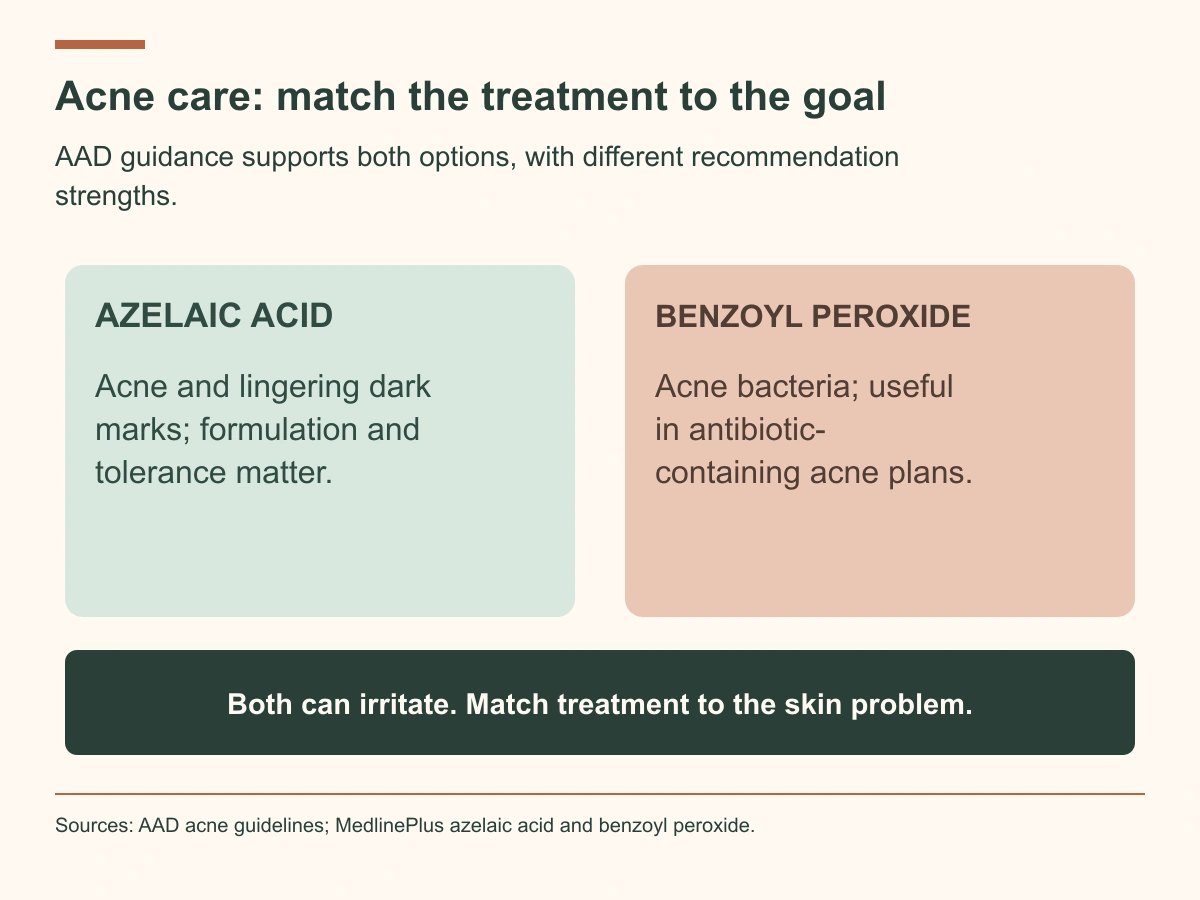
Azelaic acid and benzoyl peroxide can both be useful for acne, but they answer somewhat different needs. Benzoyl peroxide is a well-established option for acne bacteria and inflammatory breakouts. Azelaic acid can help acne while also addressing dark marks that remain after a spot settles. The better choice depends on the diagnosis, formulation, other treatments, and what your skin tolerates.
Choosing between them does not require finding the strongest percentage on a shelf. A product that fits into a consistent, tolerable routine may be more useful than an ambitious combination that leaves your skin too irritated to treat. This guide explains the evidence, practical differences, and questions to bring to a clinician or pharmacist.
What do acne guidelines say?
The American Academy of Dermatology’s 2024 acne guideline strongly recommends topical benzoyl peroxide and conditionally recommends topical azelaic acid. A conditional recommendation means that individual circumstances have more influence on the best choice. It does not mean azelaic acid is ineffective, or that benzoyl peroxide will outperform it for every person. AAD guideline overview.
The guideline also supports combining treatments with different actions when appropriate. That is a recommendation for a coherent acne plan, not a reason to start every active ingredient at once. Your existing retinoid, prescription cream, cleanser, and skin sensitivity all affect the decision.
For a broader starting point, see our guide to acne and visible pores. Persistent acne, scarring, or deep painful lesions may need treatment beyond either of these ingredients alone.
How are the two ingredients different?
| Question | Azelaic acid | Benzoyl peroxide |
|---|---|---|
| Main reason to consider it | Acne, with potential usefulness for lingering dark marks | Acne treatment, including inflammatory breakouts and antibiotic-containing regimens |
| How it is described in patient guidance | Acts on acne bacteria and keratin production; some formulations treat rosacea | An acne medicine available in washes and leave-on products |
| Common practical concern | Stinging, burning, itching, dryness, or changes in skin color | Dryness, peeling, irritation, and bleaching of colored fabric or hair |
| Important product distinction | Cream, gel, foam, and cosmetic products do not automatically have identical indications | A wash and a leave-on gel have different directions and contact times |
| Best comparison | The exact product within your complete routine | The exact product within your complete routine |
These are broad distinctions, not instructions to substitute one preparation for another. MedlinePlus describes azelaic acid cream for acne and azelaic acid gel and foam for rosacea. A clinician may use a treatment outside its labeled indication, but that should be understood as a specific prescribing decision. Azelaic acid patient information; benzoyl peroxide patient information.
When might azelaic acid be worth discussing?
Azelaic acid may be particularly relevant when active acne and post-acne discoloration are both concerns. The AAD notes its role in fading dark spots that persist after acne clears. Those marks are different from an indented scar, a raised scar, or an ongoing inflamed lesion.
That distinction helps set expectations. A fading flat mark does not prove that a scar is being repaired, and a new bump needs attention to ongoing acne. Our article on dark spots after acne explains how controlling new breakouts and caring for residual marks fit together.
People sometimes describe azelaic acid as universally gentle. It can still cause burning, itching, tingling, tenderness, or dryness. MedlinePlus also advises discussing changes in skin color, especially in people with darker complexions. An ingredient’s reputation is not a substitute for noticing your own reaction.
If you have flushing, persistent redness, or bumps that might be rosacea, ask whether acne is the correct diagnosis before choosing an acne wash. The presence of bumps alone does not establish that the same treatment is suitable. Azelaic acid precautions and adverse effects.
When might benzoyl peroxide be worth discussing?
Benzoyl peroxide is a familiar option for mild to moderate acne. It also has an important role when a clinician prescribes an acne antibiotic: the AAD recommends using benzoyl peroxide alongside topical or oral antibiotics to help limit antibiotic resistance. That is a treatment-planning issue, not a reason to take an antibiotic without a prescription. AAD recommendations.
The format matters. A cleansing product is used and rinsed according to its directions, while a leave-on product remains on the skin. Do not assume that the same amount, frequency, or contact time applies to both. Also check whether benzoyl peroxide is already included in a combination prescription so you do not unintentionally duplicate it.
There is a practical laundry issue as well: benzoyl peroxide can bleach hair and colored fabrics. Think about towels, pillowcases, collars, and handwashing after application. Product directions should guide use, including how to avoid the eyes and other sensitive areas. Benzoyl peroxide directions and precautions.
Is a higher percentage always better?
The percentage on a tube is only one part of the product. The vehicle—the cream, gel, foam, or cleanser carrying the ingredient—also affects how you use it and whether you can tolerate it. A comparison between an azelaic acid percentage and a benzoyl peroxide percentage is not a comparison of equivalent strength: they are different medicines.
Before buying a replacement, write down the active ingredient, strength, format, and intended area of use. If a clinician has prescribed a compounded combination, ask for the complete formula. A similarly named retail product is not necessarily an equivalent substitute.
Avoid increasing the amount or frequency because results feel slow. Both MedlinePlus medication guides recommend following the product or prescription directions rather than using more to speed improvement. A pharmacist can help distinguish a genuine formulation change from a packaging change.
Can you use azelaic acid and benzoyl peroxide together?
A clinician may include both in a broader routine, but adding them together is not automatically necessary. The main practical question is whether the complete regimen treats your concerns without causing unacceptable irritation. You may already be using a retinoid, exfoliating acid, medicated wash, or a combination cream.
Bring that whole list to the discussion, including products that seem like ordinary skincare. A cleanser with an acne active still contributes to the treatment burden. Ask which product goes where, which is rinsed off, and what to do if burning or peeling develops.
A simple plan is easier to evaluate. When several products are changed at once, it becomes harder to identify which change helped or caused a reaction. Our gentle acne skincare routine can help you organize those questions around cleansing, moisturizing, and sun protection.
What if you already use tretinoin?
Tretinoin introduces another active treatment, so the exact regimen deserves review before adding either ingredient. Different formulations and combination products can have different instructions. Avoid relying on a universal social-media rule about which ingredients can or cannot be used at the same time.
Ask your prescriber or pharmacist to check your actual tretinoin product and the proposed addition. A useful written plan identifies the sequence, frequency, and response to irritation without asking you to improvise from several sources.
Read starting tretinoin and tretinoin peeling and irritation for related questions. If you are comparing CoreAge Rx options, the Pore Favor treatment information and Spot On treatment information are places to review those specific products with a clinician. They should not be treated as interchangeable versions of either single ingredient discussed here.
How long should you give a treatment?
MedlinePlus notes that benzoyl peroxide may take four to six weeks to show an effect and advises contacting a clinician if acne has not improved after that period. This is a reason to agree on follow-up, not a promise that every breakout or mark will disappear by a particular week. Benzoyl peroxide patient guidance.
Azelaic acid, combination therapy, dark marks, and more severe acne have different assessment questions. Ask what early improvement should look like for your diagnosis and when the plan should be reconsidered. Fewer new inflamed spots, less discomfort, and improved ability to tolerate the routine may be useful observations alongside appearance.
If photographs help you track changes, use consistent lighting and spacing between photos. Daily scrutiny can magnify normal variation. Bring a short account of how regularly you used the product and what interrupted treatment; an apparent lack of effect may be difficult to interpret if irritation prevented consistent use.
Irritation versus a reaction that needs prompt help
Mild dryness and transient discomfort are different from marked swelling, blistering, severe burning, or symptoms of an allergic reaction. Do not keep applying a product through a severe reaction in the hope that your skin will adapt.
Breathing difficulty, throat tightness, faintness, or swelling of the lips, tongue, or face calls for emergency care. Stop using the suspected product and seek urgent advice for significant local reactions. Both medication guides describe serious reactions that require medical attention. Azelaic acid safety information; benzoyl peroxide safety information.
A clinician can also help when irritation is persistent but less dramatic. Bring the packaging and your full routine. Knowing whether you used a wash, a leave-on treatment, or multiple active products can change the advice.

Questions to take to your appointment
- Is this acne, rosacea, post-acne discoloration, scarring, or a combination?
- Which concern should we treat first, and what improvement are we looking for?
- Does my existing prescription already contain either ingredient?
- What exact format and instructions fit my skin and daily routine?
- What should I do if my skin becomes painful, very dry, or discolored?
- When should we review progress or consider another treatment?
Tell the clinician if you are pregnant, trying to conceive, or breastfeeding, and review the entire routine in that context. Do not assume that advice about one topical ingredient applies to every other ingredient in a combination.
Common questions
Which is better for acne scars?
Neither should be assumed to correct every type of scar. Flat dark marks after acne are a different issue from changes in skin texture. Start by identifying what you are seeing, then discuss the treatment most relevant to that problem.
Does benzoyl peroxide help dark spots?
Its main role in this comparison is acne treatment. Controlling new acne can be part of preventing additional marks, but that does not make it interchangeable with a treatment chosen specifically for existing pigmentation. Irritating your skin can also make the overall routine harder to sustain.
Can I switch overnight if one product is not working?
Ask whether the first treatment had an adequate, tolerable trial and whether the diagnosis is correct. A planned change makes it easier to avoid duplicating active ingredients or abandoning a prescription combination that has another purpose.
Can I use either product just on a spot?
The answer depends on the specific preparation and prescription. Follow its directions for the area to treat. A spot-treatment advertisement is not a universal instruction for every azelaic acid or benzoyl peroxide product.
The most useful choice is a treatment you understand, can tolerate, and can reassess with clear expectations. Acne care often improves through a consistent plan and a thoughtful review of what is actually happening on your skin.
Educational information for adults; individual treatment decisions require a qualified clinician. Sources reviewed October 6, 2026. Original AI-generated article images depict fictional people and objects, not patient outcomes. Other editorial images are illustrative. Graphics summarize the cited sources.