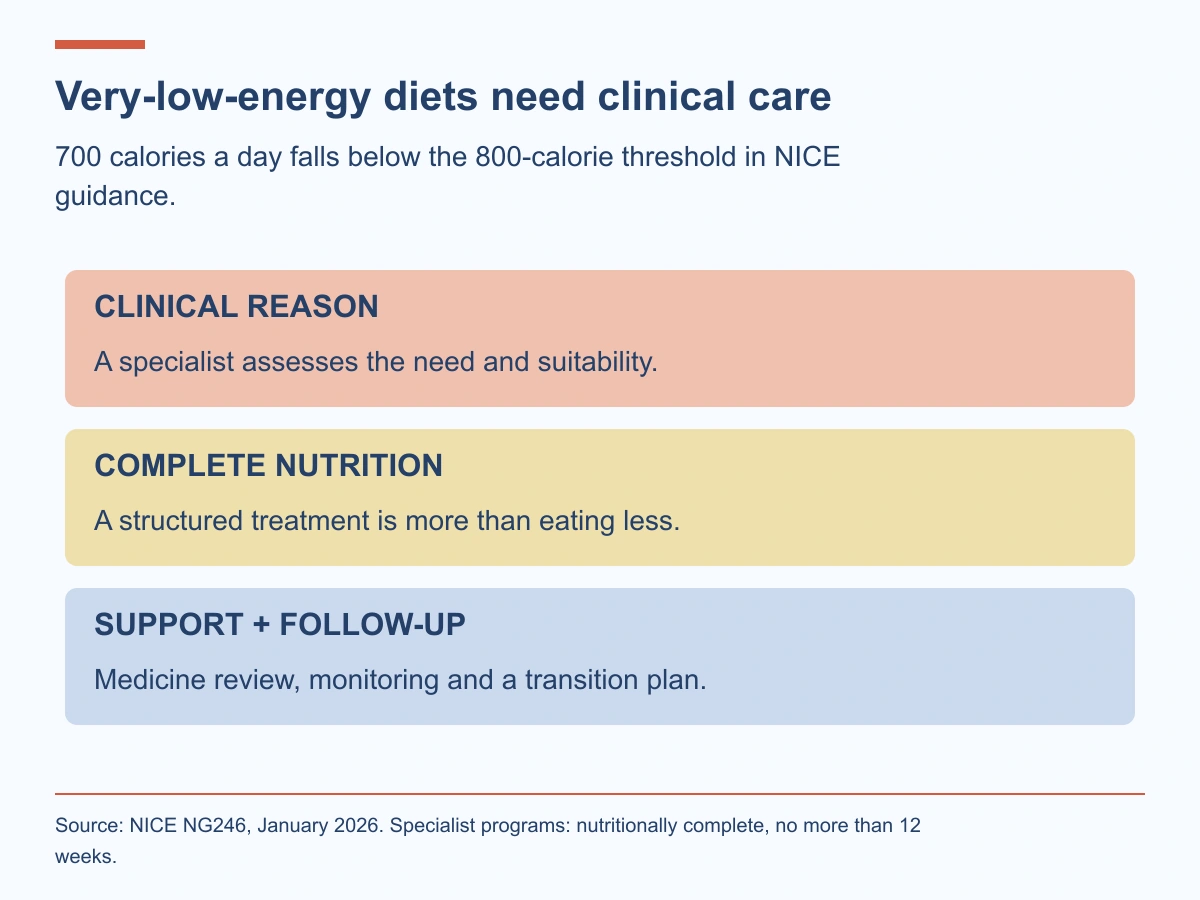
Eating 700 calories a day is a very-low-energy intake. It should not be a self-directed weight-loss target. Specialist programs sometimes use very-low-energy diets for a specific medical reason, with complete nutrition, medication review, monitoring, and a plan for returning to a wider range of foods. That is substantially more than limiting ordinary meals to a small calorie total.
If you are reaching this intake because a GLP-1 medicine has made eating difficult, contact your prescribing team. Persistent inability to eat adequately is a treatment concern, even if the scale is moving. You do not need to wait until you feel seriously unwell to ask for help.
Why does the number 700 matter?
NICE, the UK’s National Institute for Health and Care Excellence, defines very-low-energy diets as providing under 800 kilocalories per day. Its current obesity guideline reserves them for selected people living with obesity who have a clinically assessed need for rapid weight loss, such as making an operation safer, within a specialist service. NICE dietary guidance, updated January 2026.
This is a clinical framework rather than a universal daily allowance. It does not mean that 800 calories becomes an appropriate unsupervised intake, or that someone should aim just above a threshold. Needs vary with age, body size, activity, medical conditions, and other circumstances.
Our calorie intake guide explains why an estimate needs individual context. A number generated by an app cannot assess whether you are meeting nutritional needs or whether your medicines need adjustment.
How is a supervised program different from eating very little?
A specialist program has a defined purpose and a process for deciding whether it is appropriate. It also has a plan for the treatment period, follow-up, and longer-term care. Those elements cannot be recreated simply by buying meal replacements or taking a multivitamin.
| Part of care | What needs to be established |
|---|---|
| Reason for treatment | A specific clinical goal and why this approach is appropriate |
| Nutritional design | Adequate nutrients within a structured, professionally supervised intervention |
| Medicine review | Whether changes in food intake affect diabetes, blood pressure, or other treatment |
| Ongoing support | A way to assess symptoms, adherence, wellbeing, and emerging concerns |
| Transition | A plan to reintroduce a broader diet and continue support |
NICE recommends that low-energy and very-low-energy programs be nutritionally complete, have ongoing clinical supervision, and last no more than 12 weeks. It explicitly advises against using them as a long-term strategy on their own. These are recommendations for defined programs, not permission to begin a 12-week restrictive diet without assessment. NICE recommendations 1.16.8–1.16.12.
What can go wrong when intake stays too low?
A small calorie total can leave too little room for the variety and amounts of food needed to support health. The problem is not limited to hunger. Low intake can also make it harder to obtain enough protein, essential fats, vitamins, and minerals.
A joint advisory from major nutrition and obesity organizations highlights nutrient insufficiency during GLP-1 treatment and the importance of nutritional assessment. It also discusses the loss of muscle and bone that can accompany substantial weight reduction. The advisory supports attention to food quality, adequate intake, and appropriate activity; it does not establish one safe minimum calorie number for every adult. GLP-1 nutrition advisory.
Fatigue, weakness, hair changes, and trouble functioning deserve review. These symptoms have many possible causes, so they should not be diagnosed from a food log alone. A clinician may need to consider the length of restriction, other symptoms, medicines, examination findings, and targeted testing.
For related information, see semaglutide, protein, and muscle. Increasing protein alone does not turn an otherwise inadequate eating pattern into a complete diet.
Can rapid weight loss affect the gallbladder?
Yes. NIDDK explains that losing weight very quickly or going for long periods without food can increase the chance of gallstone problems. Rapid weight loss can affect bile composition and how well the gallbladder empties. Risk is not identical for everyone, and a history of gallstones matters. NIDDK dieting and gallstones.
This does not mean that every person who eats poorly will develop a gallstone, or that abdominal pain can be attributed to gallstones without assessment. It is one reason the speed and method of weight loss deserve medical context.
New severe abdominal pain, pain that persists, fever, repeated vomiting, or jaundice warrants prompt medical evaluation. Medication side effects, gallbladder disease, pancreatitis, and other conditions can overlap in how they first feel. A lower calorie total does not identify the cause.
What if semaglutide or tirzepatide has removed my appetite?
Reduced appetite can be part of treatment, but being unable to eat or drink adequately is not a goal. The team needs to know whether the issue is early fullness, nausea, vomiting, reflux, food aversion, pain, or a deliberate effort to restrict intake further.
These details lead to different questions. For example, someone who feels full after a few bites may need a nutrition and symptom review. Someone who cannot keep fluids down may need urgent assessment for dehydration. Someone who is frightened of eating more may benefit from support that addresses that fear alongside medical care.
Read semaglutide nausea and vomiting or tirzepatide nausea and reflux for symptom-specific questions. Do not increase a medicine because eating has become easier, or treat the return of ordinary hunger as a failure.
Wegovy and Mounjaro labeling includes warnings about kidney injury associated with fluid loss, particularly when gastrointestinal symptoms lead to dehydration. Contact the prescriber about sustained poor intake, repeated vomiting, or diarrhea. Follow urgent-care advice if symptoms are severe. Wegovy prescribing information; Mounjaro prescribing information.

Why do other medicines change the discussion?
A sudden change in food intake can alter the context in which a medication was prescribed. Insulin and sulfonylureas are particularly relevant because of low-glucose risk. Blood pressure treatments and diuretics also belong in a review when dizziness, poor intake, or fluid loss develops.
Do not independently stop all medicines or make dose changes from an online calorie rule. Ask for an individualized plan, including what to do when you are ill, unable to eat normally, or repeatedly vomiting. The exact medicine, indication, dose, and other health conditions matter.
NICE specifically includes medication review before a low-energy or very-low-energy intervention. Mounjaro labeling separately highlights increased hypoglycemia risk when it is combined with insulin or an insulin secretagogue. Those are reasons for coordination, not proof that everyone following a low intake will experience the same complication. NICE guidance; Mounjaro safety information.
Does a multivitamin make 700 calories safe?
No supplement can establish that a restrictive intake is appropriate for you. A multivitamin does not provide the complete energy, protein, essential fats, and individualized planning involved in nutrition care. It also does not review medication risks or explain persistent symptoms.
Supplement decisions can be useful when they address an identified need, but they should fit the broader plan. Taking more products without reviewing their ingredients can introduce duplication or unnecessary expense. Bring the labels to your clinician or dietitian rather than assuming that an extensive supplement routine solves inadequate food intake.
The same distinction applies to shakes. A commercial shake can be a food product, a supplement, or part of a clinically designed program. Its presence does not by itself establish that the overall pattern is nutritionally complete or medically suitable.
How much weight would I lose?
A responsible answer cannot convert 700 calories into a personal weight-loss forecast. That would leave out your nutritional needs, starting circumstances, changes in energy expenditure, fluid shifts, illness, and the reason for restricting intake. It could also turn a medically concerning pattern into a target to pursue.
The NIDDK Body Weight Planner is designed for adults and is not intended for children, pregnancy, or breastfeeding. Even a research-based model needs appropriate context and does not replace a clinician’s assessment. NIDDK planner guidance.
Our weight-loss timeline guide explains why a straight-line calculation is unreliable. An early scale change can include water and other short-term variation. The number on the scale cannot tell you whether a restrictive pattern is adequately supporting your health.
What should you tell the care team?
A brief, practical account is more useful than trying to produce a perfect calorie diary. Explain how long eating has been difficult and what a typical day has looked like. Include drinks, symptoms, missed meals, and whether any foods remain comfortable to eat.
Useful questions include:
- Is my current intake adequate for my health and treatment plan?
- Could symptoms, another condition, or a medicine be limiting my ability to eat?
- Do I need a dietitian or another form of nutritional support?
- What should I do if I cannot keep food or fluids down?
- Which symptoms should trigger same-day or emergency assessment?
- How should my progress be assessed beyond a change in weight?
You can also explain practical barriers: food cost, work shifts, limited cooking facilities, nausea at particular times, or worries about regaining weight. These are important parts of making a plan workable.

When should you seek urgent help?
Seek prompt care for repeated vomiting, inability to keep fluids down, fainting, markedly reduced urination, severe or persistent abdominal pain, or significant worsening weakness. Confusion, collapse, breathing difficulty, or other severe symptoms require emergency help.
If you use a medicine that can cause hypoglycemia and develop possible low-glucose symptoms, follow your established diabetes action plan and obtain help when needed. Do not assume that shakiness, sweating, or confusion is simply the expected feeling of dieting.
If restriction has become hard to stop, eating feels frightening, or tracking is taking over daily life, tell a healthcare professional. You deserve support even if your weight is not low. NICE includes assessment for eating disorders and mental-health concerns when considering these programs. NICE dietary assessment recommendations.
A more useful next step
The immediate aim is to understand why intake is so low and what support is needed. That may involve symptom treatment, a nutrition plan, a medication review, or a different approach to weight management. It does not require proving that you can tolerate further restriction.
If you are exploring CoreAge Rx care, review the semaglutide treatment information or tirzepatide treatment information with a qualified clinician. Ask specifically how nutritional intake, side effects, and follow-up are handled. A medication option should be assessed as part of ongoing care, not as a way to make a very-low-energy diet easier to sustain.
Educational information for adults; individual treatment decisions require a qualified clinician. Sources reviewed October 6, 2026. Original AI-generated article images depict fictional people and objects, not patient outcomes. Other editorial images are illustrative. Graphics summarize the cited sources.