
A weight-loss calculator can estimate how a proposed eating and activity plan might affect weight over time. It cannot promise that you will reach a particular number by a particular date. Bodies change as weight changes, daily measurements contain noise, and the assumptions entered into a tool are rarely exact.
The most useful timeline supports planning and review. It should help you ask whether a goal is reasonable, what the plan requires, and when to reassess—not encourage progressively harsher restrictions because the scale did not follow a straight line.
What does a weight-loss date calculator estimate?
Some calculators simply divide a desired weight change by an assumed weekly rate. Others use a model that accounts for changes in energy needs over time. These approaches may display similarly precise dates while relying on very different assumptions.
A date is therefore an output from a set of inputs, not an independent finding about your body. Change the assumed activity level, starting weight, or intake, and the predicted result may change. The tool may also lack information about medicines, symptoms, pregnancy, eating disorders, or conditions affecting weight.
Before relying on a result, look for an explanation of the method, intended population, limitations, and the source behind it. An attractive graph or a long list of decimal places does not establish clinical accuracy.
Why is a fixed pounds-per-week calculation limited?
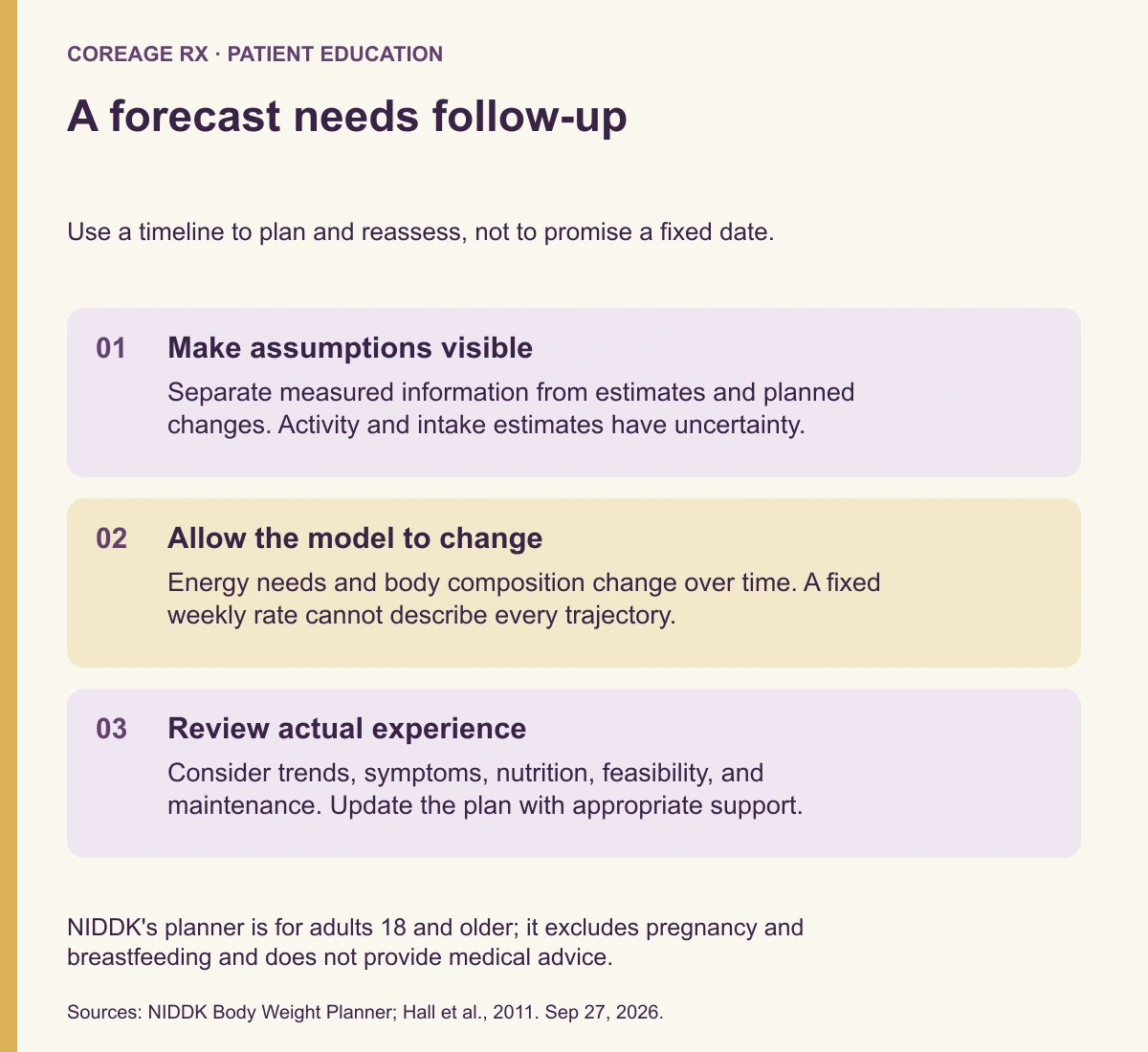
The body does not generally respond to an energy change as an indefinitely fixed amount of weight loss each week. A smaller body can have different energy requirements, and changes in expenditure and body composition affect the trajectory.
Hall and colleagues developed a dynamic model to account for these changes rather than relying on a fixed calorie-to-weight conversion. The research also describes uncertainty associated with baseline energy expenditure and other assumptions. Source: research on energy imbalance and body weight.
This does not mean planning is pointless. It means that a forecast should be revisited as actual information becomes available. Our calorie-intake guide explains why an estimated energy target is a starting point for discussion rather than a permanent rule.
What is the NIDDK Body Weight Planner?
The NIDDK Body Weight Planner is a public tool designed to help adults create calorie and physical-activity plans for a weight goal and subsequent maintenance. NIDDK also provides information about the research behind the model.
It is intended for adults aged 18 and older and is not intended for younger people or those who are pregnant or breastfeeding. NIDDK states that it does not provide medical advice; individual health questions belong with a clinician who knows the person’s history.
Use the official tool’s instructions and limits. If a proposed date produces a plan that seems impractical or unsuitable, reconsider the goal with appropriate support rather than looking for another calculator that will endorse a more aggressive approach.
Which inputs deserve the most attention?
Start with accurate basic information and a realistic description of your usual routine. Activity assumptions are especially easy to overestimate when a planned workout is entered as though it already happens consistently. A schedule that looks possible on a quiet week may not describe the rest of the month.
Similarly, food records can omit drinks, cooking ingredients, portion differences, or meals away from home. These are common estimation problems, not evidence of a personal failure. The point is to recognize uncertainty rather than treat the output as exact.
If you use the tool with a clinician or dietitian, explain which inputs are measured, which are estimates, and which describe changes you hope to make. That makes it easier to judge whether the forecast rests on assumptions you can actually maintain.
A useful timeline has more than one checkpoint
Instead of focusing only on the target date, build in opportunities to review the process. An early check can ask whether the plan is practical and whether symptoms, food access, or scheduling are causing problems. A later review can consider trends and whether the plan still fits.
For example, a person might discover that meal preparation is manageable but the proposed activity schedule conflicts with work. Another might find that medication-related nausea is making adequate intake difficult. These situations need different responses even if the scale trend looks similar.
Choose review timing with the care team when medical treatment is involved. The appropriate interval depends on the medicine, clinical situation, and symptoms; a general weight-loss article cannot prescribe one follow-up schedule for everyone.
Why daily weight can obscure the trend
A single reading can reflect more than body fat. Changes in fluid balance, food and drink in the digestive tract, and other short-term factors can affect the scale. A sudden movement therefore does not prove that the predicted fat-loss trajectory has accelerated or failed.
Our water weight versus fat loss guide explains these distinctions. If weighing is part of your plan, use a consistent method and discuss how to interpret the pattern rather than reacting to every individual result.
If weighing causes distress or rigid behavior, a clinician can help identify other ways to monitor health and treatment. There is no requirement to use a daily scale reading as the sole measure of progress.

Does a plateau mean the calculator was wrong?
A plateau can reveal that the original assumptions no longer describe the current situation. It may also prompt a review of measurement patterns, food intake, activity, medication use, symptoms, or changes in health. It cannot be diagnosed from the shape of a graph alone.
The useful response is to investigate what has changed, including whether the earlier plan was realistic. Automatically eating less, exercising more, or increasing a medicine can create problems if the underlying issue is poor intake, side effects, or a medical concern.
For people using these medicines, our semaglutide plateau guide and tirzepatide plateau guide outline the questions to review before changing treatment. A treatment reassessment is different from trying to force the body back onto an old forecast.
Can a calculator predict results from medication?
An ordinary calorie or date calculator is not automatically a validated model of an individual’s response to a particular medicine. Drug trials also report results for study groups, not a guaranteed outcome for each person who starts treatment.
Trial duration, dose escalation, diabetes status, concurrent support, missing data, and the way outcomes were analyzed all affect interpretation. Dividing a trial’s final percentage by its number of weeks does not create a reliable personal weekly schedule.
Our guide to choosing a GLP-1 medicine explains how study evidence fits into treatment decisions. If reviewing CoreAge Rx tirzepatide care, ask how the team evaluates response and side effects over time rather than seeking a guaranteed target date.
What if you have an event or deadline?
A wedding, vacation, race, or medical appointment can make a date feel urgent. The calendar does not determine whether a proposed weight change or method is appropriate. A plan that requires skipping nourishment or ignoring symptoms deserves reassessment, even if a calculator says the arithmetic works.
You can still plan useful actions before an event: arranging a clinical review, establishing manageable meals, improving preparation routines, or finding activity that fits your abilities. These actions can be worthwhile even when the final scale number remains uncertain.
Our walking guide offers a starting point for building consistency. Exercise needs to fit current capacity and medical advice; it should not become a punishment for being behind an estimated schedule.
Why maintenance belongs in the first plan
Reaching a target weight and maintaining it are related but different planning questions. The NIDDK tool includes maintenance planning because the routine after a change matters, too. Source: Body Weight Planner overview.
Ask what parts of the proposed routine can continue once the initial goal is reached. Consider meals, activity, appointments, access to treatment, and how future changes will be addressed. A plan built around a short burst of extreme effort may not answer those questions.
Medication decisions also need a separate clinical plan. Do not assume that reaching a date means a prescription should stop, or that the dose should change without review. The follow-up conversation should include ongoing benefits, adverse effects, costs, and the condition being treated.
When should a timeline be reviewed clinically?
Seek individual guidance when weight changes are unexplained, a proposed plan is very restrictive, eating has become difficult, or symptoms interfere with daily life. Pregnancy, breastfeeding, younger age, and relevant medical conditions also change which tools and goals are appropriate.
Persistent vomiting, fainting, or inability to maintain fluids requires prompt assessment rather than another calculation. If you use glucose-lowering medicines, substantial changes in food intake or activity should fit the diabetes care plan.
An appropriate review can also help when the main concern is strength, fatigue, or maintaining adequate nourishment. Weight alone may not capture those outcomes. Our weight-loss basics guide discusses health and habits beyond a target number.

Questions to ask before trusting a predicted date
Ask whether the calculator explains its method and intended users. Check whether it models changing energy needs or simply assumes a fixed weekly loss. Identify which inputs are estimates, and whether the output includes maintenance or only a finish line.
Then ask whether the suggested routine is feasible with your health, budget, schedule, and support. A technically sophisticated model still cannot make an unsuitable goal appropriate or replace an assessment of symptoms and medical history.
Finally, decide how the prediction will be used. It is most helpful as a planning aid that can change with new information. It is least helpful when treated as a deadline that overrides hunger, nourishment, medication instructions, or clinical judgment.
The practical takeaway
Use a reputable model to explore a reasonable plan, make the assumptions visible, and schedule opportunities to review what actually happens. Expect uncertainty and leave room to adjust the goal or routine.
A useful timeline helps you make informed decisions. It does not grade your effort, guarantee a biological response, or require you to chase a date at the expense of health.
Educational information for adults; individual treatment decisions require a qualified clinician. Sources checked September 27, 2026. Original AI-generated article illustrations depict fictional people and objects, not patient outcomes. Other editorial images are illustrative. Graphics summarize the cited sources.