Ondansetron, often searched for by the brand name Zofran, is a prescription medicine used to prevent nausea and vomiting in specific settings. A clinician may also prescribe it for nausea associated with semaglutide. That use requires an individual plan: it does not make persistent vomiting harmless or replace a review of the underlying treatment.
Common questions are practical. Can you take it without food? Is a dissolving tablet faster? What if you vomit after taking it? The answers should distinguish the medicine’s instructions from a personal dosing schedule, particularly when dehydration, constipation, or other prescriptions may affect safety.
Can ondansetron help nausea from semaglutide?
It may be considered by a clinician, but semaglutide-associated nausea is not among the approved indications in the current US ondansetron label. The listed uses involve preventing nausea and vomiting associated with chemotherapy, radiotherapy, and surgery. Prescribing it for another cause is an off-label use, which calls for a discussion of the reason, expected benefit, and follow-up. Source: ondansetron prescribing information.
Ondansetron blocks a type of serotonin receptor involved in nausea and vomiting. It does not treat every possible cause of those symptoms, and it is not a medicine that stimulates the stomach or intestines to move food along. Feeling less nauseated therefore does not establish that the reason for a digestive problem has resolved.
Our semaglutide nausea and vomiting guide explains the broader assessment. The timing of symptoms, ability to eat and drink, bowel pattern, and recent dose changes can matter as much as the choice of an antinausea medicine.
Can you take Zofran on an empty stomach?
Oral ondansetron can generally be taken with or without food; Alexandra Hospital’s patient instructions explicitly make that distinction. Follow the directions supplied with your own prescription, since the formulation and the reason it was prescribed still matter. Source: ondansetron patient instructions.
You do not need to force a large meal simply because you are about to take a prescribed tablet. At the same time, being unable to tolerate food or fluids is a symptom to report, not merely a medication-timing inconvenience. A person who has barely eaten for several days needs a broader review than advice about an empty stomach.
A label discussion of how food affects absorption should not be translated into a promise that taking the medicine with a particular snack will make it work better for semaglutide nausea. Use the agreed instructions rather than experimenting with food or extra doses to chase a stronger effect.
How long does ondansetron take to work?
Patient.info’s medication guide gives one to two hours as a general onset estimate. This is not a guaranteed relief time for nausea associated with a GLP-1 medicine, and it is not an instruction to repeat a dose if you still feel sick. Source: ondansetron patient guidance.
The time a tablet dissolves, the time a drug reaches a blood concentration, and the time a person feels relief are different measurements. An orally disintegrating tablet can dissolve on the tongue in seconds, but that does not mean nausea should disappear in seconds. Source: MedlinePlus ondansetron information.
The approved label includes administration times for preventing nausea around chemotherapy, radiation, and surgery. Those schedules should not be repurposed as a guaranteed rescue timeline for nausea caused by a GLP-1 medicine. Response depends on the cause of the symptoms, the prescribed preparation, and the person’s circumstances.
Ask the prescriber how long to assess the response, what counts as inadequate relief, and what to do next. If you remain unwell, do not shorten the dosing interval or take another tablet earlier than instructed. Persistent symptoms may require reassessing the nausea itself rather than repeatedly waiting for another dose to work.
What is different about an orally disintegrating tablet?
An orally disintegrating tablet, or ODT, is designed to dissolve on the tongue and then be swallowed with saliva. The current label instructs patients to use dry hands, peel back the blister foil, remove the tablet gently, and place it on top of the tongue. It should not be pushed through the foil, and liquid is not required for administration. Source: ondansetron ODT instructions.
This can be a useful practical distinction when swallowing a conventional tablet is difficult. It does not make the medicine an unlimited or risk-free option, and it should not be treated as a separate extra dose alongside another ondansetron preparation.
Check the name and strength on the actual package. If the appearance or instructions have changed after a refill, ask the pharmacist to explain the product before using it. People with phenylketonuria should also review the ingredients because some ODT products contain aspartame that supplies phenylalanine. Source: MedlinePlus precautions.
Should you take it before every semaglutide injection?
There is no universal ondansetron schedule for everyone using semaglutide. Whether a clinician recommends occasional use, planned use in a particular circumstance, or another approach depends on the assessment. Do not copy a preventive chemotherapy schedule or someone else’s online routine.
If nausea occurs repeatedly after each injection or dose increase, tell the prescribing team. Discuss the pattern before the next planned escalation rather than assuming that an additional medicine is the only way to tolerate treatment. Semaglutide products have specific schedules and safety instructions; an antinausea prescription does not replace them. Source: Wegovy prescribing information.
The semaglutide first-month guide explains useful early observations, while our dosage guide distinguishes labeled product schedules from individualized treatment decisions.

What if you vomit after taking a dose?
Do not automatically repeat it. The amount absorbed cannot be reliably determined just by seeing that vomiting occurred, and a second dose could result in more medicine than intended. Ask the prescriber or pharmacist for instructions that cover your formulation and the timing of the vomiting.
It is helpful to record when the medicine was taken, when vomiting occurred, whether other medicines were involved, and whether you can keep fluids down. If repeated vomiting makes oral medicines unreliable, that is important information for the treatment team.
Missed-dose instructions are a separate question from replacing a dose after vomiting. MedlinePlus advises against doubling a missed dose. Keep those situations distinct and obtain a clear plan rather than improvising a replacement. Source: MedlinePlus use instructions.
Can ondansetron make constipation worse?
Constipation is a recognized adverse effect. That matters when the original treatment or reduced food and fluid intake is already changing bowel habits. Relief from nausea does not mean constipation should be ignored or managed by adding several products without a review. Source: ondansetron side effects.
Tell the clinician about the last bowel movement, a major change from your usual pattern, abdominal swelling, pain, and vomiting. The combination of symptoms is more informative than the number of days alone. Our GLP-1 constipation guide explains questions to discuss and situations that need prompt assessment.
Ondansetron does not stimulate gastrointestinal movement. The label also warns about masking progressive ileus or stomach distension in certain clinical settings. Do not assume that suppressing vomiting makes substantial abdominal swelling or worsening pain safe to watch at home. Source: ondansetron warnings.
Which medicines and health conditions need review?
Bring a complete medication and supplement list to the prescriber or pharmacist. Important issues include a history of abnormal heart rhythm, congenital long-QT syndrome, heart failure, liver disease, and low potassium or magnesium. The label recommends avoiding ondansetron in congenital long-QT syndrome and describes circumstances in which ECG monitoring is appropriate. Source: current ondansetron label.
Vomiting or diarrhea can make the overall situation more complicated, especially if dehydration or electrolyte abnormalities are developing. A medicine that was previously tolerated may still need reassessment when the person’s health circumstances change.
Ondansetron must not be used with apomorphine because of the risk of a severe blood-pressure drop and loss of consciousness. Serotonin-syndrome warnings also matter when reviewing antidepressants, tramadol, and other serotonergic medicines. This does not mean you should stop another prescription yourself; it means the combination needs professional review.
Which symptoms need urgent help?
Seek immediate medical help for sudden chest pain or chest tightness, fainting, serious breathing difficulty, or signs of a severe allergic reaction. Current ondansetron labeling includes a myocardial-ischemia warning, including advice after oral administration; it should not be dismissed as relevant only to intravenous treatment. Source: ondansetron patient counseling information.
Other concerning symptoms include a markedly abnormal heartbeat or a combination of confusion, fever, sweating, and muscle stiffness or twitching. These need assessment rather than a decision to simply take the next scheduled tablet. Source: MedlinePlus serious adverse effects.
Semaglutide itself also has important warnings. Severe persistent abdominal pain, with or without vomiting, requires prompt evaluation. Repeated vomiting, inability to keep fluids down, or symptoms of significant dehydration should be reported promptly. An antinausea medicine should not be used to postpone that assessment. Source: Ozempic injection prescribing information.

What else should the nausea review cover?
A useful review looks at how symptoms affect daily life. Describe whether nausea occurs after meals, after a dose change, throughout the day, or alongside reflux or constipation. Explain what you have been able to eat and drink rather than only rating the nausea from one to ten.
Our guide to how long GLP-1 nausea lasts discusses the limits of a single expected timeline. The water and drinks guide provides broader context for hydration, including the importance of following individual fluid restrictions when they apply.
If you are comparing treatment services, ask who handles persistent symptoms, how quickly you can contact the team, and how medicines are reviewed together. CoreAge Rx’s semaglutide service information can be a starting point for those questions, with prescribing decisions made through individual clinical assessment.
Questions to resolve before relying on a rescue medicine
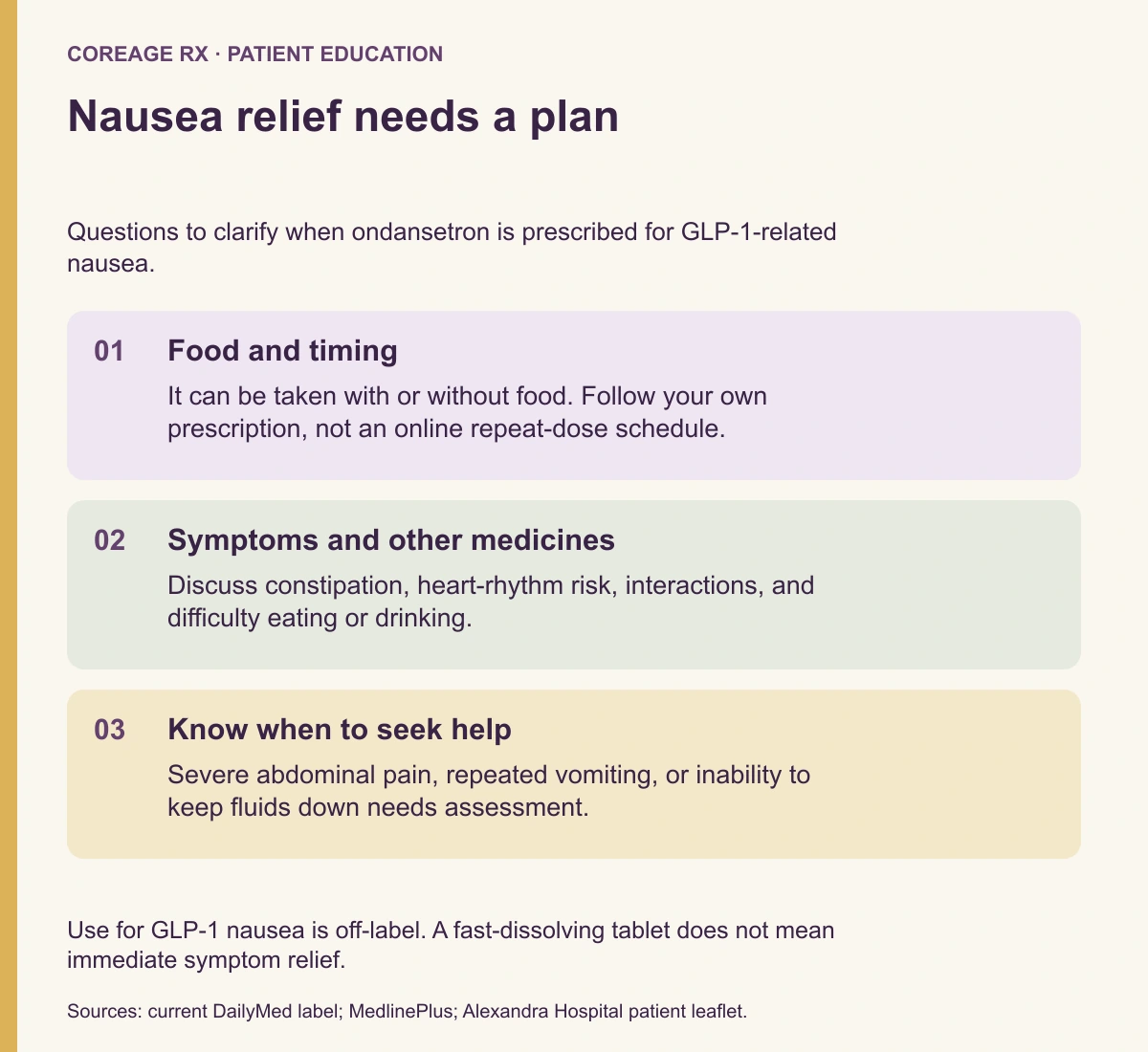
Ask what the ondansetron is intended to treat, exactly when to use it, the prescribed limits, what to do if it does not help, and what to do after vomiting. Confirm which symptoms require urgent care and when persistent nausea should trigger a review of semaglutide treatment.
That plan is more useful than treating ondansetron as a routine way to push through any degree of nausea. The goal is to manage symptoms while preserving adequate nutrition, hydration, and appropriate treatment—not merely to make vomiting less noticeable.
Educational information for adults; individual treatment decisions require a qualified clinician. Sources checked September 27, 2026. Original AI-generated article illustrations depict fictional people and objects, not patient outcomes. Other editorial images are illustrative. Graphics summarize the cited sources.