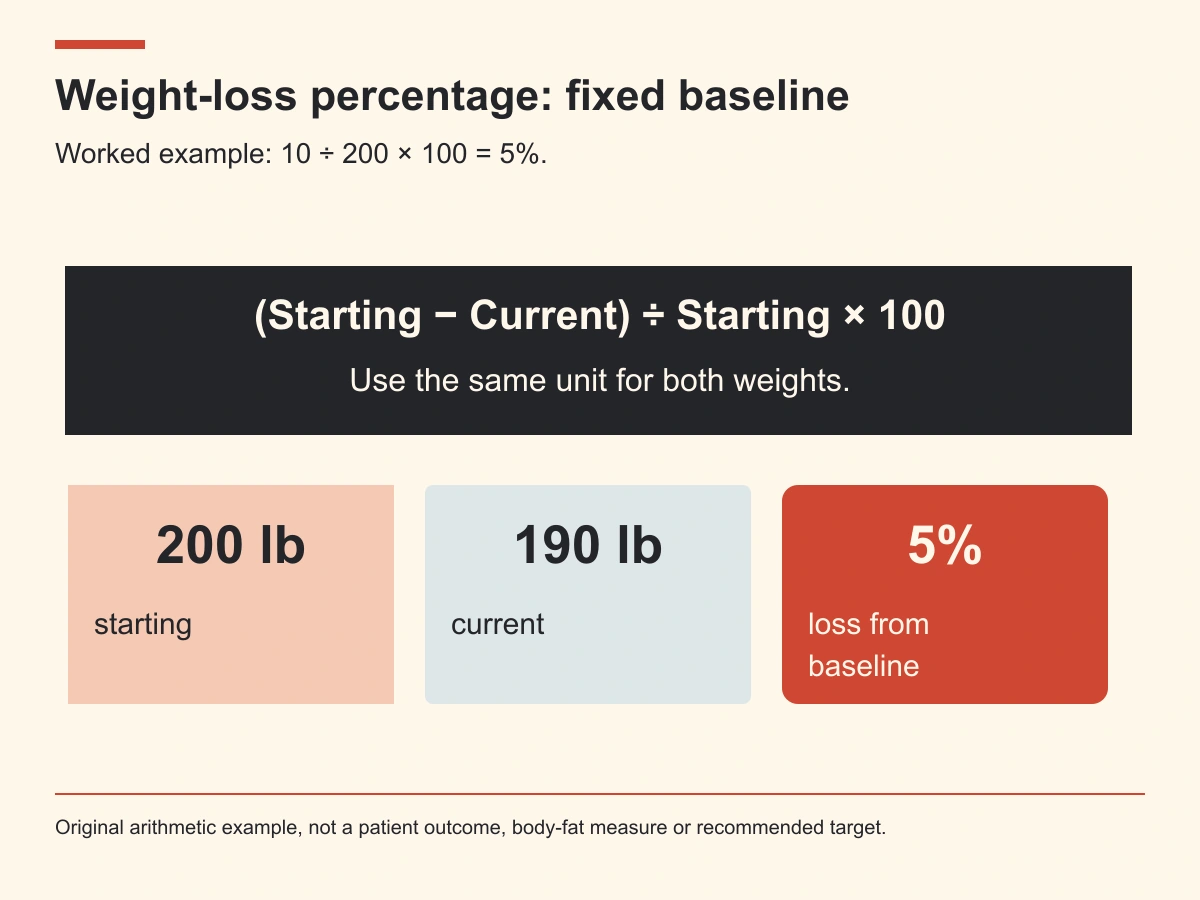
To calculate weight-loss percentage, subtract your current weight from your starting weight, divide the difference by your starting weight, and multiply by 100. Use the same unit for both measurements. For example, going from 200 pounds to 190 pounds is a 10-pound loss: 10 ÷ 200 × 100 = 5%.
The calculation describes a change relative to a baseline. It does not identify how much body fat was lost, determine whether a medication is appropriate, or tell you how quickly you should lose weight. Its value is that it makes a weight change easier to compare and discuss accurately.
The weight-loss percentage formula
Use this formula:
Weight-loss percentage = ((starting weight − current weight) ÷ starting weight) × 100
There are four steps:
- Choose the starting weight for the period you want to describe.
- Subtract the current weight from that starting weight.
- Divide the amount lost by the starting weight.
- Multiply by 100 and label the result as a percentage.
The denominator—the number beneath the division sign—is the starting weight. It stays fixed when you are describing change from that baseline. Using current weight instead answers a different mathematical question and makes the percentage appear larger after a loss.
This is ordinary arithmetic, not a treatment recommendation. If a clinician or study uses a different endpoint, baseline, or definition, report that definition rather than assuming every percentage means the same thing.
Worked examples in pounds and kilograms
| Starting weight | Current weight | Amount lost | Calculation | Percentage lost |
|---|---|---|---|---|
| 200 lb | 190 lb | 10 lb | 10 ÷ 200 × 100 | 5% |
| 250 lb | 225 lb | 25 lb | 25 ÷ 250 × 100 | 10% |
| 180 lb | 171 lb | 9 lb | 9 ÷ 180 × 100 | 5% |
| 100 kg | 93 kg | 7 kg | 7 ÷ 100 × 100 | 7% |
| 80 kg | 76 kg | 4 kg | 4 ÷ 80 × 100 | 5% |
These are hypothetical examples. They do not represent patients, medication results, or recommended targets.
Notice that the first and third examples both show a 5% reduction despite different amounts lost in pounds. A percentage describes change in relation to the starting size of the measurement. That is why clinical reports often use it alongside an absolute weight change.
Kilograms work the same way as pounds. If both measurements use kilograms, the units cancel in the division. You do not need to convert a consistent pair to pounds just to calculate a percentage.
Keep the units consistent
Do not subtract a kilogram reading from a pound reading. Convert one measurement so that both use the same unit before calculating.
A hypothetical person who starts at 100 kilograms and later weighs 90 kilograms has lost 10 kilograms, or 10%. If an app displays the later reading in pounds, change the app display or convert accurately before doing the subtraction. The percentage should remain the same for the same two underlying weights, apart from rounding.
Label stored measurements with the unit and date. A bare number such as “190” can be ambiguous later, especially if the scale display or app settings change. Keep the original measurements so you can check a calculation rather than relying on a rounded percentage alone.
Choose a baseline that matches the question
“How much have I lost since January?” and “How much have I lost since starting this prescription?” can have different starting weights. Both are valid questions, but they require different baselines.
Write the baseline date beside the baseline weight. If you began a treatment after several months of lifestyle changes, preserve both dates rather than merging them into one unexplained total.
For example, a hypothetical person weighs 220 pounds in January, 210 pounds when a prescription begins, and 200 pounds at follow-up. The January-to-follow-up reduction is 20 ÷ 220 × 100, about 9.1%. The prescription-start-to-follow-up reduction is 10 ÷ 210 × 100, about 4.8%. Neither calculation alone proves what caused the change.
The weight-loss timeline guide explains why a numerical description should not become a guaranteed treatment forecast. Recording the dates helps keep the descriptive calculation separate from a claim about cause.
What if the number is negative?
With the formula above, a higher current weight produces a negative result. Starting at 200 pounds and later weighing 204 pounds gives (200 − 204) ÷ 200 × 100 = −2%. That means a 2% increase relative to the starting weight, not a 2% loss.
For public-facing notes, write “2% weight increase from baseline” rather than an unexplained negative loss. This makes the direction clear and avoids confusing an improvement target with an observed change.
Likewise, no change gives 0%. A temporary increase or a flat reading does not, by itself, establish medication failure. It describes what the measurement shows at that moment; the clinician needs the trend, symptoms, and other context to assess care.
Percentage loss and percentage points are different
Suppose a hypothetical person has lost 5% of the original weight at one visit and 8% at a later visit. The difference is 3 percentage points. That is the clearest way to describe the change between the two percentages.
It is mathematically possible to calculate that 8 is 60% greater than 5, but saying “weight loss increased by 60%” can be misleading without explanation. It does not mean the person lost 60% of body weight. Both the 5% and 8% values still refer to the original baseline.
Do not add successive period percentages without checking their denominators. A 5% reduction from 200 to 190 pounds followed by another 5% reduction from 190 to 180.5 pounds is a total reduction of 19.5 pounds from 200, or 9.75%. It is not exactly 10%, because the second reduction used a smaller starting amount.
How should you round the answer?
For many conversations, one decimal place is enough. A change from 235 to 217 pounds gives 18 ÷ 235 × 100, approximately 7.6596%. You could report 7.7%, together with the 18-pound change and the dates.
Do the calculation with the original readings, then round at the end. Rounding intermediate values can introduce an avoidable error. If an app displays 7.6% instead, check whether it uses more precise stored weights, a different baseline, or a different rounding rule before assuming the app is wrong.
Extra decimal places do not make a measurement more clinically meaningful. A scale reading, its conditions, and the time window still matter. Report a sensible level of precision and preserve the original numbers for review.
What does 5% or 10% mean in a health discussion?
NIDDK describes an initial goal of 5% to 10% of starting weight within six months as a general example for a successful weight-loss program. It also emphasizes a program tailored to health, needs, preferences, and ongoing support. That is not a personal requirement for every adult or every medicine. NIDDK choosing a safe weight-loss program
Use percentages to ask questions about a care plan, not to assign yourself a deadline. Your clinician can explain which outcomes matter for your circumstances and how the plan should respond to tolerability, nutrition, other conditions, or a change in symptoms.
For medicine-specific context, see Mounjaro weight-loss results, Wegovy 0.5 mg questions, and Zepbound long-term side-effect questions. A treatment’s study average and your own follow-up measurement are different kinds of evidence.
Why the percentage cannot identify fat loss
The scale measures total weight. This formula does not separate fat, muscle, fluid, or other components of that weight. Calling the answer “body-fat percentage lost” would change the meaning and require different measurements.
If weight falls while you are vomiting, unable to drink, or acutely ill, do not treat a favorable-looking percentage as proof of healthy progress. Report the symptoms. If weight increases along with new swelling, the calculation cannot diagnose water retention. See Wegovy and water retention for the distinction between a scale change and a fluid-related assessment.
Similarly, waist circumference is a different measurement. A tape measure can help answer a separate question in an appropriate care plan, but the change in inches or centimeters is not the percentage of body weight lost.
How to read a trial percentage carefully
Before comparing your result with a published study, check:
- Whether the participants had type 2 diabetes or another relevant condition.
- Which medicine, dose, and treatment duration were studied.
- Whether the number is an average or a percentage of participants reaching a threshold.
- How missing measurements and treatment discontinuation were handled.
- Whether lifestyle support was part of the study.
For example, an average 10% reduction and “half of participants lost at least 10%” are not the same statement. A comparison between two separate studies also cannot automatically show what one medicine would do for you versus another.
The Mounjaro versus Zepbound guide provides context for why the active ingredient alone does not make brands, indications, and trial populations interchangeable.

Keep a progress note that is useful at follow-up
Use a simple format: baseline date and weight, current date and weight, absolute change, percentage change, and relevant symptoms. Include medicine changes and any unusual circumstances around a reading.
Ask your clinician whether weekly measurements, another interval, or a different tracking approach is appropriate. NIDDK describes support for monitoring habits and checking weight as part of a broader program, rather than making the scale the only outcome. NIDDK weight-program features
If tracking numbers creates distress or repeatedly changes your eating behavior in an unhelpful way, discuss that with the care team. A measurement tool should serve the plan, not dictate every daily decision.
Frequently asked questions
Do I divide by starting or current weight?
Divide by starting weight when describing percentage lost from that baseline. The denominator should match the period you are reporting.
How many pounds is 10% of 200 pounds?
It is 20 pounds: 200 × 0.10 = 20. That is an arithmetic example, not a recommendation to lose that amount.
Is weight-loss percentage the same as body-fat percentage?
No. The first describes change in total weight. The second describes the proportion of weight that is fat, using a different kind of assessment.
Can a percentage tell me which treatment to choose?
No. Treatment choice requires a clinical review. The CoreAge Rx tirzepatide information page offers a starting point for care questions, not a promised percentage or a finding that treatment is appropriate for you.
Educational information for adults; individual treatment decisions require a qualified clinician. Sources reviewed October 4, 2026. Original AI-generated article images depict fictional people and objects, not patient outcomes. Other editorial images are illustrative. Graphics summarize the cited sources.