Mounjaro weight-loss results should be read in the context of its actual diabetes trials. Tirzepatide obesity studies reported under the Zepbound label involve different indications, populations, and time periods. A headline percentage from one study is not a guaranteed Mounjaro result or a forecast for your first month. Mounjaro prescribing information, Zepbound prescribing information
The most useful numbers identify the population, dose, duration, units, and analysis. This guide explains several labeled results and what they can—and cannot—tell you about an individual treatment plan.
Mounjaro and Zepbound contain the same ingredient, with different labeling
Both medicines contain tirzepatide. The current Mounjaro label includes improving glycemic control in adults and children aged 10 years and older with type 2 diabetes, alongside diet and exercise. It also includes reducing major adverse cardiovascular events in adults with type 2 diabetes at high risk for those events. Those indications do not turn every obesity-study result into a Mounjaro weight-management indication. Mounjaro indications
Zepbound’s label includes reducing excess body weight and maintaining weight reduction in adults with obesity or with overweight and a weight-related comorbid condition, in combination with a reduced-calorie diet and increased activity. Brand names and indications still matter even when the ingredient is shared. Zepbound indications
See Mounjaro versus Zepbound for the broader distinction. Do not switch prescriptions, infer insurance coverage, or substitute products from a trial comparison alone.
What did Mounjaro’s monotherapy diabetes study report?
The Mounjaro label describes SURPASS-1, a 40-week trial involving 478 adults with type 2 diabetes whose glucose control was inadequate with diet and exercise. The weight results were reported in kilograms as part of the study outcomes. Mounjaro clinical studies, section 14.2
| Treatment group in SURPASS-1 | Reported mean weight change at 40 weeks |
|---|---|
| Placebo | −1.0 kg |
| Mounjaro 5 mg | −6.3 kg |
| Mounjaro 10 mg | −7.0 kg |
| Mounjaro 15 mg | −7.8 kg |
These are labeled least-squares mean changes in the modified intention-to-treat analysis, not a promise to each participant. Missing measurements were handled using the methods described in the study table. The dose names identify trial groups; they are not instructions to start at those doses.
The numbers also are not percentages. Writing “7.8%” where the label reports “7.8 kg” changes the result. Do not convert a group’s average kilogram change into an individualized percentage using your own starting weight.
What about Mounjaro compared with semaglutide in diabetes?
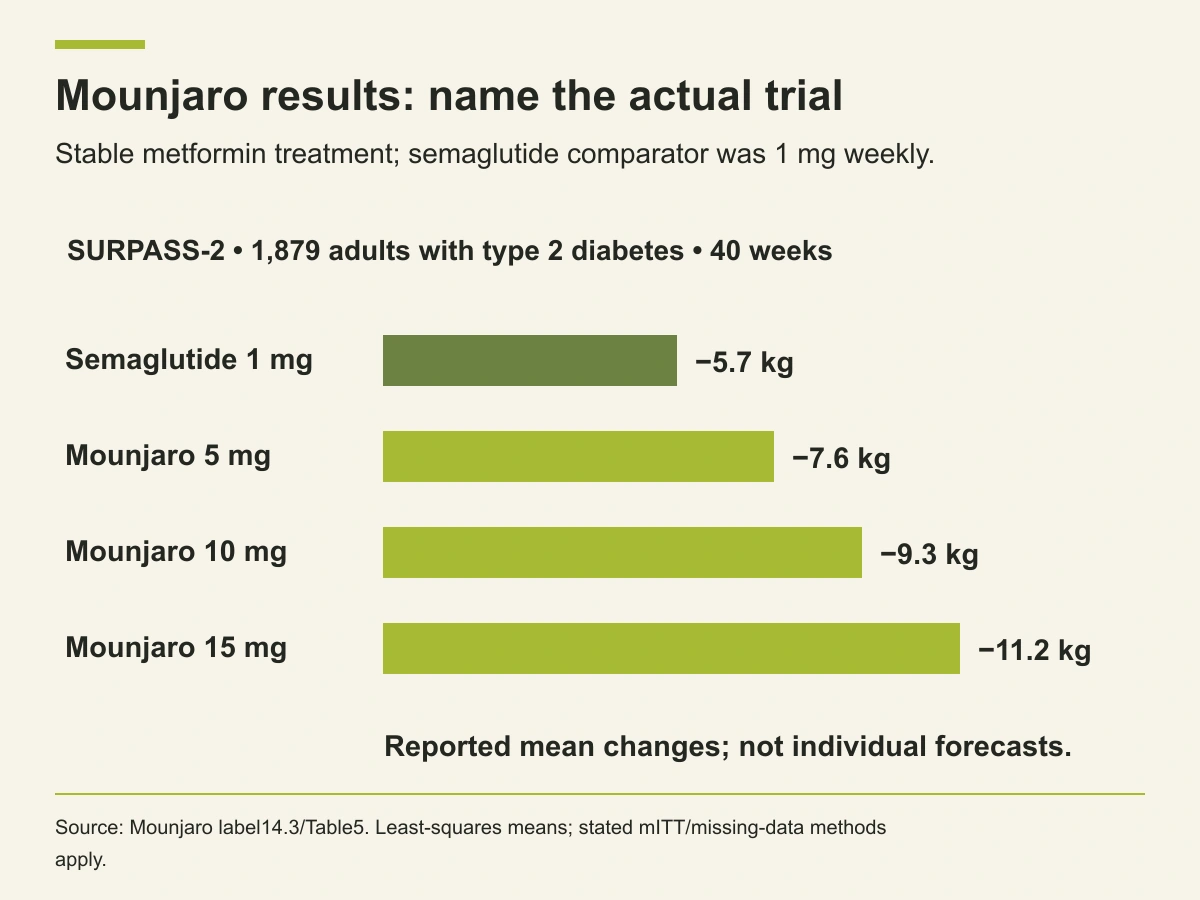
SURPASS-2 involved 1,879 adults with type 2 diabetes on stable metformin treatment. It compared Mounjaro with semaglutide 1 mg weekly over 40 weeks. The trial was open-label, with the Mounjaro dose assignment blinded. Mounjaro clinical studies, section 14.3
| Treatment group in SURPASS-2 | Reported mean weight change at 40 weeks |
|---|---|
| Semaglutide 1 mg | −5.7 kg |
| Mounjaro 5 mg | −7.6 kg |
| Mounjaro 10 mg | −9.3 kg |
| Mounjaro 15 mg | −11.2 kg |
The label reports least-squares mean changes with its stated analysis and missing-data methods. The trial is useful evidence for those treatments in that population and setting. It is not a comparison against every semaglutide dose, Wegovy regimen, or type of weight-management care.
For a broader comparison, see Mounjaro versus Ozempic. Ask which evidence matches your diagnosis rather than treating a chart as a reason to select a drug yourself.
Where do the large tirzepatide weight-loss percentages come from?
The Zepbound label describes Study 1, involving 2,539 adults with obesity or overweight and a weight-related condition, without type 2 diabetes. Outcomes were measured at 72 weeks, including a dose-escalation period. Participants received lifestyle counseling as part of the trial. Zepbound clinical studies, section 14.1
For the longer follow-up in participants with prediabetes, see what the three-year SURMOUNT-1 report shows, with original graphics, diabetes outcomes, and links to the scientific papers.
Its intention-to-treat table reports mean percentage changes from baseline of −3.1% with placebo, −15.0% with 5 mg, −19.5% with 10 mg, and −20.9% with 15 mg. These are the specified table results, rather than a different analysis selected because it produces a larger headline.
The same label’s Study 2 involved 938 adults with type 2 diabetes and a BMI of at least 27. At 72 weeks, the corresponding table reports −3.2% with placebo, −12.8% with 10 mg, and −14.7% with 15 mg. The studies did not randomly assign the same people to “diabetes” or “no diabetes,” so their difference is not a head-to-head causal test of diabetes status.
Read how to calculate weight-loss percentage to understand the denominator. A group average at 72 weeks does not specify what will happen to you at four weeks or at a particular starting weight.

Why the analysis matters
The Zepbound table includes all randomized participants in the intention-to-treat population and describes how missing weight measurements were imputed, meaning estimated using a specified statistical method. It reports adjusted mean results and other outcomes with footnotes. Zepbound trial table and footnotes
An analysis focusing on people who remained on treatment may produce a different number from an analysis designed to account for all randomized participants. Neither number should be relabeled as “everyone’s result.” When an article uses a percentage, check which analysis it belongs to.
Also distinguish an average change from the percentage of participants reaching a threshold. “Average loss of 15%” and “a certain share lost at least 15%” describe different outcomes. The weight-loss timeline guide explains why a time period and an average are essential context for a result.
What should you expect in the first month?
A 40-week or 72-week endpoint cannot provide a guaranteed four-week result. Early care also includes reviewing tolerability, the treatment goal, other medicines, and the prescribed escalation plan.
The current Mounjaro label recommends a 2.5 mg weekly starting dose and says that, if additional glycemic control is needed, the dose may be increased in 2.5 mg increments after at least four weeks at the current dose. The maximum labeled adult dose is 15 mg weekly. Follow the actual prescription; a trial’s maintenance-dose group is not a starting-dose recommendation. Mounjaro dosage instructions
See the Mounjaro dosage guide for questions to discuss at follow-up. Do not escalate early because a social-media result seems larger or because the scale did not move during a short interval.
Why individual results can differ
Your starting health, diabetes status, other medicines, prescribed dose, treatment duration, access, adherence, and tolerability all provide context for the observed trend. A trial does not recreate every person’s circumstances.
Record interruptions or dose changes rather than comparing a fragmented course with an uninterrupted study endpoint. Tell the clinician if cost, refill delays, nausea, or trouble taking the medicine affected treatment. See Mounjaro cost questions for why access deserves attention in the care plan.
Avoid relying on before-and-after images as a numerical estimate. Photographs do not establish the prescription, baseline, time frame, medical supervision, or effects of other changes. A person pictured in an editorial image should not be presented as a treatment outcome.
What outcomes belong beside the weight trend?
For diabetes care, glucose control is central to the prescription discussion. Ask which measures your clinician wants to review and how other diabetes medicines may need clinician-directed adjustment. Weight alone cannot show whether the full plan is appropriate.
Also report eating and drinking difficulties, persistent digestive symptoms, weakness, or anything that disrupts daily life. The Mounjaro label warns about gastrointestinal reactions and dehydration-related kidney injury. It identifies increased low-glucose risk when used with insulin or an insulin secretagogue such as a sulfonylurea. Mounjaro warnings
Read Mounjaro side effects for broader symptom questions. More discomfort is not evidence of more effective weight loss, and a falling scale during significant illness should not be counted as uncomplicated progress.

A useful follow-up checklist
Bring the baseline and follow-up dates, measured weights, actual dose history, and relevant symptoms. Ask:
- Which labeled indication and treatment goals apply to my prescription?
- Which study, if any, is a useful comparison for my situation?
- Should we describe change in kilograms, pounds, percentage, or several measures?
- How do interruptions and dose changes affect interpretation?
- What symptoms should change the plan or prompt urgent care?
- What will we review at the next visit besides weight?
If you have a personal or family history of medullary thyroid carcinoma or MEN2, tell the clinician. These are labeled contraindications for tirzepatide products. The Zepbound after thyroid removal guide explains why a surgery history does not erase the relevant restriction. Mounjaro contraindications
Frequently asked questions
Will I lose 20% of my weight on Mounjaro?
No individual result can be promised. The 20.9% value above comes from a specific Zepbound 15 mg group and analysis at 72 weeks in adults without type 2 diabetes. It is not a guaranteed Mounjaro outcome.
Is 22.5% the number I should use for every tirzepatide discussion?
No. Identify the trial, analysis, dose, population, and endpoint. This guide uses the current labeled intention-to-treat table values rather than treating a larger headline from another analysis as universal.
Is semaglutide 1 mg the same comparison as every Wegovy dose?
No. SURPASS-2 studied semaglutide 1 mg. Its result should not be presented as if it compared Mounjaro with all semaglutide regimens. Mounjaro SURPASS-2 description
Where can I learn about tirzepatide care?
The CoreAge Rx tirzepatide information page introduces care questions. It does not promise these trial results, establish personal eligibility, or make a product interchangeable with Mounjaro or Zepbound.
Educational information for adults; individual treatment decisions require a qualified clinician. Sources reviewed October 4, 2026. Original AI-generated article images depict fictional people and objects, not patient outcomes. Other editorial images are illustrative. Graphics summarize the cited sources.