Rosemary tea is an aromatic herbal drink made from rosemary leaves. People often ask whether it improves digestion, helps memory, lowers blood sugar, or supports weight loss. The evidence depends on the claim and, crucially, on the preparation being studied. A cup of tea is different from a capsule, a standardized extract, or concentrated essential oil.
The most defensible approach is to enjoy rosemary tea as a beverage if it suits you, while keeping expectations modest. Traditional use does not establish a proven weight-loss treatment, and laboratory findings do not tell us what a person will experience after drinking a cup.
What is rosemary tea?
Rosemary is the fragrant herb commonly used in cooking. A tea or infusion is made by steeping the leaves in hot water and then straining them. The amount of plant material, steeping time, and blend ingredients all affect the finished drink.
A product labeled “rosemary tea” may contain only the herb, or it may include green tea, black tea, sweeteners, or other plants. Read the ingredient list. A blend containing a caffeinated tea is different from a rosemary-only infusion, and an added “detox” ingredient may bring considerations unrelated to rosemary.
The name on the front of a package is not enough to identify a product’s likely effects. Before treating two products as interchangeable, compare the ingredients, form, and directions. That same principle applies to supplements used during GLP-1 treatment.
What benefits are supported by evidence?
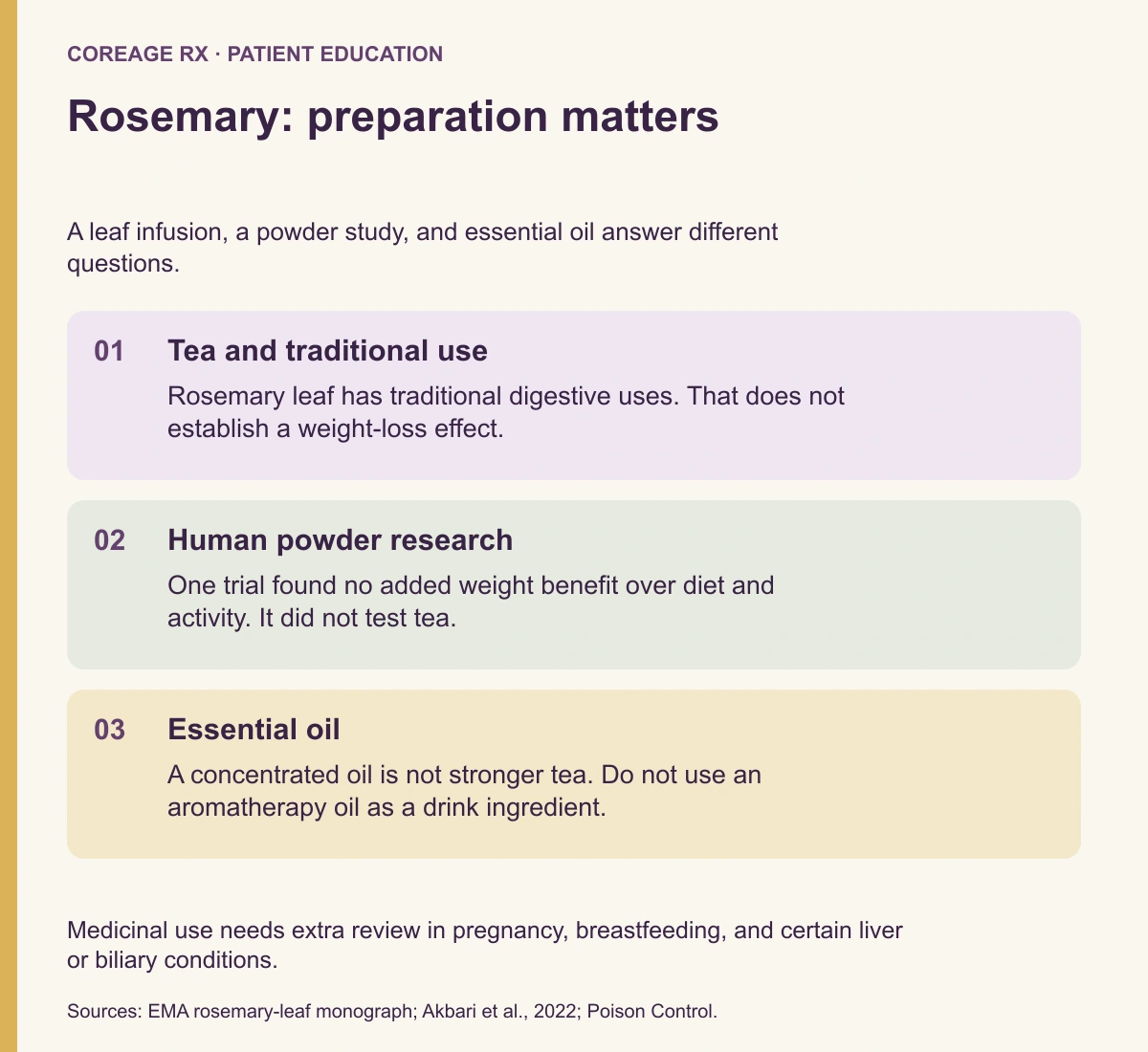
The European Medicines Agency recognizes a traditional medicinal use of rosemary leaf preparations for indigestion and mild spasmodic gastrointestinal complaints. Its monograph places this use in the traditional-use category, based on longstanding use rather than well-established clinical efficacy. It is not an approval of rosemary tea as a treatment for obesity. EMA rosemary-leaf monograph
That distinction allows a balanced interpretation. A person may enjoy the drink or find a warm beverage comforting, but it is too strong to promise that the tea will reliably treat chronic bloating, reflux, constipation, or an underlying digestive condition.
The same monograph also discusses rosemary preparations used in baths. Those uses cannot be transferred to an oral tea: putting a preparation in bathwater and swallowing it are different exposures. Be cautious when a benefits list mixes findings from different routes or products.
| Question | What the evidence can reasonably tell you |
|---|---|
| Can rosemary leaf be used traditionally for mild indigestion? | Yes, this appears in the EMA traditional-use monograph. |
| Does that prove a cup of tea treats a digestive disease? | No; traditional use and established clinical efficacy are different. |
| Is rosemary tea a proven weight-loss treatment? | No reliable tea-specific weight-loss effect was established in the sources reviewed here. |
| Can results from rosemary powder or extracts be applied directly to tea? | No; the preparation and exposure differ. |
| Is essential oil simply stronger tea? | No; it is a concentrated product with different risks. |
Does rosemary tea help with weight loss?
There is no established rosemary-tea dose or schedule that reliably produces weight loss. One relevant human trial illustrates why a study headline needs closer reading.
In a randomized trial of 110 people with nonalcoholic fatty liver disease, participants received rosemary leaf powder or placebo for eight weeks; both groups also received a weight-loss diet and physical-activity advice. Weight and several other measures improved in both groups, but the researchers did not find a significant added weight benefit from rosemary compared with placebo. This was a powder study, not a tea trial. Randomized rosemary trial
That result does not prove that every conceivable preparation has no effect. It does mean the trial should not be presented as evidence that rosemary tea independently causes weight loss. Improvement during a program does not identify which part of the program caused it.
An unsweetened cup can still serve a practical role if it replaces a sweetened drink you normally have. Any change in beverage calories depends on the actual substitution and what you add. Honey, syrups, and sweetened creamers change the drink. See water and drinks for weight management for ways to assess those choices without assigning special fat-burning properties to an ingredient.

What about metabolism, blood sugar, memory, and inflammation?
These claims often combine several kinds of evidence: laboratory experiments, animal research, studies of extracts, traditional practices, and experiences shared online. They do not all answer the same question.
For a claim about drinking rosemary tea, useful research would identify the tea preparation, compare it with an appropriate control, measure meaningful outcomes in people, and follow participants long enough to assess benefits and harms. A change in a laboratory marker is not automatically evidence of better memory, fewer illnesses, or sustained weight loss.
The sources reviewed for this article do not establish rosemary tea as a substitute for treatment of diabetes, a memory disorder, or an inflammatory condition. If you take medication for a diagnosed condition, do not adjust it based on a tea advertisement or home glucose reading without discussing the situation with your clinician.
A helpful question is, “Was this claim tested with the same product, for the same purpose, in people like me?” If the answer is unclear, the claim needs more qualification than a confident benefits list usually provides.
How to make a simple cup
For an ordinary beverage, choose a food-grade rosemary tea intended for drinking and follow its package preparation instructions. If using culinary rosemary, confirm that it is the edible herb, wash fresh leaves, steep a modest amount for taste, and strain the infusion. Avoid plants treated with products not intended for edible crops.
Start with a mild flavor rather than trying to maximize concentration. Rosemary has a strong taste; adding more leaves or steeping longer does not establish a larger health benefit. Let the drink cool to a comfortable temperature before drinking.
There is no reason to build a weight-loss protocol around cups per day. The medicinal-use quantities described in a herbal monograph are not an evidence-based weight-loss prescription. If you are considering repeated medicinal use, discuss the product and purpose with a clinician or pharmacist rather than borrowing a dose from a social-media recipe.
If you prefer another flavor, ordinary alternatives are valid. Our peppermint tea and green tea comparison discusses caffeine, digestive questions, and limits of weight claims.
Why you should not add rosemary essential oil to tea
Essential oils are concentrated preparations, not interchangeable with culinary leaves. An aromatherapy bottle should not be used as a drink ingredient. Descriptions such as “natural” or “pure” do not establish that a product is safe to swallow.
Poison Control notes that misuse of essential oils can cause poisoning and that swallowing or aspirating some oils can be dangerous. Store concentrated oils away from children and follow product-specific instructions. If an oil is swallowed accidentally, seek advice from Poison Control rather than relying on a tea recipe to judge the exposure. Poison Control on essential oils
Likewise, a capsule or extract may deliver a different amount and mixture of constituents from an infusion. Do not stack several rosemary products simply because each package uses the same plant name.

Who should discuss rosemary tea with a clinician first?
The EMA monograph does not recommend medicinal rosemary-leaf use during pregnancy or breastfeeding because adequate safety information is lacking. It also does not recommend medicinal use in children younger than 12. This guidance concerns medicinal preparations; it should not be turned into a claim that ordinary seasoning and concentrated products are identical. EMA precautions
People with gallstones, bile-duct obstruction, cholangitis, liver disease, or other biliary conditions should seek medical advice before oral medicinal use. If that list includes your condition, a tea marketed as a “digestive remedy” is a reason to check first, not evidence that it will address the problem.
The monograph reports no established interactions, but that does not demonstrate that every combination with every medicine is safe. Bring the actual package or ingredient list to a pharmacist, especially if the product is a blend or extract. A review of the complete medication and supplement list is more useful than an online interaction checklist that assumes a standardized cup.
Stop using a product that appears to cause an allergic reaction and get appropriate help. Persistent or worsening digestive symptoms also need assessment rather than stronger tea. Symptoms that keep you from eating or drinking adequately deserve particular attention.
Frequently asked questions
What is the best time to drink rosemary tea for weight loss?
No special morning, bedtime, or empty-stomach schedule has been established for weight loss. Choose a time that fits your preferences if the drink is appropriate for you. Timing does not turn uncertain evidence into a proven treatment.
Does rosemary tea contain caffeine?
A plain rosemary-leaf infusion has no tea leaf added. Check blends carefully, because green tea, black tea, or other caffeinated ingredients change that answer. The full ingredient list is more informative than the rosemary name alone.
Can I drink it while taking semaglutide or tirzepatide?
There is no proven rosemary-tea strategy for increasing GLP-1 weight-loss results. Ask your pharmacist about the specific product if you plan regular medicinal use, and mention other supplements. If nausea is the problem, our semaglutide nausea guide explains why persistent symptoms may need a treatment review.
Will it detox my liver?
That benefit has not been established. NCCIH finds no convincing support for detox diets as a way to remove toxins or manage weight, and restrictive cleanses may cause harm. A diagnosis involving the liver needs an appropriate care plan. NCCIH detox guidance
What should I focus on if weight management is the goal?
Start with a sustainable eating pattern, adequate nutrition, enjoyable movement, and any medical support appropriate for your circumstances. Our weight-loss basics and macronutrient guide explain those decisions. Rosemary tea can be a preference within that plan; it does not need to carry the plan.
Educational information for adults; individual treatment decisions require a qualified clinician. Sources checked September 27, 2026. Original AI-generated article illustrations depict fictional people and objects, not patient outcomes. Other editorial images are illustrative. Graphics summarize the cited sources.