
“GLP-1 microdosing” does not describe one standardized medical regimen. Online, it may mean using a dose below a product’s labeled schedule, taking doses at longer intervals, or making unusually small adjustments. These approaches are not interchangeable, and the word alone does not tell you what medication, amount, or treatment goal is involved.
Lower-dose treatment can be part of appropriate clinical care. But evidence supporting an approved medicine at a studied dose does not automatically establish the benefits of a different schedule advertised for weight loss, energy, or longevity. Before considering a program, ask what is being prescribed, why that regimen fits your situation, and how its effects will be assessed.
What does microdosing a GLP-1 actually mean?
The first step is replacing the marketing term with a complete description. That means identifying the active ingredient, product or pharmacy preparation, dose in milligrams, dosing interval, delivery device, and intended health outcome.
Semaglutide and tirzepatide are different medicines. Tirzepatide acts at both GIP and GLP-1 receptors; semaglutide acts at the GLP-1 receptor. A small numerical dose of one is not an equivalent amount of the other. Our semaglutide questions guide and tirzepatide questions guide explain their broader roles.
The same ingredient can also appear in products with different approved uses and instructions. A discussion about diabetes treatment cannot automatically be transferred to weight management in a person without diabetes. Ask for the specific reason for treatment before discussing how small the dose could be.
| Situation | What needs to be clarified |
|---|---|
| Starting at a low labeled dose | Is this the product’s initial escalation step? |
| Using a lower approved maintenance dose | Does this dose fit the indication and individual response? |
| Making an off-label adjustment for tolerability | What is the clinical rationale and monitoring plan? |
| Taking an unstudied amount or interval | What evidence supports that exact regimen and goal? |
| Buying a program called “microdosing” | What drug, formulation, pharmacy, instructions, and follow-up are included? |
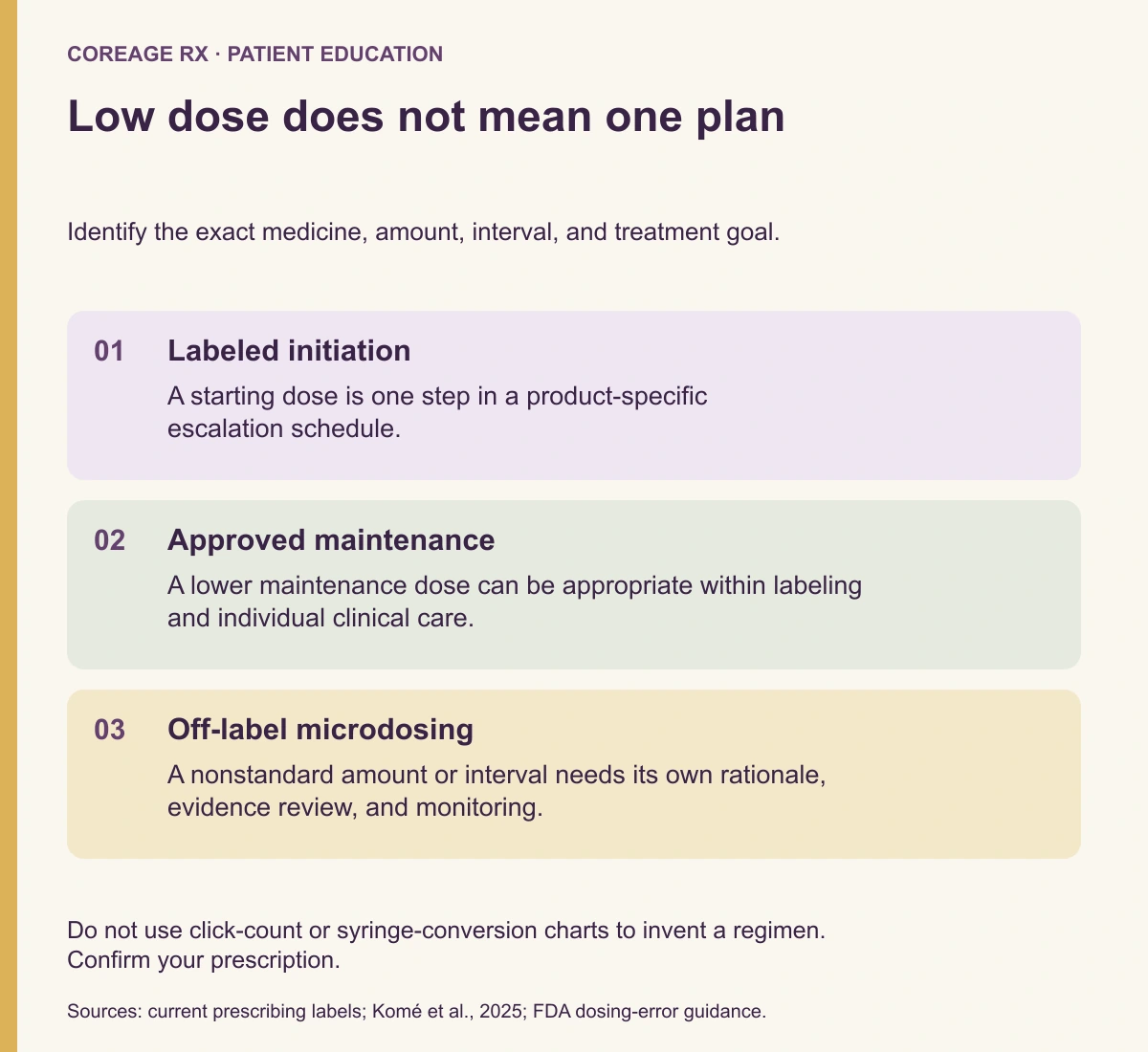
Is a starter dose the same thing as a microdose?
No. Many GLP-1 treatment schedules begin with a low dose and increase gradually to reduce gastrointestinal side effects. That planned escalation has a different purpose from indefinitely using an arbitrary fraction of a dose.
For example, the Zepbound label distinguishes its 2.5 mg initiation dose from approved maintenance doses. It also instructs clinicians to consider response and tolerability when selecting maintenance treatment. Calling every lower dose “microdosing” obscures those distinctions. Zepbound prescribing information
Ozempic likewise has a labeled starting phase and different maintenance instructions according to the treatment purpose. Its prescribing information does not create a universal semaglutide microdosing regimen for otherwise healthy people. Ozempic prescribing information
Our semaglutide dosage guide and Zepbound dosage guide explain labeled schedules. Use those guides to understand your prescription, not to invent a conversion or change a dose yourself.
What research exists on GLP-1 microdosing?
There is published discussion of the idea, so it would be inaccurate to say researchers and clinicians have never considered it. However, a clinical proposal is different from a trial demonstrating a particular regimen’s benefits and risks.
A 2025 letter in Diabetes Care proposed individualized fractional semaglutide dosing for selected clinical situations, including tolerability and access difficulties. It did not report a randomized trial. The authors explicitly acknowledged that the method was off-label, was not endorsed by the manufacturer, and lacked trials validating its safety or effectiveness. Clinical letter on semaglutide microdosing
That paper can help explain why a clinician might discuss an individualized adjustment. It cannot establish that any online low-dose program improves longevity, prevents disease in healthy adults, or delivers the same results as the regimens in large clinical trials.
When reviewing a claim, look for four details: who was studied, the actual dose and interval, the comparison group, and the outcome measured. A testimonial about reduced appetite does not answer whether a regimen produces sustained weight loss or better long-term health. A study of a different dose cannot settle that question either.
Can microdosing help with nausea or other side effects?
Tolerability is a legitimate reason to contact a prescriber. It is not a reason to accept an undocumented schedule or assume that less medication means no risk.
A useful review starts with the symptom itself: when it began, whether it followed a dose change, how often it happens, and whether you can eat and drink adequately. Constipation, vomiting, reflux, and abdominal pain may require different responses. The prescriber may reassess the medication, escalation plan, other drugs, or another cause of symptoms.
Keep a brief record of injection dates, symptoms, bowel changes, and food or fluid difficulties. Our guide to how long GLP-1 nausea lasts can help prepare that conversation. Avoid adding multiple supplements or anti-nausea medicines while also changing the injection schedule, because it becomes harder to understand what is happening.
Severe or persistent abdominal pain, repeated vomiting, or inability to keep fluids down needs prompt medical assessment. An unexpectedly large injection also needs immediate advice; do not wait for symptoms to prove there was an error. The FDA has received reports of dosing mistakes that required hospital care. FDA dosing-error alert

Is microdosing semaglutide different from microdosing tirzepatide?
Yes, because the medicines and product instructions differ, but neither term identifies a single validated protocol. “Microdosing tirzepatide” may describe a different amount, interval, formulation, and goal from one clinic or social-media post to the next.
Do not transfer instructions between semaglutide and tirzepatide, or between different concentrations of the same ingredient. The number on a syringe or pen is not a universal language for all GLP-1 products. A clinician and pharmacist should provide instructions for the exact prescription in hand.
If your real question is which medication best fits your needs, start with choosing a GLP-1 medicine. If you are considering a transition, our switching guide outlines the information needed for a clinician-led plan. Neither requires an improvised dose-equivalence chart.
Why do vials, concentrations, and “units” matter?
Milligrams describe an amount of medicine; milliliters describe a volume of liquid. Syringe markings do not establish the drug concentration. The same volume can contain a different amount of medicine when the concentration changes.
The FDA has described errors involving confusion between these measurements and compounded semaglutide preparations. It advises appropriate syringes, clear instruction, and checking uncertain calculations with the dispensing pharmacy. This is why a screenshot of someone else’s syringe is not a safe substitute for your own instructions. FDA explanation of dosing errors
If a refill looks different, the concentration changes, or the written directions conflict, resolve the discrepancy before injecting. Ask the pharmacist to demonstrate the intended measurement and confirm that it matches the prescriber’s order. Do not rely on a generic click-count or syringe-conversion chart.
Does a compounded microdosing program have FDA approval?
Compounded drugs are not FDA-approved and do not receive the agency’s premarket review for safety, effectiveness, or quality. The FDA says they should be used when a patient’s medical needs cannot be met by an available approved drug. A prescription or a branded program name does not change that regulatory status. FDA guidance on unapproved GLP-1 drugs
The same guidance warns about dosing errors, unsuitable semaglutide salt forms, and product-quality concerns. It also currently advises discarding compounded multidose GLP-1 vials within 28 days of first use, even if a compounder provides longer instructions. Do not apply one storage rule to every branded device; confirm the exact product’s directions with the pharmacist.
Stretching a vial over a longer period is therefore not simply a cost calculation. Storage, time after first use, and the ability to measure the prescription correctly are part of the decision.

What about weight maintenance, longevity, or “food noise”?
These are different goals and need different evidence. Maintaining weight after treatment, changing appetite, preventing cardiovascular events in a high-risk population, and increasing lifespan are not interchangeable outcomes.
The sources reviewed here do not establish a universal microdosing schedule that reliably preserves prior weight loss or extends life. Nor does feeling less hungry by itself establish adequate nutrition or a long-term health benefit. If appetite becomes very low, discuss food intake and function along with the scale. Our protein and muscle guide explains why nutrition remains important during treatment.
For maintenance, ask what outcome will be monitored, how often you will review progress, and what would trigger a change. A plan should also address cost and access so that missed treatment is not managed through repeated improvisation.
Questions to ask before considering a program
Bring these questions to the appointment:
- What diagnosis or health goal makes this treatment appropriate for me?
- Is the proposed product FDA-approved or compounded, and why was it selected?
- Which parts of the regimen follow labeling, and which are off-label?
- What evidence supports this exact dose, interval, and intended benefit?
- Who will answer administration questions or review side effects?
- What is the plan if it is ineffective, unaffordable, or poorly tolerated?
CoreAge Rx describes semaglutide microdosing and tirzepatide microdosing programs. Those service descriptions are a starting point for asking these questions. Availability of a program does not establish FDA approval of its regimen or prove longevity, energy, or weight-maintenance benefits.
If cost is the main concern, also review GLP-1 insurance coverage before assuming dose stretching is your only option. The useful decision is a documented treatment plan whose purpose, evidence, costs, and follow-up you understand.
Educational information for adults; individual treatment decisions require a qualified clinician. Sources checked September 27, 2026. Original AI-generated article illustrations depict fictional people and objects, not patient outcomes. Other editorial images are illustrative. Graphics summarize the cited sources.