Do not apply prescription tretinoin to the eyes or improvise an under-eye routine from a social-media tutorial. The reviewed tretinoin cream labels direct users to keep the medicine away from the eyes and other sensitive areas. If your goal is to improve under-eye lines, ask the prescriber to define where your exact product may be used and what should be avoided. Tretinoin cream labeling, Renova labeling
“Under the eyes” can mean the lower eyelid, the lash line, or skin farther onto the cheek. Those are not interchangeable application instructions. A general facial prescription does not establish a safe distance from the eye, and this guide does not invent one.
What do the labels actually say?
The reviewed 0.025% tretinoin acne cream label says to keep treatment away from the eyes, mouth, angles of the nose, and mucous membranes. Its patient instructions also say to keep medicine away from eyes and open wounds. Tretinoin cream precautions and patient instructions
Renova 0.02%, a specific tretinoin cream with a fine-facial-wrinkle indication, similarly warns to avoid the eyes and other sensitive areas. It describes the possibility of severe redness, itching, burning, stinging, and peeling if applied to those areas. Renova warnings and patient instructions
These warnings should not be rewritten as “apply close to the lash line carefully.” If a clinician recommends a particular application plan, ask for clear boundaries and instructions that match the dispensed formulation. Do not infer permission from a general before-and-after image or another person’s routine.
See starting tretinoin skin care for broader preparation questions. The eye-area question requires more specific guidance than simply knowing how often a facial product is usually applied.
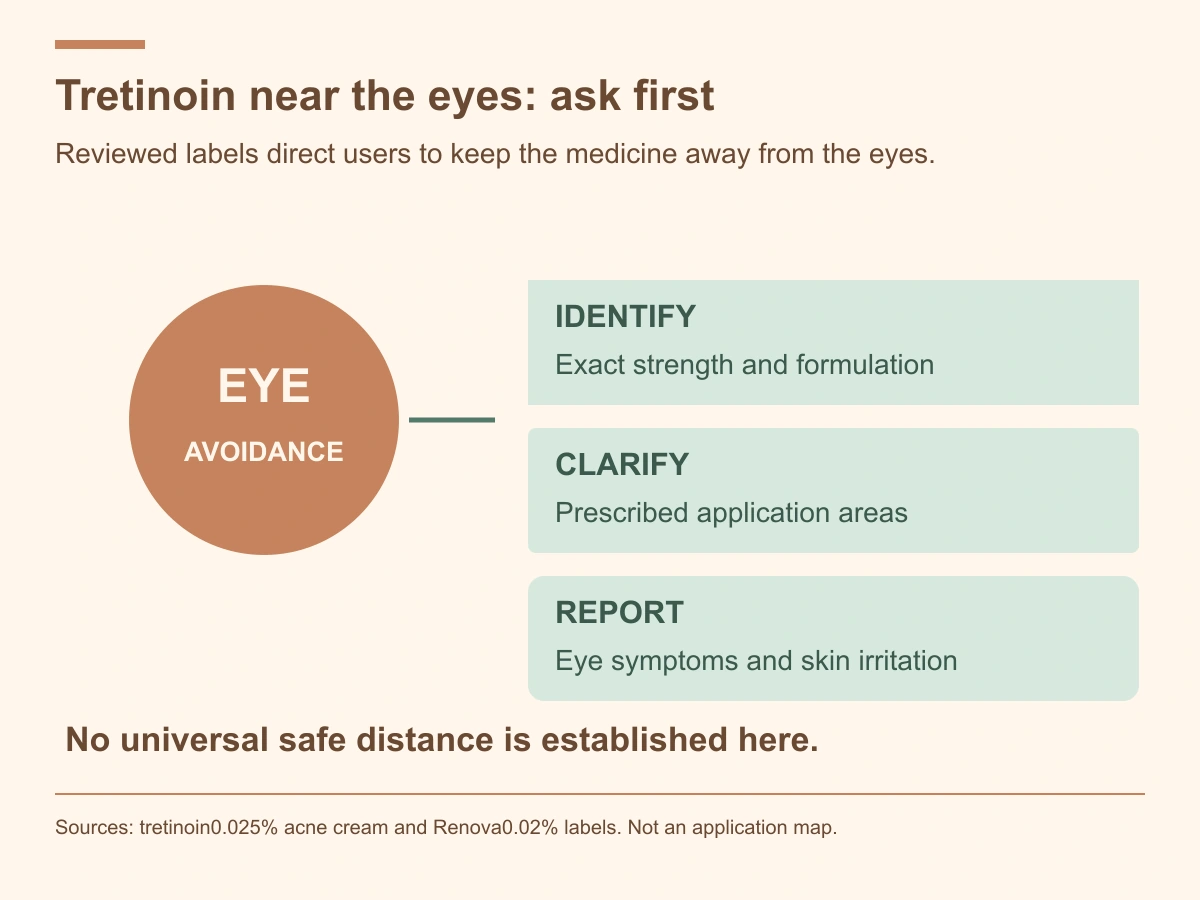
Identify the exact prescription first
Tretinoin is available in different strengths and formulations. A label for one acne cream is not a universal instruction sheet for another cream, gel, lotion, or combined prescription. Other ingredients and the reason for treatment can change the discussion.
Bring the tube, carton, or dispensing label to the appointment. Record the concentration, formulation, instructions, and any additional active ingredients. If the prescription comes from a custom formulation, obtain instructions for that actual product rather than assuming Renova’s directions establish its approved uses.
The tretinoin strengths guide explains why concentration is only one part of the prescription. A lower percentage does not automatically make eyelid use appropriate. Nor does mixing the medicine with moisturizer establish that it can be placed near the eye.
Facial fine-line evidence is not an eyelid instruction
Renova 0.02% is labeled as an adjunct for reducing the appearance of fine facial wrinkles within a comprehensive skin-care and sunlight-avoidance program. Its label says it does not eliminate wrinkles, repair sun-damaged skin, reverse photoaging, or restore younger skin. Renova indications
The label describes facial studies conducted with sun protection and other skin-care measures. That evidence should not be presented as proof that every under-eye concern improves, that every formulation has the same effect, or that the product should be applied to the eyelid.
Ask what the concern actually is: fine lines, discoloration, puffiness, irritation, or something else. Different appearances can require different assessments. The tretinoin fine-lines guide and acne-versus-photoaging guide explain why the treatment goal needs to be named before discussing results.
Why more irritation is not a better-result signal
The reviewed labels describe local redness, peeling, burning, stinging, and other irritation. They also explain that applying more medicine does not produce faster or better results and can increase discomfort. Tretinoin cream precautions, Renova warnings
Do not treat a painful under-eye reaction as a necessary “purge” or proof that the prescription is working. An irritated eye area is a reason to contact the prescriber and review what was applied, where, and how often.
The tretinoin peeling and irritation guide covers the broader distinction between a symptom worth reporting and a result you should try to intensify. Avoid increasing strength, frequency, or quantity while attempting to push through a reaction.
What should you report if the eye area becomes irritated?
Tell the clinician whether the symptom affects skin, the eye itself, or both. Describe redness, swelling, burning, itching, peeling, pain, tearing, or any change in vision. Give the time of application and when symptoms began.
If medicine entered the eye, contact a clinician, pharmacist, or poison-control service for immediate advice about the actual exposure. Do not put more tretinoin or another active skin product into the area to counteract it. Eye pain, vision changes, or a significant reaction warrants urgent assessment rather than a routine cosmetic follow-up.
The reviewed acne cream label directs users with severe or persistent irritation to discontinue use and consult the physician. Renova also describes clinician-directed changes or discontinuation when irritation warrants. Follow the instructions for your product and get specific advice before restarting around a problem area. Tretinoin patient precautions, Renova irritation warnings

Review the whole skin-care routine
An eye-area reaction may be difficult to interpret if several products changed at once. Bring a list of cleansers, moisturizers, sunscreens, acids, scrubs, retinoids, spot treatments, and cosmetics. Include products used only occasionally, such as exfoliating masks or hair-removal products.
The reviewed tretinoin cream label cautions about products with a strong drying effect, abrasive or medicated cleansers, and certain other topical medicines. Renova’s patient instructions also list products that can increase irritation. Tretinoin topical-product precautions, Renova patient precautions
This does not mean every moisturizer is unsuitable. It means the prescriber should help build a routine that matches your prescription and skin response. See tretinoin and moisturizer for questions about layering. Moisturizer cannot convert an avoided application area into a proven safe one.
| Question to clarify | Why it matters | Information to bring |
|---|---|---|
| What is my treatment goal? | Fine lines, acne, and other concerns are different | Main concern and previous treatments |
| Where may this product be applied? | Facial use does not define eye-area boundaries | Exact prescription and instructions |
| Which products should I pause or change? | Several actives can complicate irritation | Full routine and recent additions |
| What should I do for a reaction? | A restart plan needs to fit the symptoms | Onset, location, severity, photos if requested |
| How will results be reviewed? | General trial evidence does not predict every concern | Baseline, use history, sun protection |
Use the table to prepare a conversation. It is not an application map or a substitute for examining eye symptoms.
Sun protection belongs in the plan
Both reviewed labels emphasize minimizing sunlight exposure and using protective measures. Renova’s fine-wrinkle indication is specifically tied to a comprehensive skin-care and sunlight-avoidance program. Renova indications and warnings, Tretinoin sun precautions
Ask which sunscreen and protective habits fit your skin and prescription. Follow the product and clinician instructions, especially if you have a sunburn, unusual sensitivity, or a medicine that increases photosensitivity. Do not assume that a prescription replaces ordinary protection from sun exposure.
The tretinoin sunscreen guide provides broader planning questions. If sunscreen itself irritates the eye area, describe that separately so the clinician can help identify a usable product and routine.
What about dark circles, puffiness, or hollow-looking skin?
Do not assume all under-eye concerns have the same cause or respond to tretinoin. The reviewed Renova indication concerns fine facial wrinkles; it does not establish a universal treatment for every appearance around the eyes. Renova indications
Describe what changed, whether one or both sides are affected, and whether symptoms accompany the appearance. New swelling, redness, pain, or vision symptoms should be approached as a care question rather than a cosmetic target.
Ask whether a simpler routine, a different product, or another assessment is appropriate. Avoid selecting a stronger tretinoin preparation solely because an under-eye concern persists. A prescription choice needs to fit the diagnosis and application instructions.
How long should you wait to judge results?
A study time frame for facial fine wrinkles is not a personal deadline for an eye-area concern. Renova’s patient information says changes may take months, notes variation in response, and places treatment within the accompanying skin-care program. Renova patient information
Use the tretinoin results timeline guide to prepare realistic follow-up questions. Do not apply more, move closer to the eye, or add extra retinoids to accelerate an outcome.
At follow-up, report actual use and interruptions honestly. The clinician needs to know if irritation changed the routine, if instructions were unclear, or if another product was added. A useful review includes tolerability as well as any perceived improvement.

Questions to ask your prescriber
Before changing the routine, ask:
- Is tretinoin appropriate for the concern I am describing?
- Which exact areas should I treat and avoid with this formulation?
- What should I do if it reaches the eye or irritates nearby skin?
- Which other active products should be reviewed?
- How should pregnancy plans, skin conditions, or other medicines affect the plan?
- When should we reassess tolerability and results?
Renova’s labeling says not to use it during pregnancy or while attempting to become pregnant. Disclose pregnancy plans and ask about the instructions for your actual prescription. Renova patient warning
Frequently asked questions
Can I put tretinoin directly on my lower eyelid?
Do not improvise eyelid use. The reviewed labels direct users to avoid the eyes and sensitive areas. Ask your prescriber to define the boundaries for your exact formulation. Tretinoin precautions, Renova instructions
Is there a universal safe distance from the eye?
The reviewed passages do not establish one. This article therefore does not provide an arbitrary centimeter or finger-width rule.
Does buffering with moisturizer make under-eye use safe?
Moisturizer may be part of a prescribed routine, but it does not override eye-avoidance instructions or prove that a particular application area is appropriate.
Where can I learn about prescription skin-care options?
See the prescription tretinoin guide and CoreAge Rx Smooth Move information. Those pages introduce care questions; they do not authorize eyelid use or make a combined formulation identical to Renova.
Educational information for adults; individual treatment decisions require a qualified clinician. Sources reviewed October 4, 2026. Original AI-generated article images depict fictional people and objects, not patient outcomes. Other editorial images are illustrative. Graphics summarize the cited sources.