Pinalim tea should be evaluated by its actual ingredients, not by the suggestion that a “detox” tea removes body fat. The manufacturer-hosted package images reviewed for this article list senna, a stimulant laxative, along with pineapple, flaxseed, and green, red, and white tea ingredients. A laxative effect is not the same as a demonstrated weight-loss benefit.
The package images also contain serving information that does not fully align, so they cannot establish a reliable senna dose per tea bag. Check your physical package and ask a pharmacist or the manufacturer about unclear details. This guide explains the ingredient evidence, possible side effects, and when symptoms need attention.
What was actually verified on the product label?
The GN+Vida Pinalim product page and its associated package photographs were reviewed October 5, 2026. The front image shows 30 tea bags of 3 g each, with a total weight of 90 g. The Supplement Facts image lists a proprietary blend containing pineapple fruit, flaxseed, Camellia sinensis tea leaves described as green, red, and white tea, and senna identified as Cassia angustifolia. Pineapple extract appears under other ingredients. Manufacturer Pinalim product page
However, the photographed facts panel shows a serving of 3 tablespoons, or 35 g, and 18 servings, alongside a 3 g proprietary blend. Those figures do not straightforwardly match the front’s tea-bag presentation. This article therefore does not infer the amount of senna, caffeine, or calories in a brewed bag from those inconsistent images.
That is a limit of the reviewed online label evidence, not proof that every box is identical or that every batch has a problem. Compare the actual package you have, including the country of sale, ingredient list, directions, warnings, and any lot information. Contact the manufacturer when the panels do not make sense together.
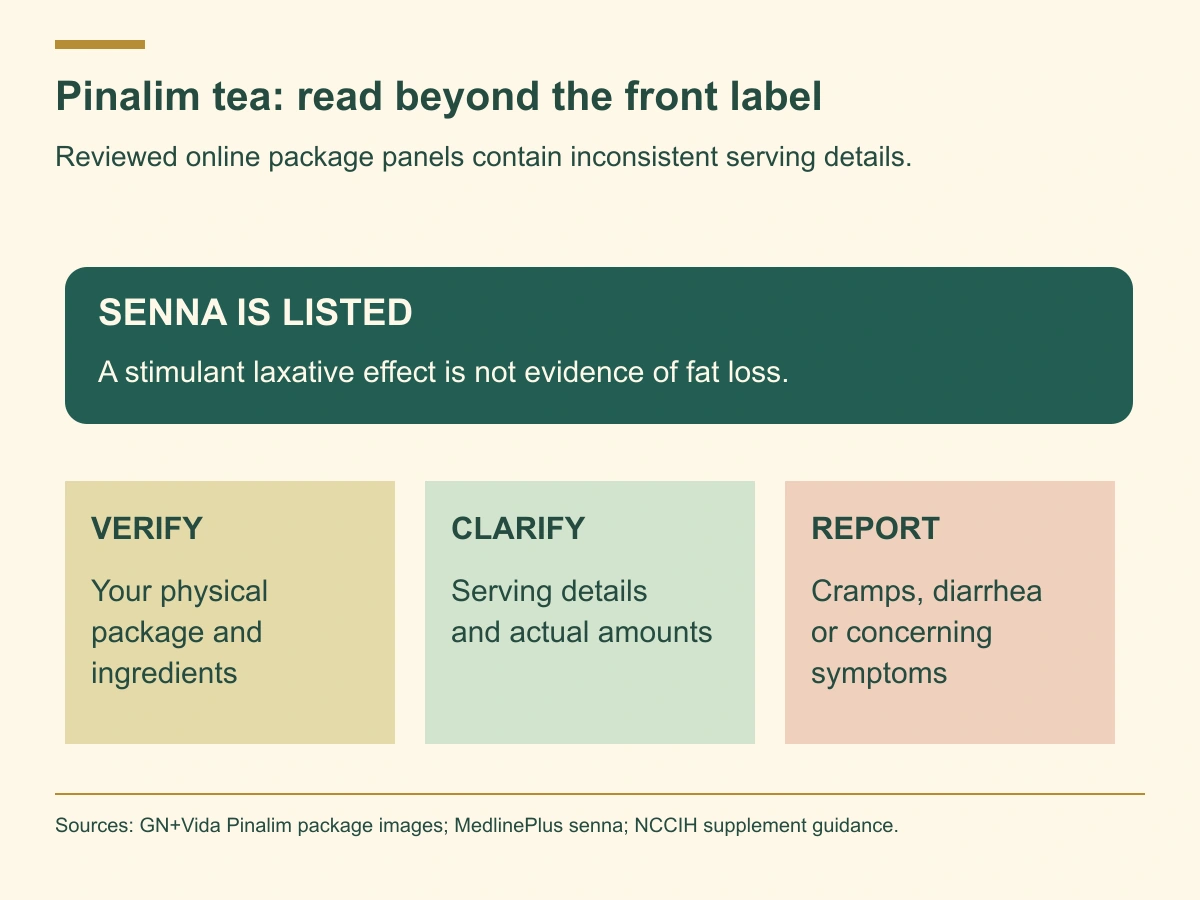
Why does senna matter more than the word “tea”?
Senna is a stimulant laxative used for short-term constipation. MedlinePlus explains that it works by increasing intestinal activity to cause a bowel movement. That pharmacological effect matters even when the product comes in a tea bag. MedlinePlus senna information
A bowel movement can reduce digestive contents and may change a scale reading. It does not demonstrate that stored body fat has been lost. Diarrhea can also reduce body water and leave someone dehydrated. Neither outcome should be presented as evidence of a successful fat-loss treatment.
Our water weight versus fat-loss guide explains these distinctions. The Smooth Move tea guide covers a related senna-containing product, but the amount and directions for one brand should not be transferred to another.
What side effects are associated with senna?
MedlinePlus lists stomach discomfort, nausea, cramps, and faintness among possible effects of senna. It also notes that urine may change to a yellow-brown color. Rectal bleeding or failure to have a bowel movement after use requires medical advice under its instructions. Senna side effects and precautions
These are senna-related considerations, not measured rates of side effects from Pinalim. The reviewed manufacturer page does not supply a controlled clinical trial that tells us how often a particular Pinalim preparation causes each symptom. The product amount, other ingredients, brewing, individual health, and other medicines can all matter to an assessment.
If you develop substantial diarrhea, repeated vomiting, marked weakness, dizziness, or difficulty keeping fluids down, seek prompt clinical advice. Severe abdominal pain, fainting, significant bleeding, or a serious allergic reaction warrants urgent attention. Do not interpret intense cramps or diarrhea as evidence that a tea is “detoxing” more effectively.
Is Pinalim suitable for daily long-term use?
Do not assume that a daily marketing routine overrides the precautions for a stimulant laxative. MedlinePlus advises against taking senna for more than one week without talking with a doctor and warns that frequent or continued use can create dependence on laxatives for bowel function. Senna duration warning
That warning does not supply a personalized Pinalim schedule. The exact product and amount need review, especially when the online serving information is unclear. If constipation repeatedly returns, the useful next step is to assess the cause and an appropriate bowel plan, not to keep increasing a laxative tea.
Tell the clinician how often you use it, how it changes bowel movements, and whether you also take other laxatives, supplements, or medicines that affect digestion. Bring the actual package. A vague report that you drink “herbal tea” can leave the senna exposure out of the medication review.
Does Pinalim contain caffeine?
The reviewed label includes Camellia sinensis tea ingredients. NCCIH explains that tea from this plant contains caffeine, although amounts vary with the preparation. The label evidence reviewed here does not establish a measured caffeine amount for a brewed Pinalim serving. NCCIH green tea information
Do not assume the product is caffeine-free simply because it also contains fruit or herbs. Ask the manufacturer for the actual formulation and caffeine information if you need to limit caffeine. Consider other tea, coffee, energy drinks, and medicines when discussing symptoms such as sleep disruption or feeling overstimulated.
The decaf tea and caffeine guide explains why “tea,” “herbal,” and “decaf” are different descriptions. A claim about one beverage does not establish the amount in a multi-ingredient product.

Does green tea evidence prove this blend causes weight loss?
No. Evidence about a particular green tea preparation or extract cannot establish a result for a different multi-ingredient tea. NCCIH describes green tea research and distinguishes beverages from concentrated extracts. Effects and risks depend on the preparation; concentrated-extract concerns should not be automatically assigned to every ordinary cup of tea. NCCIH green tea review
For Pinalim specifically, the materials reviewed for this article did not provide a controlled human weight-loss trial of the labeled blend. That is the relevant limitation. Testimonials, a before-and-after photograph, or the presence of familiar plant ingredients cannot fill that gap.
The peppermint versus green tea guide and pomegranate green tea guide explain how beverage composition, added sugar, and research design affect similar claims. A product should be judged by evidence for the actual preparation and outcome being advertised.
Which medicine and health questions should you raise?
Ask a pharmacist to review the complete ingredient list alongside your prescriptions and other supplements. Mention pregnancy or breastfeeding, kidney or heart conditions, abdominal symptoms, and any history that changes how you manage fluids or bowel movements. MedlinePlus includes pregnancy and breastfeeding among the topics to discuss before senna use. Senna precautions
Some senna product instructions involve separating it from other oral medicines, but that does not establish one universal timing gap for every tea or every prescription. Use the instructions for the actual products and obtain a coordinated plan. Do not invent a two-hour rule and assume it resolves every interaction.
NCCIH also emphasizes that dietary supplements can interact with medicines and that a studied preparation may differ from a retail product. Supplements are not FDA approved for safety and effectiveness before marketing in the same way as drugs. NCCIH supplement guidance
What if constipation started during GLP-1 treatment?
Tell your prescribing team when constipation began, how often you are having bowel movements, what you can eat and drink, and whether there is pain, vomiting, or worsening abdominal swelling. The timing can help the evaluation, but it does not establish that every symptom is an ordinary medication effect.
Do not add multiple laxatives or a “detox” routine simply because the scale has stalled. The GLP-1 constipation guide explains questions to discuss and symptoms that require assessment. If diarrhea or vomiting develops, maintaining hydration and getting appropriate advice matter; Wegovy’s label includes kidney injury associated with volume depletion. Wegovy safety information
The semaglutide plateau guide addresses longer-term progress. More bowel movements do not establish that a prescription is working better, and a lighter reading after fluid loss is not a reason to keep using a laxative.
Use this label-and-symptom checklist
| Check | What to bring to the discussion |
|---|---|
| Product identity | The physical box, country of sale, and full ingredient panel |
| Serving information | Any mismatch between bag size, serving size, and directions |
| Laxative exposure | Senna and any other constipation products used |
| Caffeine information | The manufacturer’s actual statement, plus other caffeine sources |
| Symptoms and timing | Cramps, diarrhea, bleeding, dizziness, and when they began |
| Medicines and health history | Prescriptions, supplements, pregnancy, and relevant conditions |
Keep the purpose clear as well. Treating constipation and pursuing weight management are different goals. A product that changes bowel function has not thereby demonstrated a safe or sustainable weight-management benefit.

What is a more useful approach to weight concerns?
Consider the eating pattern, activity, sleep, health conditions, and medicines that fit your situation. A drink can be enjoyable without becoming a treatment. If you replace a sweetened beverage with an unsweetened one, the change in sugar and calories comes from the substitution; it does not prove a special fat-loss effect from the tea blend.
The water and drinks guide is a useful place to compare everyday choices. For a clinical assessment, the CoreAge Rx semaglutide and tirzepatide service pages describe compounded options for eligible adults. Those services do not validate Pinalim as an add-on, and compounded medicines are not FDA approved. FDA compounded GLP-1 information
Frequently asked questions
How quickly does Pinalim work?
The reviewed material does not establish a reliable product-specific onset. Senna’s general timing information should not be used to promise what an uncertain amount in a particular brewed bag will do. Ask about the actual product rather than taking more because an expected hour has passed.
Does going to the bathroom more mean I am losing fat?
No. Stool and fluid changes do not measure body-fat loss. Cramping, diarrhea, or dehydration is not a desirable marker of progress.
Can I use Pinalim every night if it is natural?
“Natural” does not remove stimulant-laxative precautions. Discuss repeated use with a clinician, especially beyond the short-term period described in senna guidance or when symptoms persist.
What is the most important label detail to check?
Confirm whether your actual product contains senna and whether the serving and directions are understandable. The manufacturer images reviewed here support identifying senna, but they do not justify inventing a per-bag dose or a universal regimen.
Educational information for adults; individual treatment decisions require a qualified clinician. Sources reviewed October 5, 2026. Original AI-generated article images depict fictional people and objects, not patient outcomes. Other editorial images are illustrative. Graphics summarize the cited sources.