The question “Is HRT good or bad for the heart?” is too broad to capture the research. Age, time since menopause, existing disease, formulation, route, and the outcome being measured all influence what a study can tell us.
ELITE directly tested a timing hypothesis using an artery-wall measurement. KEEPS studied early treatment using a related imaging endpoint. WHI measured clinical events in much larger trials and has generated analyses by age and time since menopause. Reading these studies together helps explain why symptom treatment and cardiovascular prevention remain different decisions.
What is the timing hypothesis?
The timing hypothesis proposes that the effects of menopausal hormone therapy may differ depending on how close treatment begins to menopause. It is a research idea about treatment context, not a rule that everyone below a particular birthday is protected from every adverse event.
Age and time since menopause are related but not identical. A person can experience menopause earlier or later than average. Existing vascular disease, smoking, blood pressure, diabetes, clotting history, and other factors also influence the starting risk.
Our menopause hormone-therapy guide and HRT risks and benefits guide provide the clinical background. The research below explains why a single phrase such as “early HRT protects the heart” omits important information.
How did ELITE test timing?
ELITE randomized 643 healthy postmenopausal women, stratified by time since menopause: less than six years or at least ten years. Participants received oral estradiol or placebo; those with a uterus also received cyclic vaginal progesterone or matched placebo. Original ELITE report.
The main endpoint was the rate of change in carotid-artery intima-media thickness, or CIMT. This ultrasound measure describes the thickness of layers in an artery wall. It can inform research on subclinical atherosclerosis, but it is not itself a heart attack, stroke, or death.
Measurements were repeated every six months. The report also included coronary CT assessments at the end of treatment. The study’s design made it informative about biological effects at different menopausal stages, with a median follow-up of five years.
What did ELITE find?
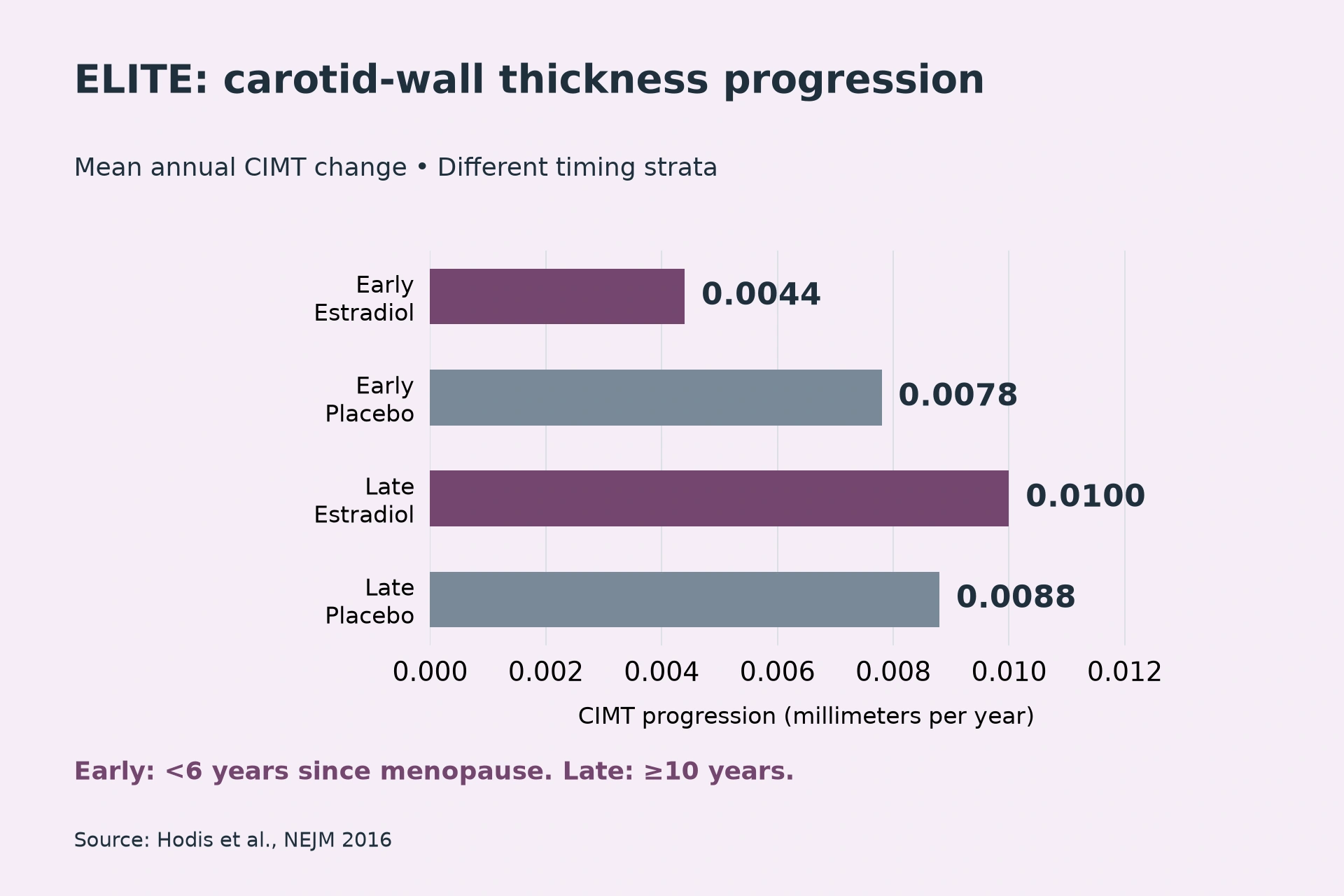
Among women less than six years past menopause, mean CIMT progression was 0.0044 mm per year with estradiol versus 0.0078 mm per year with placebo. Among women at least ten years past menopause, the corresponding rates were 0.0100 and 0.0088 mm per year, without a significant treatment difference. The interaction by timing was statistically significant. ELITE results.
The early-group result supports a timing-related effect on this artery-wall measurement. It does not establish that estradiol reduced heart attacks by the same percentage, reversed existing coronary disease, or improved every imaging measure.
In fact, coronary CT measures of calcium, stenosis, and plaque did not significantly differ between treatment groups in either timing stratum. That finding belongs alongside the favorable CIMT result, rather than being left out of the story.
Why does an imaging endpoint need caution?
An imaging measure can be a useful intermediate outcome. It may detect biological change with fewer participants or less time than a clinical-event trial. But a favorable change in a marker is not automatically a demonstrated improvement in outcomes people directly experience.
For example, treatment could improve one pathway while affecting another pathway differently. That is why researchers distinguish surrogate endpoints from events such as myocardial infarction or stroke. The distinction protects against translating a promising mechanism into a prevention claim too quickly.
ELITE’s results are relevant evidence about timing and subclinical disease. Their value does not require presenting them as something larger than the trial measured.
What did KEEPS test?
KEEPS enrolled 727 healthy women aged 42–58 who were six to 36 months from their final menstrual period and had low coronary-calcium scores. It compared low-dose oral conjugated equine estrogens, transdermal estradiol, and placebo over four years. The active regimens included cyclic oral micronized progesterone. Original KEEPS report.
The main endpoint was annual change in CIMT. Average increases were about 0.007 mm per year across groups, with no significant treatment difference. The groups also did not significantly differ in the proportion whose coronary-calcium score increased.
Some cardiovascular risk markers improved, but the trial did not demonstrate slower progression of its primary atherosclerosis measure. The authors explicitly noted insufficient power to compare clinical events.
Are ELITE and KEEPS contradictory?
They produced different results for a related imaging question, but they were not identical experiments. They differed in formulation, dose, route, enrollment timing, baseline characteristics, and study duration. Those differences make simple explanations speculative.
KEEPS is a reminder that early initiation alone does not guarantee a favorable result for every endpoint or regimen. ELITE is evidence that timing can matter under its tested conditions. A balanced discussion keeps both rather than selecting whichever trial matches a preferred conclusion.
Our estrogen patch versus pill guide explains route-related questions. These trials did not establish that one modern regimen prevents more clinical cardiovascular events than another in a direct, adequately powered comparison.
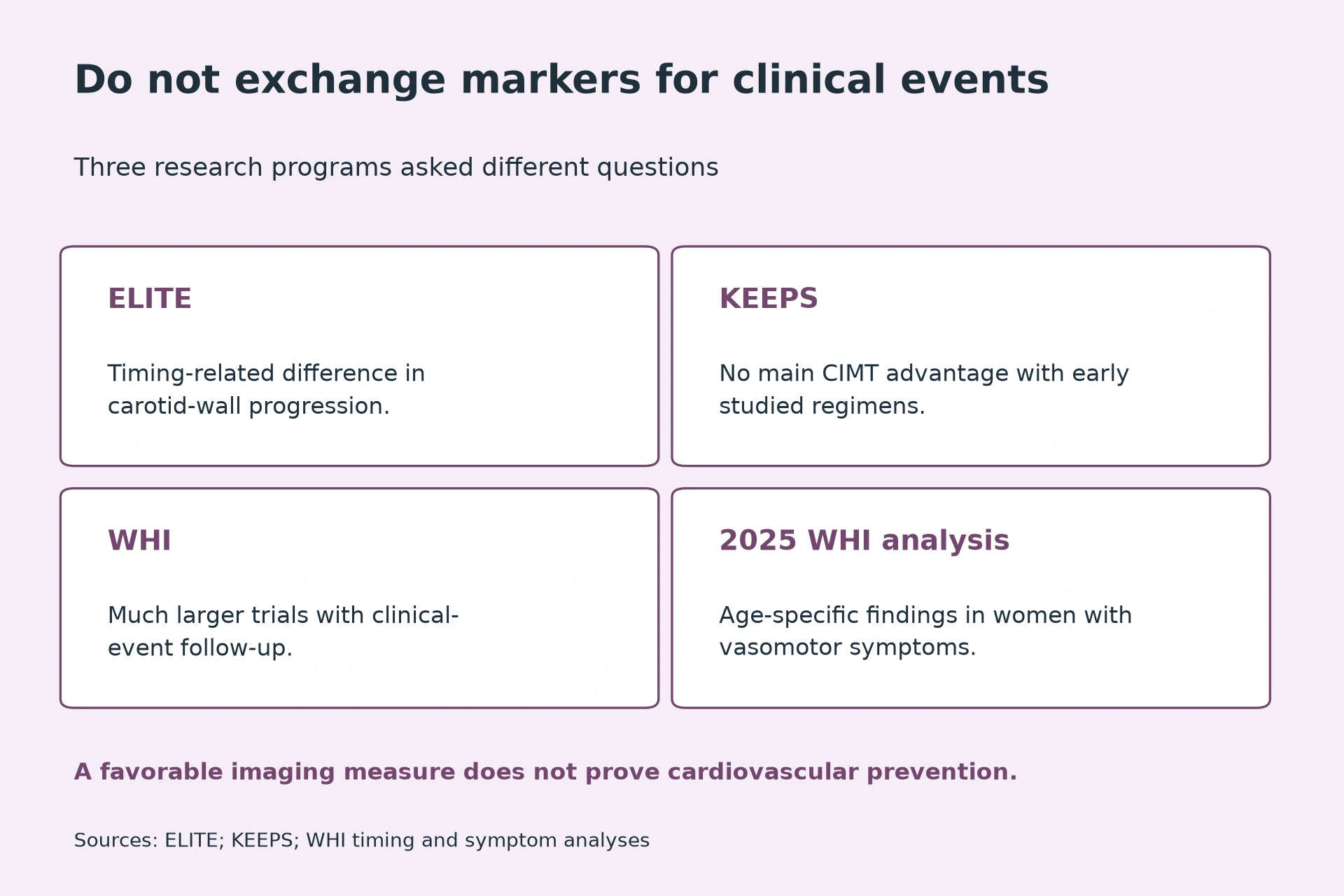
| Study | Main question in this article | Key boundary |
|---|---|---|
| ELITE | Does oral estradiol affect CIMT differently by time since menopause? | Imaging result does not prove fewer clinical events. |
| KEEPS | Do two early-treatment regimens slow CIMT progression? | No primary imaging advantage; insufficient event power. |
| WHI timing analysis | Do clinical-event associations differ by age or years since menopause? | Secondary analyses with uncertainty and multiple comparisons. |
| 2025 WHI symptom analysis | How do outcomes vary by age in women with vasomotor symptoms? | Specific older oral regimens; subgroup estimates are not universal risk predictions. |
What did the WHI timing analysis show?
A 2007 secondary analysis combined the WHI hormone trials to examine coronary heart disease and stroke by age and years since menopause. For women less than ten years from menopause, the coronary-disease hazard ratio was 0.76, with a 95% confidence interval of 0.50–1.16. WHI timing analysis.
The point estimate favored hormone therapy, but the interval included 1. The authors also cautioned that the timing trend did not meet their criterion for statistical significance. It is therefore too strong to describe this subgroup as definitive proof of coronary prevention.
Stroke risk was increased in the combined analysis, with a hazard ratio of 1.32 and a 95% confidence interval of 1.12–1.56, without significant variation by age or time since menopause. A favorable-looking coronary subgroup should not erase a different outcome’s risk.
What did a newer WHI analysis add?
A 2025 secondary analysis examined women with vasomotor symptoms such as hot flashes. In those aged 50–59 with moderate or severe symptoms, neither oral regimen significantly changed the broad atherosclerotic cardiovascular composite. Estimates for older symptomatic women, particularly those aged 70 or more, were less favorable. Original 2025 analysis.
For the younger symptomatic group, the hazard ratios were 0.85 for conjugated equine estrogen alone and 0.84 for estrogen plus medroxyprogesterone acetate, with wide confidence intervals crossing 1. These are not demonstrated percentage reductions in personal heart risk.
The analysis adds clinically relevant nuance about symptom treatment and age. It does not establish equivalent risks for all routes, products, or people, and it should not be interpreted as an instruction to stop established treatment abruptly at a birthday.
How do current guidance and labeling fit?
The Menopause Society describes hormone therapy as an option for appropriate menopausal symptoms after considering individual benefits and risks. Age, time since menopause, route, personal history, and treatment goals belong in that discussion. Patient guidance.
In February 2026, the FDA announced labeling changes for six menopausal hormone products, including removal of cardiovascular, breast-cancer, and probable-dementia statements from the boxed warning. A labeling change is not a new randomized prevention trial, and it does not mean every product or patient has identical risk. FDA announcement.
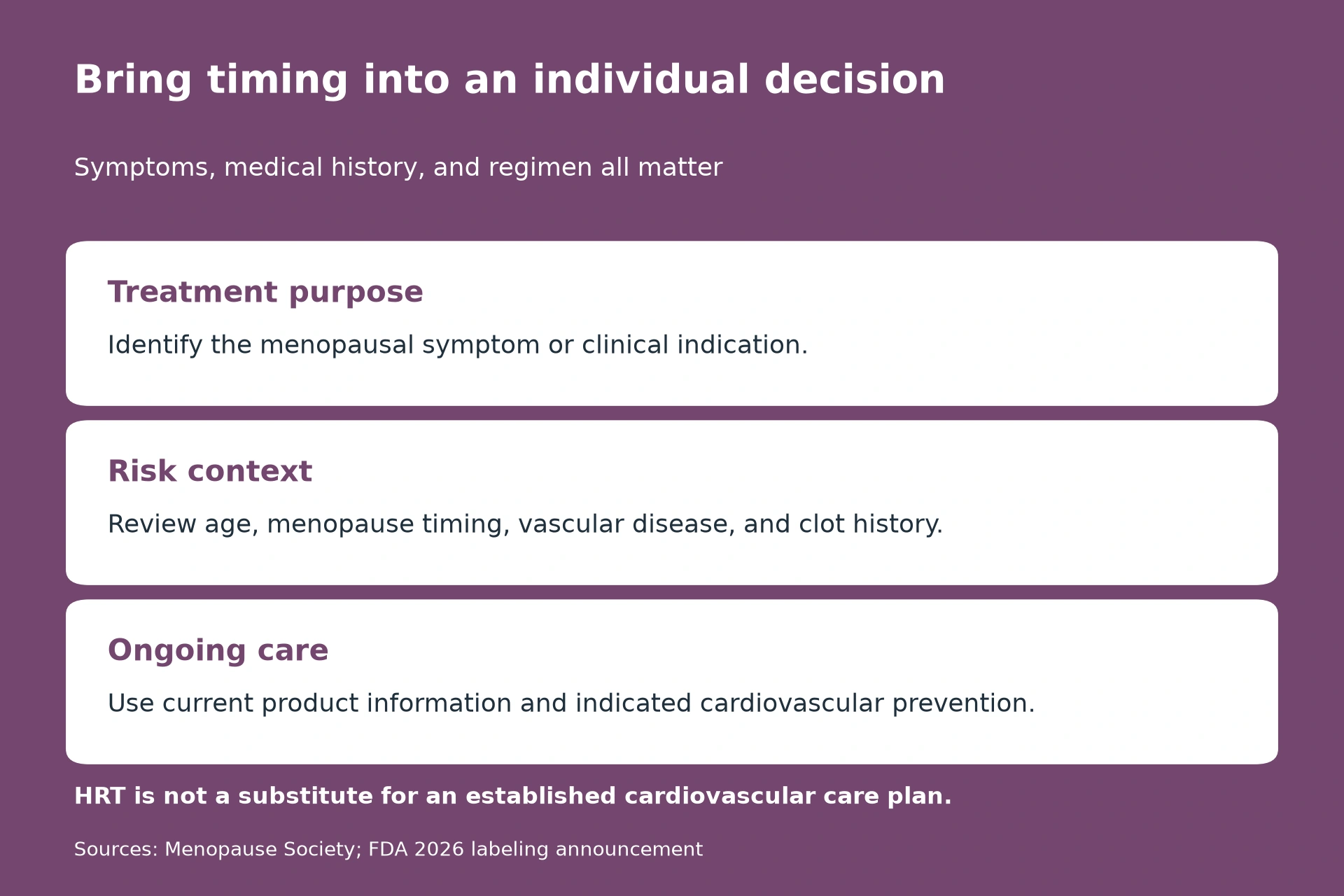
Use the current labeling for the exact product and a clinical assessment. The studies reviewed here do not justify replacing blood-pressure treatment, lipid management, smoking cessation, or other indicated cardiovascular care with HRT.
What if the main reason for treatment is hot flashes?
Then the symptom benefit should be evaluated directly alongside the person’s risks and preferences. Our MsFLASH hot-flash review describes randomized symptom results. The HRT sleep review explains another related but separate outcome.
CoreAge Rx’s estrogen information and oral progesterone information can help identify product questions. A clinician should clarify whether systemic or local treatment is intended and whether endometrial protection is needed. A product page does not establish that its exact regimen reproduces ELITE, KEEPS, or WHI.
Questions worth bringing to the visit
- Which symptom or diagnosed condition are we treating?
- How do my age, time since menopause, and medical history affect the decision?
- Do I have prior cardiovascular disease, blood clots, or risk factors that change the options?
- Which formulation and route are proposed, and what evidence applies to them?
- What benefits should be apparent, and when will we reassess?
- Which cardiovascular prevention steps are indicated independently of HRT?
These questions turn “good or bad for the heart” into a review of a specific treatment for a specific person. They also make it easier to revisit the plan if symptoms, preferences, or health change.
Video: the symptom-treatment context
This Mayo Clinic video discusses help for menopausal hot flashes. It explains a common reason for considering treatment; it does not demonstrate cardiovascular prevention or summarize all the timing studies.
Frequently asked questions
Does starting within ten years guarantee heart protection?
No. Timing is one factor. The studies differ in outcomes and regimens, and several favorable subgroup estimates include substantial uncertainty.
Is an estrogen patch proven to prevent heart attacks?
KEEPS did not establish that claim. Route can matter clinically, but an adequately powered event comparison is needed to demonstrate a specific prevention benefit.
Does the FDA warning change make the old studies irrelevant?
No. Labeling interpretation can change while the original data remain important. Read current product information alongside the evidence rather than treating either as a universal rule.
What is the clearest research conclusion?
Timing and formulation deserve attention, but an improved marker, relief of hot flashes, and prevention of cardiovascular events are distinct outcomes. Treatment should be matched to the actual indication and individual risk assessment.
Original papers and supporting sources
The references distinguish full research papers, published abstracts, and official guidance. This educational narrative review is not a systematic review or an individual treatment recommendation. Sources were checked in October 2026.
- Hodis HN et al. Vascular Effects of Early versus Late Postmenopausal Treatment with Estradiol. (2016). Full text reviewed. DOI: 10.1056/nejmoa1505241. Open full text.
- Harman SM et al. Arterial imaging outcomes and cardiovascular risk factors in recently menopausal women: a randomized trial. (2014). Published abstract reviewed. DOI: 10.7326/m14-0353.
- Rossouw JE et al. Postmenopausal hormone therapy and risk of cardiovascular disease by age and years since menopause. (2007). Published abstract reviewed. DOI: 10.1001/jama.297.13.1465.
- Rossouw JE et al. Menopausal Hormone Therapy and Cardiovascular Diseases in Women With Vasomotor Symptoms: A Secondary Analysis of the Women’s Health Initiative Randomized Clinical Trials. (2025). Published abstract reviewed. DOI: 10.1001/jamainternmed.2025.4510.
- The Menopause Society: hormone therapy. Official guidance.
- FDA: 2026 labeling changes for menopausal hormone therapy. Official guidance.