Hot flashes and night sweats can interrupt work, sleep, and everyday activities. Hormone therapy is an established option for appropriate patients, but people also want to know how much improvement was seen in trials and how nonhormonal treatments compare.
The MsFLASH trial is particularly useful because it tested low-dose oral estradiol, venlafaxine, and placebo within the same randomized study. Its results support both active treatments for vasomotor symptoms while leaving important questions about long-term safety and individual treatment choice.
What are vasomotor symptoms?
Vasomotor symptoms, often abbreviated VMS, are the hot flashes and night sweats associated with the menopause transition. They can differ in frequency, intensity, duration, and impact. Someone with fewer episodes may still be very bothered if those episodes repeatedly interrupt sleep or an important activity.
A treatment study therefore may measure more than the number of daily episodes. Severity, bother, and interference with daily life are related outcomes that can help explain whether a numerical improvement feels meaningful.
Our menopause hormone-therapy guide introduces the main options, while the perimenopause symptoms guide discusses why treatment conversations can begin before periods have stopped permanently.
Who entered the MsFLASH trial?
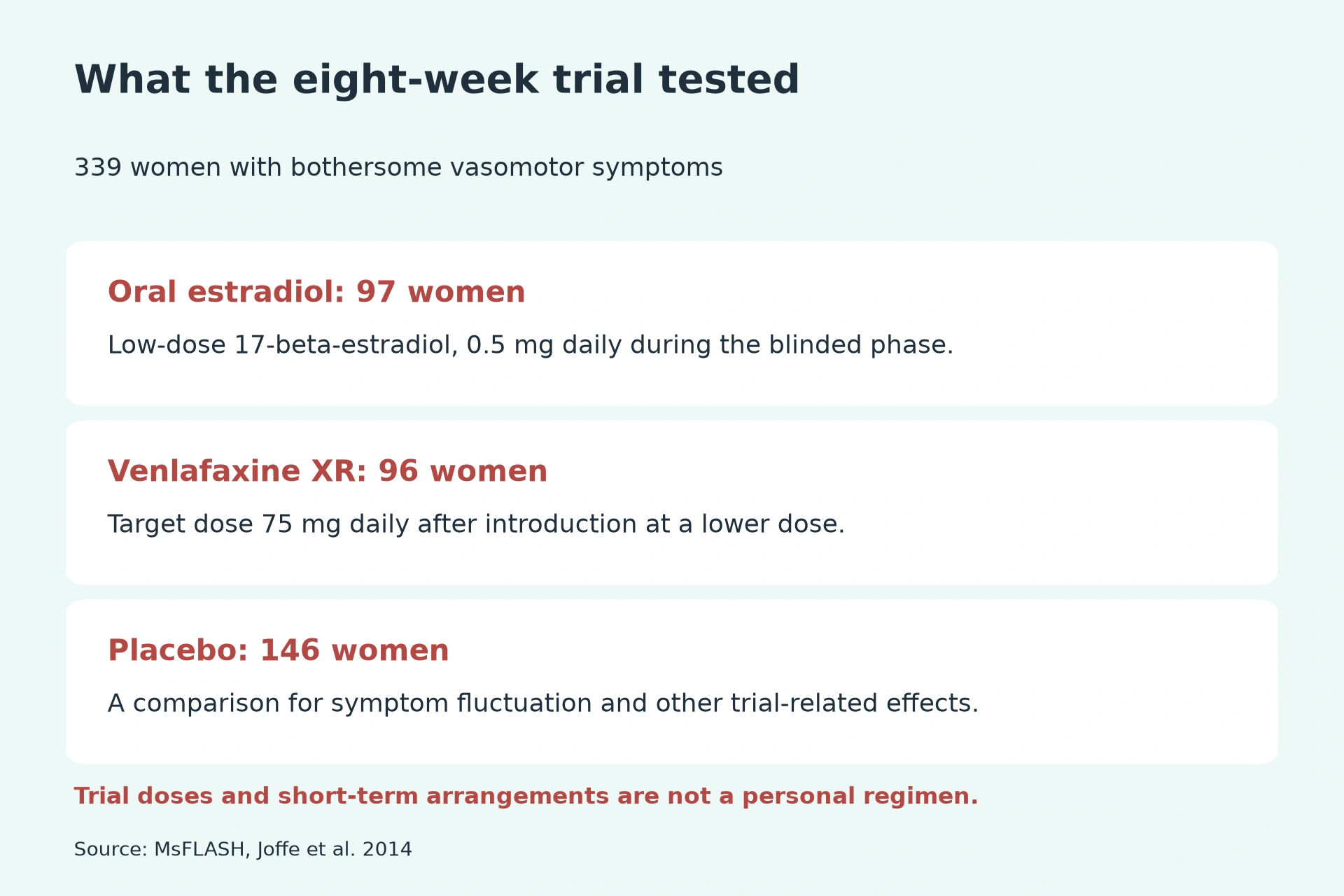
The trial recruited 339 women with at least two bothersome vasomotor symptoms per day. The average baseline frequency was about 8.1 daily episodes. Participants were perimenopausal or postmenopausal and were recruited through the MsFLASH research network. Original randomized trial.
They were assigned to eight weeks of oral 17-beta-estradiol 0.5 mg daily, venlafaxine extended release targeting 75 mg daily, or placebo. The group sizes were 97, 96, and 146, respectively. Treatment was double-blind, so participants and study personnel did not know the assignment during the blinded phase.
These dose details identify the study interventions; they are not instructions to start treatment. Venlafaxine was introduced at a lower dose and tapered after the study, and the estradiol protocol included specific endometrial-protection arrangements. Copying only the headline dose would omit important elements of the trial.
Women with several relevant medical conditions were excluded, including uncontrolled hypertension, certain cardiovascular or thrombotic conditions, and breast or gynecologic cancers. The findings therefore do not establish that both treatments are suitable for everyone who has hot flashes.
How much did symptoms improve?
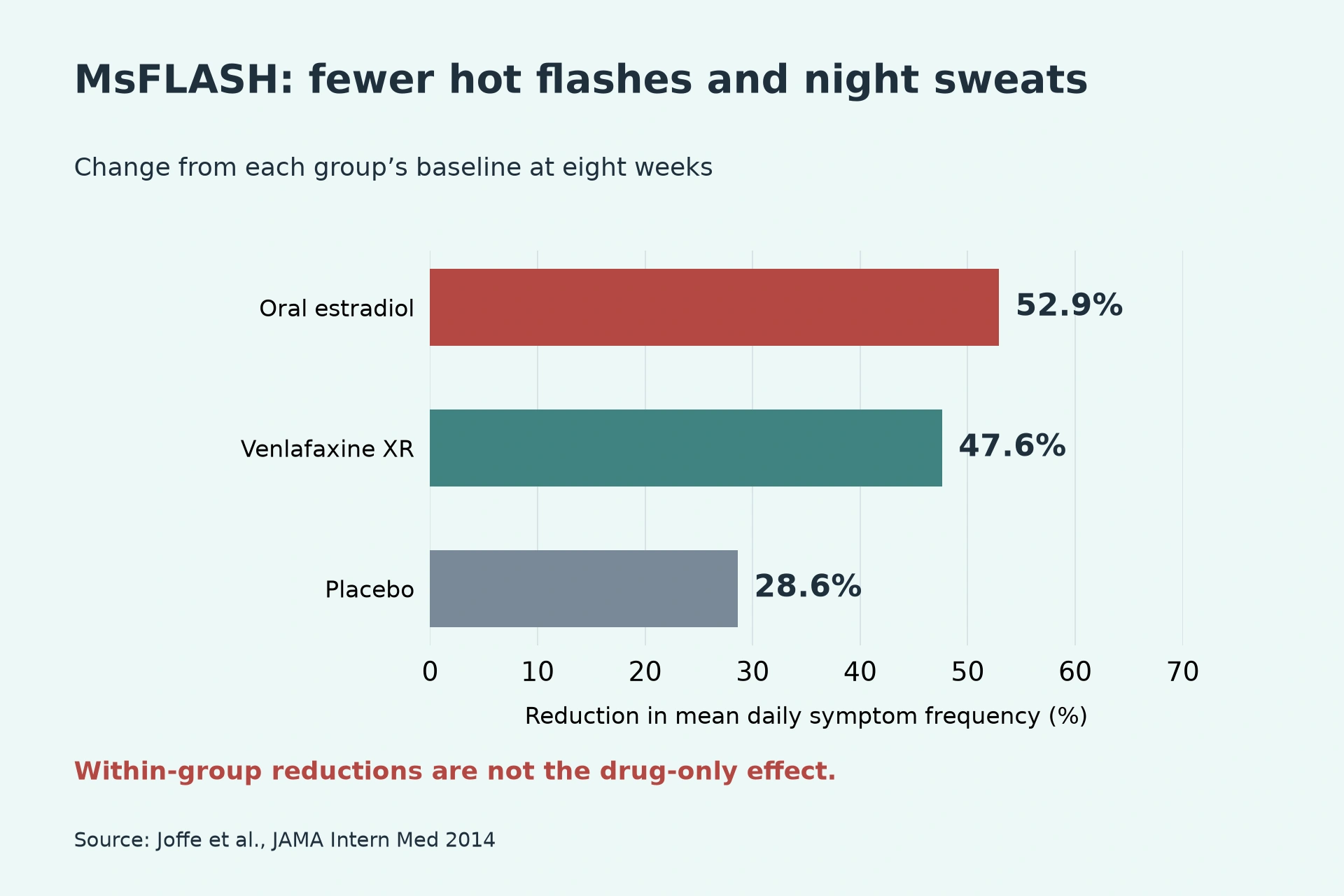
At week eight, the reported mean symptom frequencies were 3.9 per day with estradiol, 4.4 with venlafaxine, and 5.5 with placebo. The corresponding reductions from baseline were 52.9%, 47.6%, and 28.6%. MsFLASH results.
The trial’s adjusted comparison found that estradiol reduced symptoms by 2.3 more episodes per day than placebo, while venlafaxine reduced them by 1.8 more per day. These adjusted treatment differences are not necessarily reproduced by simply subtracting the rounded final group means, because baseline values and the analysis model also matter.
That distinction prevents a common interpretation error. The final number of daily symptoms, the percentage reduction from a group’s starting value, and the adjusted difference in change versus placebo are three ways of summarizing results; they should not be mixed in one calculation.
Why did the placebo group also improve?
Symptoms can fluctuate over time, and trial participation includes attention, repeated measurement, expectations, and other influences. A placebo group helps estimate how much improvement occurs without the active study drug under those conditions.
It would be misleading to attribute the entire 52.9% estradiol reduction to the drug alone without mentioning the 28.6% reduction in the comparison group. The randomized treatment contrast is what helps separate an intervention effect from other changes during follow-up.
This does not make the placebo improvement unimportant to participants. It simply means that a before-and-after change within one group answers a different question from the difference between randomized groups. The same principle applies when interpreting testimonials outside a trial.
Was estradiol better than venlafaxine?
The estimated difference favored estradiol by about 0.6 episode per day, with a P value of 0.09. The authors described the difference as small and of uncertain clinical relevance. Head-to-head comparison.
That does not prove the two treatments are identical or formally equivalent. Demonstrating equivalence or noninferiority requires an appropriate study design, adequate sample size, and a predefined margin. Failure to detect a conventional statistically significant difference is not the same as proving no meaningful difference exists.
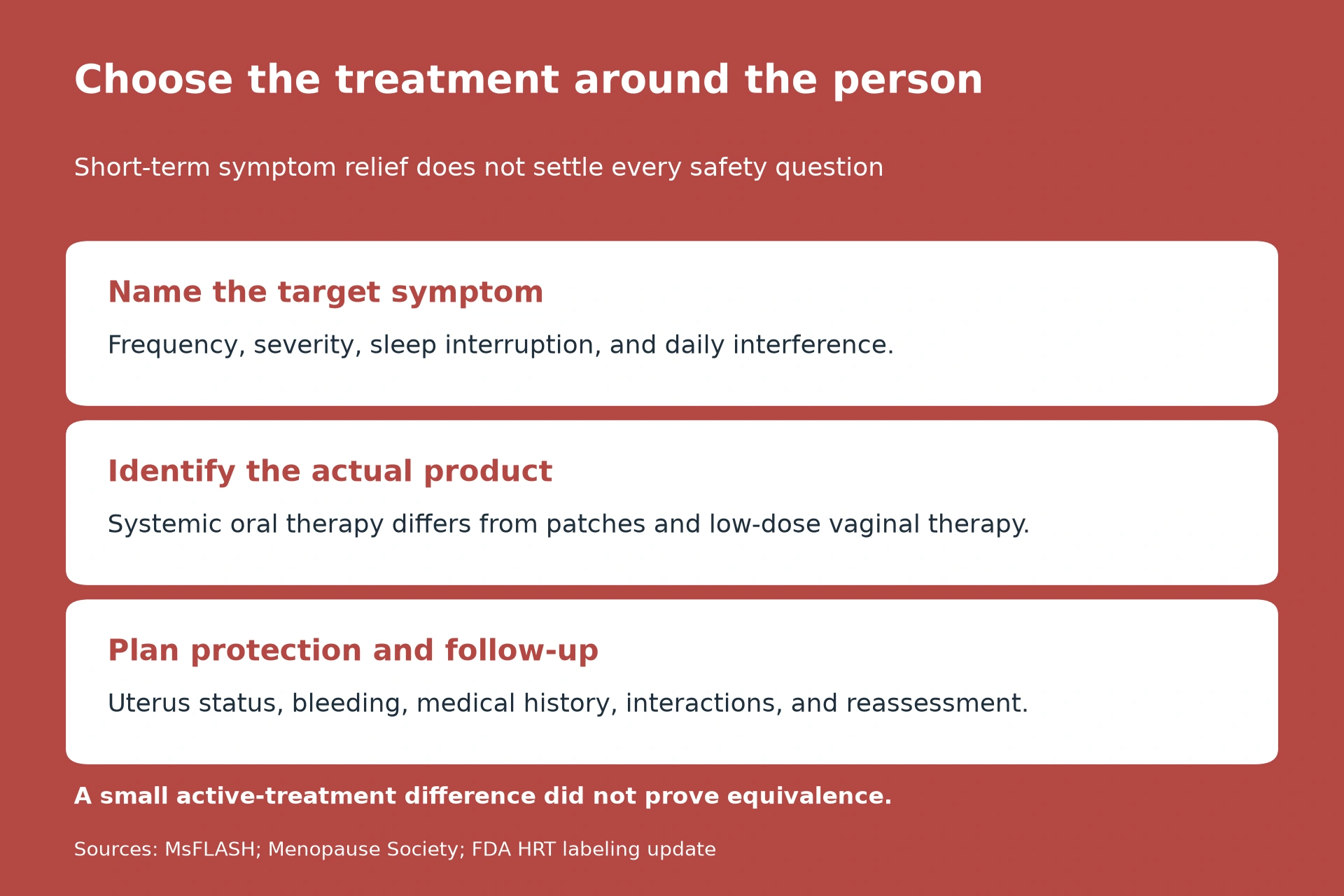
For an individual, the choice can also depend on contraindications, other symptoms, side effects, interactions, preferences, and prior treatment response. The trial supports discussing a nonhormonal option; it does not provide a universal ranking for every patient.
What else did participants report?
The study assessed symptom severity, bother, interference, and treatment satisfaction. Improvements in these outcomes generally supported the frequency findings. Satisfaction was highest in the estradiol group, intermediate with venlafaxine, and lowest with placebo. Original report.
Those additional measures help explain why counting episodes is only part of the treatment goal. Two women with the same daily number may experience very different disruption, depending on sleep, work, and symptom intensity.
When discussing response, it is useful to describe both frequency and impact: fewer awakenings, less interruption during meetings, or more ability to exercise comfortably. These are concrete observations that can inform follow-up, even though an individual experience cannot substitute for a trial comparison.
What does the study tell us about side effects?
Treatment discontinuation because of adverse events was uncommon over eight weeks. However, a short study of 339 selected participants cannot establish the frequency of rare events or risks accumulated over years.
The trial observed some elevated blood-pressure measurements with venlafaxine and abnormal bleeding among some women receiving estradiol. These findings support individualized monitoring. They do not mean that every new symptom has the same cause or that an average trial tolerability result makes a specific side effect unimportant. Safety findings.
Venlafaxine is a prescription medicine with considerations beyond hot-flash relief, including interactions and discontinuation symptoms. It should not be started, stopped, or substituted for another psychiatric medicine based on this article. Similarly, hormone therapy requires a product-specific discussion rather than a general assumption that “low dose” means no risk.
Why does uterus status matter?
Systemic estrogen can stimulate the uterine lining. People who have a uterus generally need an appropriate progestogen strategy when using systemic estrogen, unless a specific alternative regimen addresses endometrial protection. Those who have had a hysterectomy have a different treatment context. Menopause Society guidance.
MsFLASH restricted its estradiol intervention to eight weeks and provided a course of medroxyprogesterone after unblinding for endometrial protection. That research arrangement is not a template for indefinite estrogen-only treatment in someone with a uterus.
Our estrogen and progesterone guide explains the distinction. Report unexplained or postmenopausal bleeding to a clinician rather than assuming it is an expected inconvenience of treatment.
Do these results apply to patches, gels, or vaginal estrogen?
MsFLASH tested a particular oral estradiol regimen. It did not directly compare oral estrogen with a patch, gel, or other systemic formulation. The average effect should not be assigned unchanged to every route or dose.
Low-dose vaginal estrogen is generally directed at local genitourinary symptoms and is a different treatment category from systemic therapy for hot flashes. Some vaginal products are systemic, so identifying the exact product matters more than relying on the word “vaginal” alone. Hormone-therapy guidance.
Our patch-versus-pill guide and vaginal-versus-systemic HRT guide address those distinctions. The vaginal-estrogen UTI research review examines a separate outcome and should not be treated as a hot-flash trial.
How should the newer FDA labeling changes be understood?
In February 2026, the FDA announced approved labeling changes for an initial group of six menopausal hormone-therapy products. Statements about cardiovascular disease, breast cancer, and probable dementia were removed from their boxed warnings as part of a broader labeling initiative. FDA announcement.
This was a specific regulatory development, not a finding that all risks disappeared or that every product had identical revised labeling. The current label for the exact product, age, time since menopause, medical history, and treatment goals still belong in the decision.
MsFLASH’s eight-week symptom results also should not be used to answer questions about dementia or fractures. Our HRT dementia review and HRT fracture review examine the distinct studies behind those outcomes.
How can someone prepare for a treatment discussion?
Track the pattern of symptoms and what they interrupt. Note menstrual history, sleep effects, prior treatments, medicines, bleeding, and relevant personal or family medical history. A clinician can then consider whether symptoms fit the menopause transition and whether another condition also needs evaluation.
Ask how success will be assessed, when follow-up should occur, which symptoms should prompt contact, and whether endometrial protection is needed. The starting-HRT questions guide provides a practical checklist.
The CoreAge Rx estrogen information page can support a consultation about the specific formulation offered. The MsFLASH paper does not establish that every estrogen product has the same absorption, benefits, or risk profile, and no product should be assumed appropriate solely because the trial showed an average symptom benefit.
Watch: understanding hot flashes and relief options
This Mayo Clinic video explains hot flashes in the menopause transition and provides general clinical context. It is not a presentation of MsFLASH or a personalized treatment recommendation.
Common questions about the trial
Does a 52.9% reduction mean hot flashes disappear?
No. The estradiol group still averaged 3.9 episodes per day at week eight. A substantial reduction and complete symptom resolution are different outcomes.
Does the study prove venlafaxine is just as effective as HRT?
No. It compared one venlafaxine regimen with one low-dose oral estradiol regimen over eight weeks. The difference was small, but the study did not establish universal equivalence across HRT products or patients.
Can hormone therapy help sleep if hot flashes improve?
It may help some women, but sleep deserves its own assessment. The KEEPS and MsFLASH sleep review explains why sleep-quality scores, insomnia symptoms, and objective sleep measurements are different endpoints.
Is HRT the right option for every woman with symptoms?
No. The balance depends on individual factors and the actual product. Nonhormonal options may be appropriate, and persistent or unusual symptoms may need evaluation beyond a menopause-treatment discussion.
What is the most useful conclusion?
MsFLASH provides direct randomized evidence that both low-dose oral estradiol and venlafaxine reduced bothersome vasomotor symptoms more than placebo. It helps set realistic expectations while leaving long-term safety and personalized choice to a broader clinical assessment.
Original papers and supporting sources
The references distinguish full research papers, published abstracts, and official guidance. This educational narrative review is not a systematic review or an individual treatment recommendation. Sources were checked in October 2026.
- Joffe H et al. Low-dose estradiol and the serotonin-norepinephrine reuptake inhibitor venlafaxine for vasomotor symptoms: a randomized clinical trial. (2014). Full text reviewed. DOI: 10.1001/jamainternmed.2014.1891. Open full text.
- The Menopause Society. Hormone Therapy. Professional society guidance.
- FDA. Labeling changes to six menopausal hormone therapy products, February 12, 2026. FDA labeling announcement.