Repeated urinary tract infections after menopause can lead to a frustrating cycle of symptoms, testing, and antibiotics. Local vaginal estrogen is one prevention option supported by randomized research and professional guidance, but it is important to distinguish preventing future infections from treating an infection that is already present.
It is equally important to distinguish local vaginal therapy from systemic hormone therapy. They are not interchangeable treatments, and studies of infection, urinary leakage, and vaginal symptoms do not all answer the same question.
Why can menopause change urinary and vaginal symptoms?
Changes in estrogen exposure can affect vaginal and nearby urinary tissues. Dryness, irritation, burning, discomfort, and some urinary symptoms may occur as part of the genitourinary syndrome of menopause, often shortened to GSM.
These symptoms can overlap with infection, but overlap is not proof of a UTI. Burning may have more than one explanation, and urgency alone does not identify bacteria as the cause. Appropriate history, examination, and testing help distinguish recurrent infection from another condition.
Our vaginal estrogen versus systemic HRT guide explains the treatment categories. The Menopause Society’s hormone-therapy guidance also distinguishes local therapy for genitourinary symptoms from systemic treatment for hot flashes and other indications.
What did the 1993 estriol trial study?
The double-blind, placebo-controlled trial enrolled 93 postmenopausal women with a history of recurrent UTIs. Fifty were assigned to intravaginal estriol cream and 43 to placebo cream. Researchers obtained urine cultures at enrollment, monthly over eight months, and when urinary symptoms occurred. They also assessed vaginal cultures and pH. Raz and Stamm, 1993.
The intervention was a specified vaginal estriol preparation. Estriol and estradiol are different estrogen compounds, and the result should not be presented as proof that any product labeled “estrogen cream” is identical to the study treatment.
Follow-up completion was incomplete: 36 women in the estriol group and 24 in the placebo group completed eight months. That attrition matters when considering the strength and generalizability of the result. A trial can show a large treatment difference while still having limitations that readers should see.
How large was the difference in infection rates?
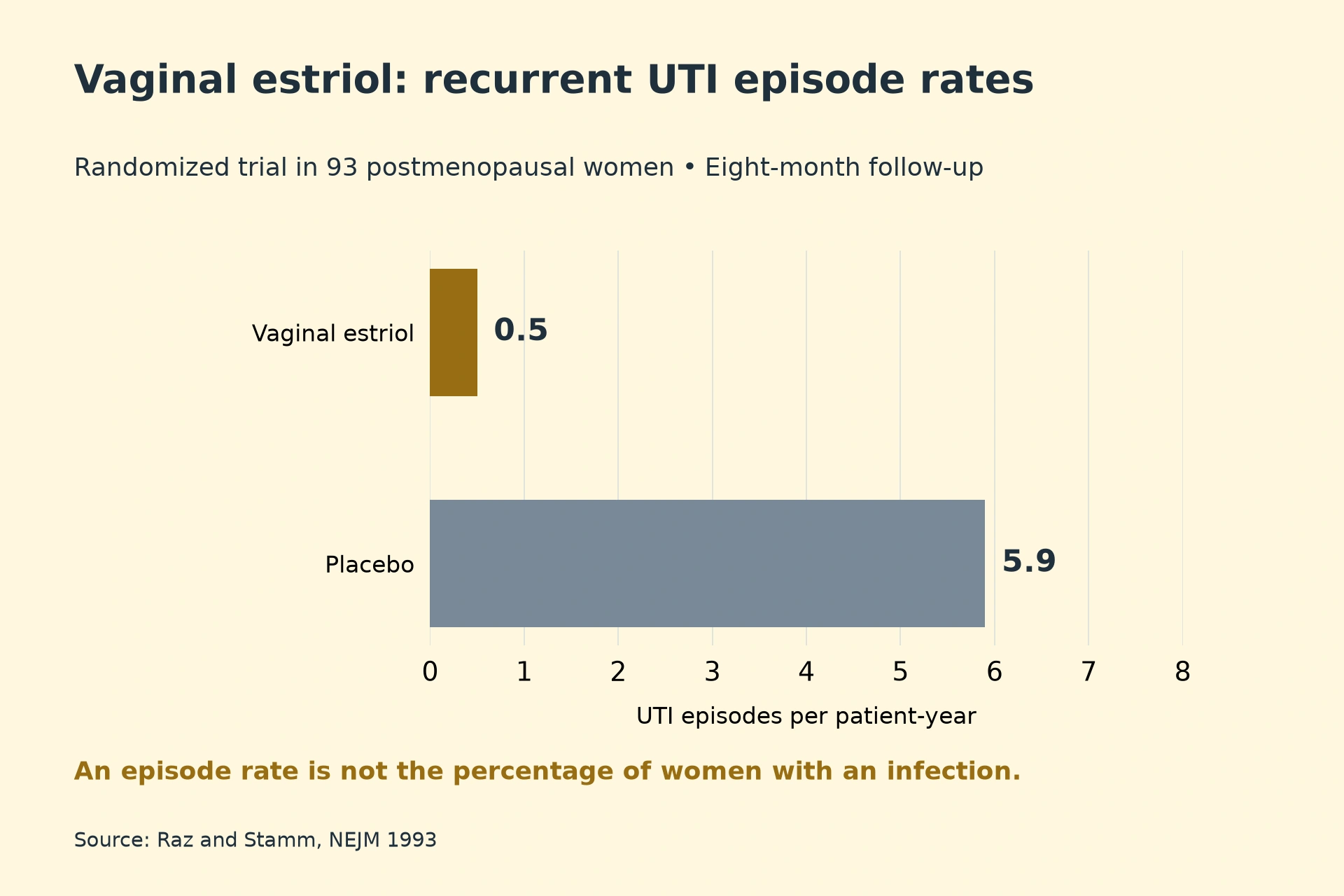
The reported UTI incidence was 0.5 episodes per patient-year with estriol and 5.9 with placebo. The difference was statistically significant. Original trial results.
An episode rate per patient-year combines the number of infections with the time participants were observed. It is not the percentage of women who had an infection and is not a promise that a person will experience exactly that many episodes next year.
The follow-up lasted eight months, even though the rate was expressed per year for comparison. Converting observed time into patient-years does not mean the trial followed every participant for a full year. This distinction is important when a large numerical difference is used in a headline.
What did the vaginal measurements suggest?
The estriol group showed changes in vaginal pH and bacterial flora. Lactobacilli reappeared in many assessed estriol-treated women, and vaginal colonization with Enterobacteriaceae decreased. These observations supported a possible explanation for reduced recurrent infection. Microbiological findings.
A plausible mechanism strengthens interpretation, but it is not a substitute for the infection outcome. A person should not assume that changing a home pH result guarantees protection or that every urinary symptom can be managed by altering the vaginal microbiome.
The report also described treatment discontinuations related to local side effects. “Local” therefore should not be read as “incapable of causing symptoms.” Tolerability, correct use, and reassessment remain relevant even when systemic exposure is lower than with systemic hormone therapy.
What did the later vaginal-estrogen trial add?
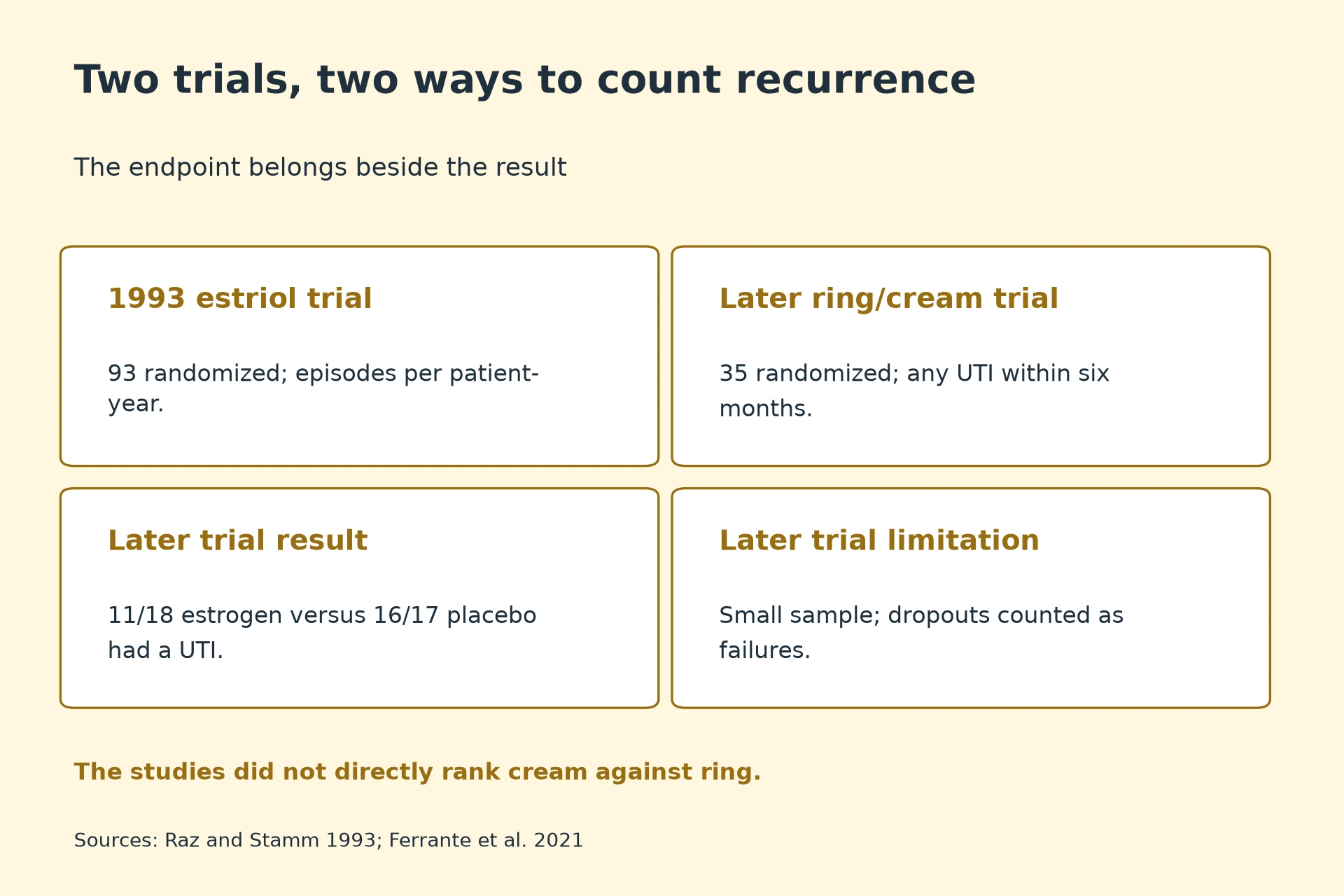
A later investigator-initiated trial compared commonly used vaginal estrogen delivered by a ring or cream with placebo cream in postmenopausal women with documented recurrent UTI. It randomized 35 women. Slow recruitment led the investigators to combine the two estrogen groups for the principal comparison. Ferrante and colleagues, 2021 publication.
In the intention-to-treat analysis, which treated dropouts as failures, 11 of 18 women receiving vaginal estrogen had a UTI within six months, compared with 16 of 17 receiving placebo. The reported P value was 0.041.
There were nine dropouts before six months, disproportionately in the placebo group. A per-protocol analysis also favored estrogen, but the small sample and attrition limit precision. The trial supports the prevention approach without establishing an exact personal benefit or a definitive cream-versus-ring ranking.
Why do the two trials use different kinds of numbers?
The older trial reported infection episodes per patient-year. The later trial’s primary endpoint was whether a woman experienced at least one UTI within six months. One person can have several episodes, so these are different outcomes.
| Study | Population and size | Main result shown here | Important limitation |
|---|---|---|---|
| Raz and Stamm | 93 postmenopausal women | 0.5 versus 5.9 episodes per patient-year | Incomplete eight-month follow-up |
| Ferrante and colleagues | 35 postmenopausal women | 11/18 versus 16/17 with UTI by six months | Small sample; dropouts counted as failures |
It would be misleading to combine these figures as though one were an updated version of the other. The studies differ in products, design, follow-up, and how recurrence was counted. Their consistent direction is informative, while the exact effect size remains context-dependent.
What does current professional guidance recommend?
The 2025 AUA/CUA/SUFU guideline recommends vaginal estrogen for peri- and postmenopausal women with recurrent UTIs when there is no contraindication to vaginal estrogen. The recommendation is graded moderate, with evidence level B. Recurrent-UTI guideline.
That recommendation concerns an evaluated recurrent-UTI population. It does not establish that every person with occasional urinary discomfort needs estrogen or that treatment is appropriate without clarifying the diagnosis.
The guideline also addresses assessment, urine testing, antibiotic decisions, and other prevention options. Vaginal estrogen fits into a broader care plan rather than replacing the need to identify and treat a symptomatic infection correctly.
Does systemic HRT prevent urinary leakage?
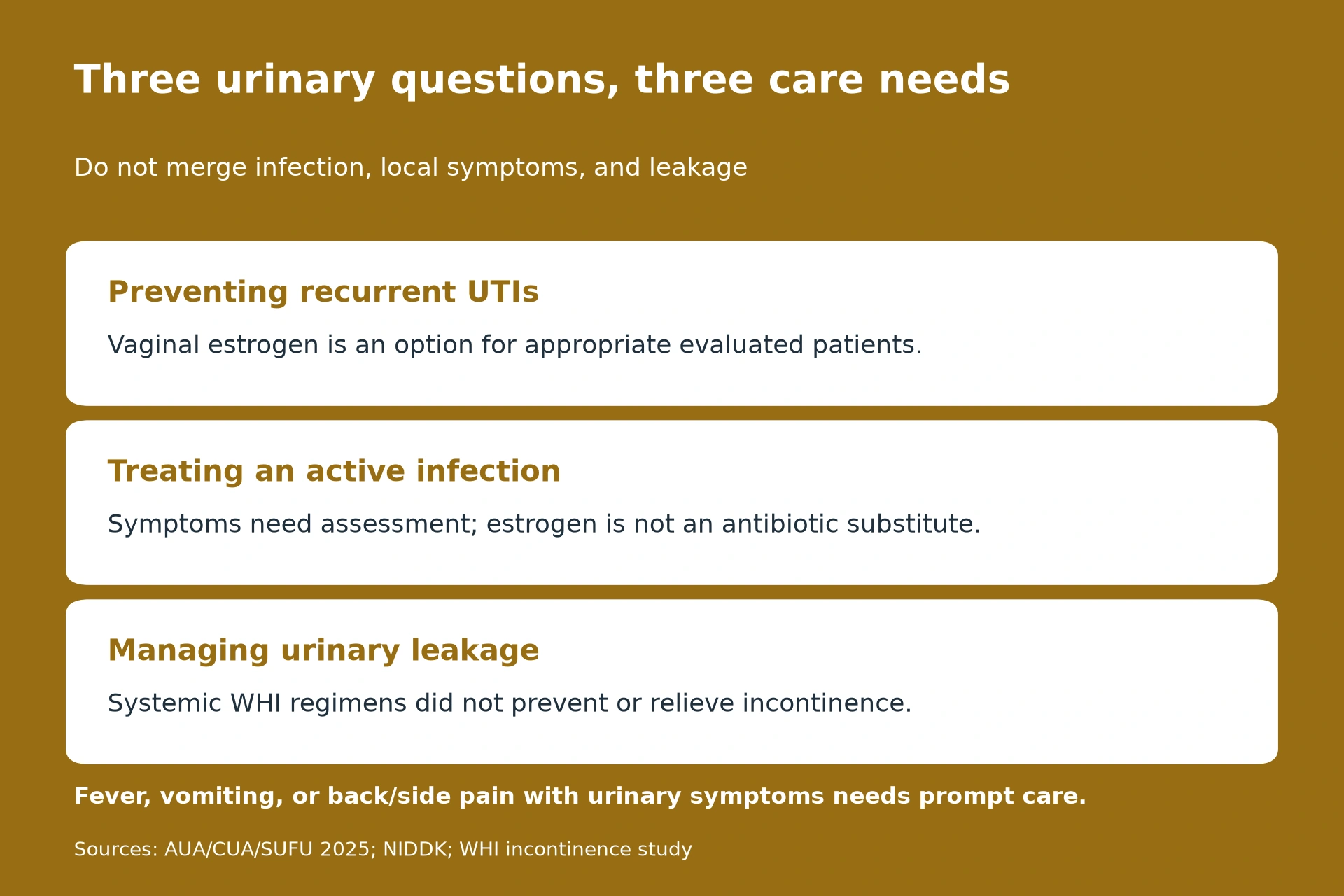
That is a separate question, and the WHI urinary-incontinence analysis provides a useful caution. It studied oral conjugated equine estrogen, with or without medroxyprogesterone depending on hysterectomy status. These systemic regimens increased new urinary incontinence and worsened several features of existing incontinence after one year. WHI incontinence paper.
Urinary incontinence means leakage, whereas a UTI is an infection. The WHI finding should not be used to claim that vaginal estrogen worsens all urinary health, just as the recurrent-UTI trials should not be used to prescribe systemic oral estrogen for leakage.
The correct comparison keeps route, formulation, population, and endpoint together. A broad statement that “estrogen helps the bladder” is too imprecise to guide a treatment decision.
Can vaginal estrogen treat an active UTI?
The prevention trials do not establish vaginal estrogen as treatment for an active bacterial bladder infection. If symptoms suggest infection, contact a clinician for assessment and appropriate treatment. Do not delay that evaluation while waiting for a preventive therapy to work.
The NIDDK describes symptoms such as burning with urination, frequent or intense urges, lower abdominal discomfort, and cloudy or bloody urine. Fever, chills, vomiting, or pain in the back, side, or groin can indicate a more serious infection requiring prompt care. NIDDK symptom guidance.
Symptoms may overlap with GSM or other conditions, which is another reason repeated episodes deserve careful evaluation rather than automatic self-diagnosis or repeated leftover antibiotics.
What if there is a history of breast cancer or unexplained bleeding?
Those details need to be raised before treatment. Low-dose vaginal therapy and systemic HRT have different exposure patterns, but lower exposure does not remove the need for an individualized decision in a complex medical history.
A clinician may involve the relevant specialist when considering therapy after hormone-sensitive cancer. Unexplained vaginal bleeding also requires evaluation. This article and the two small prevention trials cannot settle every cancer-history or bleeding scenario.
The HRT risks-and-benefits guide provides context, while the Menopause Society guidance explains why the actual product, route, and medical history matter. Avoid assuming that an over-the-counter or compounded product is automatically safer because it is described as natural.
How do the FDA’s 2026 labeling changes fit?
The FDA announced approved labeling changes to six initial menopause hormone-therapy products in February 2026, including products across systemic and local categories. Selected risk statements were removed from boxed warnings. FDA announcement.
The announcement should not be generalized into a claim that all estrogen products are identical or that every warning and contraindication disappeared. The current prescribing information for the product being considered remains the appropriate reference.
It also does not change the basic prevention-versus-treatment distinction: a labeling update is not evidence that estrogen eradicates an active infection. The original trial endpoints remain the basis for the claims in this review.
What should a consultation cover?
Bring the timing of prior episodes, culture results if available, treatments received, allergies, current symptoms, bleeding history, and relevant medical conditions. A clear record helps determine whether the problem is recurrent bacterial infection, persistent symptoms from another cause, or a mixture.
Ask which estrogen formulation is proposed, whether it is local or systemic, what symptoms and outcomes it is intended to address, how it should be used, and how tolerability and recurrence will be reviewed. Our starting-HRT questions guide can help organize the discussion.
The CoreAge Rx estrogen page describes systemic and local options. A prescriber should identify the exact product; the page does not make every offered form equivalent to the estriol cream or estrogen ring studied in these trials.
Watch: general UTI-prevention context
This Mayo Clinic Health System video discusses practical urinary-health habits. It is broader education, not a presentation of the estrogen trials or evidence that habits alone replace treatment for an active infection.
Common questions about vaginal estrogen and UTIs
Does vaginal estrogen prevent every recurrence?
No. Even in the later trial, many participants receiving estrogen had a UTI during follow-up. A lower average recurrence risk is different from complete protection.
Can I substitute an estrogen patch for vaginal treatment?
The recurrent-UTI evidence does not establish that substitution. Systemic and local treatments have different purposes and exposure patterns, and the exact product should be discussed with the prescriber.
Is burning always an infection after menopause?
No. Infection, GSM, and other conditions can cause overlapping symptoms. Appropriate evaluation helps prevent both missed infections and unnecessary treatment.
Does this research apply to men or everyone with a catheter?
No. The trials reviewed here enrolled selected postmenopausal women with recurrent UTIs. Other populations need evidence and management appropriate to their own circumstances.
What is the most useful conclusion?
Vaginal estrogen is a supported prevention option for appropriately evaluated women with recurrent UTIs around and after menopause. Keep it distinct from active-infection treatment, systemic HRT, and treatment of urinary leakage.
Original papers and supporting sources
The references distinguish full research papers, published abstracts, and official guidance. This educational narrative review is not a systematic review or an individual treatment recommendation. Sources were checked in October 2026.
- The Menopause Society. Hormone Therapy. Professional society guidance.
- Raz R et al. A controlled trial of intravaginal estriol in postmenopausal women with recurrent urinary tract infections. (1993). Published abstract reviewed. DOI: 10.1056/nejm199309093291102.
- Ferrante KL et al. Vaginal Estrogen for the Prevention of Recurrent Urinary Tract Infection in Postmenopausal Women: A Randomized Clinical Trial. (2021). Published abstract reviewed. DOI: 10.1097/spv.0000000000000749.
- AUA/CUA/SUFU. Recurrent Uncomplicated Urinary Tract Infections in Women, 2025. Professional guideline.
- Hendrix SL et al. Effects of estrogen with and without progestin on urinary incontinence. (2005). Published abstract reviewed. DOI: 10.1001/jama.293.8.935.
- NIDDK. Symptoms and Causes of Bladder Infection in Adults. NIH patient guidance.
- FDA. Labeling changes to six menopausal hormone therapy products, February 12, 2026. FDA labeling announcement.