NAD+ research attracts attention because the molecule is involved in fundamental cellular processes. The difficult question is whether changing NAD-related measurements produces benefits people can feel or that improve long-term health.
Human randomized trials provide a more useful starting point than animal longevity headlines. They show that some oral precursors can raise certain NAD+ measurements, while effects on insulin sensitivity and other outcomes are mixed and population-specific. These findings should not be transferred automatically to injectable or nasal NAD+ products.
What are NAD+, NR, and NMN?
Nicotinamide adenine dinucleotide, or NAD+, participates in cellular energy-transfer reactions and serves as a substrate for several enzymes. Nicotinamide riboside, or NR, and nicotinamide mononucleotide, or NMN, are related molecules involved in pathways that can contribute to NAD+ production.
That biological relationship does not make the three interchangeable medicines. Swallowing a precursor exposes the gut and metabolic pathways to a different compound than an injection of NAD+ or a nasal preparation. How a substance is absorbed and processed can affect what reaches different tissues.
Our NAD+ injections versus NR and NMN guide introduces the distinctions. This review examines selected original human trials and explicitly separates changes in a laboratory marker from demonstrated clinical benefit.
The 2026 comparison: what was actually randomized?
A randomized, open-label, placebo-controlled study compared oral NR, NMN, nicotinamide, and placebo over 14 days. It randomized 67 healthy adults, but two received the wrong assigned product throughout the study and were excluded from the modified intention-to-treat analysis. The reported analysis therefore included 65 participants. Original Nature Metabolism paper.
The tested daily regimens were NR 1,000 mg, NMN 1,000 mg, nicotinamide 500 mg, or placebo. These are study descriptions, not supplement recommendations. The compounds also have different molecular weights, so equal milligram quantities do not automatically mean equal numbers of molecules.
Participants were relatively young healthy adults, with a mean age of about 35. This was not a trial in frail older adults or people selected for a diagnosed NAD+ deficiency. It was also open-label, an important feature when considering design quality and generalization.
What happened to whole-blood NAD+?
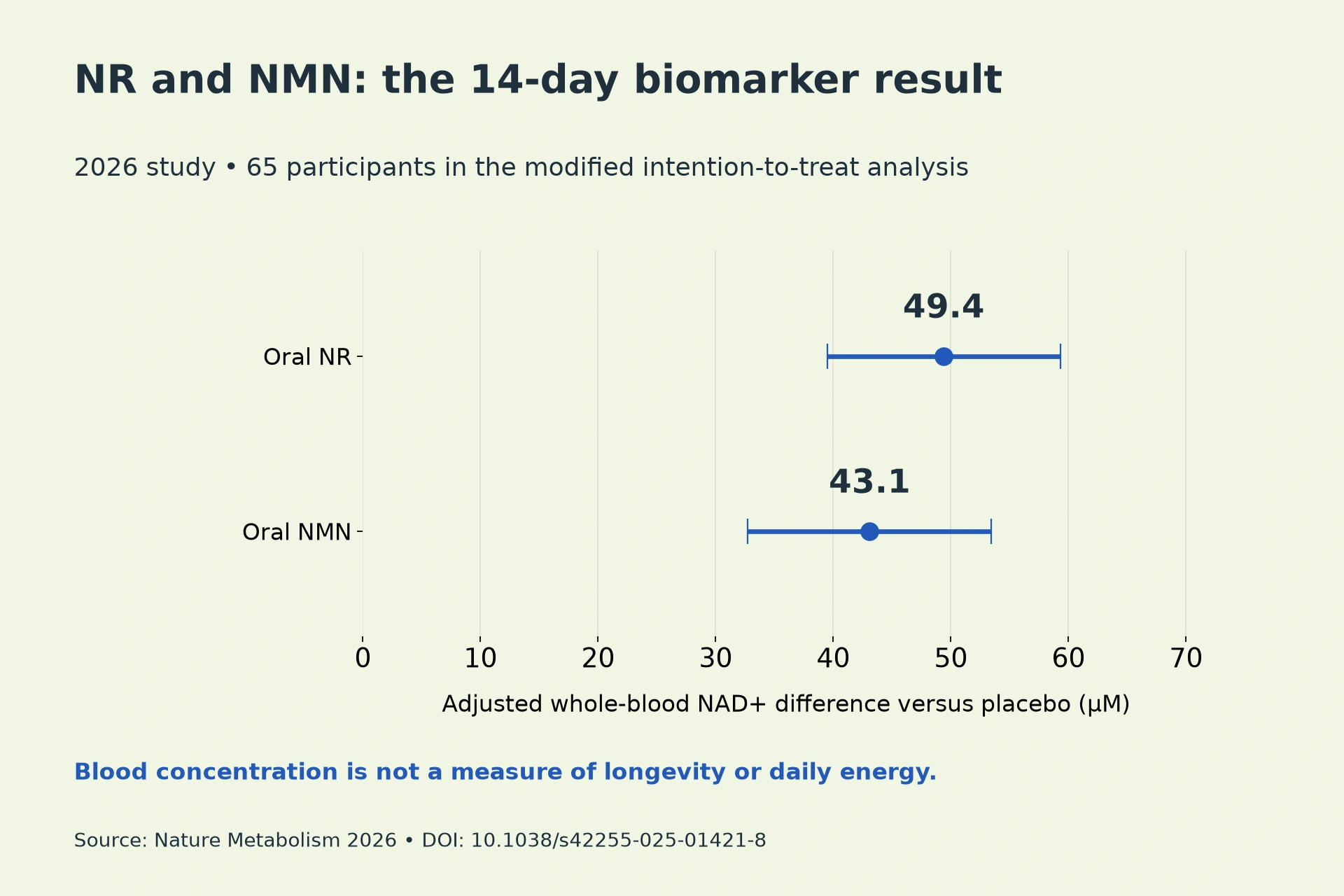
After 14 days, NR and NMN increased baseline whole-blood NAD+ concentrations by approximately twofold. The adjusted differences compared with placebo were 49.4 micromolar for NR and 43.1 micromolar for NMN, with respective 95% confidence intervals of 39.5–59.3 and 32.7–53.4. Nicotinamide did not show the same sustained increase in this comparison. Biomarker results.
These findings support biological activity in the measured blood compartment. They do not mean participants doubled their energy, slowed aging by half, or improved every tissue’s NAD+ concentration by the same amount.
The two positive estimates also should not be turned into a clinical ranking of NR over NMN. Their numerical difference does not establish superior health outcomes, and the study was not a long-term trial of disease prevention, physical performance, or survival.
Did the study prove better gut health?
The investigators also used ex vivo experiments, meaning work performed outside the living body, with human microbiota and whole blood. Those experiments supported a model in which microbial conversion contributes to precursor metabolism. Mechanistic experiments.
The human supplementation trial and the laboratory fermentation experiments are different parts of the paper. A change in microbes or metabolites in an experimental system is not the same as proving symptom improvement or better gut health in treated participants.
The authors described limitations, including the need for clinical stool samples to confirm aspects of the proposed pathway. The study was conducted at Nestlé Research, and several authors reported employment with Nestlé or related organizations. These disclosures belong alongside the findings rather than being omitted from an enthusiastic summary.
What did the earlier NR study in older adults find?
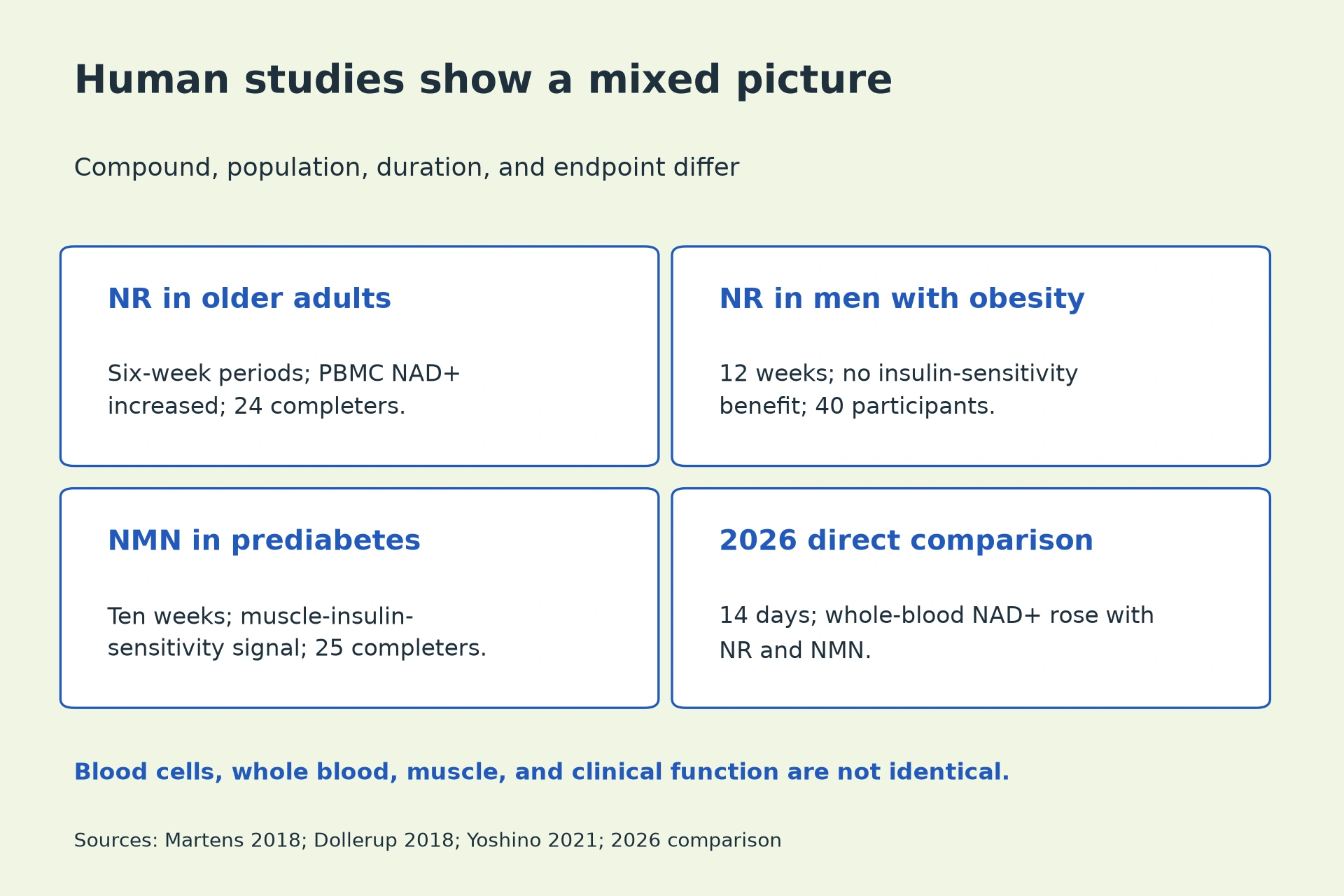
A 2018 randomized, double-blind crossover trial studied NR in healthy adults aged 55–79. Thirty participants were randomized and 24 completed the trial. Each treatment period lasted six weeks, with NR 500 mg twice daily compared with placebo. Martens and colleagues, 2018.
The study found an increase in NAD+ in peripheral blood mononuclear cells, or PBMCs, of approximately 60% relative to placebo. PBMCs are a particular group of blood cells. This measurement is not identical to whole-blood NAD+ in the 2026 paper, so the percentages should not be compared as if they came from the same assay and compartment.
The investigators also explored physiological outcomes, including blood pressure and arterial stiffness. They presented these as signals needing more targeted confirmation, not established indications for NR treatment. The study was small, short, and conducted in relatively healthy participants.
A negative NR trial is equally important
Another randomized, double-blind, placebo-controlled trial enrolled 40 sedentary men with obesity and insulin resistance. They received oral NR 1,000 mg twice daily or placebo for 12 weeks. Researchers used detailed metabolic testing, including a hyperinsulinemic-euglycemic clamp. Dollerup and colleagues, 2018.
NR did not improve insulin sensitivity, glucose production or disposal, resting energy expenditure, lipid oxidation, or body composition in that study. No serious adverse events attributed to NR were observed during the trial, but that short-term observation does not establish unrestricted long-term safety.
The null result matters because plausible cellular mechanisms do not guarantee a clinical effect. It also does not prove NR can never affect any outcome in any population. The accurate conclusion is specific: this regimen did not improve the measured metabolic outcomes in these men over 12 weeks.
What did the NMN trial in women with prediabetes show?
A 2021 double-blind randomized trial assessed oral NMN in postmenopausal women with prediabetes and overweight or obesity. Twenty-five women completed the study: 13 in the NMN group and 12 in the placebo group. Treatment lasted ten weeks and used NMN 250 mg daily. Yoshino and colleagues, 2021.
The researchers found improved insulin-stimulated glucose disposal and muscle insulin signaling with NMN. The reported muscle-insulin-sensitivity measure was approximately 25% higher after treatment than before in the NMN group, while it did not change similarly in the placebo group.
That result is narrower than saying NMN reversed prediabetes or caused weight loss. Body composition, blood pressure, and several circulating metabolic measurements did not change, and liver and adipose-tissue insulin sensitivity did not show the same benefit.
Muscle NAD+ content also did not simply rise in parallel with the blood-cell findings. This illustrates why a favorable result in one tissue or process should not be converted into a claim that every organ received the same effect.
Why do the trials not add up to one universal conclusion?
| Study | Population and duration | Main contribution discussed here |
|---|---|---|
| 2026 precursor comparison | 65 analyzed healthy adults; 14 days | Whole-blood NAD+ rose with NR and NMN |
| Martens NR trial | 24 completers, ages 55–79; six-week periods | PBMC NAD+ increased; physiological findings exploratory |
| Dollerup NR trial | 40 men with obesity; 12 weeks | No improvement in measured insulin sensitivity or body composition |
| Yoshino NMN trial | 25 women with prediabetes; ten weeks | Specific muscle-insulin-sensitivity benefit |
These are different compounds, regimens, populations, and measurement methods. A direct comparison of results across them cannot identify a best dose or prove that one product is superior for healthy aging.
The studies also differ in size and duration. A 14-day biomarker trial answers a useful early scientific question, but it cannot answer whether years of exposure prevent disability or change lifespan.
What is a biomarker, and when does it become meaningful?
A biomarker is a measurable biological feature. It can show that an intervention reached a pathway or changed a process. A clinical outcome concerns something such as symptoms, physical function, disease events, or survival.
An intervention can change a biomarker without delivering the hoped-for clinical benefit. The NR metabolic trial is a reminder that the biology-to-benefit path must be tested rather than assumed. Conversely, an interesting clinical signal in a small selected group still needs replication and a clear assessment of harms.
Our NAD+ biomarker guide explains why a blood measurement should not be used alone to diagnose the cause of fatigue or declare that someone has reversed biological aging. The type of sample, assay, reference context, and treatment goal all matter.
Do these studies support NAD+ injections or nasal spray?
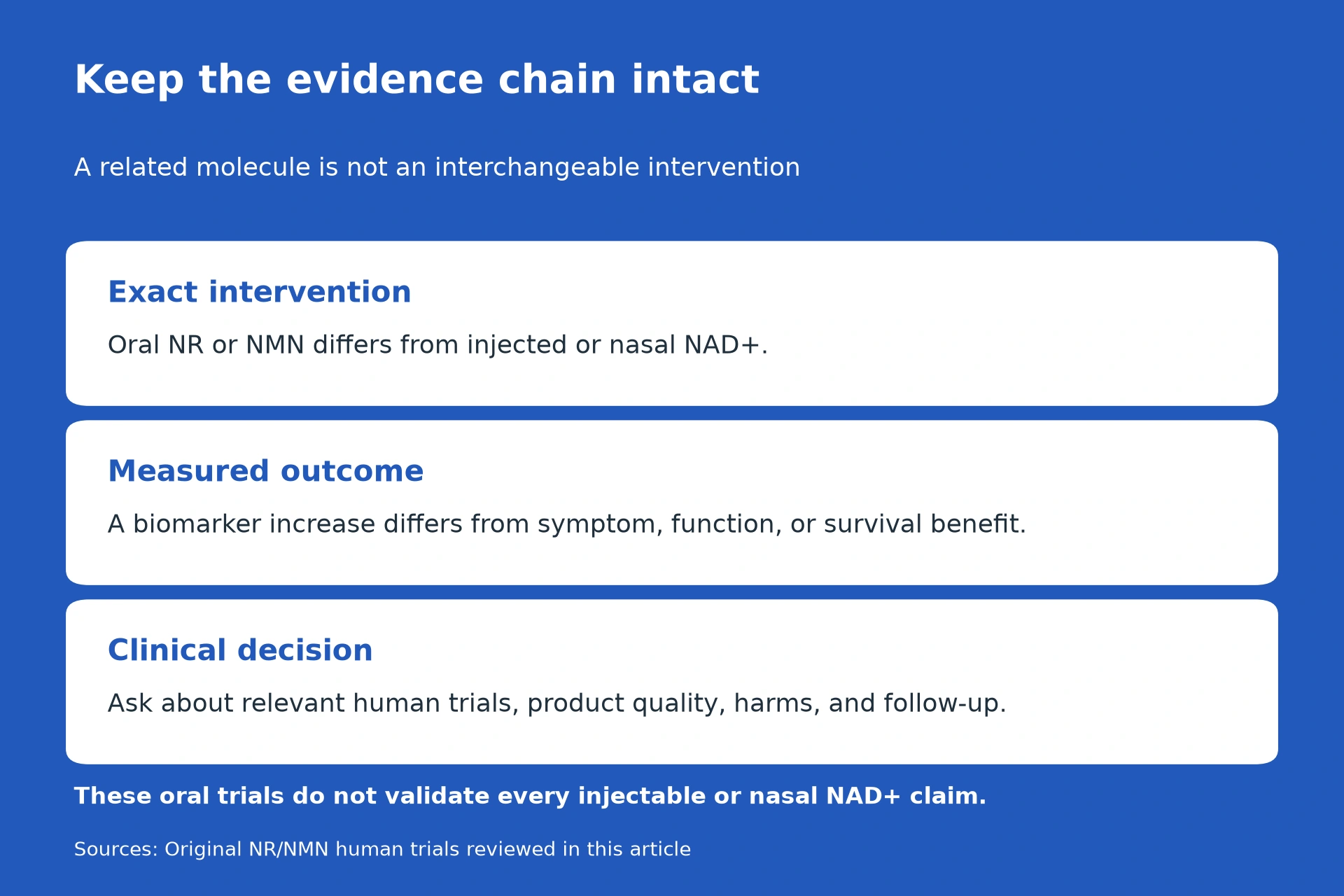
Not directly. All four human interventions reviewed here used oral precursors. They did not establish the effectiveness of injected NAD+ or nasal NAD+ for fatigue, cognition, athletic recovery, or longevity.
A shared biochemical pathway is a reason to investigate another route, not a substitute for route-specific human trials. The NAD+ injection guide, nasal-spray evidence guide, and injection-versus-IV comparison discuss those practical evidence boundaries.
The CoreAge Rx NAD+ injectable page and NAD+ nasal page can help identify the products being discussed. The oral NR/NMN results should not be presented as proof that those products reproduce the same biomarker changes or clinical effects.
What should someone ask before trying a product?
Start with the intended outcome. “Support cellular health” is difficult to evaluate unless it is connected to a meaningful, measurable goal. If the concern is fatigue, brain fog, or reduced exercise tolerance, appropriate assessment should consider other causes rather than assuming NAD+ is the explanation.
Ask which exact compound and route are offered, what human trial supports that combination, what the study measured, and whether the participants resemble the person considering treatment. Also ask about product quality, adverse effects, interactions, and how to decide whether continuing is worthwhile.
Short studies with few participants cannot reliably detect uncommon harms or establish safety in every medical condition. A research dose is not a self-treatment instruction, and stacking several related products does not automatically create a stronger evidence base.
Watch: broader context on infusion claims
This Cleveland Clinic discussion examines IV vitamin therapy. It is included as general context for thinking about benefits, risks, and route-specific claims. It is not evidence that IV NAD+ works, and it does not review the oral NR/NMN trials summarized in this article.
Common questions about NR, NMN, and NAD+
Does doubling blood NAD+ mean doubling cellular energy?
No. A concentration change in a measured blood compartment is not a measure of perceived energy or total cellular energy production. Those outcomes need their own assessment.
Did the human trials prove longer lifespan?
No. The trials reviewed here were short and did not establish longer human survival or a general reversal of aging.
Is NMN better than NR?
The 2026 comparison found that both increased the measured NAD+ concentration. It did not establish which produces better long-term health outcomes. Separate trials in different populations cannot settle that ranking.
Does the NMN insulin-sensitivity result make it a diabetes treatment?
No. It was a small, specific metabolic study, not a trial establishing diabetes remission, complication prevention, or replacement of standard care. Our diabetes-prevention evidence discussion explains why endpoints matter across treatment claims.
What is the most useful conclusion?
Human research supports biological activity for some oral NAD+ precursors and a few specific early clinical signals. It also includes negative findings and major unanswered questions. Keep the compound, route, tissue measurement, and real-world health outcome separate when evaluating a claim.
Original papers and supporting sources
The references distinguish full research papers, published abstracts, and official guidance. This educational narrative review is not a systematic review or an individual treatment recommendation. Sources were checked in October 2026.
- Christen S et al. The differential impact of three different NAD+ boosters on circulatory NAD and microbial metabolism in humans. (2026). Full text reviewed. DOI: 10.1038/s42255-025-01421-8. Open full text.
- Martens CR et al. Chronic nicotinamide riboside supplementation is well-tolerated and elevates NAD+ in healthy middle-aged and older adults. (2018). Full text reviewed. DOI: 10.1038/s41467-018-03421-7. Open full text.
- Dollerup OL et al. A randomized placebo-controlled clinical trial of nicotinamide riboside in obese men: safety, insulin-sensitivity, and lipid-mobilizing effects. (2018). Published abstract reviewed. DOI: 10.1093/ajcn/nqy132.
- Yoshino M et al. Nicotinamide mononucleotide increases muscle insulin sensitivity in prediabetic women. (2021). Full text reviewed. DOI: 10.1126/science.abe9985. Open full text.