People sometimes notice less interest in alcohol while taking semaglutide. That experience has prompted a serious research question: can a medicine used for metabolic conditions also help people with alcohol use disorder? Randomized trials now provide early evidence, but their results need more explanation than a headline about “ending cravings.”
Two small studies, published in 2025 and 2026, tested different formulations in different populations. Both found encouraging signals for some drinking outcomes. Neither established a general cure for alcohol use disorder, and the newer oral trial did not meet its primary craving endpoint.
Why study a metabolic medicine for alcohol use?
The rationale involves reward, motivation, and the signals that influence consumption. A plausible biological mechanism helps researchers decide what to test. It does not establish that a treatment works for a particular person, at a particular dose, or over years.
Random assignment is valuable here because people who start a weight-management medicine may also change meals, social routines, and other behaviors. Observational reports cannot fully separate those changes from medication effects. A placebo-controlled trial provides a stronger comparison, although a small trial still leaves considerable uncertainty.
Our semaglutide appetite and food-noise review addresses a related research area. Food thoughts and alcohol cravings are distinct outcomes; a favorable result for one cannot simply be transferred to the other.
What happened in the 2025 injection trial?
Hendershot and colleagues randomized 48 adults with alcohol use disorder to semaglutide or placebo during nine weeks of outpatient treatment. Participants were not seeking alcohol treatment or actively trying to reduce their drinking. Most were women, and the average age was about 40. Original 2025 report.
The research schedule began with low weekly injections and increased during the study. The laboratory alcohol assessment occurred after the period using 0.5 mg weekly, before the final escalation. These details describe a supervised experiment; they do not provide an alcohol-treatment dosing schedule.
The main laboratory procedure offered participants an opportunity to delay drinking and then consume alcohol under controlled conditions. Researchers assessed the amount consumed and peak breath alcohol concentration. The setting provided a standardized comparison, but it was not the same as observing months of everyday recovery.
Which results improved, and which did not?
Semaglutide reduced laboratory alcohol consumption and peak breath alcohol concentration relative to placebo. The paper reported standardized model effects, including a coefficient of −0.48 for grams consumed, with a 95% confidence interval of −0.85 to −0.11. That number is not a 48% reduction in drinking. It describes an effect on the model’s standardized scale. Study results and methods.
The complete laboratory comparison involved only 25 participants with the necessary data: 13 assigned semaglutide and 12 placebo. That smaller denominator belongs beside the result. Saying “48 people proved the laboratory benefit” would obscure how much information actually supported that specific analysis.
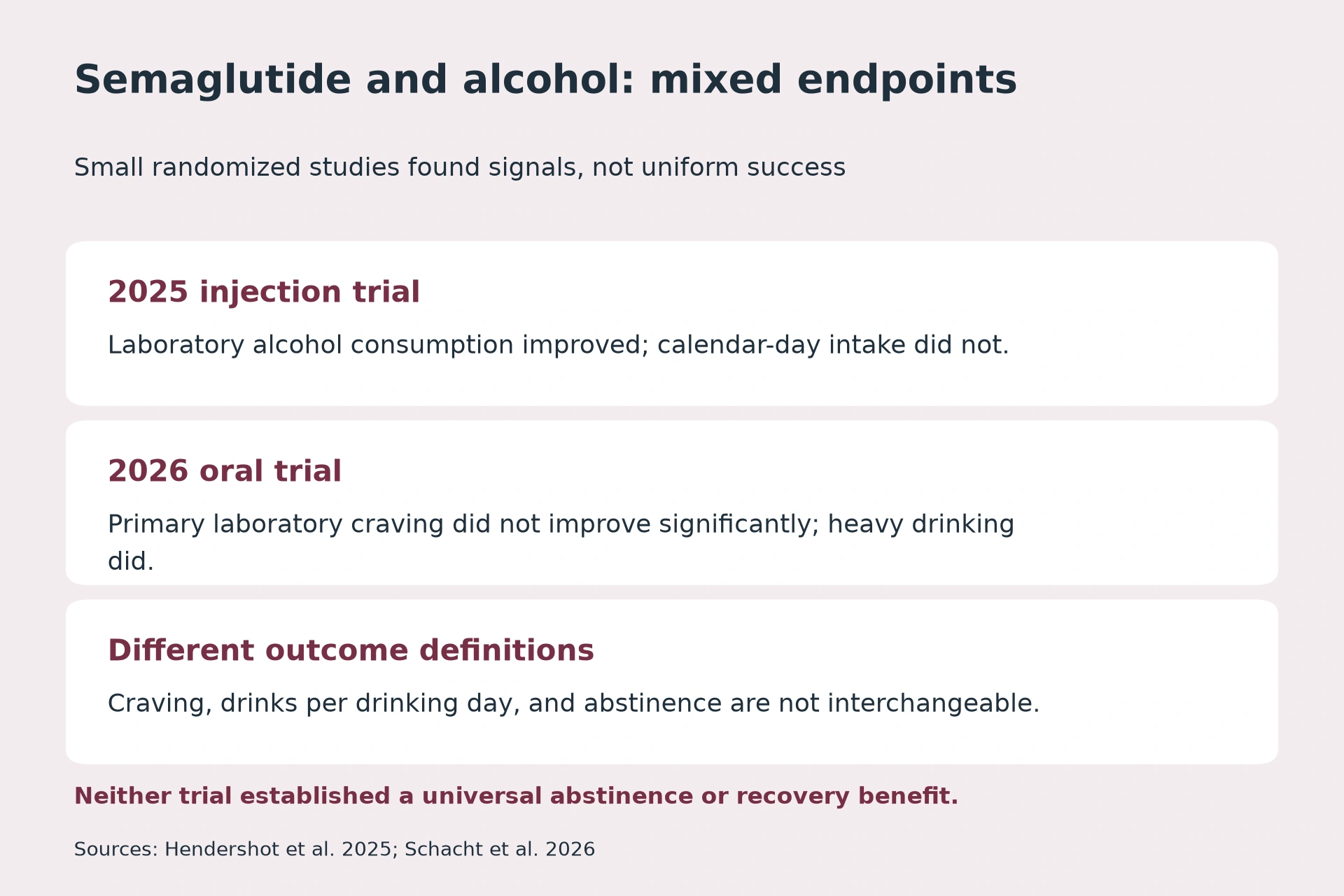
Outside the laboratory, drinks per drinking day and weekly craving improved, and heavy drinking showed a favorable treatment-by-time pattern. Average drinks per calendar day and the number of drinking days did not significantly improve. A report that lists only the positive outcomes gives an incomplete account.
Why are drinks per day and drinks per drinking day different?
Imagine someone drinks on two evenings in a seven-day week. “Drinks per drinking day” describes those two drinking occasions. “Drinks per calendar day” spreads the total across all seven days. Either measure may be useful, but each answers a different question.
A person could drink less on each occasion while still drinking on the same number of days. A trial could detect a change in one measure and have too much uncertainty to establish a change in another. That is why the actual endpoint matters more than a broad statement that alcohol use “went down.”
Craving adds another dimension. Someone may feel less urge to drink without becoming abstinent. Conversely, a person may reduce drinking despite continued cravings. Treatment goals, functioning, safety, and sustained behavior all matter alongside questionnaire scores.
What did the newer oral trial add?
Schacht and colleagues randomized 50 treatment-seeking adults with moderate-to-severe alcohol use disorder to oral semaglutide or placebo for eight weeks. The research regimen used 3 mg daily initially and 7 mg daily later. Participants had overweight or obesity; the findings cannot establish the same effect in people at lower body weights. Original 2026 report.
The primary outcome was alcohol-cue-induced craving measured in a laboratory at week six. Showing a participant an alcohol-related cue and asking about immediate craving is a different experiment from allowing laboratory drinking or collecting weekly reports of everyday cravings.
The study did not show a significant advantage for its primary laboratory craving measure. It also did not show a significant difference in the preregistered drinks-per-calendar-day outcome. It did find fewer heavy drinking days and favorable results for several other measures, including drinks per drinking day and naturalistic craving.
How should a positive secondary result be interpreted?
A primary endpoint is the question a study is principally designed to answer. Secondary endpoints add useful information, but they do not erase an unsuccessful primary result. Exploratory findings are especially useful for planning the next study rather than settling a clinical question.
In the oral trial, heavy drinking days were a key preregistered secondary outcome. The model coefficient was −0.580, with a 95% confidence interval of −1.012 to −0.148. Because the analysis used a log-link count model, that coefficient should not be labeled “0.58 fewer heavy drinking days.” Analysis methods.
The most accurate summary is therefore mixed: the selected laboratory craving test did not establish benefit, while some clinically relevant drinking outcomes favored semaglutide. This supports further investigation without treating every endpoint as interchangeable.
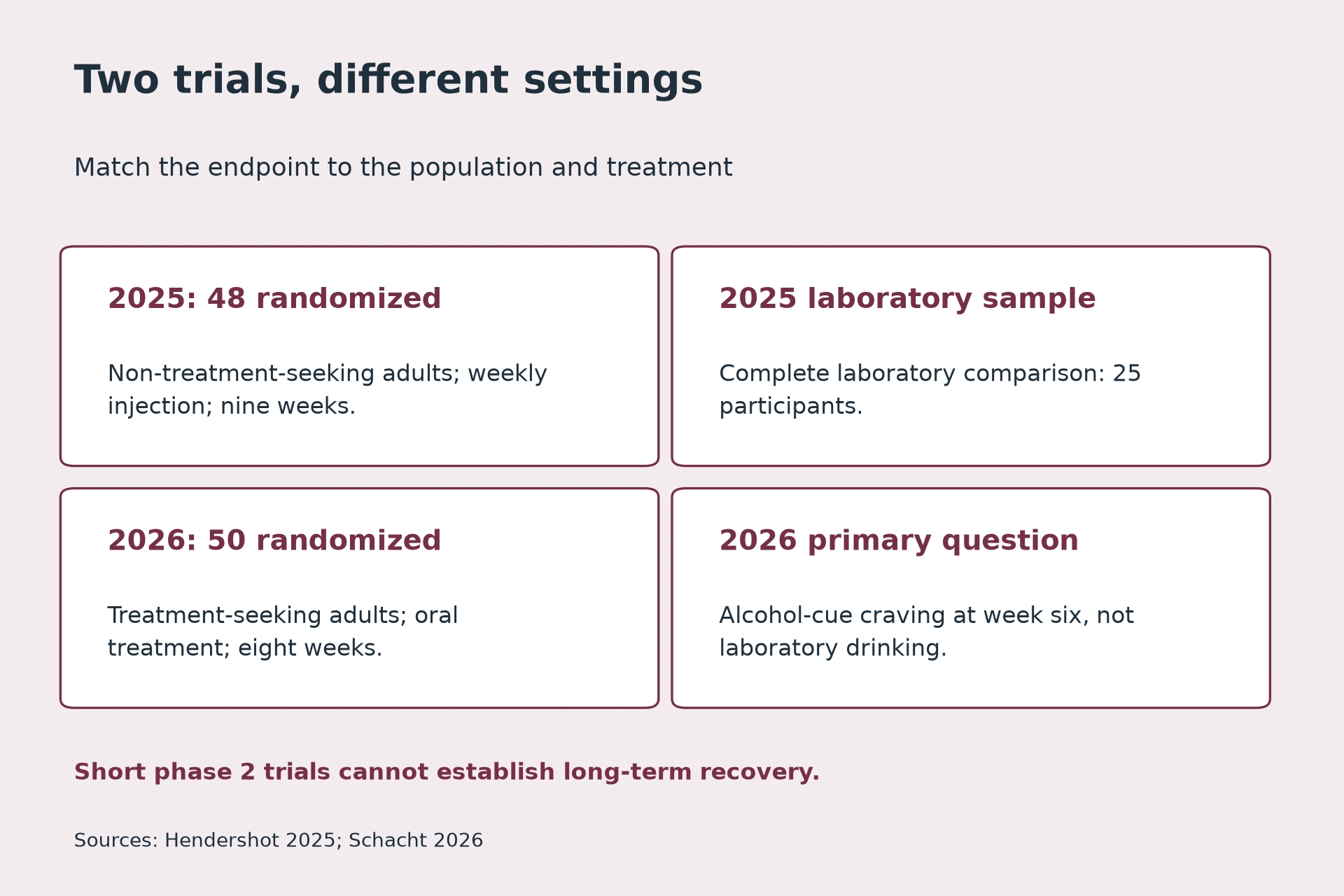
| Feature | 2025 injection trial | 2026 oral trial |
|---|---|---|
| Randomized participants | 48 | 50 |
| Treatment-seeking status | Not seeking alcohol treatment | Seeking treatment |
| Duration | Nine weeks | Eight weeks |
| Main laboratory question | Alcohol self-administration | Cue-induced craving |
| Main laboratory result | Favorable consumption signal | No significant primary craving benefit |
| Everyday outcomes | Mixed, with several favorable signals | Mixed, with fewer heavy drinking days |
Do the studies prove the benefit is independent of weight loss?
The injection trial recorded weight loss with semaglutide. The oral trial did not find a significant between-group difference in weight change over its short treatment period. That makes the relationship between weight change and drinking an interesting research question, but it does not establish the precise mechanism.
The studies did not randomize people to equal weight loss through different methods. Nor did they directly establish which brain pathway caused each behavioral change. It is reasonable to describe potential mechanisms as hypotheses; it is premature to state that the medicine “rewires addiction.”
Our oral semaglutide versus injection guide explains why formulation matters. Milligram amounts across oral and injected medicines are not a conversion rule for patients to use themselves.
What are the main limitations?
Both trials were small, short phase 2 studies. They could detect promising signals but could not establish uncommon harms, long-term recovery, or what happens after treatment ends. The participants were selected for research eligibility, so the results do not represent every person with alcohol use disorder.
The oral study relied on reported drinking without a biological alcohol-consumption marker. Its authors also discussed imperfect blinding, limited demographic diversity, and selection for alcohol-cue reactivity. The injection study had a particularly small complete laboratory sample. These limitations do not make the findings worthless; they define the next questions to test.
Neither study compared semaglutide head-to-head with naltrexone, acamprosate, or disulfiram. Comparing effect sizes from separate studies would not establish that semaglutide is better. The reports disclose funding and investigator relationships; readers can find those details in the linked full papers.
Where does established treatment fit?
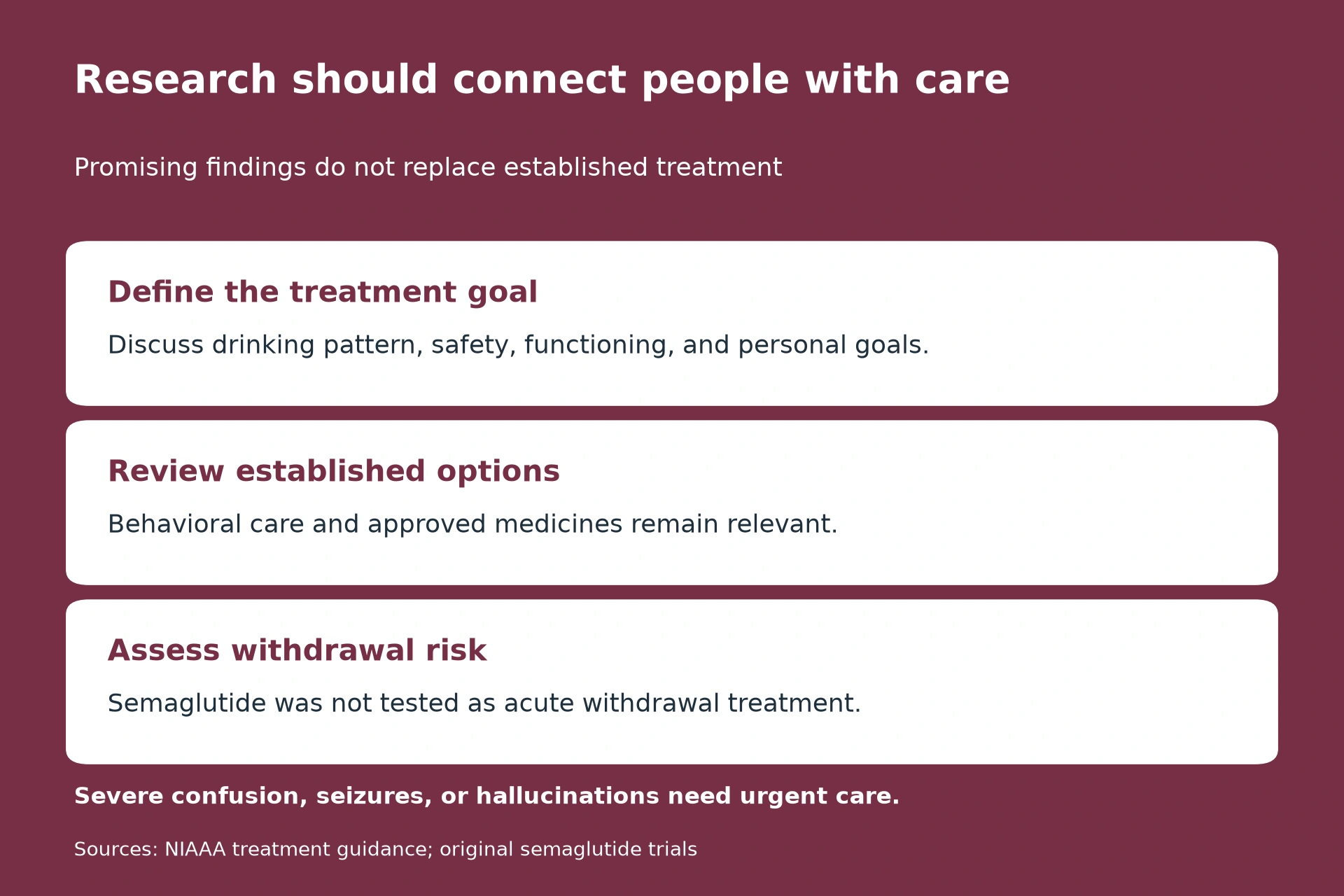
The National Institute on Alcohol Abuse and Alcoholism describes behavioral treatments, mutual-support approaches, and approved medicines as options in alcohol care. Treatment can be matched to a person’s goals, medical history, and level of risk. An emerging research finding should expand a conversation, not delay access to existing care. NIAAA treatment information.
These two studies do not establish an FDA-approved alcohol-use-disorder indication for semaglutide. They also do not test it as treatment for acute alcohol withdrawal. People with physical dependence can become seriously ill when alcohol is abruptly reduced or stopped; a clinician can help determine whether medically supervised withdrawal is needed.
Seizures, hallucinations, or severe confusion after reducing alcohol require urgent medical care. Semaglutide is not a substitute for that assessment.
Questions to bring to an appointment
- What diagnosis and drinking pattern are we trying to address?
- Could withdrawal be dangerous for me, and what support would make a change safer?
- Which established treatments fit my goals and medical history?
- If I already use semaglutide for another indication, how should changes in drinking, appetite, or nutrition be monitored?
- What evidence supports the exact formulation being discussed?
- How would we judge meaningful progress beyond a lower craving score?
Our Ozempic and alcohol guide covers practical medication questions. For general metabolic-treatment information, the semaglutide product page and semaglutide questions guide are separate resources; they should not be read as offers of a proven addiction treatment. Compounded products are not FDA-approved and are not automatically equivalent to the products used in these trials. FDA information.
Video: hear the 2025 investigators discuss the study
This JAMA Network interview discusses the injection trial. It provides context for that paper and predates the conclusions of the separate oral study summarized above. The article’s comparison remains necessary when interpreting the newer evidence.
Frequently asked questions
Does semaglutide make everyone stop drinking?
No. Neither trial demonstrated universal abstinence. The studies found changes in selected outcomes, with important null findings and considerable individual variation.
Does feeling fewer cravings mean alcohol is safer to drink?
No. Craving intensity does not measure alcohol-related injury risk, medication interactions, liver health, or withdrawal risk. A reduced urge is one observation to discuss, not a safety test.
Can I use a smaller dose specifically for cravings?
The doses described here belonged to research protocols. They do not establish a self-directed prescription, a dose conversion, or a reliable “microdosing” strategy for alcohol use disorder.
What would stronger evidence look like?
Larger and longer trials, prespecified meaningful drinking outcomes, biological confirmation where practical, representative participants, and direct comparisons with established care would help. Follow-up after discontinuation is particularly important for understanding durability.
Original papers and supporting sources
The references distinguish full research papers, published abstracts, and official guidance. This educational narrative review is not a systematic review or an individual treatment recommendation. Sources were checked in October 2026.
- Hendershot CS et al. Once-Weekly Semaglutide in Adults With Alcohol Use Disorder: A Randomized Clinical Trial. (2025). Full text reviewed. DOI: 10.1001/jamapsychiatry.2024.4789. Open full text.
- Schacht JP et al. Oral Semaglutide for Alcohol Use Disorder: A Randomized Clinical Trial. (2026). Full text reviewed. DOI: 10.1176/appi.ajp.20260003. Open full text.
- NIAAA: treatment for alcohol problems. Official guidance.
- FDA: concerns with unapproved GLP-1 drugs. Official guidance.