People often use “food noise” to describe persistent thoughts about eating, cravings, or the effort required to resist food cues. It is a useful conversational phrase, but it does not automatically identify one specific symptom or research outcome.
Semaglutide studies have measured hunger, fullness, cravings, control of eating, food preoccupation, and how much participants eat during a test meal. Reading those measurements separately gives a more accurate explanation than saying the medication simply switches food thoughts off.
What does “food noise” mean in a scientific paper?
A person might mean frequent thoughts about snacks, strong cravings, feeling hungry soon after a meal, or difficulty concentrating because food is constantly on their mind. These experiences overlap, but they are not identical. Our food-noise introduction explains the terminology in everyday language.
Researchers need more specific measurements. Hunger concerns the desire to eat; fullness and satiety concern satisfaction during and after eating. A questionnaire about control of eating asks a different question from weighing how much food someone consumes at lunch.
The original studies discussed here did not all use the same instrument or a single universal food-noise score. That means their findings can support a discussion about appetite and food thoughts without proving that every experience grouped under “food noise” will respond equally.
The 2017 study: an early look at eating behavior
A randomized, double-blind crossover trial studied 30 adults with obesity. Participants received semaglutide, escalated to 1.0 mg weekly, and placebo in separate treatment periods. After 12 weeks of treatment, researchers assessed meals, appetite ratings, food preferences, and related outcomes. Blundell and colleagues, 2017.
In a crossover design, the same participant receives both treatments at different times. This can help account for stable differences between people, but the trial still depends on its sequence, timing, and analysis. It should not be counted as two independent groups of 30 participants.
Total energy intake across the unrestricted meals and snacks assessed that day was 24% lower with semaglutide than placebo. Participants also reported less hunger and food craving and better control of eating. Resting metabolic rate adjusted for lean body mass did not differ between treatments.
That pattern supports reduced intake as a mechanism of weight loss. It does not support a claim that semaglutide works primarily by dramatically increasing resting calorie burning. The study was small and short, so it could not establish lifelong appetite effects or predict every person’s experience.
The 2021 trial: what happened at the test lunch?
A separate double-blind, parallel-group trial randomized 72 adults with obesity to semaglutide, escalated to 2.4 mg weekly, or placebo for 20 weeks. It assessed appetite and food cravings and measured energy intake during an ad libitum lunch, meaning participants could choose how much to eat from the food offered. Friedrichsen and colleagues, 2021.
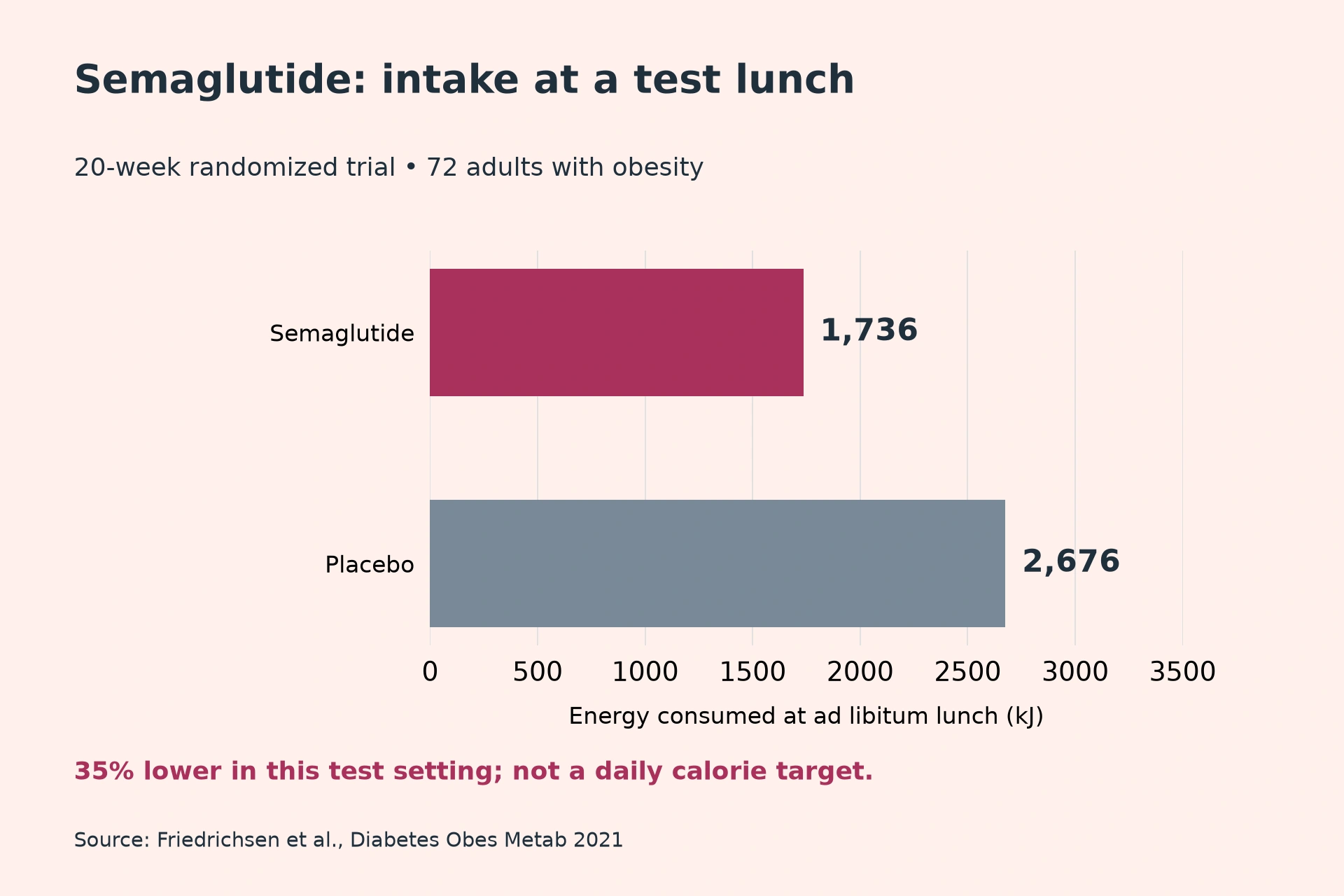
Reported lunch intake was 1,736 kJ with semaglutide and 2,676 kJ with placebo, an estimated difference of −940 kJ. This was approximately 35% lower in the semaglutide group. Hunger and prospective food consumption decreased, while fullness and satiety increased relative to placebo.
The percentage describes that test lunch under research conditions. It is not a recommendation to cut all meals by 35%, and it does not establish that each person consumed 35% fewer calories every day. Food availability, social setting, meal timing, and daily routine outside a laboratory can differ substantially.
Does this prove that nausea explains all the reduced intake?
No. The earlier 2017 study found similar nausea ratings between treatment conditions during the assessments while appetite and eating measures differed. That argues against reducing the entire effect to “people eat less only because they feel sick.” 2017 study.
It also does not mean nausea is unimportant or absent in clinical care. A person who cannot eat enough because of persistent symptoms needs follow-up. Desired changes in hunger and distressing difficulty eating are different experiences, even if both reduce food intake.
When describing progress, it helps to distinguish reduced intrusive food thoughts from nausea, vomiting, aversion to most foods, or inability to maintain normal meals. These differences give the clinician more useful information than simply saying that appetite is “strongly suppressed.”
What did the gastric-emptying measurement show?
The 2021 trial assessed gastric emptying indirectly through paracetamol absorption after a standardized breakfast. It found no evidence of delayed gastric emptying at week 20 using that method. Original paper.
This finding needs its method and timing attached. It does not establish that semaglutide never affects gastric emptying, that effects are identical early and late in treatment, or that every type of stomach-emptying test would produce the same result. An indirect absorption test is not a complete description of gastrointestinal function.
The practical lesson is to avoid an overly simple explanation that all appetite effects come from food physically staying in the stomach. The trial observed changes in eating and appetite even without evidence of delayed emptying by its week-20 assessment method.
A newer 60-week study adds an important qualification
A randomized, double-blind trial published in 2026 assigned 120 adults with overweight or obesity to semaglutide 2.4 mg or placebo in a 3:2 ratio. Participants attended laboratory assessments at baseline and weeks 20, 40, and 60. The study measured test-lunch intake, appetite after breakfast, and food-reward questionnaires. Tronieri and colleagues, 2026.
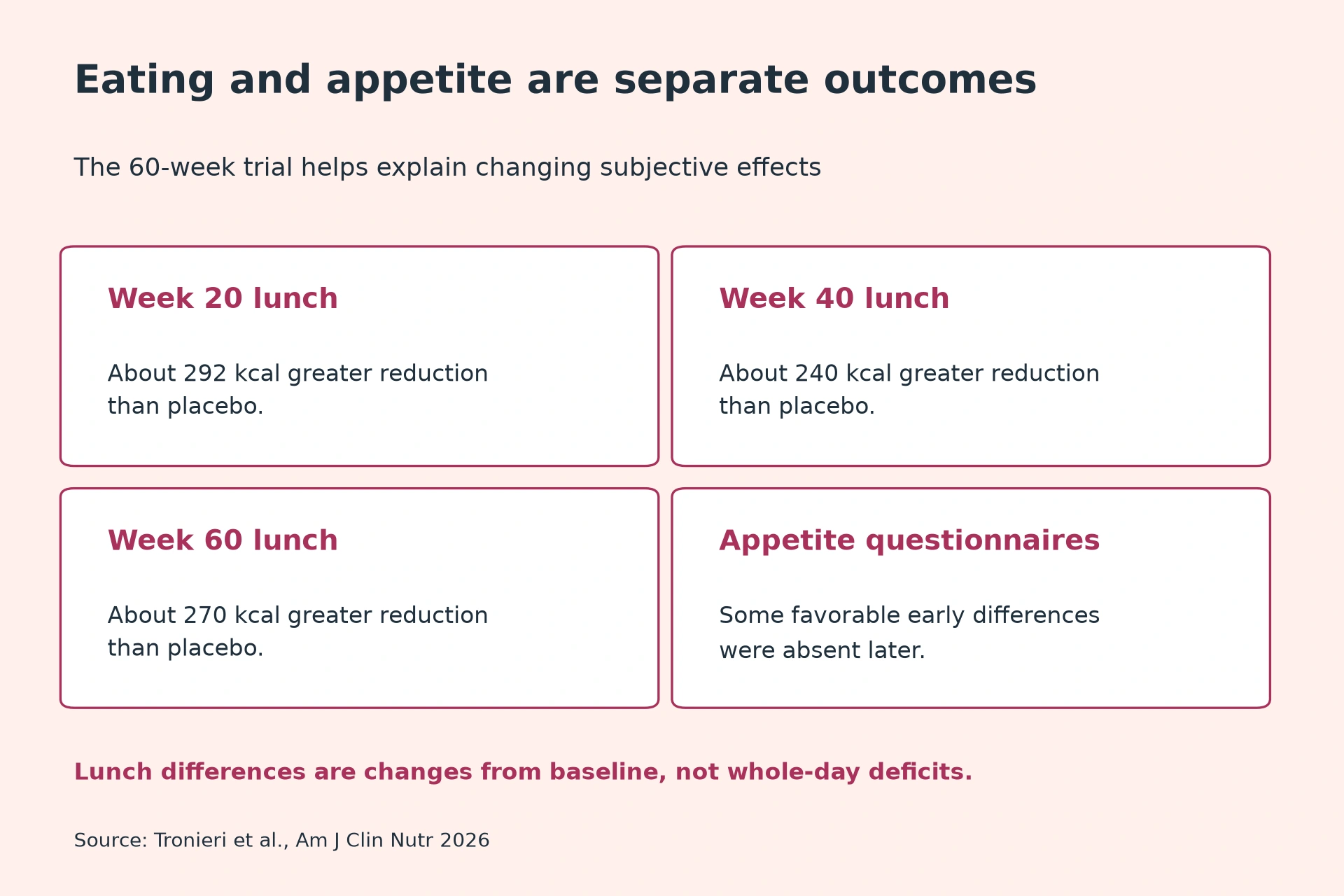
The semaglutide group had larger reductions in test-lunch intake from baseline than placebo at all three follow-up assessments. The estimated between-group differences were approximately 292 kcal at week 20, 240 kcal at week 40, and 270 kcal at week 60.
Those values are differences in change at an assessed lunch, not a daily calorie prescription or a demonstrated daily deficit maintained throughout the study. Multiplying one of them by 365 would create a prediction the study did not establish.
At week 20, semaglutide participants also had greater appetite suppression and larger reductions in past-week hunger and food preoccupation. However, the groups did not differ significantly on the appetite outcomes at weeks 40 or 60. Food-reward responsiveness also followed its own pattern, with favorable differences at weeks 20 and 40.
Why can food thoughts return while treatment still has an effect?
The 60-week results show why subjective experience and measured eating should be followed separately. Participants continued consuming less at test lunches on average even when some questionnaire differences were no longer statistically significant.
That does not prove what is happening in any one person who reports returning hunger. It does show that the feeling of appetite suppression is not a perfect on/off indicator of the medication’s effect. A changing sensation should be considered alongside weight trend, intake, side effects, health goals, and the actual treatment regimen.
The trial had limitations, including greater-than-expected dropout in the placebo group. Researchers used missing-data methods designed to make conservative assumptions, but unobserved outcomes remain uncertain. Most participants were female, White, and non-Hispanic, which also limits generalization. Study methods and limitations.
How do the three trials fit together?
| Research report | Main design | Useful contribution |
|---|---|---|
| Blundell, 2017 | 30-person crossover trial; 12-week treatment periods | Early appetite, meal, and food-preference findings |
| Friedrichsen, 2021 | 72-person parallel trial; 20 weeks | Obesity-dose meal testing and indirect gastric-emptying assessment |
| Tronieri, 2026 | 120-person parallel trial; 60 weeks | Longer follow-up separating intake from subjective appetite |
The reports strengthen the case that semaglutide changes eating behavior. They do not establish that every questionnaire measures the same construct, that each result applies to all formulations, or that eliminating hunger is a necessary treatment goal.
The earlier trials were manufacturer-funded, and the newer trial reports an investigator-initiated grant and relevant industry relationships. Funding does not invalidate a randomized finding, but transparency about sponsorship and design helps readers judge the evidence.
What should people track besides the scale?
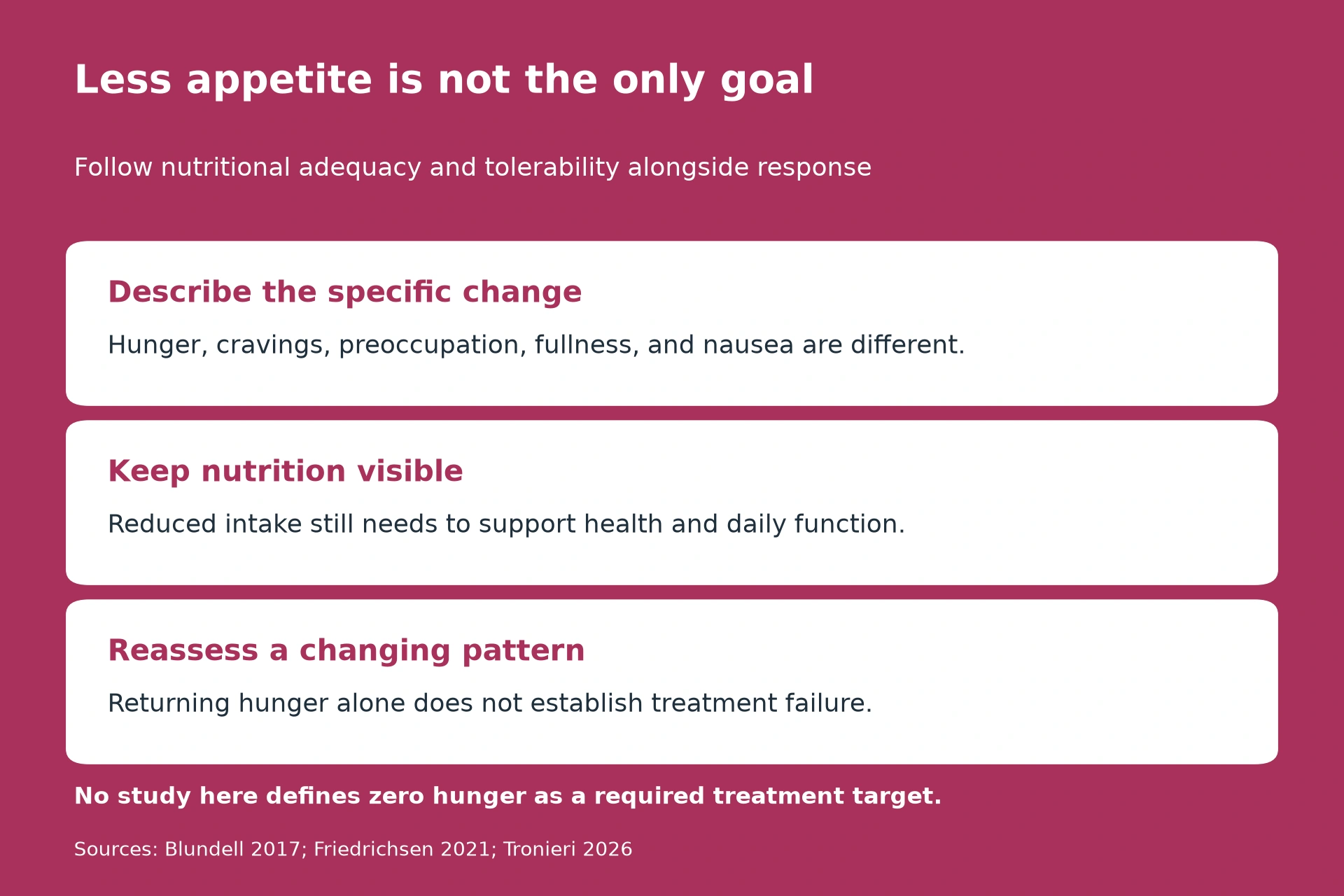
A useful review can include whether meals remain regular, whether adequate food and fluids are possible, whether symptoms interfere with work or exercise, and which food thoughts have changed. Describe concrete examples: fewer evening cravings, less distraction between meals, or feeling too full to complete ordinary meals.
These observations are more informative than trying to maximize appetite suppression. They also help distinguish a desired behavioral change from a side effect that needs attention. A dietitian or clinician can help assess nutritional adequacy when intake changes substantially.
Our GLP-1 lean-mass research review explains why body composition and strength deserve attention during weight loss. Reduced food intake does not automatically mean protein, micronutrient, and activity needs are being met.
Do these results apply equally to tirzepatide or compounded semaglutide?
The studies reviewed here tested specified semaglutide regimens. Tirzepatide has its own clinical evidence; results should not be assigned to it merely because the medicines share GLP-1 activity. Our SURMOUNT-5 review addresses their direct weight-loss comparison.
Likewise, oral, injectable, approved, and compounded products are not interchangeable evidence categories. The FDA’s information on unapproved GLP-1 drugs explains why compounded products do not undergo the same premarket review as approved drugs.
Use the CoreAge Rx semaglutide page or tirzepatide page to discuss the actual product and follow-up offered. The scientific findings should support informed questions rather than imply that any preparation will reproduce a published result.
Watch: nutrition when appetite changes on a GLP-1
This Mayo Clinic podcast discusses eating, nutritional needs, and symptoms during GLP-1 treatment. It offers broader clinical context; it is not a presentation of the three appetite trials or a personalized meal plan.
Common questions about food noise and semaglutide
Is food noise the same as hunger?
Not necessarily. The phrase may include cravings, preoccupation, or responsiveness to food cues. Explaining the specific experience helps connect it to the measures used in research and to practical care.
Does returning hunger mean treatment has stopped working?
Not by itself. The 60-week trial found that measured intake and subjective appetite could change differently over time. Review the broader pattern with the prescriber before interpreting one symptom as treatment failure.
Should the goal be to feel no hunger at all?
The trials did not establish complete absence of hunger as a necessary or desirable target. The goal is an appropriate health response with adequate nutrition, tolerable symptoms, and useful daily function.
Can the studies predict when my food thoughts will change?
They describe assessments at defined research visits, not a reliable onset schedule for every person. Individual experience may differ during titration and longer treatment.
What happens after stopping?
These appetite studies do not establish a strategy that prevents weight regain after withdrawal. Our GLP-1 withdrawal review explains the separate maintenance evidence and its limits.
Original papers and supporting sources
The references distinguish full research papers, published abstracts, and official guidance. This educational narrative review is not a systematic review or an individual treatment recommendation. Sources were checked in October 2026.
- Blundell J et al. Effects of once-weekly semaglutide on appetite, energy intake, control of eating, food preference and body weight in subjects with obesity. (2017). Full text reviewed. DOI: 10.1111/dom.12932. Open full text.
- Friedrichsen M et al. The effect of semaglutide 2.4 mg once weekly on energy intake, appetite, control of eating, and gastric emptying in adults with obesity. (2021). Full text reviewed. DOI: 10.1111/dom.14280. Open full text.
- Tronieri JS et al. Short- and long-term effects of semaglutide 2.4 mg on energy intake, appetite, and food reward: a 60-week, double-blind randomized controlled trial. (2026). Full text reviewed. DOI: 10.1016/j.ajcnut.2026.101403. Open full text.
- FDA. Concerns with unapproved GLP-1 drugs used for weight loss. FDA safety information.