Weight regain after stopping a GLP-1-based medicine can feel discouraging, especially after months of effort. Randomized withdrawal studies help explain why this is a treatment-planning issue rather than a simple test of willpower.
The strongest studies do more than observe that some people regain weight. They compare continuing treatment with switching to placebo after an initial treatment period. A separate semaglutide extension followed a subset after medication and the study’s lifestyle program ended. Reading those designs separately makes the results much clearer.
Why the study design changes the answer
A randomized withdrawal trial starts by giving everyone the active medicine. People who reach the next stage are then randomly assigned either to keep taking it or to switch to placebo. That design asks what happens after initial treatment among people who were able to continue to randomization.
It differs from randomizing a previously untreated population on day one. People who stopped early because of side effects or other reasons may not enter the withdrawal comparison. The results therefore describe a selected group of treatment completers or tolerators.
An off-treatment extension asks another question: what happens to a followed subset after a trial’s active phase ends? That can provide useful information, but it is not automatically a new randomized comparison of “continue versus stop.” STEP 1’s extension is an example of this distinction.
Our practical guides on stopping semaglutide and stopping tirzepatide cover appointment planning. This review explains the research those conversations often draw on.
STEP 4: continuing semaglutide versus switching to placebo
STEP 4 began with a 20-week semaglutide period that included dose escalation. Of 902 participants who began that period, 803 reached the 2.4 mg weekly maintenance dose and were randomized. They had lost an average 10.6% of their starting body weight by that point. Original STEP 4 report.
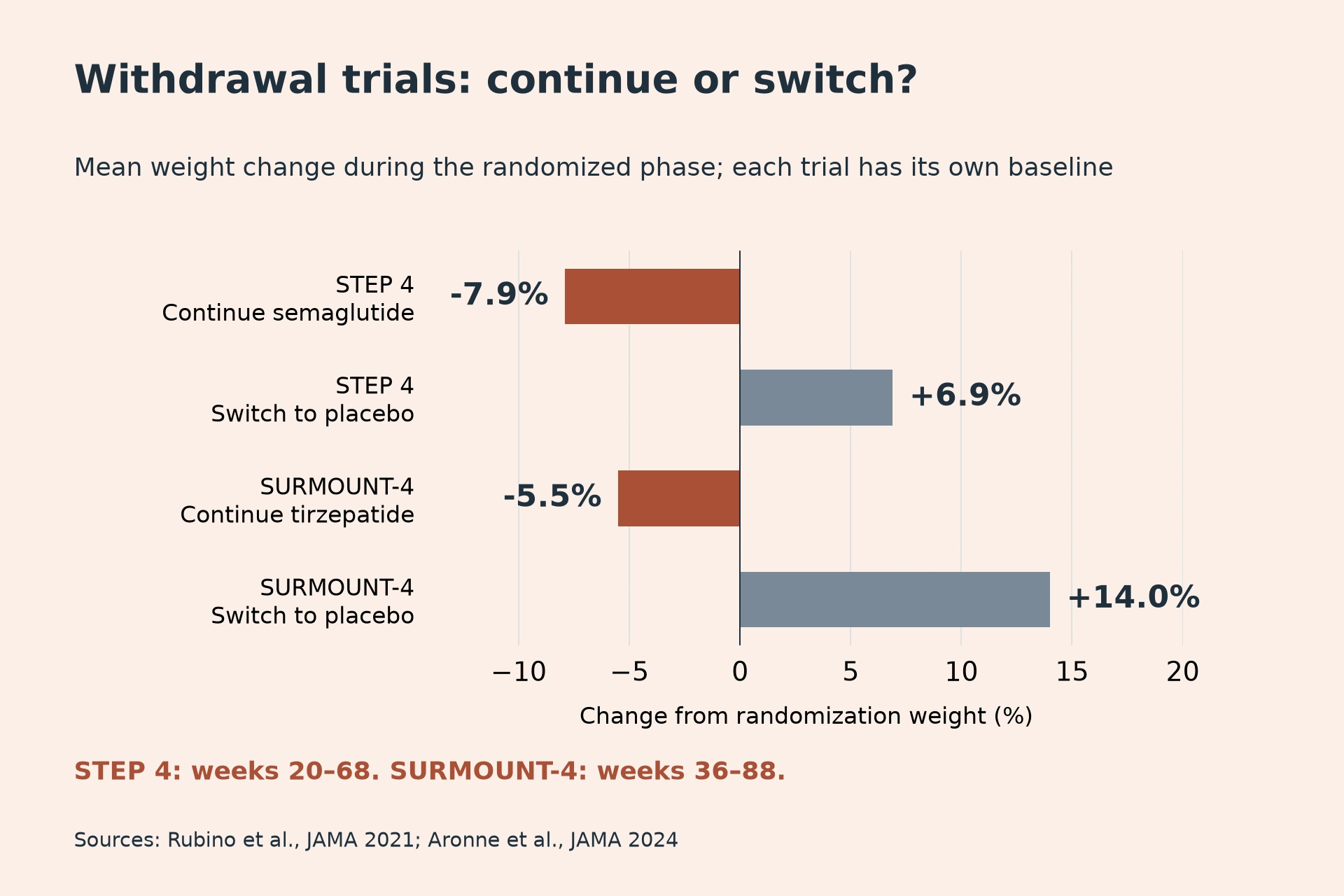
Participants were then assigned to continue semaglutide or switch to placebo for another 48 weeks. Both groups continued the study’s lifestyle intervention. From randomization at week 20 to week 68, weight changed by −7.9% with continued semaglutide and +6.9% after switching to placebo.
The estimated between-group difference was −14.8 percentage points, with a 95% confidence interval of −16.0 to −13.5. Waist circumference, systolic blood pressure, and reported physical functioning also favored continued treatment.
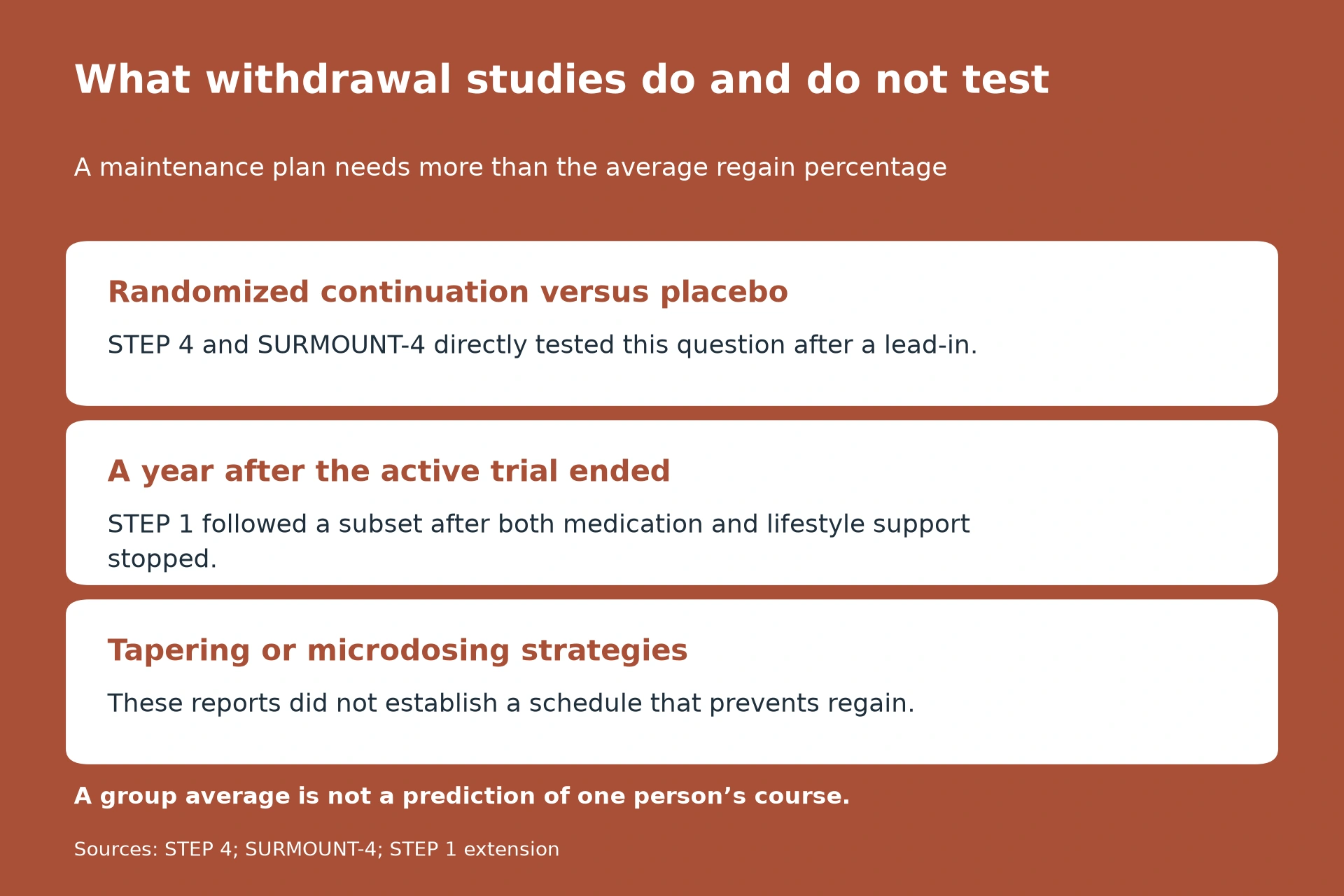
This supports an ongoing treatment effect. It does not show that medication is the only useful component of care, or that every participant who stopped returned to their original starting weight. It also does not test a gradual taper: the randomized comparison was continued full study treatment versus placebo.
SURMOUNT-4: the tirzepatide withdrawal trial
SURMOUNT-4 used a 36-week open-label lead-in with tirzepatide, targeting the maximum tolerated 10 or 15 mg weekly dose. Of 783 participants who entered that phase, 670 were randomized to continue tirzepatide or switch to placebo for 52 more weeks. Participants did not have diabetes. They had lost an average 20.9% of their initial weight before randomization. Original SURMOUNT-4 report.
From week 36 to week 88, weight changed by −5.5% with continued tirzepatide versus +14.0% with placebo. The trial reported a between-group difference of −19.4 percentage points. The difference between the rounded group values is slightly different because the reported analysis and rounding are not identical to subtracting two displayed numbers.
At week 88, 89.5% of the tirzepatide group retained at least 80% of the loss achieved during the initial phase, compared with 16.6% of the placebo group. Across the entire 88 weeks, average weight reduction was 25.3% with continued treatment and 9.9% in those switched to placebo.
The placebo-switch group therefore regained substantial weight but, on average, still remained below its original starting weight. “They regained everything” would not accurately describe that result.
Be careful about the denominator
A percentage change is always measured relative to something. In STEP 4, the randomized phase started at week 20. In SURMOUNT-4, it started at week 36. Their reported randomized-phase percentages use the weight at those points as the reference, not necessarily the original pretreatment weight.
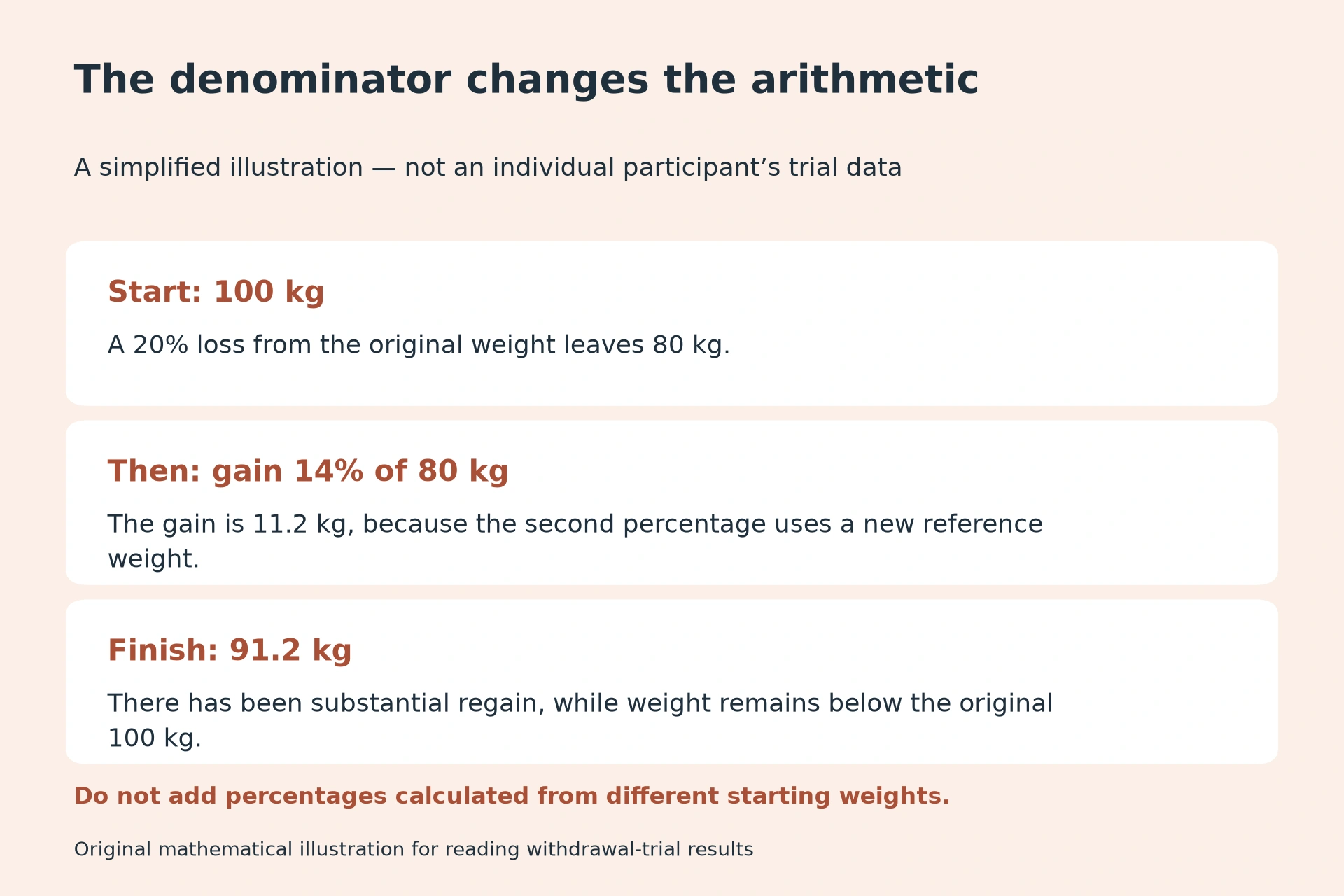
Here is a simplified mathematical illustration, not a reconstruction of an individual trial participant: a person starting at 100 kg who loses 20% reaches 80 kg. If they then gain 14% of 80 kg, they gain 11.2 kg and reach 91.2 kg. They have regained more than half of the kilograms lost while still remaining below 100 kg.
You cannot simply subtract 14 from 20 and treat the result as the exact net percentage change, because the reference weights differ. This is why trial reports provide both change after randomization and overall change from the original baseline.
STEP 1 extension: the source of the “two-thirds” headline
STEP 1 originally randomized 1,961 adults without diabetes to semaglutide 2.4 mg weekly or placebo plus lifestyle intervention for 68 weeks. The later extension followed 327 participants for another year after the study treatment ended. At week 68, the medication and the trial’s lifestyle intervention were both discontinued. Original STEP 1 extension.
In that followed subset, average weight loss during the active phase was 17.3% with semaglutide and 2.0% with placebo. During the year after withdrawal, the groups regained 11.6 and 1.9 percentage points, respectively. At week 120, net weight loss from the original baseline was 5.6% and 0.1%.
The semaglutide group’s average regain amounted to about two-thirds of its previous weight loss. This is a group summary, not a prediction that each person will regain exactly two-thirds. Some may regain less or more.
Several cardiometabolic improvements also moved back toward baseline. That suggests maintenance discussions should include blood pressure, glucose-related measures, and other health targets rather than treating the scale as the only outcome.
Why the extension needs a different level of certainty
The extension was exploratory and involved a subset of the original participants. It did not newly randomize people at week 68 to continuing semaglutide versus stopping it. In addition, the study’s structured lifestyle support ended at the same time as medication.
Those features limit how precisely the extension can isolate the effect of medication withdrawal alone. STEP 4 and SURMOUNT-4 are particularly useful complements because their randomized withdrawal periods compared continuation and placebo while retaining lifestyle intervention.
The three reports should not be counted as three identical experiments. Their shared pattern is informative, and their different methods explain why the exact regain figures differ. STEP 4 and STEP 1 were funded by Novo Nordisk; SURMOUNT-4 was funded by Eli Lilly.
What the studies say about long-term treatment
The results support viewing obesity as a condition that often needs ongoing management. A medication’s appetite and weight effects may diminish after it is removed, just as the benefits of treatments for other chronic conditions can depend on continued care.
That does not establish a universal rule that every person must take the same drug at the same dose forever. The studies did not randomize every possible maintenance strategy, alternate medication, surgical approach, nutrition program, or exercise intervention. They also did not answer what is affordable or tolerable for a particular person.
The clinically useful conclusion is to plan maintenance early and revisit it over time. A decision to continue, change, or stop treatment should include the original reason for prescribing, benefits achieved, adverse effects, other conditions, and access.
What about tapering, lower doses, or “microdosing”?
STEP 4 and SURMOUNT-4 did not establish that a particular taper prevents regain. SURMOUNT-4 did not allow dose adjustments after randomization, which the authors identified as a limitation. It compared continued maximum-tolerated study treatment with switching to placebo.
Therefore, a claim that “the trials prove tapering solves rebound” is unsupported. The opposite blanket claim, that no lower-dose maintenance strategy could ever help, also goes beyond these studies. The right question is which strategy has evidence and is appropriate for the specific prescribed product and patient.
Do not create a dosing schedule from trial averages or divide a product in a way its instructions do not support. For interruptions and restarting, our semaglutide missed-dose guide and tirzepatide missed-dose guide explain why the prescriber should help determine the plan.
What a useful maintenance plan tracks
A plan can define what will be monitored, when follow-up happens, and what would trigger an earlier review. Weight trend is one part. Appetite, food intake, strength, physical activity, blood pressure, and diabetes-related measures may also matter depending on the person.
It is helpful to discuss what worked during treatment and what became difficult. Severe restriction that is hard to sustain, persistent nausea, loss of strength, or an inability to meet nutritional needs should not be ignored merely because weight fell. Our lean-mass study review explains why preserving function deserves its own attention.
A maintenance visit can also address cost or access before a supply interruption becomes an unplanned stop. If you are exploring CoreAge Rx’s semaglutide or tirzepatide services, ask about follow-up and product-specific long-term planning as well as starting treatment.
The separate tirzepatide and prediabetes research review considers another outcome that may matter over time. Weight and diabetes risk are related, but a maintenance decision should keep each health target explicit.
Watch: a clinical discussion of stopping GLP-1 medicines
Cleveland Clinic endocrinologist Peminda Cabandugama discusses common reasons for stopping and what patients may notice afterward. The video includes broader clinical opinions about maintenance strategies; those discussions should not be mistaken for strategies directly proven by STEP 4 or SURMOUNT-4. The section on what happens after stopping begins around 2:01.
Common questions about regain
Will everyone regain all the weight?
No. Trial averages do not describe every person’s course. In SURMOUNT-4, the placebo-switch group remained below its original baseline on average at week 88 despite substantial regain. The studies support a risk of regain, not a universal exact outcome.
Does regain mean the medicine failed?
Not necessarily. Weight reduction while taking treatment and regain after withdrawal can indicate that the treatment had an ongoing effect. The more useful question is what maintenance strategy is realistic and clinically appropriate.
Did the trials test intensive exercise as a replacement?
These specific withdrawal comparisons did not establish an intensive exercise program as an equivalent substitute for continued medication. They also do not make exercise irrelevant. Exercise, nutrition, function, and other treatment options should be considered on their own evidence and suitability.
Can I restart at my old dose after a long break?
Do not assume so. The safe restart plan depends on the product, duration of interruption, previous tolerability, and clinical circumstances. Contact the prescriber rather than use the withdrawal studies as a dosing guide.
What is the strongest takeaway?
Continuing treatment maintained more weight loss than switching to placebo in the randomized withdrawal trials. A good treatment plan includes maintenance and follow-up from the start, while allowing individual decisions as benefits, tolerability, and circumstances change.
Original papers and supporting sources
The references distinguish full research papers, published abstracts, and official guidance. This educational narrative review is not a systematic review or an individual treatment recommendation. Sources were checked in October 2026.
- Rubino D et al. Effect of Continued Weekly Subcutaneous Semaglutide vs Placebo on Weight Loss Maintenance in Adults With Overweight or Obesity: The STEP 4 Randomized Clinical Trial. (2021). Published abstract reviewed. DOI: 10.1001/jama.2021.3224.
- Aronne LJ et al. Continued Treatment With Tirzepatide for Maintenance of Weight Reduction in Adults With Obesity: The SURMOUNT-4 Randomized Clinical Trial. (2024). Full text reviewed. DOI: 10.1001/jama.2023.24945. Open full text.
- Wilding JPH et al. Weight regain and cardiometabolic effects after withdrawal of semaglutide: The STEP 1 trial extension. (2022). Full text reviewed. DOI: 10.1111/dom.14725. Open full text.