A falling number on the scale does not tell us exactly what the body has lost. During weight reduction, changes can include fat, lean tissue, and water. That is why body-composition research has become a major part of the discussion around semaglutide and tirzepatide.
The research deserves a careful reading. “Lean mass fell” is not identical to “the same amount of skeletal muscle was destroyed,” and an improved lean-mass percentage does not mean that lean mass increased in kilograms. This guide explains the original DXA reports and connects them to research that measured physical function more directly.
What does a DXA scan measure?
Dual-energy X-ray absorptiometry, usually shortened to DXA or DEXA, estimates body compartments using differences in X-ray absorption. In body-composition reporting, it can distinguish fat mass, lean soft tissue, and bone mineral measures.
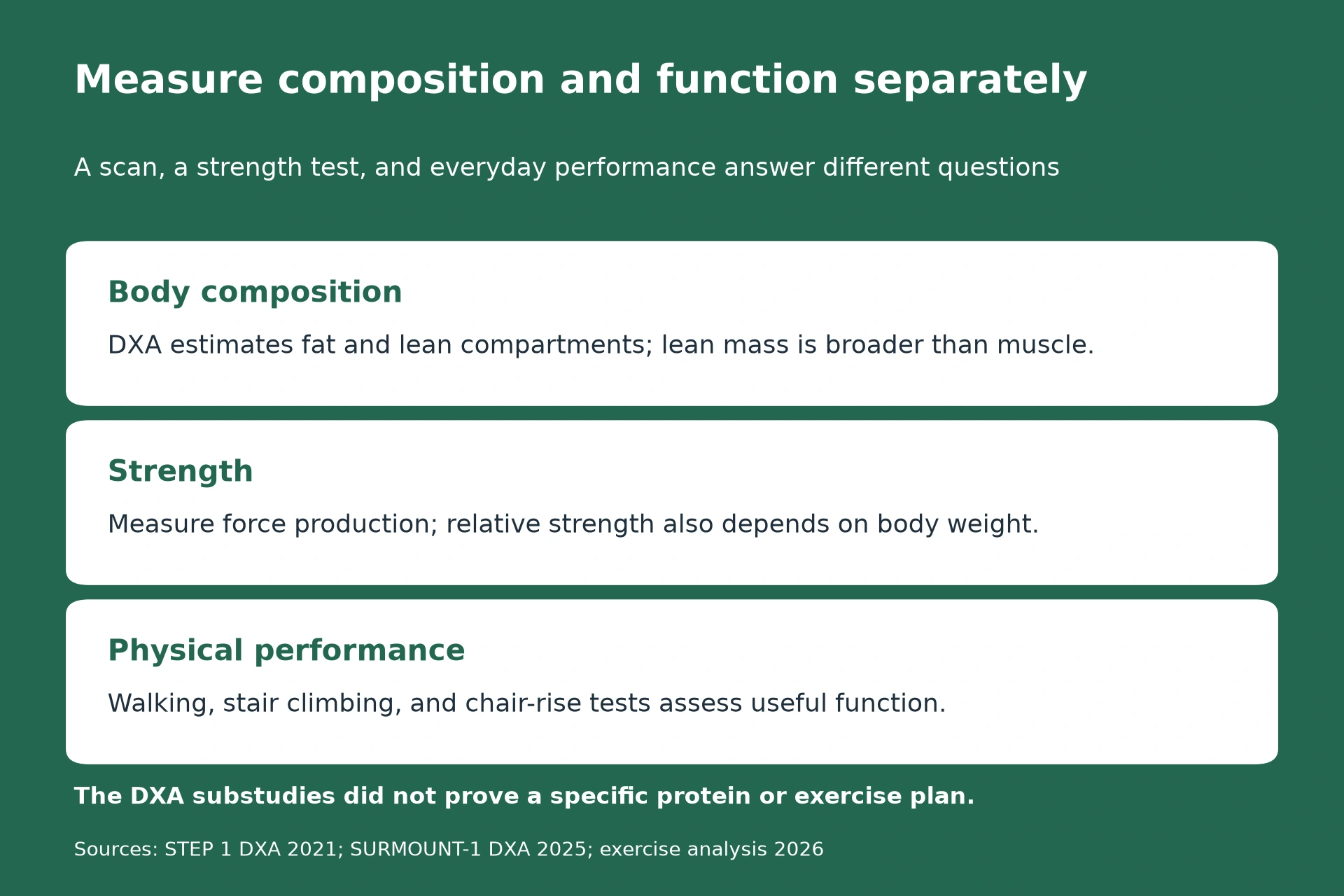
Lean mass is broader than skeletal muscle. It includes water and other nonfat soft tissues, including organs. A change in DXA lean mass is therefore informative, but it is not an anatomical inventory of contractile muscle fibers and does not directly tell us how strong someone is.
Strength and function require their own measurements, such as force production, walking performance, stair climbing, or the ability to rise from a chair. Someone may have a higher proportion of lean mass after losing more fat while still having less lean mass in absolute terms. These are different statements that can both be true.
Our practical guides to semaglutide, protein, and muscle and tirzepatide, protein, and muscle focus on follow-up questions. Here, we examine what the studies actually measured.
STEP 1: the semaglutide body-composition report
An exploratory STEP 1 analysis used DXA in 140 participants, with 95 assigned semaglutide and 45 placebo. Participants came from selected sites and had a BMI no higher than 40 for substudy eligibility. The average BMI was 34.8, and 76% were women. Original STEP 1 DXA report.
An important evidence-quality detail: this report was published as a conference-supplement abstract, not as a full-length body-composition paper with the same methodological detail as the later tirzepatide report. It is original research, but readers should know the format and the limits of the information available.
Over 68 weeks, average weight change was −15.0% with semaglutide versus −3.6% with placebo. In the semaglutide group, total fat mass fell 19.3%, regional visceral fat mass fell 27.4%, and total lean body mass fell 9.7% from their respective baseline values.
These percentages use different compartments as their denominators. A 19.3% reduction in starting fat mass and a 9.7% reduction in starting lean mass do not mean that 19.3% and 9.7% of all lost weight came from those compartments.
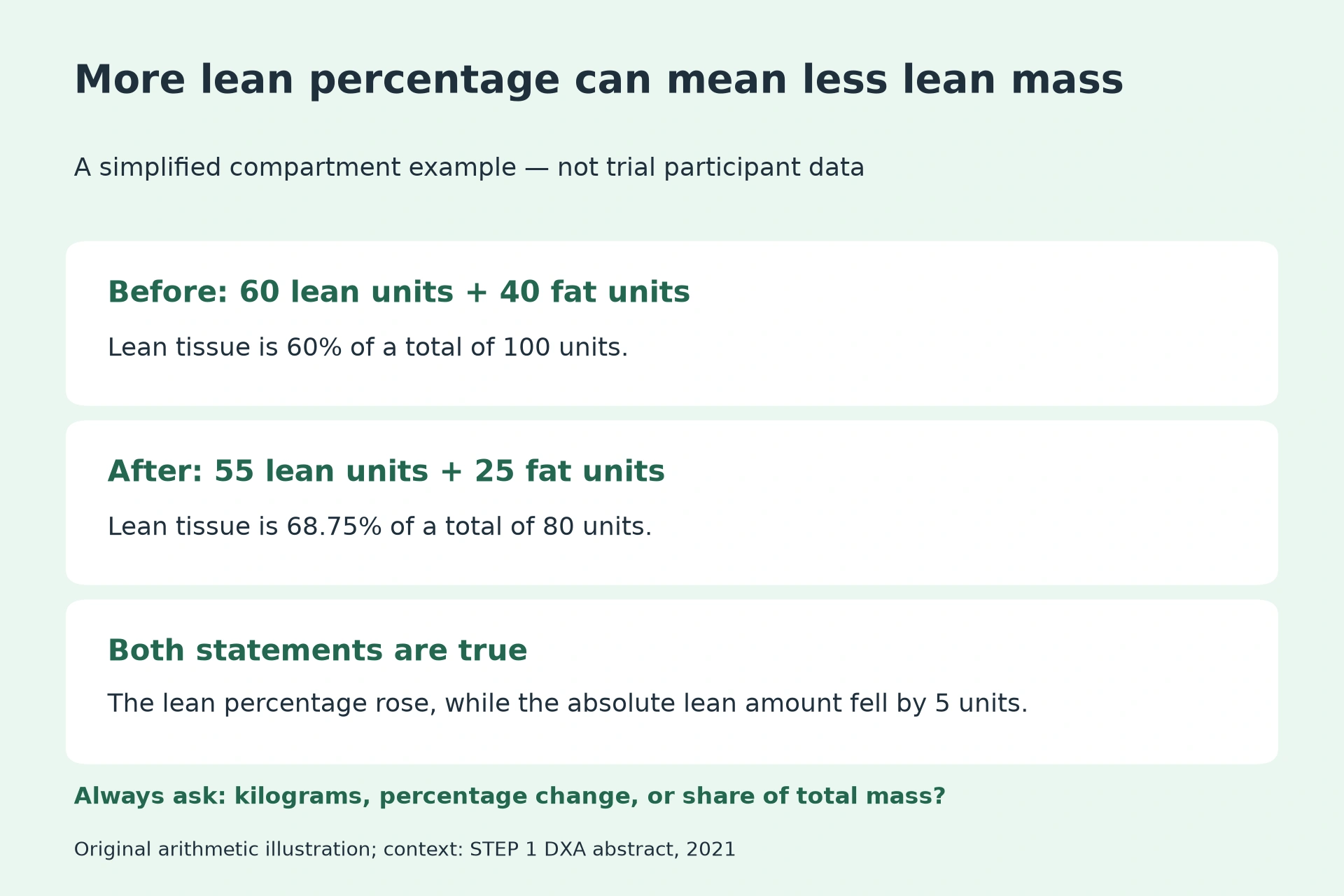
How could the lean-mass proportion increase if lean mass fell?
In the semaglutide analysis, the proportion of body mass classified as lean increased by 3.0 percentage points even though absolute lean mass declined. This can happen when fat mass decreases proportionally more.
Consider a simplified illustration: a person with 60 units of lean tissue and 40 units of fat has 60% lean tissue. If they lose 5 lean units and 15 fat units, they have 55 lean units out of 80 total, or 68.75%. Their lean percentage rose, while the absolute amount of lean tissue fell. This example explains the arithmetic; it is not a reconstruction of STEP 1 or an individual’s DXA scan.
A favorable ratio therefore should not be used to claim “no lean tissue was lost.” Equally, an absolute decline should not be used alone to claim someone has become weaker. Both require context and, ideally, functional assessment.
SURMOUNT-1: the tirzepatide DXA substudy
The 2025 body-composition report included 160 participants with baseline and end-of-study DXA data: 124 receiving pooled tirzepatide doses and 36 receiving placebo. They represented a small subset of the larger 2,539-participant SURMOUNT-1 trial. The substudy was 73% female, with mean weight 102.5 kg and BMI 38.0. Original SURMOUNT-1 DXA paper.
At week 72, changes from baseline were:
| Measurement | Tirzepatide | Placebo |
|---|---|---|
| Body weight | −21.3% | −5.3% |
| Fat mass | −33.9% | −8.2% |
| Lean mass | −10.9% | −2.6% |
Again, each percentage is a change relative to that measure’s own starting value. The authors also examined the composition of the total weight lost, a separate calculation. Approximately 75% was fat mass and 25% lean mass in both groups.
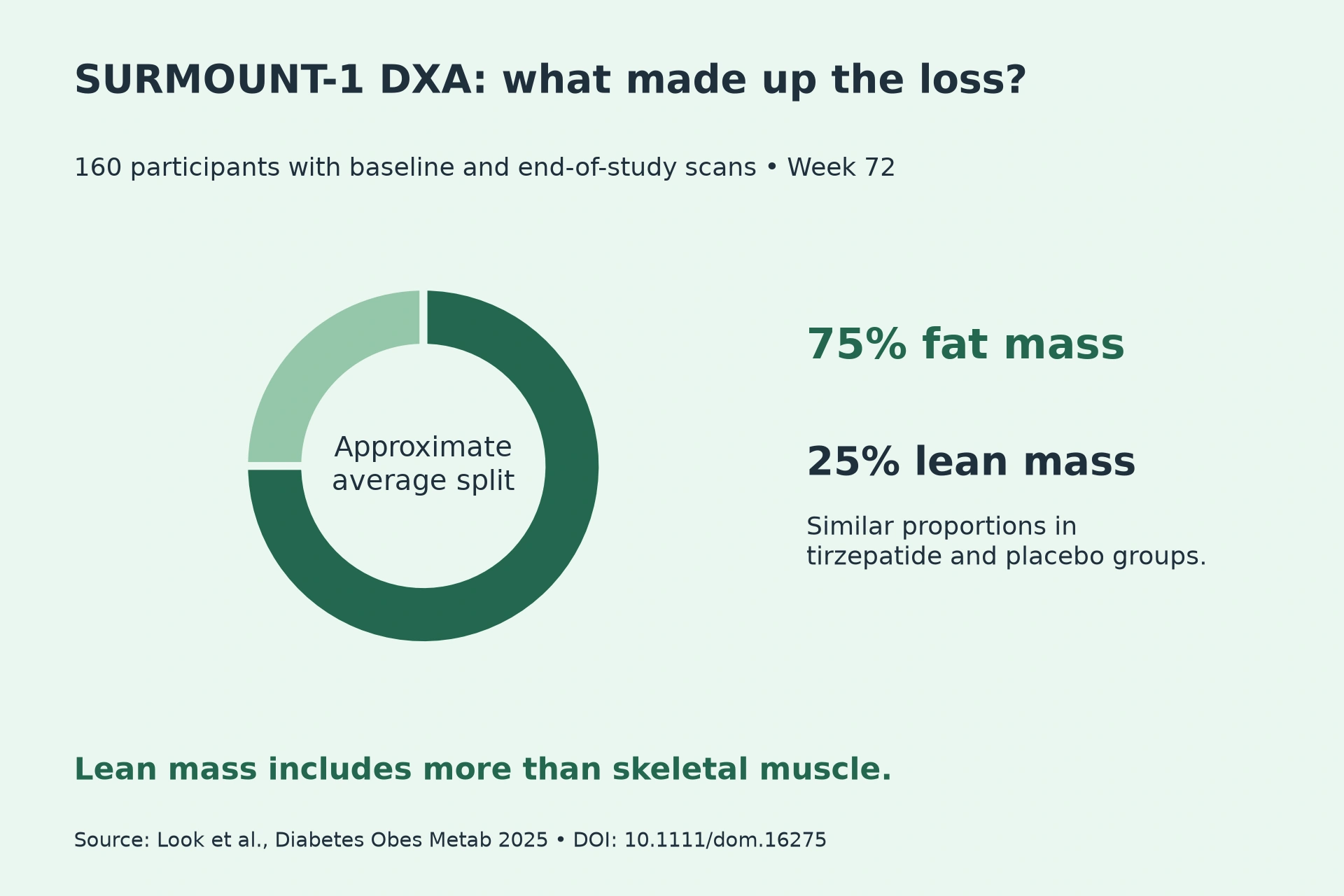
That 75/25 split is an average summary in this substudy. It is not a guarantee for every person, an ideal target, or evidence that exactly one-quarter of every person’s weight loss is skeletal muscle. The distinction between lean mass and muscle still applies.
What the tirzepatide report did not measure
The authors noted that their analysis did not evaluate physical activity and nutrient intake in relation to DXA changes. They also called for research using direct functional outcomes, such as physical-performance testing or sit-to-stand measures.
The substudy therefore cannot prove which specific protein intake or resistance-training program prevented lean loss, because those were not randomized interventions in this analysis. It also cannot establish from DXA alone whether an individual developed clinically important weakness or sarcopenia.
Post hoc analyses examined age, sex, and weight-loss categories. Some subgroups were very small. For example, certain placebo subgroups contained fewer than a dozen participants, making unusual observations capable of moving an average substantially. The authors cautioned against overinterpreting apparent subgroup differences. Methods and limitations.
Can these studies tell us which medicine preserves muscle better?
No reliable head-to-head conclusion follows from placing the STEP 1 and SURMOUNT-1 DXA numbers side by side. The reports differed in eligibility, duration, weight loss, sample size, analysis, and publication format. Participants were not randomized between semaglutide and tirzepatide in these two substudies.
The semaglutide report’s 9.7% lean-mass decline and tirzepatide report’s 10.9% decline are not a valid proof that one drug causes more muscle loss than the other. They describe different selected groups, and neither figure is a direct muscle-strength result.
For the broader choice between medications, see our semaglutide and tirzepatide comparison. Choosing treatment requires more than a numerical comparison across unrelated substudy tables.
What exercise trials add to the picture
A 2021 randomized trial studied adults with obesity who first completed an eight-week low-calorie diet. The 195 randomized participants then received a supervised exercise program, liraglutide, both together, or placebo with usual activity for one year. The combination produced favorable weight-maintenance and body-fat outcomes. Original exercise and liraglutide trial.
This was liraglutide, a different GLP-1 receptor agonist, and a weight-maintenance study after diet-induced loss. It was not a trial of adding resistance training to semaglutide or tirzepatide. Its value here is that it deliberately tested an exercise strategy alongside pharmacotherapy instead of merely assuming what participants did.
A 2026 secondary analysis from the same research program examined stair climbing, cardiorespiratory fitness, and knee-extensor strength. It found that exercise alone and exercise combined with liraglutide improved fitness-related outcomes more than liraglutide alone. The combined group completed the stair-climb test 1.2 seconds faster than the liraglutide-only group, with a confidence interval of 0.6–1.9 seconds. Original physical-fitness analysis.
This is not an independent second randomized cohort. It is another analysis of the same trial program, answering a different question. Its importance is conceptual as well as practical: body weight, body composition, and functional performance need not change in exactly the same way.
Why function should be followed separately
The 2026 analysis also distinguished absolute strength from strength relative to body weight. Relative strength can improve when a person carries less body weight while preserving absolute force production. That is different from building more absolute muscle strength.
For a patient, meaningful progress might include carrying groceries more comfortably, rising from a chair, maintaining walking distance, or recovering from activity. These observations are not substitutes for formal clinical testing when needed, but they can help a clinician decide what deserves assessment.
Our HFpEF trial review includes six-minute walking outcomes, while the STEP 9 knee-pain review includes physical-function scores. Those disease-specific studies further illustrate why “lost weight” and “functions better” should be measured separately.
Practical questions for nutrition and activity planning
A clinician or registered dietitian can help assess whether food intake is sufficient and appropriate for the person’s kidney function, age, activity, and other conditions. A universal protein number is not a substitute for that assessment. Severe appetite suppression, persistent nausea, or a very restrictive diet can make adequate intake harder.
Exercise planning should consider pain, balance, cardiovascular limitations, previous activity, and access to suitable support. New or worsening weakness, falls, difficulty rising, or a clear decline in daily function deserves attention even when weight loss is otherwise proceeding as intended.
Ask how the plan will be adjusted if treatment reduces appetite so much that meals become difficult. Our semaglutide nausea guide and tirzepatide nausea guide address symptoms that can interfere with nutrition. The weight-regain evidence review explains why long-term planning also matters.
CoreAge Rx’s semaglutide and tirzepatide information pages can support a discussion about treatment and follow-up. Neither these products nor a supplement should be presented as guaranteed to preserve muscle on the basis of the DXA studies.
Watch: Mayo Clinic on nutrition during GLP-1 treatment
Mayo Clinic’s discussion with a registered dietitian and physician covers nutrition, side effects, and muscle preservation. The muscle-loss discussion begins around 9:55, and protein intake around 16:25. This is clinical education; it is not an additional randomized DXA trial.
Common questions about lean mass and muscle
Does losing lean mass automatically mean I have sarcopenia?
No. Sarcopenia is a clinical muscle-health condition that requires more than a single change in total DXA lean mass. Strength, performance, body composition, and the clinical setting all contribute to assessment.
Does an increasing lean percentage prove muscle was preserved?
No. The percentage can rise because fat fell faster, even while absolute lean mass declined. Ask whether a result is reported in kilograms, percentage change from baseline, or percentage of total body mass.
Is the 75/25 ratio the same for everyone?
No. It is an average from a selected tirzepatide substudy and was also approximately observed in its placebo group. Individual changes can differ, and lean mass is not synonymous with skeletal muscle.
Have these studies proven the best protein or exercise prescription?
No. The DXA substudies did not randomize specific nutrition or exercise programs. The liraglutide exercise trial provides related evidence, but its regimen and population cannot simply be transferred as a guaranteed result with another medicine.
What is the most useful takeaway?
Substantial weight loss can include both fat and lean mass. Follow the quality of weight loss as well as its quantity, with nutrition, activity, and functional changes considered alongside the scale.
Original papers and supporting sources
The references distinguish full research papers, published abstracts, and official guidance. This educational narrative review is not a systematic review or an individual treatment recommendation. Sources were checked in October 2026.
- Wilding JPH et al. Impact of Semaglutide on Body Composition in Adults With Overweight or Obesity: Exploratory Analysis of the STEP 1 Study (2021). Original conference-supplement abstract. DOI: 10.1210/jendso/bvab048.030.
- Look M et al. Body composition changes during weight reduction with tirzepatide in the SURMOUNT-1 study of adults with obesity or overweight. (2025). Full text reviewed. DOI: 10.1111/dom.16275. Open full text.
- Lundgren JR et al. Healthy Weight Loss Maintenance with Exercise, Liraglutide, or Both Combined. (2021). Published abstract reviewed. DOI: 10.1056/nejmoa2028198.
- Jensen SBK et al. Physical Fitness with Exercise and GLP-1 Receptor Agonist Treatment Alone or Combined After Diet-Induced Weight Loss: A Secondary Analysis of a Randomized Controlled Trial in Adults with Obesity. (2026). Published abstract reviewed. DOI: 10.1007/s40279-025-02386-0.