Heart failure can occur even when the heart’s ejection fraction is preserved. In this form of disease, usually shortened to HFpEF, a seemingly reassuring pumping percentage does not mean that filling pressures, breathing, exercise tolerance, or daily function are normal.
For people who also have obesity, recent semaglutide and tirzepatide trials have added an important line of evidence. The studies asked overlapping but different questions: can treatment improve symptoms and physical limitations, and can it reduce worsening heart-failure events?
What does “preserved ejection fraction” mean?
Ejection fraction describes the proportion of blood in a ventricle that is pumped out with each contraction. It is one measurement of heart function. People with HFpEF may have difficulty with the heart relaxing and filling, and can experience congestion, breathlessness, reduced exercise capacity, and fatigue despite a preserved fraction.
This distinction matters for interpreting research. A study in obesity-related HFpEF is not automatically evidence for every form of heart failure, including heart failure with reduced ejection fraction. Nor does shortness of breath in a person with obesity establish HFpEF. The diagnosis requires clinical assessment, often including imaging and other testing.
Our semaglutide and heart-health research article addresses cardiovascular-event trials such as SELECT and SOUL. The studies below focus on an established heart-failure syndrome and its burden.
STEP-HFpEF: what semaglutide changed after one year
The 2023 STEP-HFpEF trial randomized 529 participants with HFpEF and a BMI of at least 30 to once-weekly semaglutide 2.4 mg or placebo for 52 weeks. The population did not have diabetes. Its two main outcomes were change in body weight and change in the Kansas City Cardiomyopathy Questionnaire clinical summary score, or KCCQ-CSS. Original STEP-HFpEF paper.
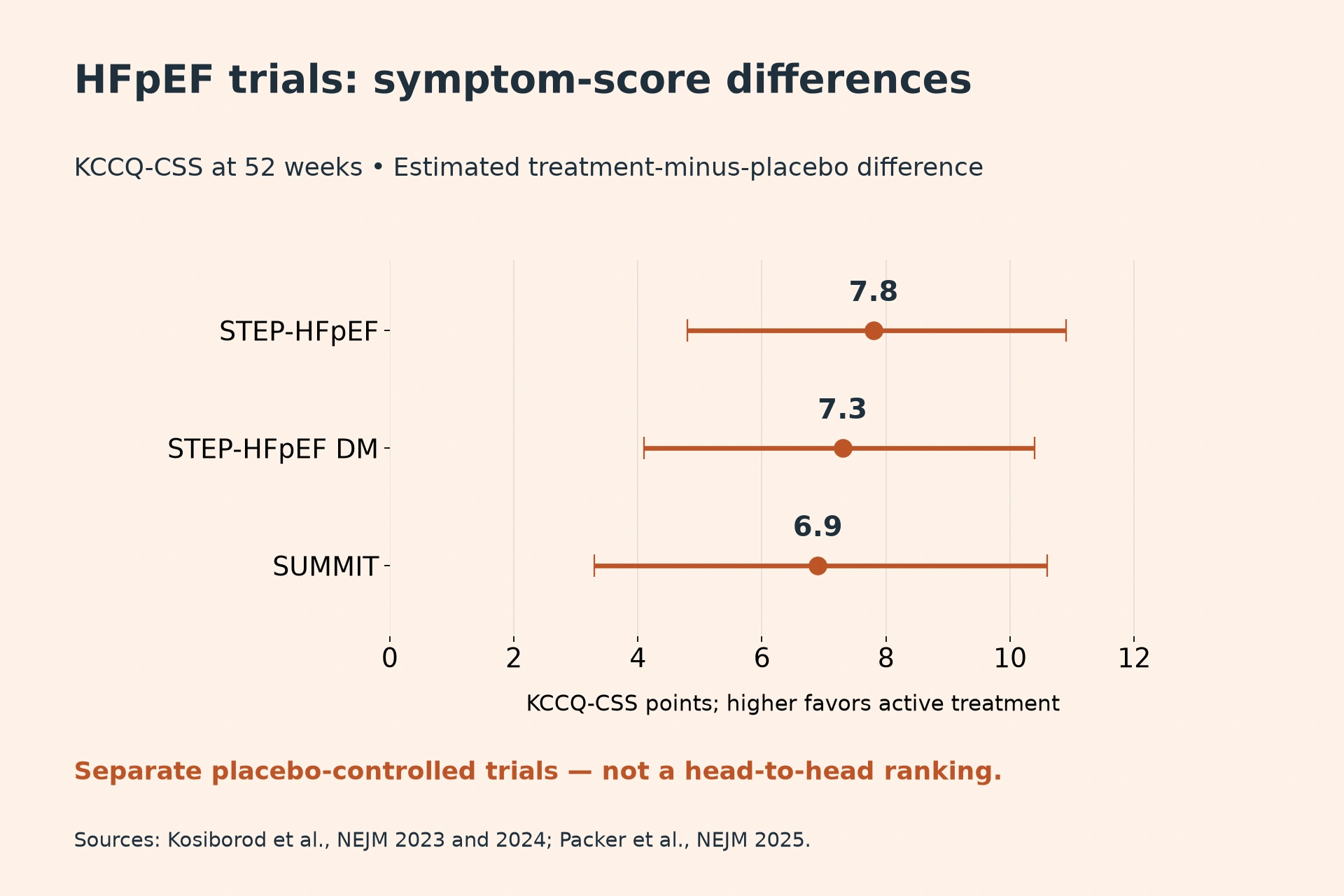
KCCQ-CSS runs from 0 to 100; a higher score reflects fewer symptoms and physical limitations. Semaglutide participants improved by an average 16.6 points, compared with 8.7 points on placebo. The trial’s estimated between-group difference was 7.8 points, with a 95% confidence interval of 4.8–10.9.
That is not the same as saying all participants improved by 7.8 points, or that symptoms disappeared. Both groups improved on average, and the estimate describes the additional average benefit attributed to assignment to semaglutide.
Average weight change was −13.3% with semaglutide versus −2.6% with placebo. The six-minute walk distance also improved more with semaglutide: an estimated between-group difference of 20.3 meters. These outcomes connect the study to experiences people notice, such as walking and activity, rather than only a laboratory marker.
STEP-HFpEF DM: a separate trial in type 2 diabetes
The 2024 companion trial enrolled 616 participants with HFpEF, obesity, and type 2 diabetes. It also compared weekly semaglutide 2.4 mg with placebo over 52 weeks. Original STEP-HFpEF DM report.
KCCQ-CSS improved by 13.7 points with semaglutide and 6.4 with placebo. The estimated difference was 7.3 points, with a confidence interval of 4.1–10.4. Weight change was −9.8% versus −3.4%, and the estimated difference in six-minute walk improvement was 14.3 meters.
This is useful because it tests a related clinical population directly rather than assuming that a no-diabetes trial answers every diabetes question. The smaller weight difference in this trial should not be read as a personalized prediction or an informal competition between the two trial populations.
How should the symptom findings be interpreted?
The two STEP trials support improvements in heart-failure-related symptoms, physical limitations, and weight in the populations studied. They also reported favorable secondary analyses. But their primary design centered on symptom scores and weight over one year, not a definitive mortality trial.
Both used a hierarchical composite analysis that could incorporate death, heart-failure events, symptoms, and walking distance. A favorable result on such a combined ranking should not be rewritten as a separately established reduction in cardiovascular death. Combining outcomes is a statistical strategy; it does not make every component individually proven.
Both studies were funded by Novo Nordisk. Randomization and placebo control strengthen the comparison, while sponsorship, eligibility rules, duration, and endpoint selection still belong in the appraisal. The goal is to understand what was tested, not to dismiss or exaggerate the result.
SUMMIT: tirzepatide and worsening heart-failure events
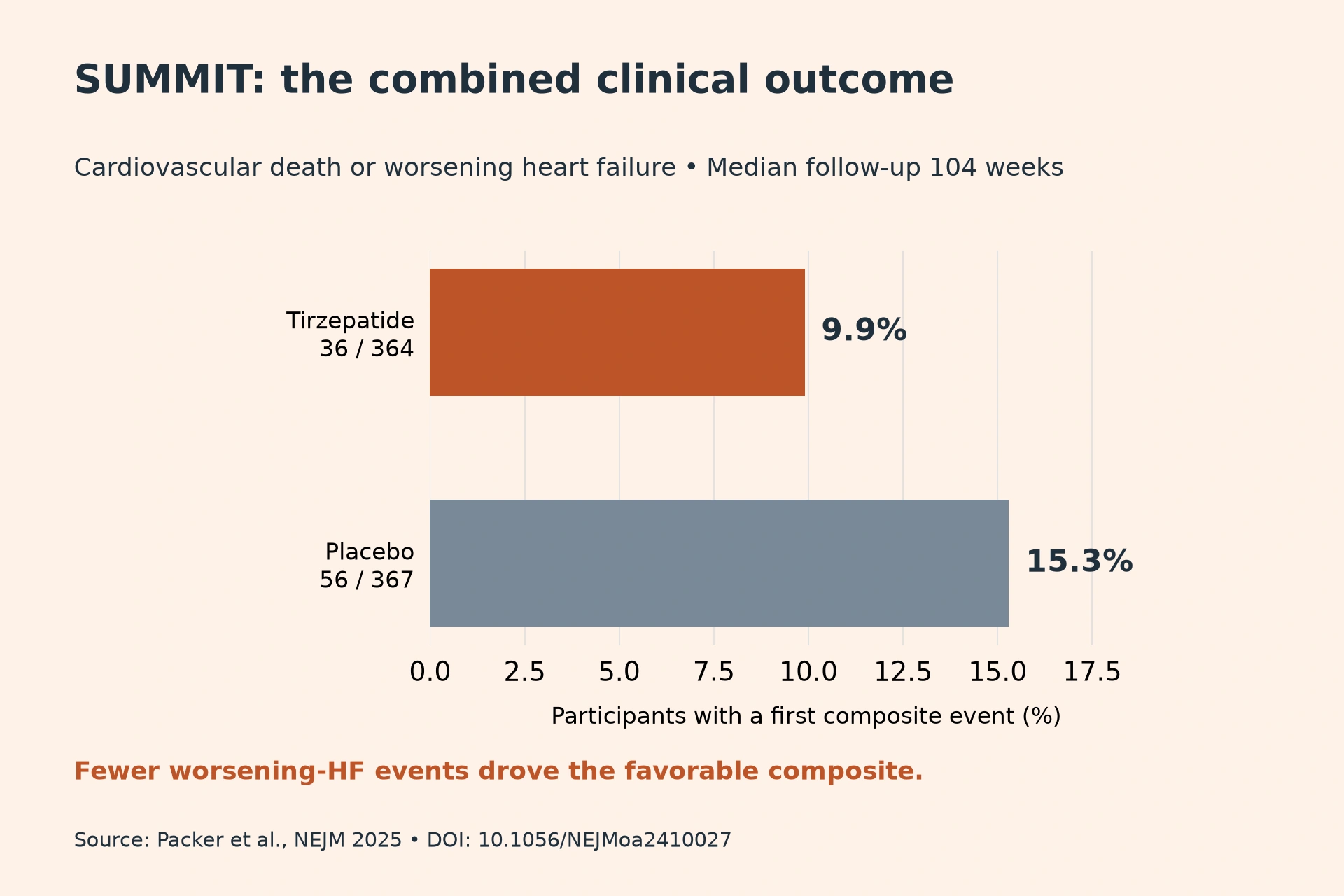
SUMMIT randomized 731 people with heart failure, an ejection fraction of at least 50%, and a BMI of at least 30. There were 364 participants assigned tirzepatide, up to 15 mg weekly, and 367 assigned placebo. Median follow-up was 104 weeks. Eli Lilly funded the study. Original SUMMIT paper.
One primary outcome was the first occurrence of cardiovascular death or a worsening heart-failure event. It occurred in 36 participants, or 9.9%, with tirzepatide, compared with 56 participants, or 15.3%, with placebo. The hazard ratio was 0.62, with a 95% confidence interval of 0.41–0.95.
The simple difference between the reported proportions is 5.4 percentage points. The often-quoted 38% relative reduction comes from the hazard ratio and answers a different statistical question. Neither is a promise for an individual person, and neither should be described as a 38-percentage-point reduction.
Why the separate components matter
Worsening heart-failure events occurred in 29 tirzepatide participants, or 8.0%, versus 52 placebo participants, or 14.2%. Cardiovascular deaths occurred in eight, or 2.2%, versus five, or 1.4%, respectively.
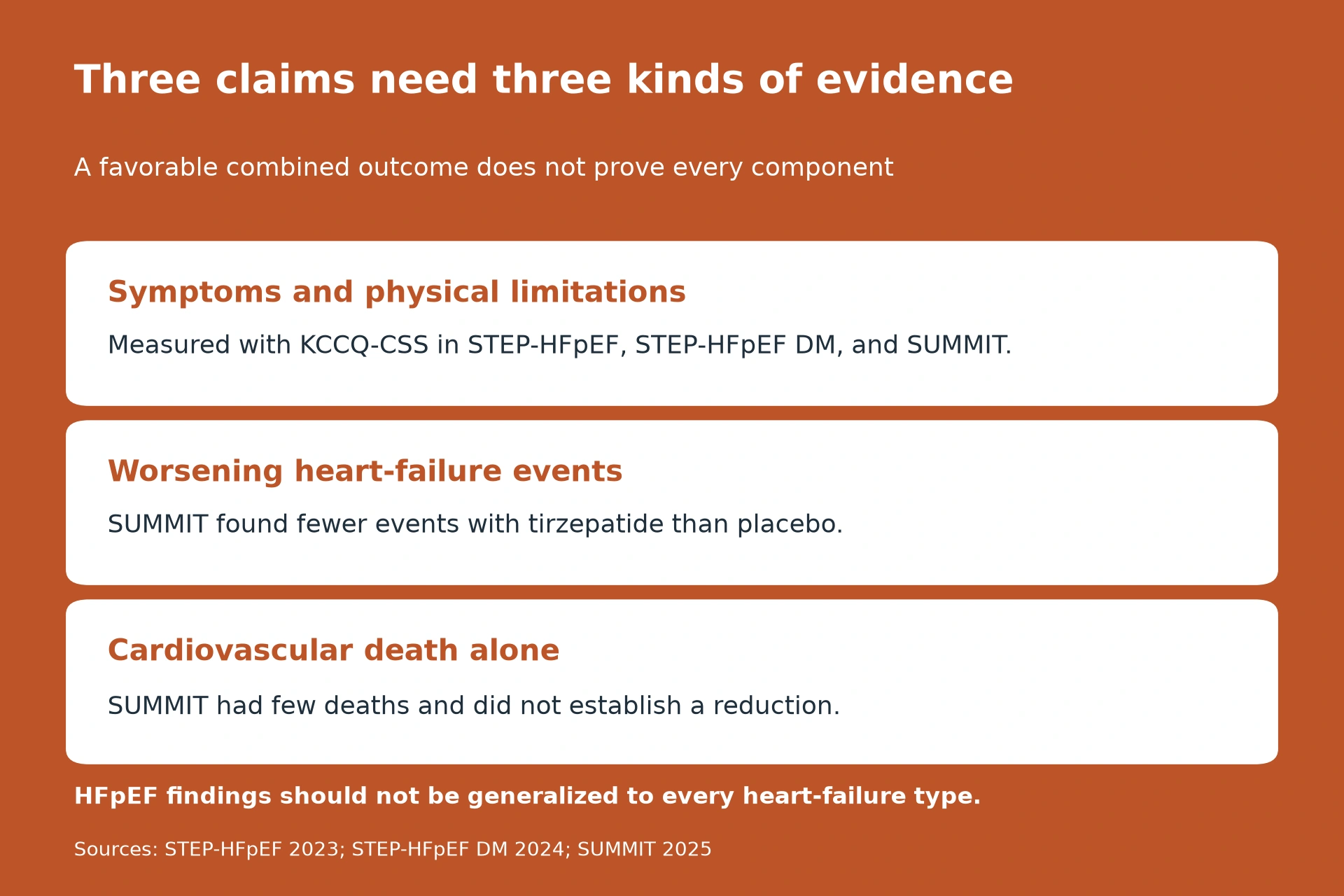
The cardiovascular-death hazard ratio was 1.58 with a very wide confidence interval, 0.52–4.83. The number of deaths was small. These data do not establish a mortality benefit, and they also do not establish a precise harmful effect on mortality. The defensible conclusion is that the favorable composite result was driven by fewer worsening heart-failure events, while the death-only estimate remained uncertain.
The composite counts people at their first qualifying event. Its components should not simply be added to reproduce the total, because a participant can experience more than one kind of event over follow-up. That is another reason to read the endpoint definition rather than manipulate the percentages as interchangeable quantities.
Did people feel better as well?
SUMMIT’s other primary outcome was change in KCCQ-CSS at 52 weeks. The mean improvement was 19.5 points with tirzepatide and 12.7 with placebo, with an estimated between-group difference of 6.9 points and a confidence interval of 3.3–10.6.
Thus the trial supported both a favorable combined clinical-event result and better reported health status. Those are complementary outcomes. Neither means the underlying heart failure was cured or that other heart-failure medicines could be removed.
The three trials at a glance
| Study | Participants | Duration used here | Main contribution |
|---|---|---|---|
| STEP-HFpEF | 529; HFpEF and obesity without diabetes | 52 weeks | Symptoms, physical limitations, weight, and walking performance |
| STEP-HFpEF DM | 616; HFpEF, obesity, and type 2 diabetes | 52 weeks | Similar symptom-focused question in a diabetes population |
| SUMMIT | 731; HFpEF and obesity | Median 104-week follow-up; symptom score at 52 weeks | Cardiovascular death/worsening-HF composite and health status |
These studies do not establish which medicine is better for a particular person with HFpEF. They used different populations, follow-up periods, and endpoint designs. Comparing 7.8 KCCQ points in one study with 6.9 in another is not a randomized head-to-head test.
Our semaglutide versus tirzepatide guide explains why treatment selection also includes approved indications, tolerability, access, and the rest of a person’s health history.
What this research does not justify
The trials do not justify diagnosing HFpEF from symptoms alone, treating sudden breathlessness as a weight issue, or independently replacing diuretics and other prescribed heart medicines. They also do not show that every formulation containing semaglutide or tirzepatide reproduces the studied outcomes.
People with heart failure may have specific fluid, blood-pressure, and kidney-monitoring needs. Gastrointestinal side effects can complicate that picture when intake falls or vomiting and diarrhea occur. A clinician may need to review the whole regimen rather than treat each prescription in isolation.
Adverse events leading to trial-drug discontinuation in SUMMIT occurred in 6.3% of tirzepatide participants and 1.4% of placebo participants, mainly because of gastrointestinal effects. Treatment benefit and tolerability both matter. Our guides to semaglutide nausea and vomiting and tirzepatide nausea and reflux offer questions to raise at follow-up.
How do kidney disease, sleep apnea, and muscle health fit?
HFpEF rarely exists in isolation. The FLOW kidney-trial review examines a separate semaglutide population with diabetes and chronic kidney disease. The SURMOUNT-OSA review explains tirzepatide’s sleep-apnea evidence. Neither substitutes for the HFpEF trials, but each can inform a different part of a coordinated evaluation.
Function also deserves attention during weight loss. Better walking performance does not mean that every aspect of muscle health has been measured. Our lean-mass evidence review separates body-composition scans from strength and physical performance.
If you are considering CoreAge Rx’s semaglutide or tirzepatide services, ask about the exact product and how any obesity treatment would be coordinated with the clinician managing your heart failure. A trial result is not an individualized prescription or a guarantee of eligibility.
Watch the publisher’s SUMMIT summary
NEJM’s video introduces SUMMIT and its main outcomes. Keep the distinction between the composite and cardiovascular death alone in mind while watching.
Questions for a heart-failure appointment
- What evidence confirms my heart-failure diagnosis and type?
- How closely do I resemble the participants in these trials?
- Which target matters most in my case: congestion, activity tolerance, symptoms, weight, or future events?
- How would treatment fit with my current medicines and kidney function?
- What symptoms, blood-pressure changes, or problems eating and drinking should trigger contact?
- How will we measure progress beyond the scale?
Common questions about GLP-1 medicines and HFpEF
Does a normal ejection fraction rule out heart failure?
No. Ejection fraction is only one part of the assessment. A preserved value can coexist with clinically important heart failure. A qualified clinician needs to interpret symptoms, examination findings, imaging, and other tests together.
Did SUMMIT prove that tirzepatide prevents cardiovascular death?
No. It reduced the combined outcome of cardiovascular death or worsening heart failure, with the benefit driven by fewer worsening events. Deaths alone were too few for a precise conclusion and were not lower in the tirzepatide group.
Can I compare the percentages to choose a medication?
Not reliably across these separate trials. A head-to-head trial would be needed for a direct causal comparison. Individual treatment decisions also depend on the exact diagnosis, formulation, tolerability, and current product labeling.
Can weight loss replace heart-failure care?
No. The useful takeaway is that obesity treatment may contribute to care for selected people with HFpEF. New or worsening breathlessness, chest pain, fainting, or rapidly worsening swelling requires medical evaluation, not a wait for weight loss to work.
Original papers and supporting sources
The references distinguish full research papers, published abstracts, and official guidance. This educational narrative review is not a systematic review or an individual treatment recommendation. Sources were checked in October 2026.
- Kosiborod MN et al. Semaglutide in Patients with Heart Failure with Preserved Ejection Fraction and Obesity. (2023). Published abstract reviewed. DOI: 10.1056/nejmoa2306963.
- Kosiborod MN et al. Semaglutide in Patients with Obesity-Related Heart Failure and Type 2 Diabetes. (2024). Published abstract reviewed. DOI: 10.1056/nejmoa2313917.
- Packer M et al. Tirzepatide for Heart Failure with Preserved Ejection Fraction and Obesity. (2025). Published abstract reviewed. DOI: 10.1056/nejmoa2410027.