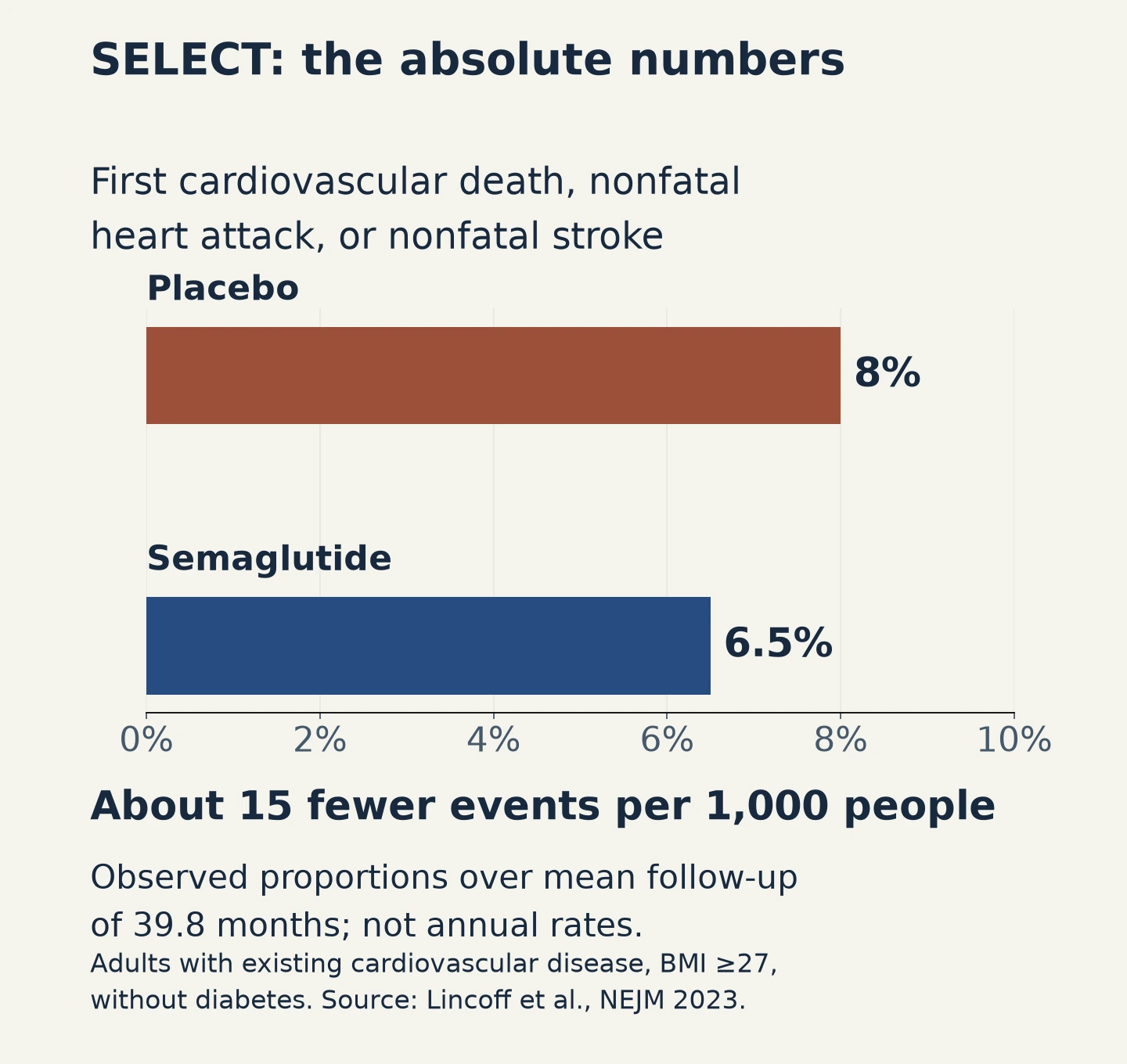
Semaglutide has evidence for reducing serious cardiovascular events in specific groups of adults. The clearest study in people without diabetes is SELECT: among adults with established cardiovascular disease and overweight or obesity, a first cardiovascular death, nonfatal heart attack, or nonfatal stroke occurred in 6.5% receiving semaglutide versus 8.0% receiving placebo during an average 39.8 months of follow-up. Both groups also received usual cardiovascular care. SELECT paper.
That result is meaningful, but its meaning depends on the details. It is evidence about preventing another major event in a population already at elevated risk. It does not mean everyone taking any semaglutide preparation has a 20% chance of avoiding a heart attack.
This guide walks through the original trial, two later analyses of the same participants, and a separate oral semaglutide trial. You can watch the research videos, inspect the numbers, and follow the papers yourself.
- SELECT found fewer major cardiovascular events with the studied weekly semaglutide regimen.
- The headline 20% describes a relative reduction in the hazard of the combined outcome; the observed difference in event proportions was about 1.5 percentage points.
- The trial studied people with existing cardiovascular disease, not a general population trying to prevent its first heart problem.
- Benefits, tolerability, the exact product, and ongoing cardiovascular care all belong in the treatment decision.
What did the SELECT trial actually test?
SELECT was a randomized, double-blind trial involving 17,604 adults at 804 sites across 41 countries. Random assignment helps create comparable treatment groups; blinding means participants and investigators did not know the assigned treatment. Those features make the study stronger evidence of a treatment effect than comparing people who independently chose to take or avoid a medicine. Trial methods.
Participants were at least 45 years old, had a body mass index of at least 27, and had established cardiovascular disease. Qualifying disease included a previous heart attack, previous stroke, or symptomatic peripheral arterial disease—impaired blood flow in arteries outside the heart. People with a history of diabetes were excluded. The mean age was about 62, and approximately 72% were men.
Researchers compared weekly injected semaglutide, increased toward a target dose of 2.4 mg, with matching placebo. Treatment adjustments were allowed for tolerability. This describes the research regimen; it is not a starting-dose instruction. People remained eligible for the main analysis even if they stopped their assigned treatment, an approach called intention to treat.
The question was whether adding semaglutide to cardiovascular care reduced a major event. Around 90% of participants already used lipid-lowering medication, and many used other cardiovascular medicines. SELECT therefore supports an additional treatment option within care, not replacing a statin, blood-pressure treatment, or another prescribed medicine. SELECT baseline treatment and analysis.
Why the combined outcome matters
The primary outcome combined three events: cardiovascular death, nonfatal myocardial infarction (heart attack), and nonfatal stroke. Researchers measured the time to a person’s first event in that combination, often called three-point MACE, for major adverse cardiovascular events.
A combined outcome can reveal a treatment effect efficiently, but it does not show that every component improved by the same amount. In SELECT, cardiovascular death alone occurred in 2.5% versus 3.0%; its hazard ratio was 0.85, with a 95% confidence interval of 0.71–1.01. That comparison did not meet the trial’s required statistical threshold. The paper’s planned testing sequence also limits definitive claims about the later secondary outcomes. A headline saying “20% fewer heart-related deaths” would misstate the primary finding. SELECT results and statistical plan.
What does a 20% cardiovascular risk reduction mean?
The primary analysis reported a hazard ratio of 0.80, with a 95% confidence interval of 0.72–0.90. A hazard ratio compares how quickly first events occur during follow-up among people who have not yet had one. Here it is commonly described as a 20% relative reduction in the hazard of the combined cardiovascular outcome. It is not a 20-percentage-point reduction in the proportion of participants having an event.
The observed counts make the scale easier to see:
| SELECT result | Semaglutide | Placebo |
|---|---|---|
| Participants assigned | 8,803 | 8,801 |
| Participants with a first primary cardiovascular event | 569 | 701 |
| Observed proportion with an event | 6.5% | 8.0% |
8.0% minus 6.5% is 1.5 percentage points: about 15 fewer people with an event per 1,000 participants, using the rounded study proportions. This is a descriptive comparison over the trial’s follow-up, not an annual rate, a lifetime prediction, or a precise personal forecast. The time-to-event analysis and the simple subtraction answer related but slightly different statistical questions. Published counts and hazard ratio.
The confidence interval expresses uncertainty around the estimated hazard ratio. Because the entire interval is below 1, the main result supports a reduction in the combined outcome. It does not say that an individual patient’s benefit has a 95% probability of falling in that range.
Your starting risk matters. The same relative effect, if it applied, could produce a smaller absolute benefit in a lower-risk group. SELECT did not establish that its effect size transfers unchanged to people without existing cardiovascular disease.
Watch the research explained
A short journal overview
NEJM Group: “Semaglutide and Cardiovascular Outcomes in Obesity” is a roughly two-minute video accompanying the original research. Use it as a visual introduction to the study question and results, then return to the absolute numbers above. The video was published in December 2023; current prescribing information and the later papers below provide additional context.
A discussion with the SELECT investigator
Radcliffe Cardiology: “AHA 23 Late-Breaker Discussion: The SELECT Trial” features trial investigator A. Michael Lincoff of Cleveland Clinic in conversation with Harriette Van Spall of McMaster University. It was recorded at the 2023 American Heart Association Scientific Sessions. This is useful context from an investigator, with the original paper remaining the source for the exact methods and results. Publisher’s video page.
As you watch, keep three questions in mind: Who was enrolled? Was the outcome a heart attack or stroke, a blood test, or weight change? What was being added to existing care? Those questions make research videos easier to evaluate without relying on a headline alone.
Is the heart benefit simply a result of losing weight?
The main trial established that the assigned semaglutide strategy reduced major cardiovascular events. Establishing why that happened is a different research problem.
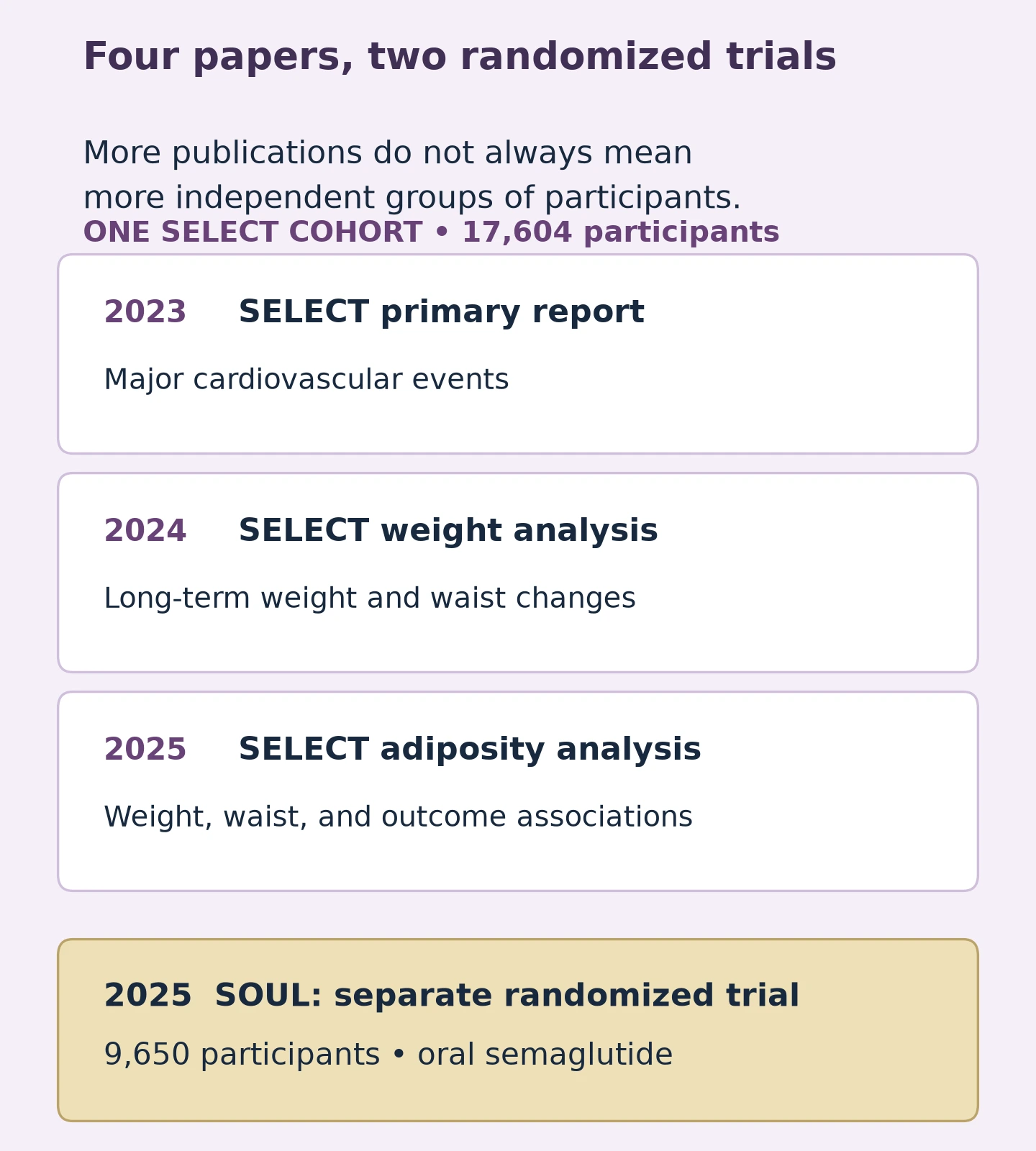
A 2024 analysis in Nature Medicine examined long-term weight and waist measurements in SELECT. At 208 weeks, the reported mean weight change was −10.2% with semaglutide and −1.5% with placebo in the in-trial analysis. This supports sustained average weight reduction during the study. It does not prove that weight loss caused the entire cardiovascular benefit. Nor does it mean every participant lost that amount or remained on medication for four years. Ryan and colleagues, 2024.
A 2025 prespecified analysis in The Lancet examined how body measurements related to cardiovascular outcomes. Benefits were consistent across baseline weight and waist-circumference categories. Among semaglutide recipients, the researchers found no linear relationship between the amount of weight lost by week 20 and subsequent MACE risk. Changes in waist circumference were more closely related to cardiovascular outcomes; a statistical mediation analysis estimated that waist reduction accounted for, or marked, about one-third of the observed benefit. Deanfield and colleagues, 2025.
That is evidence suggesting mechanisms beyond the number on the scale. It is not proof that weight is irrelevant or that a particular anti-inflammatory pathway explains the remaining benefit. Participants were randomized to medication, not to a particular amount of weight or waist reduction. Differences after randomization can reflect adherence, other illnesses, behavior, and other factors. The authors specifically identify this limitation: those analyses cannot prove the mechanism.
For readers, the practical distinction is that a modest change on the scale does not by itself settle whether treatment is meeting a cardiovascular goal. Decisions still require the relevant diagnosis, tolerability, and clinician follow-up. Our explanation of Wegovy and inflammation discusses why a biomarker change also cannot substitute for a clinical outcome.
What does the SOUL trial add about oral semaglutide?
SOUL, published in 2025, provides a separate randomized trial rather than another analysis of SELECT. It enrolled 9,650 adults aged 50 or older with type 2 diabetes and atherosclerotic cardiovascular disease, chronic kidney disease, or both. It compared daily oral semaglutide, up to 14 mg, with placebo in addition to standard care. McGuire and colleagues, SOUL.
Over an average 47.5 months of follow-up, a first major cardiovascular event occurred in 579 of 4,825 participants taking oral semaglutide (12.0%) and 668 of 4,825 receiving placebo (13.8%). The hazard ratio was 0.86, with a 95% confidence interval of 0.77–0.96.
These findings strengthen the evidence for oral semaglutide in the population and regimen studied. They do not provide a direct comparison with injected semaglutide. The higher observed event rates in SOUL do not mean tablets are less protective: participants, baseline risks, and follow-up differed.
| Question | SELECT | SOUL |
|---|---|---|
| Who participated? | Adults with established cardiovascular disease and BMI ≥27, without diabetes | Adults with type 2 diabetes and atherosclerotic cardiovascular disease, chronic kidney disease, or both |
| What was studied? | Weekly injected semaglutide targeting 2.4 mg | Daily oral semaglutide up to 14 mg |
| Average follow-up | 39.8 months | 47.5 months |
| Primary event proportions | 6.5% versus 8.0% | 12.0% versus 13.8% |
| Main comparison | Semaglutide versus placebo, added to care | Semaglutide versus placebo, added to care |
The figures come from the SELECT paper and SOUL paper. Doses describe those trials and should not be converted between oral and injected products. Our oral semaglutide versus injections guide explains the product and administration differences.
Which semaglutide products have a cardiovascular indication?
The current U.S. Wegovy prescribing information reviewed for this article includes a cardiovascular risk-reduction indication for both Wegovy injection and Wegovy tablets in adults with established cardiovascular disease and overweight or obesity, alongside a reduced-calorie diet and increased physical activity. Wegovy prescribing information, section 1.
The approved indication and an individual trial’s design are not identical descriptions. SELECT directly tested the weekly injection regimen; SOUL tested a different oral regimen in people with type 2 diabetes. Neither should be described as a direct cardiovascular-outcomes trial of every current semaglutide presentation or dose.
For example, the current Wegovy label distinguishes the recommended cardiovascular-risk-reduction regimens from the higher injectable dose that can be used for weight reduction in some adults. Its recommended daily Wegovy tablet maintenance dose is also different from the oral dose studied in SOUL. A larger milligram number cannot be assumed to produce greater heart protection. Wegovy dosing and clinical studies, sections 2 and 14.
If your question is access, start with the diagnosis and exact formulation in our guide to getting a Wegovy prescription. An FDA-labeled use does not by itself guarantee a particular plan will pay; the GLP-1 insurance guide explains the separate coverage process.
Can compounded semaglutide claim the same cardiovascular results?
The cited trials do not establish equivalent cardiovascular outcomes for a particular compounded preparation. FDA explains that compounded drugs are not FDA approved and do not undergo its premarket review for safety, effectiveness, and quality. Evidence about a studied branded formulation should not be used to promise identical results from every product described as semaglutide. FDA explanation.
CoreAge Rx’s semaglutide service page describes a compounded offering. Readers considering that service should discuss its formulation and suitability with the prescribing clinician; this research article does not establish that offering as equivalent to Wegovy or as a proven cardiovascular-risk-reduction treatment.
How should benefits be weighed against side effects?
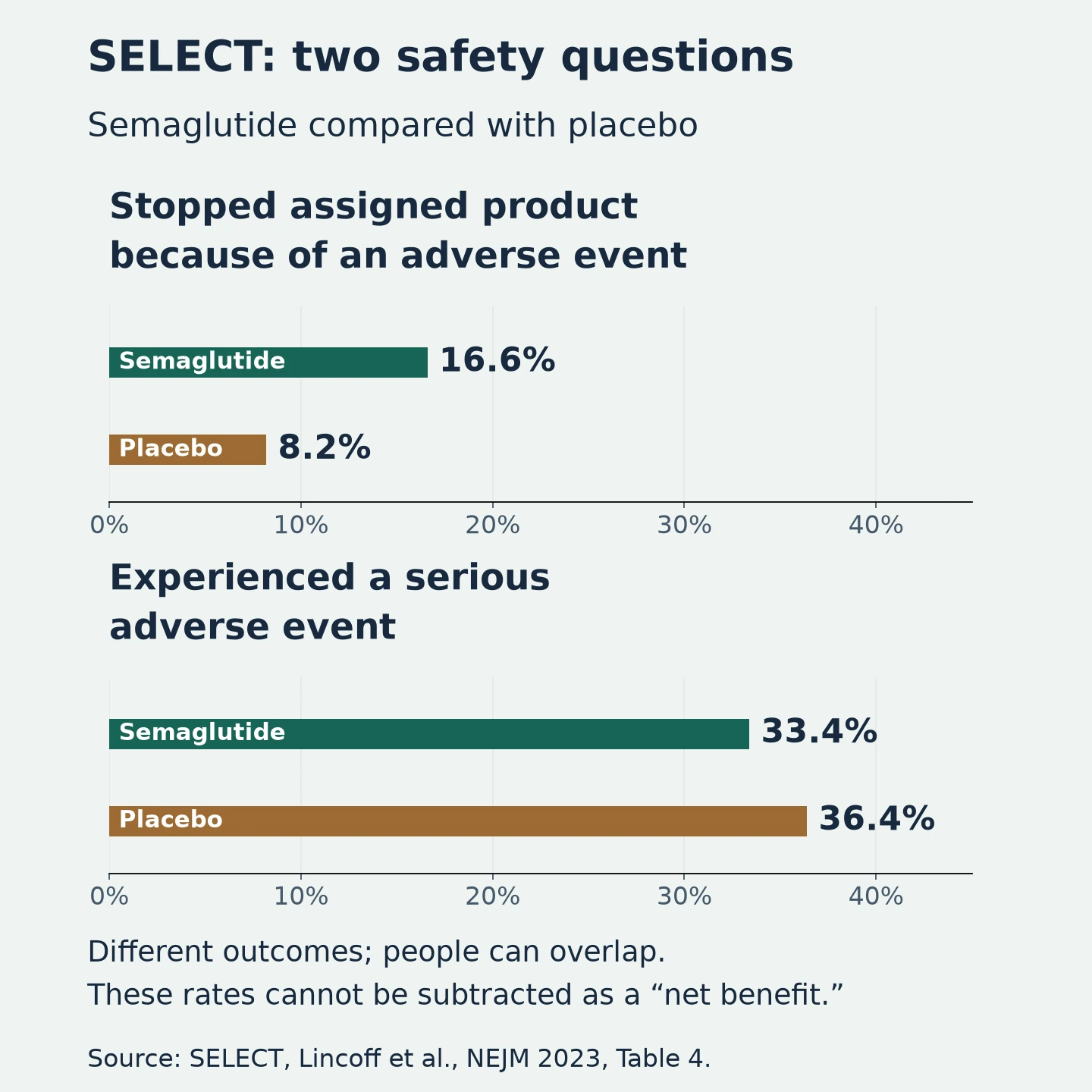
In SELECT, adverse events led to permanent discontinuation of the assigned product in 16.6% of semaglutide participants versus 8.2% of placebo participants. Gastrointestinal disorders accounted for much of the difference: discontinuation associated with those disorders occurred in 10.0% versus 2.0%. Tolerability was therefore a meaningful issue even in a trial with cardiovascular benefit. SELECT safety results.
At the same time, serious adverse events overall were reported in 33.4% versus 36.4%. These statistics answer different questions. “Stopped because of an adverse event” is not the same outcome as “experienced a serious adverse event,” and events recorded during a trial are not automatically caused by the medicine. It would be misleading to interpret the 16.6% figure as the rate of serious drug injury.
The current label also addresses pancreatitis, gallbladder disease, severe gastrointestinal reactions, kidney injury related to fluid loss, and heart-rate increases. It carries a boxed warning based on thyroid C-cell tumors in rodents; whether that finding applies to humans is unknown. Wegovy is contraindicated in people with a personal or family history of medullary thyroid carcinoma or multiple endocrine neoplasia syndrome type 2, and in people with a prior serious hypersensitivity reaction to semaglutide or its ingredients. Wegovy safety information.
Those are examples of why cardiovascular benefit does not establish suitability for every individual. The long-term Wegovy safety guide explains monitoring questions in more detail. Pregnancy plans, other prescriptions, eating and drinking difficulties, and upcoming procedures also belong in the clinical review.
A medicine can reduce long-term risk in a study while still requiring prompt assessment of new symptoms. The label instructs patients to report palpitations or a racing heartbeat at rest. Suspected heart-attack symptoms require emergency help; in the United States, call 911. Our chest pain and palpitations guide explains why a cardiovascular indication cannot rule out an urgent problem.
What are the main gaps in this evidence?
First-event prevention is a different question. SELECT participants already had cardiovascular disease. It cannot establish the same benefit for a younger person with obesity but no prior cardiovascular disease. A weight-management indication and evidence for preventing a recurrent cardiovascular event should be discussed separately.
The population was not evenly representative. SELECT was international, but most participants were White and male. This limits the precision of conclusions for some underrepresented groups. It does not demonstrate that those groups cannot benefit. The distinction is between a lack of precise subgroup evidence and evidence of no benefit. SELECT population; later analysis limitations.
Follow-up is substantial but finite. An average of about 3.3 years supplies stronger long-term information than a short weight-loss study, but it cannot establish lifetime benefit or safety. It also does not directly answer how long cardiovascular protection persists after treatment stops.
The trials did not compare every competing treatment. SELECT and SOUL compared semaglutide with placebo alongside care. A separate weight-loss comparison cannot establish which medicine prevents more cardiovascular events. For that distinction, see our tirzepatide versus semaglutide evidence guide.
Funding deserves transparency. Novo Nordisk funded SELECT and SOUL and the SELECT analyses discussed here. Randomization, blinded outcome assessment, prespecified methods, and peer review are strengths, but sponsorship and the authors’ disclosures remain part of a complete reading. Multiple publications from SELECT add useful detail without becoming independent replications. SELECT, SOUL, weight analysis, adiposity analysis.
Questions to bring to a cardiovascular or weight-management visit
Use the evidence to make the discussion specific:
- What is my treatment goal? Is it weight management, cardiovascular risk reduction, diabetes care, or more than one?
- Which study population resembles me? A previous heart attack, diabetes, kidney disease, age, and current medicines can change which findings are relevant.
- Which exact product and route are being considered? Ask how the proposed formulation relates to the trial evidence and current labeling.
- What cardiovascular care should continue? Clarify the role of existing lipid, blood-pressure, antiplatelet, and other treatments rather than changing them yourself.
- How will tolerability and progress be reviewed? Include eating, hydration, symptoms, daily function, and the treatment goal—not just a target weight.
- What is the plan if access or side effects interrupt treatment? A workable follow-up plan matters for a medicine being considered for ongoing care.
For a broader starting point, the semaglutide questions guide connects the practical topics. The central finding here is specific and valuable: semaglutide reduced major cardiovascular events in well-defined clinical-trial populations. A good treatment decision preserves that specificity while connecting it to the person’s own health history.
Read the original papers and supporting sources
- Lincoff AM and colleagues. Semaglutide and Cardiovascular Outcomes in Obesity without Diabetes. New England Journal of Medicine, 2023. DOI: 10.1056/NEJMoa2307563. The primary SELECT report. Journal page · Publisher-hosted paper PDF · PubMed abstract.
- Ryan DH and colleagues. Long-term weight loss effects of semaglutide in obesity without diabetes in the SELECT trial. Nature Medicine, 2024. DOI: 10.1038/s41591-024-02996-7. A prespecified analysis of the same SELECT participants. Open-access paper.
- Deanfield JE and colleagues. Semaglutide and cardiovascular outcomes by baseline and changes in adiposity measurements: a prespecified analysis of the SELECT trial. The Lancet, 2025. DOI: 10.1016/S0140-6736(25)01375-3. The weight, waist, and cardiovascular-outcome analysis. Paper · University research record.
- McGuire DK and colleagues. Oral Semaglutide and Cardiovascular Outcomes in High-Risk Type 2 Diabetes. New England Journal of Medicine, 2025. DOI: 10.1056/NEJMoa2501006. The independent SOUL randomized trial. Journal page · Publisher-hosted paper PDF · PubMed abstract.
- Wegovy U.S. prescribing information. Revised June 2026; reviewed October 7, 2026. Used for current indications, formulation distinctions, and warnings. Full label.
- U.S. Food and Drug Administration. Concerns with unapproved GLP-1 drugs used for weight loss. Used for compounded-product distinctions. FDA resource.
How this article was researched: The four linked research papers, current product label, and FDA guidance were checked for the population, formulation, outcomes, follow-up, and limitations described above. This is a focused narrative evidence review, not a systematic review or individualized medical advice. The videos provide additional explanation of the 2023 trial; later findings are identified in the text. Sources reviewed October 7, 2026. Original graphics summarize published aggregate data; no patient-level results were reconstructed. The AI-generated cover is an illustrative heart model, not a clinical photograph.