
Long-term Wegovy safety is best understood by separating three questions: what the current label warns about, what clinical studies observed in their participants, and how your own treatment should be followed over time. A multiyear trial supplies useful evidence, but it cannot guarantee lifetime safety for every dose, presentation, or patient.
Common digestive symptoms and serious warning signs also need different responses. Persistent difficulty eating, severe pain, or dehydration should not be accepted simply because treatment is intended to continue long term.
What “long term” means in a clinical study
Different studies follow different populations for different lengths of time. An average follow-up is not the amount of treatment every participant completed. Study dose, route, health history, and the outcome being measured all affect how the result should be interpreted.
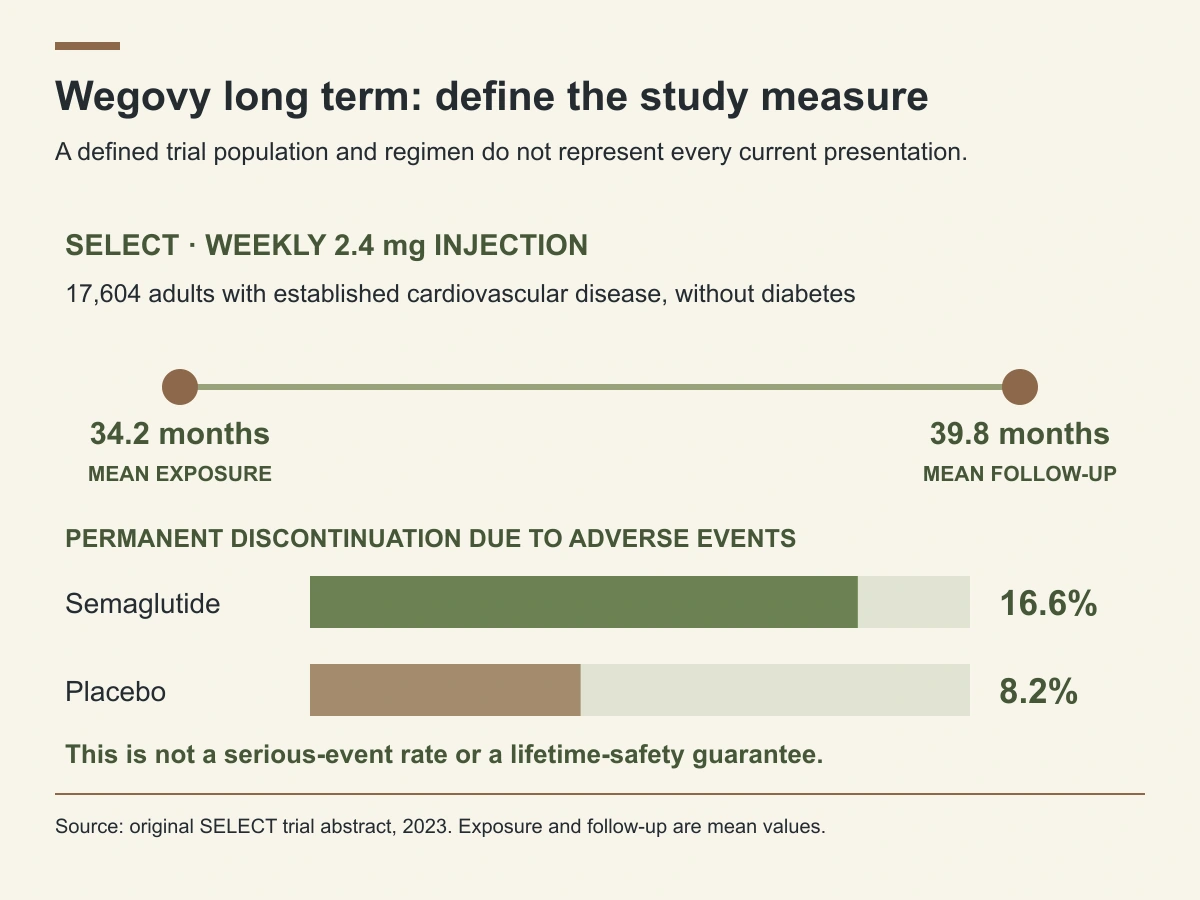
The SELECT trial randomized 17,604 adults aged 45 or older with established cardiovascular disease and a body mass index of at least 27, without diabetes. It tested once-weekly injected semaglutide 2.4 mg against placebo. Mean treatment exposure was 34.2 months; mean follow-up was 39.8 months. Original SELECT trial abstract.
Those findings inform care for the studied setting. They do not represent every current Wegovy presentation or dose, every younger person, or someone with diabetes. They also do not establish that symptoms can be ignored for years because a treatment has been studied for years.
What SELECT reported about stopping treatment
In SELECT, adverse events led to permanent treatment discontinuation in 16.6% of semaglutide participants and 8.2% of placebo participants. That measure describes stopping treatment because of an adverse event. It is not the percentage with a serious adverse event, the rate of one particular symptom, or a personal prediction. SELECT study report.
| Trial detail | Reported value | Interpretation limit |
|---|---|---|
| Randomized participants | 17,604 | A defined cardiovascular-risk population |
| Tested semaglutide regimen | Weekly 2.4 mg injection | Not every current route or dose |
| Mean exposure | 34.2 months | Not identical treatment time for everyone |
| Mean follow-up | 39.8 months | Not a lifetime observation |
| Adverse-event discontinuation | 16.6% semaglutide; 8.2% placebo | Not a serious-event or GI-only rate |
The practical lesson is that tolerability and follow-up matter. A medicine can have benefits in a trial and still require an individual decision to adjust or stop treatment when the balance changes.
Digestive effects need a plan
Wegovy’s label includes nausea, vomiting, diarrhea, constipation, abdominal pain, and other digestive adverse reactions. It also warns about severe gastrointestinal reactions and says the medicine is not recommended for people with severe gastroparesis. Persistent or severe symptoms should be reported. Wegovy prescribing information.
Track the pattern in a way that helps the clinician: when symptoms started, whether they followed a dose change, what you can eat and drink, and whether bowel habits have changed. Avoid assuming that every new problem is the medicine or that none can be related because you tolerated it previously.
The semaglutide first-month guide addresses early treatment questions. Long-term follow-up still needs to consider symptoms that appear later, recurring difficulty eating, and other illnesses or medicines that enter the picture.
Warning signs that should not wait for a routine review
The label warns about pancreatitis, gallbladder disease, dehydration-related kidney injury, serious allergic reactions, and other clinically important problems. Persistent severe abdominal pain, repeated vomiting, inability to keep fluids down, or significant worsening symptoms needs prompt medical assessment. Breathing difficulty, severe swelling, collapse, or another emergency requires immediate help. Wegovy safety warnings.
Do not try to identify the cause from location alone. Severe pain can have several explanations, and a diagnosis may require examination or testing. Our abdominal pain guide explains the importance of assessment rather than labeling every episode as a routine GLP-1 effect.
Ask your prescriber in advance what symptoms should lead to a call, urgent care, or emergency services and what the treatment instructions are in those situations. A clear plan is more useful than an instruction to tolerate any symptom until the next refill.
Thyroid warnings: what is known and unknown
Wegovy carries a boxed warning based on thyroid C-cell tumors in rodents. The human relevance has not been established. The product is contraindicated in people with a personal or family history of medullary thyroid carcinoma, or with multiple endocrine neoplasia syndrome type 2. Wegovy boxed warning.
Do not translate that into either “it definitely causes human thyroid cancer” or “there is no risk to discuss.” Give the prescriber your family and personal history accurately. A neck lump, persistent hoarseness, trouble swallowing, or breathing concerns deserves assessment.
The label also says routine calcitonin testing or thyroid ultrasound has uncertain value for early detection in this setting. A blog should not prescribe a screening schedule for everyone. Your clinician can decide what investigation is appropriate for your history and symptoms.

Glucose and eye-health questions
Wegovy lowers glucose. Its label highlights increased hypoglycemia risk with insulin or insulin secretagogues and the need for appropriate monitoring in people with diabetes. It also addresses diabetic retinopathy concerns and monitoring when relevant. Wegovy diabetes-related warnings.
Tell your care team about other glucose-lowering medicines and existing eye disease. Ask which readings or symptoms should prompt contact and whether your diabetes treatment needs review as your health changes. Do not independently alter insulin or another medicine from a general article.
New visual changes should be assessed rather than assumed to be a normal adjustment. Likewise, sweating, confusion, weakness, or other possible low-glucose symptoms needs response according to your individual plan. The Wegovy sweating article explains why symptoms alone do not identify the cause.
Nutrition and daily function belong in the follow-up
An appetite change is not the only outcome to monitor. Tell your clinician if you are persistently unable to eat enough, regularly skip meals because food is difficult, or have declining strength and daily function. Weight change without context can conceal a practical nutrition problem.
Discuss the entire day rather than one protein number. Which meals can you manage? Are foods enjoyable and accessible? Are nausea, constipation, or other symptoms limiting variety? A dietitian can help adapt the pattern when needed.
Our balanced meals guide, semaglutide protein and muscle guide, and lunch planning article offer practical starting points. None should be used to justify escalating restriction or ignoring persistent symptoms.
The supplements and GLP-1 guide can help organize questions about additional products. A supplement does not automatically solve inadequate intake, and it should be disclosed alongside prescriptions.
Heart rate, procedures, and other changes
The label addresses resting heart-rate increases and instructs patients to report palpitations or a racing heartbeat at rest. It also describes pulmonary aspiration reports during general anesthesia or deep sedation and tells patients to inform the procedure team about treatment. Wegovy monitoring and procedure warnings.
Before a procedure, tell the clinician and anesthesia team the actual product, route, last dose, and current digestive symptoms. They should provide the plan for your circumstances. Do not adopt a universal hold interval from an old post or assume that ordinary fasting instructions settle the question.
Update your prescribing team when you start another medicine, receive a new diagnosis, plan pregnancy, or experience a major change in intake. Long-term treatment is an ongoing review, rather than one eligibility decision made at the first visit.
Current presentations should not inherit older trial results automatically
The current Wegovy label includes different injection presentations and tablets, with route-specific instructions and dosing. A study of weekly 2.4 mg injection does not become a study of every newer dose or daily tablet simply because the brand name is shared. Current Wegovy product information.
Ask which evidence applies to your prescribed presentation and indication. The oral semaglutide versus injections guide addresses another treatment format. If your device or route changes, request appropriate training and instructions.
Compounded semaglutide is a separate product category. FDA does not review compounded products as approved drugs, and its current safety information includes dosing and quality concerns. Do not use Wegovy trial findings to claim equivalent safety or effectiveness for an unapproved preparation. FDA unapproved GLP-1 information, compounded GLP-1 guide.

What a useful ongoing review can cover
Ask your care team how often to review treatment and what information to bring. The schedule should reflect your condition, treatment phase, and symptoms. A useful review might address:
- Benefits that matter for your indication and health goals.
- Digestive symptoms and ability to eat and drink adequately.
- Glucose, eye-health, heart-rate, or laboratory monitoring when relevant.
- Other prescriptions, supplements, diagnoses, and planned procedures.
- Whether the current dose and presentation remain appropriate.
- The plan if treatment is interrupted or no longer suitable.
Do not choose a higher dose simply because progress is slower than expected. Treatment response and tolerability need to be considered together. If treatment stops or is interrupted, ask about the correct restart instructions rather than using an old dose automatically.
CoreAge Rx’s semaglutide service information and tirzepatide service information describe separate care pathways. They do not guarantee that a particular product is appropriate or that trial results transfer between medicines.
Frequently asked questions
Is Wegovy safe to take for years?
Multiyear evidence is useful, but it cannot guarantee lifetime safety for every person. The decision depends on the indication, benefits, symptoms, risks, and ongoing clinical review. Use the evidence for the actual product and regimen.
Will digestive symptoms always go away?
Do not assume that persistent symptoms must resolve or should simply be tolerated. Report symptoms that affect food, fluids, or daily function, and seek prompt assessment for severe warning signs.
Does the 16.6% SELECT number mean serious side effects?
No. It is the percentage who permanently discontinued semaglutide because of adverse events in that trial. It is not a serious-event rate, a GI-only rate, or your individual probability.
Does SELECT prove safety of daily tablets or every dose?
It tested weekly injected semaglutide 2.4 mg in a defined population. Different routes, doses, and patient groups require their own evidence and label review.
Do I need routine thyroid ultrasound?
The label says routine ultrasound or calcitonin testing has uncertain value for early detection in this context. Your clinician should decide what assessment is appropriate for your history or symptoms.
What should I do before surgery or sedation?
Tell the procedure and anesthesia teams about the medicine, route, last dose, and symptoms. Follow the individualized plan they give you rather than a blanket online stopping rule.
Educational information for adults; individual treatment decisions require a qualified clinician. Sources reviewed October 2, 2026. Original AI-generated article images depict fictional people and objects, not patient outcomes. Other editorial images are illustrative. Graphics summarize the cited sources.