
There is no single calorie number that every lunch should contain for weight loss. A useful lunch fits your overall needs, the rest of the day, your appetite, activity, health conditions, and preferences. A fixed online allowance can be too little for one person and unnecessary for another.
Start with the daily pattern, then plan a meal you can actually eat and enjoy. Calories can be one tool, but lunch also needs to be assessed for adequacy, practicality, and how you feel afterward.
Why a universal lunch quota does not work
People divide food across the day differently. Someone who eats an early breakfast and a late dinner may need a different lunch from someone who works nights or eats a larger morning meal. Exercise, work demands, medical needs, and appetite changes add further variation.
A daily estimate is also an estimate, rather than a precise measurement of your body’s needs every day. NIDDK’s Body Weight Planner uses personal information to estimate adult energy needs and changes over time. It is designed for adults 18 and older and is not intended for children or people who are pregnant or breastfeeding. It does not prescribe a universal percentage of calories for lunch. NIDDK Body Weight Planner.
Our calorie intake guide explains the broader planning question. If you have a medical condition, an eating-disorder history, or difficulty eating adequately, an individualized clinician or dietitian discussion may be more appropriate than adopting a calculator result on your own.
How to place lunch within the day
Look at when you eat and where the practical problems occur. Are you skipping lunch because work is busy? Eating a very small lunch and becoming intensely hungry later? Packing food you dislike? Those problems may call for a better routine rather than a smaller number.
If you already have a clinician-directed daily target, discuss how to distribute it in a way that suits your schedule. There is no requirement to make every meal equal. Keep room for other meals and any snacks that help meet your needs.
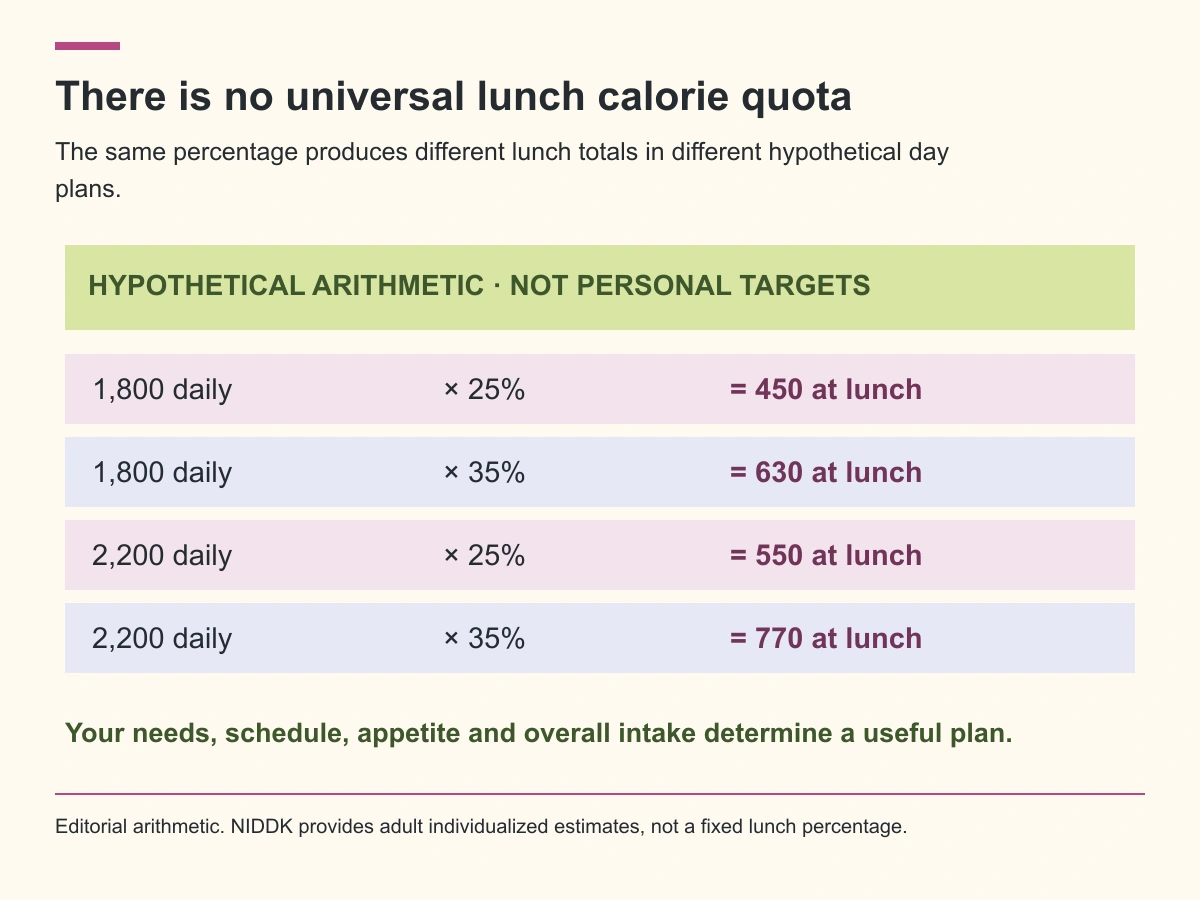
The following arithmetic is hypothetical. It illustrates distribution, not a recommended daily intake or a correct lunch allowance:
| Illustrative daily total | Hypothetical share assigned to lunch | Arithmetic result |
|---|---|---|
| 1,800 calories | 25% | 450 calories |
| 1,800 calories | 35% | 630 calories |
| 2,200 calories | 25% | 550 calories |
| 2,200 calories | 35% | 770 calories |
Neither the totals nor the percentages are guidelines for you. The example shows why a percentage without an appropriate daily context is not a personal answer. It also shows that two lunches can differ while belonging to different workable day plans.
Build the meal before chasing a number
Consider what you want the lunch to provide: enough food, a protein contribution, vegetables or fruit, and other components that fit your preferences and needs. Current federal dietary guidance emphasizes varied nutrient-dense foods, including protein foods, produce, and whole grains. It does not require one lunch recipe or brand. Dietary Guidelines for Americans overview.
Possible lunches include:
- A sandwich or wrap with a protein filling, vegetables, and a side you enjoy.
- A rice or grain bowl with beans, tofu, poultry, or seafood and vegetables.
- Leftover dinner divided into a practical packed meal.
- Soup paired with another food when the soup alone is not enough.
- A substantial salad with a protein component and other foods that help meet your needs.
These are structures, not equal-calorie recipes. The ingredients and amounts determine the finished meal. Our balanced meals guide offers more examples, and the shrimp nutrition article shows how one protein food fits into a larger meal.
If you estimate calories, count the complete meal
Use the information for the actual food and preparation. Oil, butter, mayonnaise, dressing, cheese, sauces, and drinks contribute to the meal too. A label for plain chicken does not describe a chicken sandwich with all its additions.
Match the serving size. A Nutrition Facts panel might describe half the container, while you plan to eat all of it. A recipe may state four servings, but the portions you prepare could be different. Read the measurement units so that raw and cooked weights are not mixed accidentally.
For a homemade dish, list the ingredients for the whole recipe and decide how you actually divide it. For restaurant food, use the specific menu item’s information when available. When it is not available, treat an estimate as uncertain rather than turning it into a precise fact.
You do not need to track every ingredient forever to learn something useful. A few realistic examples can reveal whether a frequently eaten meal has been misunderstood. If tracking becomes distressing or encourages escalating restriction, discuss another approach with a qualified professional.

Hunger after lunch is information
If you are hungry soon after lunch, do not assume that you need more willpower. Review whether the meal was adequate, enjoyable, and timed appropriately. A protein drink alone, a very small salad, or a rushed snack may not meet the needs of your day.
Consider the interval until dinner. A lunch that works when dinner is early may not be enough on a day with a late shift or evening activity. A planned snack can be part of a coherent pattern rather than evidence that lunch failed.
Our food noise and hunger guide explains how to describe persistent appetite concerns. Our protein shake meal ideas article discusses drinks in the context of food. A higher protein number does not automatically make a drink a complete lunch.
What if a GLP-1 medicine makes lunch difficult?
Reduced appetite can change the practical task from limiting food to finding manageable ways to eat enough. Do not interpret persistent inability to finish meals as a reason to keep lowering a calorie goal. Tell your care team about the actual amount you can eat and any nausea, vomiting, or other symptoms.
Smaller manageable eating occasions, different textures, or simpler foods may be discussion points with a clinician or dietitian. The best approach depends on your health and symptoms. Severe or persistent symptoms need medical assessment rather than a generic lunch adjustment.
The semaglutide first-month guide and tirzepatide first-month guide address early treatment questions. The semaglutide protein guide covers another part of maintaining adequate nutrition during treatment.
CoreAge Rx’s semaglutide service and tirzepatide service information describe separate prescription care options. A lunch calorie target does not determine eligibility, and those services should not be treated as permission to pursue inadequate intake.
Practical planning for a busy week
Choose two or three lunches that fit your access, budget, and storage options. Decide which components can be prepared in advance and which are easier to assemble fresh. Keep a fallback for days when the original plan is not possible.
A fallback might be a familiar grocery meal, leftovers, or a convenient combination of foods. It does not have to be perfect to be useful. The aim is to avoid a pattern in which a demanding day leaves you with no realistic lunch option.
When comparing convenience products, consider the whole container, cost per meal, preparation time, and whether you need to add another food. A product labeled “light” may still be insufficient for your situation; a meal with more calories may fit better into an adequate daily plan.
If a shared household meal helps with consistency, adapt it rather than creating an entirely separate menu without a clear reason. Your plan should be practical enough to use on ordinary days, not only when time and motivation are abundant.
When the plan needs individualized help
Ask for professional guidance if you have recurrent dizziness, weakness, difficulty eating, significant unplanned weight change, or a medical condition that affects nutrition. Pregnancy, breastfeeding, adolescence, diabetes treatment, kidney disease, and eating-disorder concerns can change what is appropriate.
Bring a typical day’s food and schedule, rather than only asking for a lunch number. Explain when you are hungry, what you can afford, and what makes eating difficult. That gives a clinician or dietitian something concrete to work with.
Ask how progress will be assessed. Energy, function, tolerability, clinical measures, and a sustainable routine may all matter alongside weight. A plan that produces a lower number while leaving you persistently unwell deserves review.

Questions to use when reviewing your lunch
Instead of asking only “Was it under the limit?”, consider:
- Did I eat enough to function comfortably until the next planned eating occasion?
- Did the meal contribute useful nutrients and foods I enjoy?
- Were drinks, sauces, and recipe additions included in any estimate?
- Did the plan fit my workday, budget, and storage options?
- Did symptoms or a medicine change make eating harder?
- Would a planned snack or different meal timing work better?
These questions can make a discussion more specific. They also help distinguish a numerical planning issue from a food-access, symptom, or routine issue that a calorie target alone will not solve.
Frequently asked questions
How many calories should lunch be to lose weight?
There is no universal amount. Lunch should fit an appropriate daily plan and your circumstances. If you use calorie estimates, start with the broader needs and avoid treating an online meal quota as an individual prescription.
Is a 400-calorie lunch always enough?
No fixed number is enough for everyone. The answer depends on your overall intake, activity, schedule, health, and appetite. Review adequacy rather than assuming that a popular number is correct.
Should lunch be my largest meal?
There is no requirement from the sources used here that it must be. Meal distribution can reflect your schedule and preferences. Discuss any medicine-related food instructions or specific clinical needs separately.
Can I skip lunch if I am not hungry?
A single day and a persistent pattern are different situations. If reduced appetite repeatedly prevents adequate eating, discuss it with your care team. Do not use lack of hunger alone as proof that your body needs no food.
Do I need to count calories forever?
Not necessarily. Estimates can be a temporary learning tool or part of an individualized plan. Other approaches may be more useful if tracking is burdensome or distressing. A dietitian can help choose a practical method.
Will the same lunch work every day?
It may be convenient, but needs and schedules can vary. Keep room to adjust for appetite, activity, and the rest of the day. No one recipe guarantees a particular weight outcome.
Educational information for adults; individual treatment decisions require a qualified clinician. Sources reviewed October 2, 2026. Original AI-generated article images depict fictional people and objects, not patient outcomes. Other editorial images are illustrative. Graphics summarize the cited sources.