
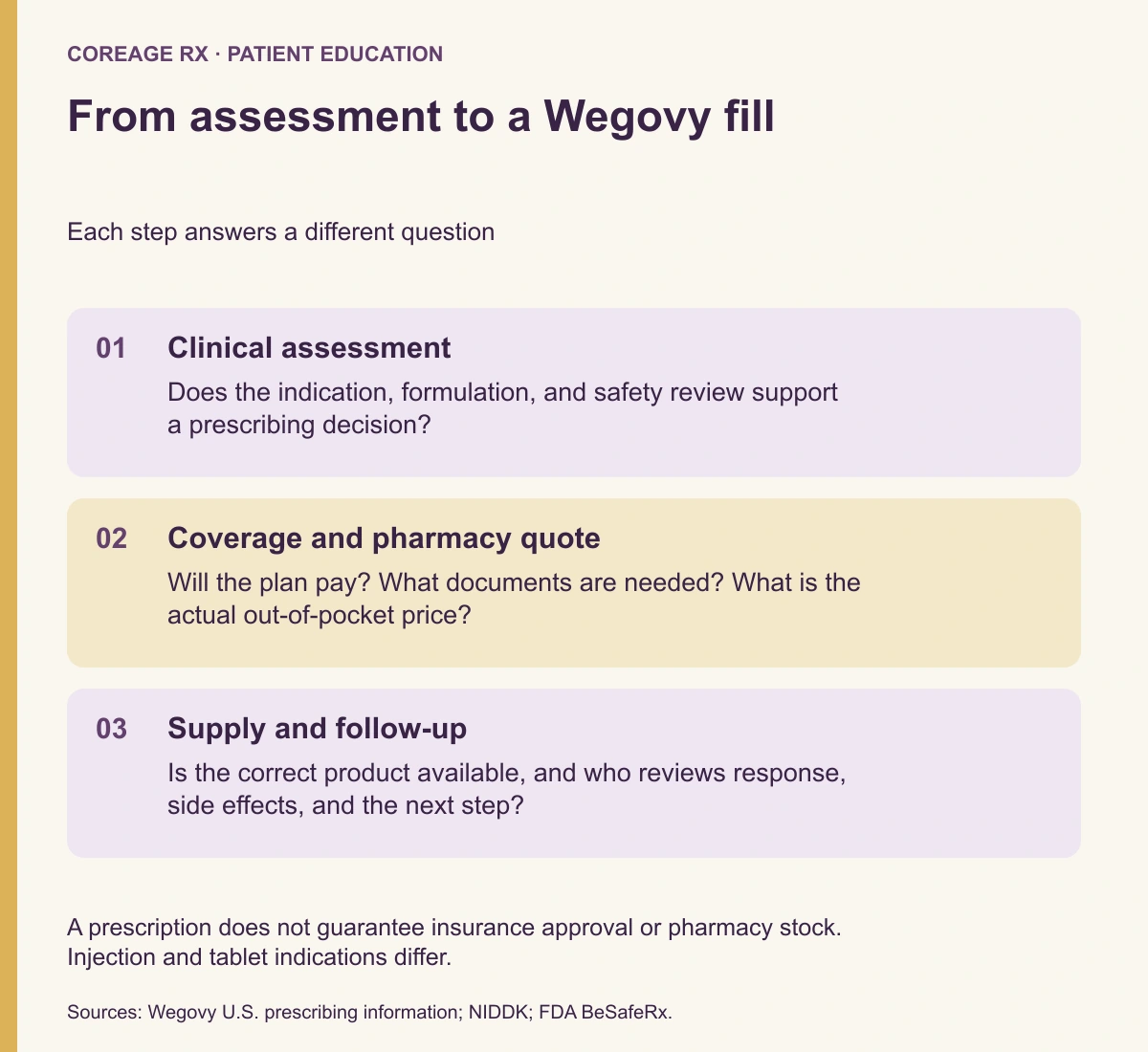
Getting a Wegovy prescription starts with a clinical assessment: what condition is being treated, whether this particular medicine fits your health history, and how treatment would be monitored. A prescription, an insurance approval, and an affordable pharmacy fill are separate steps. Completing one does not guarantee the others.
It also matters which Wegovy formulation you mean. Current U.S. prescribing information includes weekly injections and daily tablets, with differences in approved uses, administration, and patient populations. Bring the exact product question to the appointment rather than asking for “semaglutide” as though every preparation were interchangeable.
Who may be considered for Wegovy?
For adult weight management, a common starting point is obesity, or overweight accompanied by a weight-related condition. NIDDK describes prescription weight-management medication screening in adults using a BMI of 30 or higher, or 27 or higher with a weight-related health problem such as high blood pressure or type 2 diabetes. These are screening criteria, not an automatic prescription. See NIDDK’s prescription medication overview.
A clinician also considers medical history, previous treatment, other medicines, pregnancy plans, preferences, and the ability to follow the treatment plan. A number calculated from height and weight does not answer those questions. Our BMI and waist-measurement guide explains why measurements provide context rather than a complete health assessment.
Wegovy has additional approved uses that should not be reduced to the adult weight-management BMI pathway. The reason for treatment needs to be identified accurately before discussing the appropriate formulation and coverage.
Injections and tablets have different approved uses
Our guide to Ozempic and related-product age limits distinguishes adult indications from specific pediatric product indications, and separates prescription assessment, clinic scope and coverage.
The current Wegovy label distinguishes these routes:
| Treatment context | Wegovy injection | Wegovy tablets |
|---|---|---|
| Adult weight management | Adults with obesity, or overweight with at least one weight-related condition | Same adult population described in the label |
| Pediatric weight management | Patients age 12 and older with obesity | No pediatric indication in the current label |
| Cardiovascular risk reduction | Adults with established cardiovascular disease and overweight or obesity | The same specified adult cardiovascular population |
| Certain liver disease | Adults with noncirrhotic MASH and moderate to advanced fibrosis, consistent with F2–F3 | No MASH indication in the current label |
MASH is metabolic dysfunction-associated steatohepatitis, a form of liver disease. The injection’s MASH indication received accelerated approval based on improvements in MASH and fibrosis; continued approval may depend on confirmation of clinical benefit. It is not an indication for every person with fatty liver.
Pediatric assessment is also different from adult screening. Do not apply adult BMI cutoffs or an adult online-care pathway to a child. The treating clinician must evaluate age-appropriate criteria and follow-up needs.
Our guide to Wegovy care questions in Fort Worth reviews actual JPS assistance information, Texas license tools and separate assessment, coverage and pharmacy questions without claiming local stock.
For Nevada-specific research, our guide to Ozempic care questions in Las Vegas explains licensing, UMC resources, coverage and pharmacy verification without claiming a local office or stock.
Where can you discuss a prescription?
A primary-care clinician, a clinician specializing in obesity medicine, or another appropriately qualified treating professional may be a starting point. The right setting depends on the condition being addressed and the complexity of your health history. Existing cardiovascular or liver disease may require coordination with the team already managing it.
Telehealth can provide a route to an assessment when the service can appropriately evaluate and follow the patient. Check who provides the clinical care, whether the service serves your location and age group, and how in-person concerns are handled. A brief checkout questionnaire alone does not tell you what follow-up care is available.
Our online weight-loss prescription guide covers clinician, pharmacy, and service questions in more detail. For Wegovy specifically, confirm whether the service evaluates the branded product and formulation you are asking about before paying a visit or membership fee.
What should you bring to the appointment?
Prepare information that helps the clinician make an informed decision:
- Your current medicines and supplements, including any semaglutide or other GLP-1 product.
- Relevant diagnoses, allergies, prior medication reactions, and previous weight-management treatments.
- Recent height and weight measurements, if available, and health goals beyond a target number.
- Pregnancy, breastfeeding, or pregnancy-planning information.
- Questions about eating, activity, appetite, sleep, or treatment routines that may affect follow-through.
- Insurance details and any plan documents describing medication coverage requirements.
Previous treatment information is useful because it shows what was tried, for how long, and why it stopped. A prior medicine may have been unaffordable, poorly tolerated, ineffective for the agreed goal, or difficult to obtain. Those situations call for different solutions.
You do not need to invent an extensive treatment history to qualify. Accurate information is more useful than presenting the answer you think a clinic or insurer wants to hear.
What health issues need particular attention?
Wegovy is contraindicated in people with a personal or family history of medullary thyroid carcinoma, MEN2, or relevant hypersensitivity to the medicine or its ingredients. Its boxed thyroid warning is based on tumors observed in rodents; whether it causes those tumors in humans is unknown. Source: Wegovy contraindications and warnings.
The assessment should also address significant digestive disease, previous pancreatitis or gallbladder problems, kidney concerns, dehydration, diabetic retinopathy, and medicines that can contribute to low blood sugar. Wegovy is not recommended in severe gastroparesis. Not every condition on a warning list automatically rules out treatment, but it should not be omitted from the history.
Weight-management use is not appropriate during pregnancy. The label advises stopping at least two months before a planned pregnancy in this treatment context. Pregnancy decisions for a separate indication such as MASH require the treating team’s specific risk-benefit assessment.

Will you need blood tests first?
There is no single laboratory checklist that every person can use to approve themselves for treatment. The clinician decides which measurements, records, or tests are needed based on the medical history and reason for prescribing.
For people with diabetes, the Wegovy label calls for blood-glucose monitoring before and during treatment. Other testing may be appropriate to evaluate known disease, symptoms, or treatment risks. Ask what a proposed test is intended to clarify and how its result could change the plan.
If a service advertises “no labs needed,” that marketing statement does not establish that testing would be unnecessary for your situation. Likewise, a long list of optional tests is not automatically evidence of better care. The useful question is whether the assessment addresses your actual clinical needs.
A prescription does not guarantee insurance coverage
After a prescribing decision, the insurance plan may still require prior authorization, documentation of the treatment indication, or other plan-specific criteria. The clinician’s assessment and the insurer’s payment decision answer different questions.
Ask the plan whether it covers the exact Wegovy formulation for the reason it is being prescribed, what documents are needed, and what your responsibility would be at the pharmacy. A statement that a plan “covers weight-loss medication” may not describe every product, route, or benefit arrangement.
If a request is denied, obtain the stated reason. Missing records, a formulary restriction, and a benefit exclusion may require different next steps. The prescribing team and insurer can explain whether additional information or a formal review is available. See our Wegovy cost guide for the distinction between insurance, cash prices, and manufacturer programs.
Check the pharmacy and the actual prescription
FDA advises using an online pharmacy that requires a valid prescription, has a U.S. address and phone number, has a licensed pharmacist available, and is licensed with the relevant state board of pharmacy. Its BeSafeRx guidance explains how to check these features.
Before filling, confirm the brand, route, strength, quantity, device if applicable, and final out-of-pocket price. Pharmacy stock can vary. A prescription being sent does not prove the product is ready for collection or shipment.
Branded Wegovy, other approved semaglutide products, and compounded preparations have different identities and instructions. Do not assume a clinic’s generic reference to semaglutide promises a branded Wegovy prescription. Our compounded GLP-1 guide explains questions about those distinctions.
What happens after the first prescription?
Treatment includes an introduction and follow-up plan. Wegovy injection begins at a lower dose and follows a labeled escalation schedule; tablets have a different daily administration routine and escalation schedule. The milligram numbers cannot simply be exchanged across routes.
Ask when the next review will occur, how response and tolerability will be assessed, and who to contact before a planned dose change. The Wegovy dosage guide provides general label context, while oral semaglutide versus injections explains route-related questions.
Also clarify what needs prompt medical attention. Severe or persistent abdominal pain, inability to keep fluids down, or serious allergic symptoms should not wait for a routine refill appointment. Our Wegovy side-effects guide explains the safety discussion in more detail.

Questions that make the decision clearer
Before agreeing to treatment, ask: What condition are we treating? Why this formulation? What would count as a useful response? What is the plan if side effects, cost, or stock prevent continuing? Which charges cover clinical care, and which cover medication?
If you explore CoreAge Rx’s semaglutide care information, confirm the exact preparation, pharmacy arrangements, and services included. A care-program description should not be read as a guarantee of branded Wegovy, insurance approval, or a particular clinical outcome.
Frequently asked questions
Can I buy Wegovy without a prescription?
Wegovy is a prescription medicine. An offer to bypass a valid prescription is inconsistent with FDA’s advice for choosing a safe online pharmacy.
Does meeting a BMI threshold mean I qualify automatically?
No. It can support an initial adult weight-management assessment, but the clinical review and any insurance requirements still matter.
Can I request tablets because I dislike injections?
You can discuss that preference. The clinician still needs to check the indication, daily routine, other medicines, and suitability of the specific formulation.
Educational information for adults; individual treatment decisions require a qualified clinician. Sources checked September 27, 2026. Original AI-generated article illustrations depict fictional people and objects, not patient outcomes. Other editorial images are illustrative. Graphics summarize the cited sources.