Taking Ozempic does not provide a universal yes or no answer about donating plasma. U.S. centers screen donors according to their own requirements, your health condition, symptoms, and medication history. Ask the center about your exact medicine before making the trip, and keep taking prescribed treatment unless your clinician tells you otherwise.
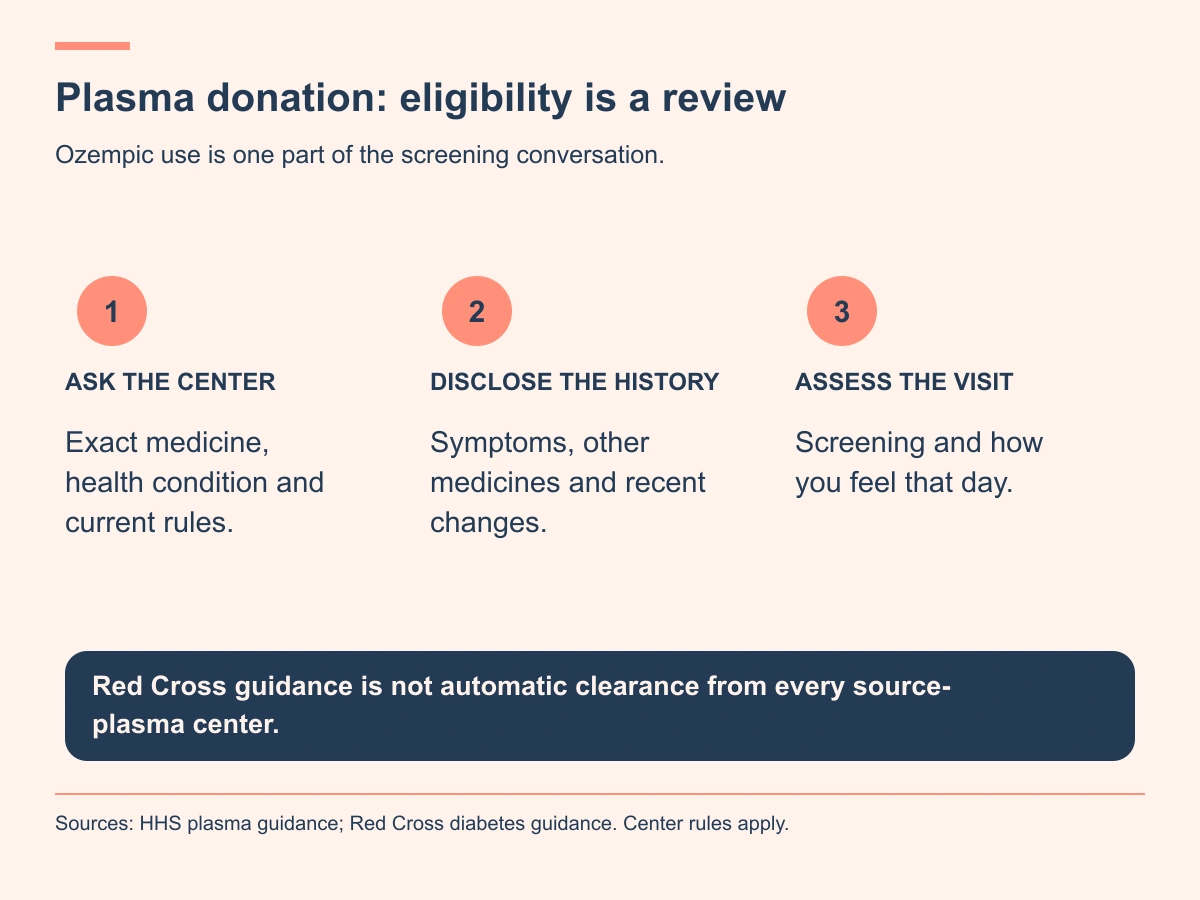
The American Red Cross says people with well-managed diabetes who feel well can generally donate and specifically discusses medicines including Ozempic. That guidance is useful, but it should not be treated as automatic clearance from every commercial source-plasma center.
Plasma donation is not identical to every blood-donation program
Plasma is the liquid component of blood. During plasmapheresis, the donation process separates plasma and returns other blood components to the donor. The details of screening and collection matter, so an answer about one blood-donation service may not settle eligibility at another plasma center. HHS: giving plasma
Before relying on an online eligibility list, check who published it and which donation program it describes. A center collecting source plasma may have different procedures from a hospital-based or community blood service. The center is responsible for deciding whether you meet its requirements at that visit.
If your question is specifically about another semaglutide brand or blood donation, our Wegovy blood-donation guide discusses that related issue. It does not replace the current screening process at the center you plan to use.
What does Red Cross guidance say about diabetes and Ozempic?
The Red Cross discusses blood, platelet, and plasma donation for people with diabetes whose condition is well managed and who feel well. Its page names insulin and several diabetes medicines, including Ozempic and Mounjaro, in explaining that medication use is not typically an automatic disqualification within its guidance. Red Cross: diabetes and blood donation
The important context is the whole eligibility review. A named medicine appearing on that page is not a personal approval or a promise that all centers follow identical rules. Symptoms, other conditions, and additional medicines still belong in the screening conversation.
If you have had recent glucose problems, illness, or a treatment change, explain that clearly. “I take Ozempic” gives less information than the medicine name plus why you take it, how you are feeling, and any recent complications.
What will a plasma center ask about?
HHS describes health screening, medical history, examination, and testing as parts of plasma donation. Its process guide notes checks such as vital signs and screening at visits. Eligibility can vary, so it directs potential donors to contact the center about conditions and medicines. HHS: giving plasma, HHS: donation process
Make an accurate list of prescription medicines, nonprescription products, and supplements. Include the actual product name rather than using “a weight-loss shot” as a substitute. If you use compounded semaglutide, say that and provide the label details the center requests.
Do not omit a medicine because someone online says it is accepted. Disclosure is part of assessing whether donation is appropriate for you. The center may also need information that seems unrelated to Ozempic, such as recent illness, procedures, or other treatments.
Questions to ask before the appointment
| Question for the center | Why it is useful |
|---|---|
| Do your rules allow donors using my exact product? | Checks the medicine against that center’s current process |
| Does the condition I take it for affect eligibility? | Separates medication use from the underlying health issue |
| Do recent dose changes or symptoms affect the visit? | Prevents a general eligibility answer from missing a current concern |
| What medicine information or documents should I bring? | Helps you arrive prepared for screening |
| What should I do if I feel unwell before or after donation? | Identifies the center’s follow-up and urgent-care instructions |
Ask for clarification if the answer is only “diabetes medicines are fine.” Confirm that the person has understood your exact product and situation. You can also ask whether the answer is preliminary advice or whether an on-site medical review is still required.

Why nausea, vomiting, or poor intake matter
The decision is not only about whether the medicine appears on a deferral list. Donation should be considered in the context of how you feel and whether you are eating and drinking adequately.
Ozempic labeling warns about kidney injury associated with volume depletion, particularly when gastrointestinal symptoms lead to dehydration. HHS also describes possible donation effects such as dizziness, fatigue, and dehydration. These sources support discussing active symptoms before donation rather than assuming a generally acceptable medication makes the visit appropriate. Ozempic prescribing information, HHS: giving plasma
If you have persistent vomiting, diarrhea, significant dizziness, or difficulty keeping fluids down, contact your care team and the center before going. Do not use plasma donation as a way to test whether you are adequately hydrated.
Our semaglutide nausea and vomiting guide and Ozempic dizziness guide help organize those symptoms. Neither provides a personal clearance to donate.
What if you also use insulin or a sulfonylurea?
Ozempic labeling identifies increased hypoglycemia risk when used with insulin or an insulin secretagogue such as a sulfonylurea. If these medicines are part of your care, ask your clinician how the donation visit fits your glucose-management plan. Ozempic prescribing information
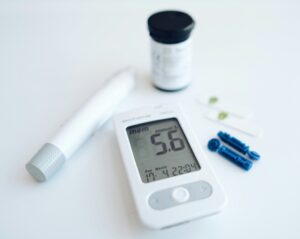
Bring your usual glucose-monitoring supplies when appropriate and follow your established care plan. Discuss preparation and meal timing with the center and clinician rather than adopting a generic fasting rule. Do not adjust insulin, skip medicines, or deliberately eat unusually to meet a donation number without guidance.
Symptoms that could represent low glucose require your existing management plan and medical advice when needed. A plasma-center screening measurement is not a replacement for ongoing diabetes care. Our Ozempic side-effect guide explains why medication combinations matter to the safety review.
Can someone with type 1 diabetes donate plasma?
That requires the center’s assessment of the person’s health and its rules. A diabetes diagnosis alone is not enough information for a universal answer. The Red Cross discusses both type 1 and type 2 diabetes, but its guidance should not be generalized to every collection setting. Red Cross: diabetes and blood donation
Also separate the donation question from the indication for Ozempic. Ozempic is labeled for particular uses in adults with type 2 diabetes; donation guidance is not evidence that it is an appropriate treatment for type 1 diabetes. Ozempic prescribing information
When asking about eligibility, provide the diabetes type, medicines, current health, and any complications the center requests. The purpose is an accurate review rather than fitting your situation into a broad online category.

Preparing if the center considers you eligible
Plan for the visit to take the time the center advises, particularly for a first appointment. Ask how to reach staff with a question after leaving and whether you should report a change in health before a return visit. An earlier eligible visit does not guarantee eligibility every time.
If you are told to defer, ask whether the reason concerns a temporary symptom, documentation, a medicine, or an underlying condition. Keep that explanation for your clinician. Do not change treatment merely to satisfy a rule without understanding why the deferral occurred.
Follow the center’s instructions about identification, meals, fluids, and arrival. HHS describes eating, drinking, and resting as preparation considerations, but individual circumstances can change what is appropriate. Someone with a prescribed fluid restriction needs a specific plan rather than a universal water target. HHS: donation process
Ask what to expect during collection and how to report symptoms promptly. If you become unwell during the visit, tell staff immediately. For severe symptoms after leaving, seek appropriate medical care rather than waiting for an online answer.
Frequency rules are limits within a program, not a recommendation that every eligible person should donate at the maximum frequency. Ask the center and your clinician how donation fits your health and recovery needs.
Common questions about Ozempic and plasma donation
Should I skip Ozempic before donating?
Do not skip or reschedule prescribed treatment solely to improve eligibility. Ask the center about its requirements and your prescriber about any treatment question. If a donation cannot proceed under your current circumstances, that does not automatically justify changing your medicine.
Is semaglutide different from Ozempic for screening?
Semaglutide is the ingredient; Ozempic is a particular product. The center needs your actual product and health history. Our semaglutide questions guide explains why brand, presentation, and indication should be identified accurately.
Can I donate if I am using it for weight management rather than diabetes?
Tell the center why you take the product and whether you have any symptoms or other conditions. It still needs to assess eligibility. Do not assume the absence of diabetes removes all screening considerations.
Will donation remove enough medicine to require another dose?
Do not calculate or administer a replacement dose after donation on your own. Eligibility advice is not a dosing instruction. If you have a specific treatment concern, ask the prescriber or pharmacist who knows your regimen.
What if different centers give different answers?
Use the current rules and medical review of the center where you intend to donate. Ask the reason for the answer and whether it concerns the medicine, underlying condition, or current symptoms. A permissive answer elsewhere does not override that review.
The CoreAge Rx semaglutide page can support a treatment conversation. Plasma-donor eligibility belongs with the collecting center, while prescription decisions belong with your qualified care team.
Educational information for adults; individual treatment decisions require a qualified clinician. Sources reviewed October 3, 2026. Original AI-generated article images depict fictional people and objects, not patient outcomes. Other editorial images are illustrative. Graphics summarize the cited sources.