
Taking Wegovy does not, by itself, answer whether you can donate blood. U.S. blood donation eligibility depends on the collection organization’s current rules, your health on the day, the reason you take medicines, and the full medication list. The donor center makes the eligibility decision after screening.
The American Red Cross medication deferral list reviewed for this article does not name Wegovy or semaglutide. That absence is useful information, but it is not personal clearance. Do not stop or delay a prescription to try to qualify for donation.
What the U.S. Red Cross guidance actually says
The Red Cross explains that many medicines do not disqualify a donor. Often, the condition being treated matters more than the medicine itself. Its medication deferral list specifically instructs people not to stop prescribed treatment in order to donate. Red Cross eligibility criteria, Red Cross medication deferral list.
For someone taking Wegovy, the right approach is to identify the actual product and disclose it during screening. Include whether it is an injection or tablet, the indication, other medicines, and any current symptoms. A medication name missing from a list does not override a different health or eligibility requirement.
This article addresses U.S. Red Cross guidance. Another organization or country may use different rules. A search result describing a waiting period abroad should not be applied to a U.S. donation without confirmation from your collection service.
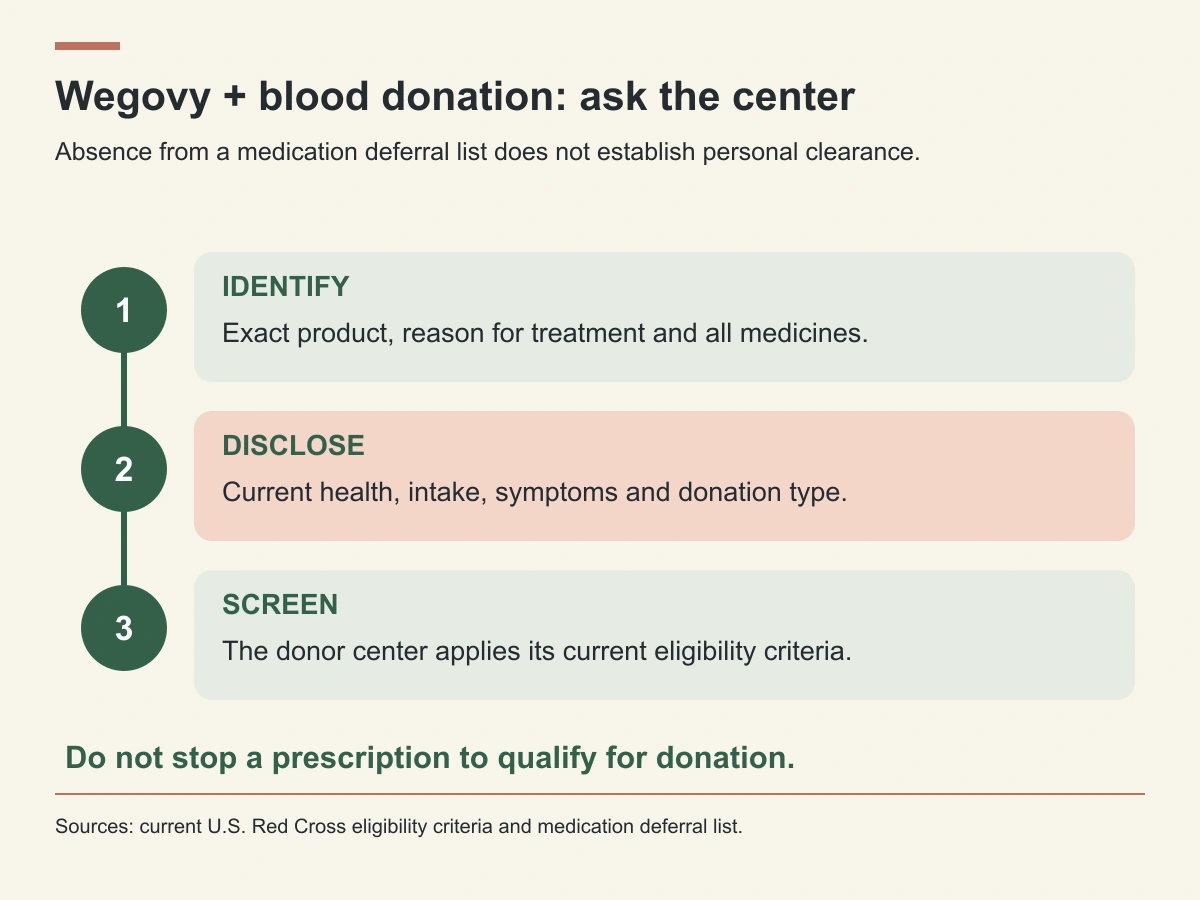
Eligibility is a set of questions, not one drug rule
Donor screening considers more than prescription medicines. The Red Cross lists minimum weight requirements, hemoglobin screening, general health, and other criteria. Its standard minimum weight is 110 pounds, with additional height and weight requirements for certain younger donors. Red Cross eligibility information.
Do not try to manipulate a weigh-in or use a donor screen as a replacement for medical assessment. If you have been losing weight, eating poorly, or feeling unwell, describe that situation honestly. Eligibility and whether donation is a sensible choice that day are related questions that deserve careful screening.
| Question to discuss | Why it matters | Who can help |
|---|---|---|
| What medicine and presentation do I use? | Different products should be identified accurately | Your pharmacist and donor center |
| Why is it prescribed? | The underlying condition can affect eligibility | Your clinician and donor center |
| Am I well and eating normally today? | Current symptoms matter at screening | Your clinician and donor staff |
| What other medicines do I take? | Some have specific deferral rules | Donor center using its current list |
| Which donation type am I considering? | Whole blood and platelet rules can differ | The collection organization |
| Have there been recent health changes? | A familiar medicine does not describe the whole situation | Your clinician and screening staff |
What if you have diabetes?
The Red Cross says people with diabetes or prediabetes may be eligible if they are otherwise well and their condition is appropriately controlled. It also emphasizes reviewing the condition and medicines rather than assuming that a diagnosis alone settles eligibility. Red Cross diabetes criteria.
If you use insulin, a sulfonylurea, or another medicine that can lower glucose, ask your care team how donation fits your existing food and monitoring plan. Wegovy’s label warns about hypoglycemia, with increased risk when used with insulin or an insulin secretagogue. Wegovy prescribing information.
Do not improvise a skipped medicine, a large sugar load, or an altered insulin dose from a general blog article. Bring your usual monitoring supplies if relevant and tell donor staff about symptoms. Donation staff can assess donation suitability, while your prescribing team can advise about individual diabetes management.
The semaglutide questions guide explains why brand, route, and indication matter. Wegovy and Ozempic contain semaglutide but have different labeled uses and presentations; they should be named accurately during screening.
Nausea, vomiting, and limited intake deserve attention first
Wegovy can cause digestive adverse reactions. Its label warns that nausea, vomiting, or diarrhea may lead to dehydration and acute kidney injury. Persistent symptoms that prevent adequate food or fluid intake should be discussed with the prescriber. Wegovy safety information.
If you feel dizzy, weak, or unable to eat normally, do not treat a donation appointment as something you must push through. Call the center and discuss whether to postpone. A convenient appointment or a desire to help does not replace the need to be well enough to donate.
Our semaglutide first-month guide covers early treatment questions, and the balanced meals guide offers practical eating ideas. Neither should be used to conceal ongoing symptoms or manufacture eligibility.
Severe or persistent abdominal pain, repeated vomiting, fainting, or other concerning symptoms require medical assessment. If you have symptoms of an emergency, seek immediate help rather than waiting for a donation screening appointment.

Preparing for a donation appointment
The Red Cross advises donors to get adequate rest, eat before donation, follow its fluid guidance, and bring a list of prescription and nonprescription medicines. Follow the collection site’s preparation instructions and disclose any medical reason you cannot follow them, such as a fluid restriction. Red Cross before, during, and after donation guidance.
A useful preparation list includes:
- The exact medicine names, including supplements and over-the-counter products.
- Your donor appointment information and required identification.
- A brief description of current symptoms or recent treatment changes.
- Any relevant diabetes monitoring supplies and your established care plan.
- Questions about the donation type and organization-specific eligibility.
Avoid planning the appointment around an unverified claim that the day before or after an injection is always safer. Your symptoms, health history, and screening results matter more than a generic online schedule.
If you are unsure which product you have, a pharmacy label or medication list can help. Do not describe a compounded preparation only by a brand name it is not. Our compounded GLP-1 medication guide explains why that distinction is clinically useful.
Other medicines can change the answer
Blood thinners and several other medicines appear in donation-specific guidance. Some rules differ between whole blood and platelet donation. A person who takes Wegovy plus another medicine needs review of the whole list, rather than a yes-or-no answer about Wegovy alone. Red Cross medication deferral list.
Hair-loss treatments, acne medicines, antiplatelet drugs, and other prescriptions may be relevant depending on the product and donation type. Do not assume that a medicine used for a cosmetic concern is irrelevant. Give donor staff the actual name instead of its general category.
Do not stop aspirin, an anticoagulant, or any prescribed medicine to satisfy a waiting period without the prescribing clinician’s direction. The donation center can explain whether a deferral applies; it should not become a reason to interrupt necessary care.
If you also use testosterone treatment, donation eligibility is a separate issue from managing an elevated hematocrit. The TRT hematocrit and blood count guide discusses clinician-directed monitoring. A routine donation should not be self-prescribed as a substitute for reviewing testosterone treatment or a blood-count abnormality.
Does blood donation remove Wegovy or change its dose?
Do not use donation as a way to remove a medicine, recover from an extra dose, or justify another injection. A blood donation appointment does not create a new prescribing schedule. Follow the instructions for your actual medicine and contact your prescriber or poison-control service after a possible dosing error.
The same applies if you feel less hungry after a donation or notice a different appetite the next day. A change in how you feel does not establish a change in drug concentration or a need for additional medication.
If you have a dose due around the appointment, ask your prescribing team about your circumstances. This article cannot provide an individualized instruction to take, hold, or reschedule treatment.
What to do after donation
Follow the center’s recovery directions about rest, food, fluids, activity, and care of the needle site. Red Cross guidance includes avoiding alcohol during its post-donation recovery period and following restrictions on strenuous activity. Ask staff for the exact instructions that apply to your donation. Red Cross recovery guidance.
If you become lightheaded or unwell, tell staff immediately. After leaving, contact the center and seek medical care when appropriate if symptoms persist or worsen. Do not assume that every symptom is a normal Wegovy effect simply because you take the medicine.
Keep your care team informed if donation is followed by difficulty eating, significant symptoms, or concerns about glucose. Your usual medication follow-up still matters, even when the donation itself went smoothly.

How this relates to weight-management care
Blood donation eligibility is not evidence that a weight-management treatment is appropriate, effective, or safe for every person. The donor service and prescribing clinician answer different questions.
CoreAge Rx’s semaglutide service information and tirzepatide service information describe separate prescription care pathways. If you are comparing options, bring questions about your health history, other medicines, and follow-up. Do not use a favorable donor-screening result as a substitute for that assessment.
Frequently asked questions
Is Wegovy on the Red Cross medication deferral list?
Wegovy and semaglutide were not named on the list reviewed for this article. That does not guarantee eligibility. The center still reviews your condition, current health, other medicines, and other screening criteria.
Should I skip my dose before donating blood?
Do not stop or delay prescribed treatment to qualify for donation. Ask the collection center about eligibility and your prescriber about any treatment concern. The Red Cross explicitly advises against stopping prescribed medicines for this purpose.
Can I donate if I have nausea?
Discuss current symptoms with the donor center and prescriber. Persistent nausea, poor intake, vomiting, or dehydration should be addressed first. The answer depends on how you are feeling and the center’s screening, rather than the medication name alone.
Are platelet donation rules the same as whole blood rules?
For plasma-specific questions, our guide to plasma donation while taking Ozempic distinguishes collection-center screening from another organization’s blood-donation guidance and reviews symptoms that deserve attention before donation.
Not always. Some medication-related restrictions depend on donation type. Tell the center which donation you are considering and provide your full medication list.
Does Ozempic have the same eligibility answer?
A shared active ingredient does not provide automatic clearance. State the actual product and why you take it. Diabetes, other medicines, and your current health may be relevant, and the collection organization decides eligibility.
Can I use this advice outside the United States?
Use the current guidance from your local collection organization. This article’s Red Cross sources address U.S. screening, and another country’s rules may differ.
Educational information for adults; individual treatment decisions require a qualified clinician. Sources reviewed October 2, 2026. Original AI-generated article images depict fictional people and objects, not patient outcomes. Other editorial images are illustrative. Graphics summarize the cited sources.