Fenugreek water is usually made by soaking or steeping fenugreek seeds and drinking the liquid. It is often promoted as a simple weight-loss remedy, but a preparation method is not evidence that it produces lasting fat loss. Research on whole seeds, extracts, or short-term appetite ratings cannot automatically validate a homemade strained drink.
If you enjoy fenugreek as a food ingredient, that is a different decision from using it as a concentrated treatment. Before adding a daily remedy, consider the evidence, medicines, pregnancy status, allergies, and whether it might make adequate eating more difficult.
What is fenugreek water?
Fenugreek is an herb whose seeds are used in foods and traditional preparations. Online recipes may call for overnight soaking, boiling, grinding, or adding the seeds to the finished drink. These methods do not necessarily produce the same preparation.
Three products need to be distinguished:
- Whole seeds used in food: the seeds remain part of what you eat.
- Soaked or strained water: some material enters the liquid, while some is left behind.
- An extract or supplement: the formulation may be processed or concentrated and have a labeled amount.
The National Center for Complementary and Integrative Health, or NCCIH, describes limited evidence for many proposed fenugreek uses and important safety considerations. It does not establish a universal weight-loss recipe for fenugreek water. NCCIH fenugreek overview.
When a claim quotes research, check which of these preparations was studied. If the study used a standardized extract, a teaspoon of kitchen seeds is not the same intervention. If the study used tea, its findings still need to be examined for the outcome and duration.
What did the small tea study actually find?
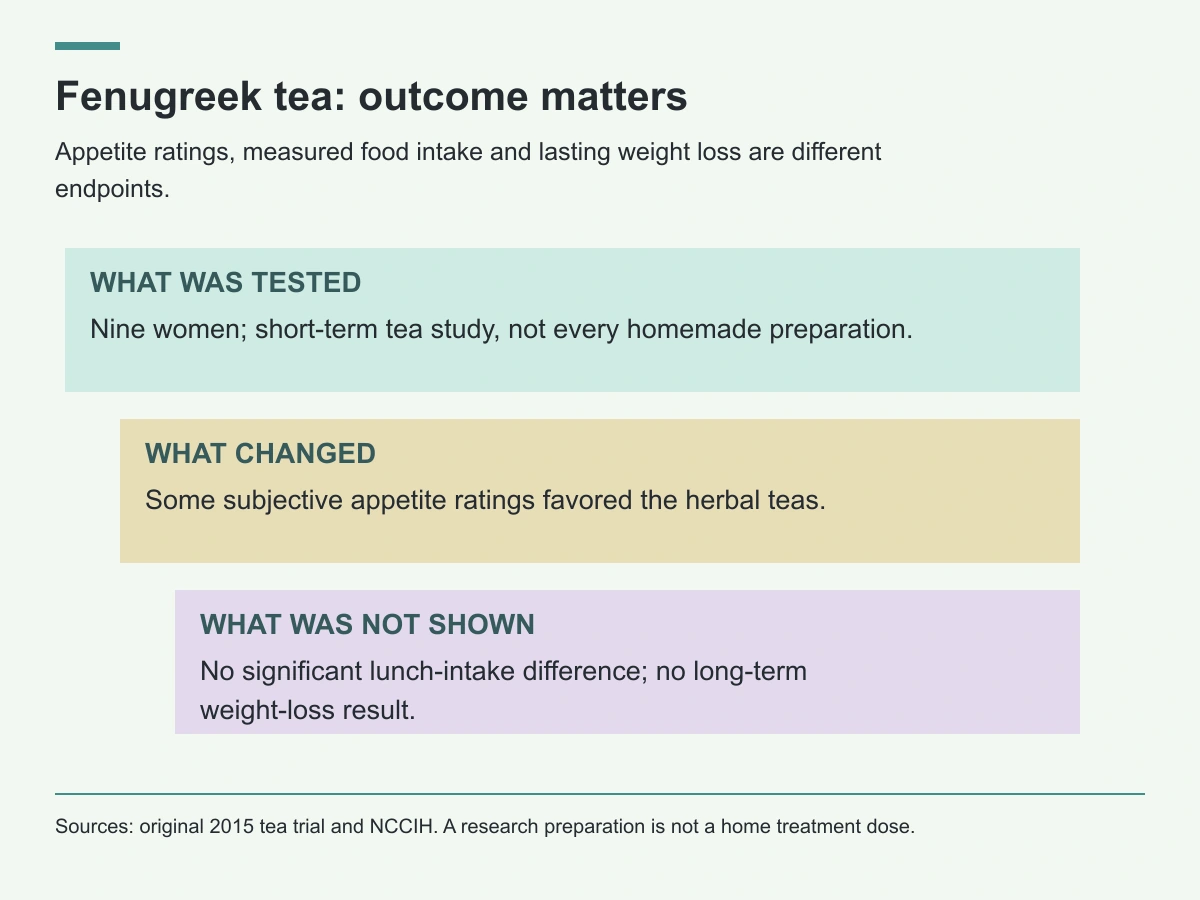
An original randomized crossover study tested fenugreek tea, fennel tea, and a placebo tea in nine Korean women. It examined short-term appetite ratings and food consumption during study days. Some subjective appetite measures favored the herbal teas, but there was no statistically significant difference in lunch-buffet food consumption. The study did not demonstrate long-term weight or body-fat loss. Original fenugreek and fennel tea study.
That is a much narrower result than “fenugreek water melts fat.” A person reporting greater fullness on a rating scale is not the same outcome as sustained weight change. A study with nine participants also cannot reliably answer questions about many different populations or uncommon adverse effects.
The researchers noted that the substances in the water-soluble fraction were not fully analyzed and that larger, longer studies were needed. Their research preparation should not be turned into a daily home treatment dose. The study’s cited papers are also separate sources, not additional trials that this article has independently reviewed.
| Claim you may encounter | What would be needed to support it | What the reviewed tea study establishes |
|---|---|---|
| “It makes you feel fuller” | Appropriate short-term appetite measurements | Some subjective measures changed in a small sample |
| “It makes you eat less” | Measured food intake compared with control | Lunch intake was not significantly different |
| “It causes lasting weight loss” | Longer controlled studies measuring weight | That outcome was not established |
| “This home recipe has the same effect” | A matching, characterized preparation | Homemade recipe equivalence was not established |
| “It is safe for everyone” | Relevant safety evidence and individual review | A small appetite study cannot provide that assurance |
Why a biological explanation is not a weight-loss result
Marketing often moves from an ingredient’s proposed action to a promised outcome. A claim about fiber, digestion, or glucose does not tell you how much weight someone will lose or whether a particular drink is appropriate for them.
Strained water also should not be counted as though you ate all the original seeds. The amount of material remaining in the drink depends on the preparation, and an unmeasured home recipe does not provide a verified fiber value. If your goal is a predictable fiber contribution, use actual food labels and portions rather than assigning the seeds’ full nutrient profile to the liquid.
Our fiber supplement guide explains the broader differences between foods and supplemental fiber. The fiber and medication timing guide addresses another important question: adding a product can change a medication conversation even when the product is marketed as natural.
Can it lower blood sugar?
NCCIH reports that some studies suggest a glucose-related effect, but much of the research is not high quality. It also warns that larger amounts can cause a harmful drop in blood sugar. Those points do not provide an individual diabetes treatment plan. NCCIH evidence and safety information.
If you take insulin, a sulfonylurea, or another glucose-lowering treatment, discuss fenugreek before using a concentrated or regular remedy. Give the clinician the actual product or recipe rather than describing it only as herbal water. Do not reduce a prescribed medicine because a drink is advertised to control glucose.
Feeling shaky, sweaty, confused, or unwell requires assessment according to your existing care plan. Symptoms alone cannot establish whether fenugreek, a prescription, missed food, or another issue is responsible. People who do not monitor glucose should not assume that feeling faint is proof that the drink is “working.”

Safety issues that matter more than the recipe
NCCIH distinguishes ordinary food use from larger amounts. It lists digestive effects and allergic reactions, including serious reactions. It warns that amounts above those normally present in food are unsafe during pregnancy and that information about larger amounts during breastfeeding is limited. NCCIH fenugreek safety guidance.
These distinctions are especially relevant when an online recipe becomes a daily routine, the seeds are concentrated, or multiple fenugreek products are combined. “It is a spice” does not describe how much you are taking or whether it is suitable for your situation.
Before using it as a remedy, discuss:
- Pregnancy, pregnancy plans, or breastfeeding.
- Diabetes medicines and a history of low glucose.
- Allergies and any previous reaction to fenugreek.
- Other prescriptions, supplements, and digestive symptoms.
- Whether reduced appetite is already making adequate eating difficult.
For breathing difficulty, throat swelling, collapse, or another severe reaction, seek emergency help. Stop treating new symptoms as a cleansing effect and seek appropriate medical advice.
How to think about preparation claims
There is no established fat-loss preparation that this article can recommend. Longer soaking, a darker drink, or a more bitter taste does not prove a greater therapeutic effect. A measured amount of seeds also does not become a validated medical dose simply because it appears in a recipe.
If you use fenugreek in ordinary cooking, follow food-use instructions from a reliable source and handle food hygienically. If you are considering a concentrated product, read its label and discuss the exact product with your pharmacist or clinician. Do not assume that combining capsules, tea, and soaked water is equivalent to one culinary use.
Sweeteners and other additions change the drink too. Honey, sugar, juice, or milk should be considered as actual ingredients, not ignored because the base drink has an herbal name. Our sweet tea versus soda comparison illustrates how a beverage’s preparation and serving size can matter more than its image.
What if you take semaglutide or tirzepatide?
Adding a remedy to a prescription plan deserves a specific conversation. If your appetite is already reduced or you are experiencing digestive symptoms, pursuing additional appetite suppression may make the practical problem harder. Share what you take, how often, and why.
The supplements while taking GLP-1 medicines guide helps organize questions for your care team. It does not provide blanket clearance for fenugreek. Persistent vomiting, inability to keep fluids down, or severe abdominal pain should be medically assessed rather than managed by layering on another product.
CoreAge Rx’s semaglutide service and tirzepatide service information describe prescription care options. Fenugreek water is not a substitute for those medicines, and a supplement mechanism should not be described as equivalent to their approved branded formulations. Eligibility and product selection require an individual assessment.
A more useful approach to the weight-loss question
First identify what you hope the drink will solve. Is it thirst, a preference for an unsweetened drink, persistent hunger, meal planning, or a weight plateau? Choosing an enjoyable beverage is a smaller decision than choosing a treatment.
For thirst, a drink does not need a fat-burning claim to be useful. For hunger, consider whether meals are adequate and predictable. For a plateau, review the broader pattern and any medical factors rather than judging progress by whether you added a new remedy.
Our balanced meals guide, food noise and hunger guide, and calorie intake guide offer different ways to explore those questions. A clinician or dietitian can help if appetite, illness, or restrictive eating makes the situation more complex.
NCCIH’s general weight-control guidance notes that many products promoted for rapid weight loss lack good long-term evidence and that some can be harmful. That is a reason to ask for meaningful outcomes, rather than assume an inexpensive product has no downside. NCCIH weight-control information.
Frequently asked questions
How do I make fenugreek water for weight loss?
There is no validated weight-loss recipe or dose established by the reviewed evidence. Soaking or steeping seeds describes a preparation method, not a proven treatment. This article does not turn a research tea recipe into a daily medical instruction.
Should I drink it on an empty stomach?
There is no established timing rule that guarantees fat loss. An empty-stomach claim does not resolve safety issues, medication interactions, or whether you are eating adequately. Discuss a proposed regular remedy with your care team.
Does eating the soaked seeds make it more effective?
Eating seeds and drinking strained water are different exposures. Their nutrient contributions and tolerability can differ, but that does not establish a weight-loss effect. Do not increase the amount in pursuit of a result that has not been demonstrated.
How long until I lose weight?
The small tea study did not establish a long-term weight-loss timeline. A specific pounds-per-week or belly-fat promise would go beyond its findings. Review your overall plan and realistic follow-up with a qualified clinician.
Is it safe because it is natural?
Natural origin does not establish safety for every amount or person. Pregnancy, low-glucose risk, medicines, and allergies are relevant. Ordinary use in food is different from a concentrated or repeated remedy.
Can I use it instead of a prescribed diabetes medicine?
Do not replace or reduce prescribed treatment on that basis. Glucose management needs an individualized plan and monitoring. Bring the actual product or preparation to your clinician if you want to discuss it.
Educational information for adults; individual treatment decisions require a qualified clinician. Sources reviewed October 2, 2026. Original AI-generated article images depict fictional people and objects, not patient outcomes. Other editorial images are illustrative. Graphics summarize the cited sources.